Agentic AI Analytics: The Enterprise Implementation Guide

Agentic AI analytics refers to autonomous AI agents that continuously monitor data, surface explainable insights, and trigger governed actions in a closed-loop workflow — without waiting for a human to run a query. Unlike a dashboard or a text-to-SQL tool, these systems plan multi-step analyses, select certified metrics, and recommend or execute decisions within predefined boundaries. According to Databricks, the core sequence is ingest → analyze → explain → recommend → act, with continuous learning from outcomes.
Three things matter most before you build or buy:
- Governed metrics are non-negotiable. Agents need a semantic layer with explicit metric definitions. Without one, they can generate syntactically correct SQL that produces the wrong business answer — a subtle failure mode that’s harder to catch than an outright error.
- The shift is from reactive reporting to continuous decisioning. Agentic analytics replaces the “someone notices, someone queries, someone acts” cycle with a closed loop that runs around the clock.
- Privacy and compliance obligations follow the data. When agents process protected health information, HIPAA safeguards apply regardless of whether the system is cloud-hosted or local. Tools like Plotstudio address this by running analysis entirely on-device.
Key Takeaways
Agentic AI analytics delivers its full value only when governed metrics, a trusted execution layer, and human-in-the-loop controls are in place before the first autonomous action runs.
| Point | Details |
|---|---|
| Define the semantic layer first | Certified metric definitions prevent agents from producing correct SQL with wrong business answers. |
| Enforce an execution gate | A governed proxy between the agent and production systems is the single most important safety control. |
| Pilot one decision before scaling | Start with a single, measurable decision; validate precision and audit completeness before expanding scope. |
| Governance precedes autonomy | Human-in-the-loop controls, action boundaries, and decision contracts must be in place before auto-execution. |
| Plotstudio for privacy-sensitive workflows | Local execution and pre-registered analysis plans make Plotstudio suited for IRB, NHS, and GDPR-governed data. |
Table of Contents
- What is agentic AI analytics, and how does it differ from adjacent technologies?
- How does agentic analytics work? The closed-loop framework
- What does the technology stack for agentic analytics look like?
- What capabilities define a production-ready agentic analytics system?
- What business benefits and use cases does agentic analytics deliver?
- How do you implement agentic analytics? A practical checklist
- What are the risks, governance requirements, and privacy considerations?
- How do you measure success in agentic analytics?
- What does a realistic agentic analytics rollout look like?
- Research-backed insights and reproducible analytics workflows
- The metric layer is the real competitive moat
- Plotstudio brings research-grade agentic analytics to privacy-sensitive teams
- Sources
What is agentic AI analytics, and how does it differ from adjacent technologies?
The cleanest way to understand agentic analytics is by contrast. A text-to-SQL tool translates a natural-language question into a single SQL query and returns a result set. That’s one step, one output, no follow-through. Augmented analytics adds statistical suggestions on top of a BI dashboard but still waits for a human to interpret and act. RPA automates rule-based workflows but cannot reason about data it hasn’t been explicitly programmed to handle. MLOps manages the lifecycle of machine learning models but doesn’t orchestrate multi-step analytical decisions.
Agentic analytics does something categorically different: it chains reasoning steps, selects the right metrics from a governed semantic layer, interprets results in business context, and either recommends or executes a follow-on action. IBM’s coverage of AI analytics notes that AI agents can analyze petabyte-scale datasets across structured, semi-structured, and unstructured sources — a scope that static dashboards simply can’t match.
| Technology | Core capability | Output | Human required for action? |
|---|---|---|---|
| Text-to-SQL | Single-query translation | Result set | Yes |
| Augmented analytics | Statistical suggestions on BI | Chart + recommendation | Yes |
| RPA | Rule-based workflow automation | Task execution | Partially |
| MLOps | Model lifecycle management | Model artifact | Yes |
| Agentic analytics | Multi-step reasoning + closed-loop action | Insight + governed action | Optional (configurable) |
A concrete example: A business analyst asks, “Why did margin drop in EMEA last quarter?” A text-to-SQL tool returns a revenue table. An agentic analytics system, by contrast, pulls margin data from the semantic layer, cross-references it against cost-of-goods and FX rate feeds, identifies that a specific product category was a major contributor to the decline, checks whether a pricing rule was recently changed, and surfaces a recommended pricing adjustment — all before the analyst finishes their coffee. The key difference isn’t speed alone. It’s that the agent selected the right certified metrics, reasoned across multiple data sources, and produced a recommendation with a traceable audit trail.
How does agentic analytics work? The closed-loop framework
The architecture follows a six-stage loop: sense → analyze → explain → recommend → act → learn. Each stage has a distinct role, and the loop runs continuously rather than on demand.

At the sense stage, ingestion pipelines pull from databases, APIs, event streams, and file stores. The analyze stage routes the question through a reasoning layer — typically a large language model orchestrated by a planner — that decomposes the question into sub-tasks and selects the appropriate metrics from the semantic layer. Explain produces a human-readable rationale alongside the result, including which data sources were used and which business rules applied. Recommend surfaces a proposed action. Act executes it through a governed adapter, only if the action falls within predefined boundaries and, for high-impact changes, only after human approval. Learn updates the agent’s context with the outcome so future recommendations improve.
The components that make this work:
- Ingestion layer: connectors to databases, data lakes, streaming platforms, and file systems
- Semantic layer: certified metric definitions, business rules, and data contracts that translate raw fields into governed business concepts
- Reasoning/LLM layer: the model that decomposes questions, selects tools, and generates explanations
- Planner/orchestrator: coordinates sub-agents or tool calls, manages retries, and enforces step sequencing
- Execution adapters: governed interfaces to downstream systems (CRM, ERP, alerting) with action-boundary enforcement
- Monitoring and audit logs: trace logs of every query, model call, tool invocation, and decision, as Towards Data Science details
It queries the semantic layer for the certified “checkout conversion” metric, cross-references session error logs, identifies a payment gateway timeout affecting mobile users in Germany, and generates an incident summary with a recommended rollback flag. The action is held in an approval queue. A human engineer approves at 2:31 AM. The rollback executes. Every step — the query, the model call, the approval timestamp, the action taken — is written to an immutable audit log.
Pro Tip: Log the agent’s reasoning chain, not just its final output. When a recommendation turns out to be wrong, the reasoning trace is what tells you whether the failure was a data quality issue, a metric definition gap, or a model hallucination — three very different root causes requiring very different fixes.
What does the technology stack for agentic analytics look like?
The stack has six layers: data infrastructure, semantic layer, model/runtime, orchestration, execution adapters, and observability. Each layer introduces its own risk surface, and the tradeoffs between deployment options affect all of them.
Recommended architecture pattern: place an orchestration layer above the semantic model service, with an execution gate/proxy sitting between the orchestrator and any downstream system that can be written to. The gate enforces action boundaries, logs every attempted action, and routes high-impact requests to an approval workflow before execution. This pattern, described in detail in Plotstudio’s engineering breakdown of AI data agents, prevents the most common production failure: an agent with overly broad permissions making an irreversible change.
| Deployment option | Data residency | Latency | Cost profile | Best for |
|---|---|---|---|---|
| Cloud-hosted | Vendor cloud | Low–medium | Usage-based, scales easily | General enterprise, non-sensitive data |
| Hybrid | Split (compute cloud, data on-prem) | Medium | Higher engineering overhead | Regulated industries with some cloud tolerance |
| On-prem / local | Fully local | Lowest (no network hop) | Higher upfront, lower ongoing | IRB, NHS, GDPR special-category, and air-gapped environments |
Security considerations cut across all three options. PII detection should run at ingestion, before data reaches the reasoning layer. Approval gates must be enforced at the execution adapter, not just recommended in documentation. Model determinism matters for auditability: if the same input produces different outputs on different runs, reproducing a past recommendation becomes impossible. Pinning model versions and logging inference parameters addresses this directly.
Cost drivers worth sizing early: inference costs scale with query volume and model size; embedding and retrieval costs depend on the size of the semantic layer; audit log storage grows with agent activity volume. Teams that skip cost modeling in the pilot phase routinely face budget surprises at scale.
- PII handling: run entity recognition at ingestion; mask or tokenize before the LLM layer sees the data
- Approval gates: enforce programmatically, not by convention — agents will eventually call an action at 3 AM when no one is watching
- Model versioning: pin model versions in production; log the version ID in every audit record
Pro Tip: For sensitive data environments, evaluate whether the model runtime can run fully offline. A local model eliminates the network exfiltration risk entirely and satisfies data residency requirements without complex network controls.
What capabilities define a production-ready agentic analytics system?
Production readiness isn’t a binary. It’s a checklist of capabilities, and the absence of any one of them creates a specific failure mode. MIT Sloan’s framing of agentic AI puts it plainly: enterprise leaders must answer essential governance and capability questions before scaling — not after.
The core traits to evaluate:
- Multi-step reasoning: the agent can decompose a complex question into sub-tasks and sequence them correctly, not just answer single-turn queries
- Certified metrics via a semantic layer: every metric the agent uses is defined, versioned, and governed — not derived ad hoc from raw columns
- Explainability and audit trail: every recommendation includes a traceable rationale, and every action is logged with enough context to reproduce the reasoning
- Action boundaries: the agent can only execute actions within a predefined scope; anything outside that scope requires human approval
- Continuous learning: the system updates its context from outcomes, improving recommendation quality over time without requiring manual retraining cycles
- Human-in-the-loop controls: configurable approval workflows for high-stakes actions, with clear escalation paths
Red-flag signals that indicate immaturity or unsafe behavior:
- Metric outputs that vary for the same question on different runs (no metric governance)
- Direct read/write access to production systems without a proxy or gate
- No metric provenance — the agent can’t explain which definition it used for “revenue” or “margin”
- Recommendations that contradict known business rules without flagging the conflict
- No rollback mechanism for executed actions
During a pilot, test each trait deliberately. Ask the agent the same question twice with slightly different phrasing and check whether the metric it selects is consistent. Submit a request that falls outside its action boundary and verify it routes to the approval queue rather than executing. Pull the audit log for a completed recommendation and confirm you can reconstruct the full reasoning chain from it.
Pro Tip: Build a “red team” session into every pilot. Have a data engineer try to get the agent to use an uncertified metric or bypass an approval gate. The failure modes you find in a controlled test are far cheaper to fix than the ones you find in production.
What business benefits and use cases does agentic analytics deliver?
The core value proposition is speed, scale, and continuous optimization — replacing the human-in-the-loop for routine analytical decisions while keeping humans accountable for high-stakes ones. IoT Analytics research from 2026 documents the commercial shift: agentic AI has moved from pilots to commercially available offerings, with vendors adopting outcome-based pricing and buyers demanding domain-specific models. That shift reflects real enterprise ROI, not just vendor enthusiasm.
Industry signal: Enterprise leaders surveyed by IBM expect AI agents to enable real-time operational insights at a scale that human analyst teams cannot match — a finding that reflects the IBM Institute for Business Value’s assessment of AI analytics adoption drivers.
Industry use cases where the pattern delivers measurable value:
- Marketing campaign optimization: agents monitor conversion metrics in real time, detect underperforming segments, and adjust bid strategies or audience targeting within approved parameters — cutting the lag between signal and action from days to minutes
- Supply chain control loops: agents track inventory levels, supplier lead times, and demand signals simultaneously, flagging reorder points and, within boundaries, triggering purchase orders before a stockout occurs
- Financial anomaly detection: agents monitor transaction streams for statistical outliers, cross-reference against known fraud patterns, and route flagged transactions to human reviewers with a pre-built evidence summary
- Clinical monitoring with human oversight: agents track patient cohort metrics against protocol thresholds, surface signals that warrant clinical review, and log every observation with full data provenance — the human clinician makes the care decision
The supply chain use case illustrates the implementation pattern clearly. A manufacturer connects inventory, ERP, and supplier API data to an agentic layer. The agent monitors certified “days-of-supply” and “supplier lead time” metrics continuously. When days-of-supply for a critical component crosses a threshold, the agent generates a reorder recommendation with supporting data, routes it to a procurement manager for approval, and — once approved — submits the purchase order through the ERP adapter. The entire sequence is logged. The procurement manager reviews an exception, not a spreadsheet.
How do you implement agentic analytics? A practical checklist
The most common reason agentic projects stall isn’t the model. It’s the data foundation. Towards Data Science’s analysis identifies the knowledge gap — the distance between raw data and explicit business context — as the largest adoption barrier. Agents need governed metric definitions to avoid misleading recommendations, and most organizations haven’t built them yet.
Must-haves before starting a pilot:
- A semantic layer with at least the metrics relevant to the pilot decision (certified definitions, not ad hoc SQL)
- Data contracts specifying schema, freshness SLAs, and quality thresholds for every data source the agent will touch
- An execution gate that enforces action boundaries programmatically
- An approval workflow for any action above a defined impact threshold
- An audit log schema that captures query, model version, sources used, reasoning summary, action taken, and outcome
Pilot scope template:
- Target question: one specific business decision (e.g., “Which marketing segments should we reallocate budget from this week?”)
- Data contract: two or three certified data sources with defined freshness and quality rules
- Success criteria: measurable outcome (e.g., recommendation precision above 80%, time-to-recommendation under five minutes)
- Metrics to measure: time-to-insight, recommendation acceptance rate, false-action rate
- Rollback policy: all actions reversible within the pilot scope; no irreversible writes to production
Common pitfalls that break pilots:
- Knowledge gap: launching before the semantic layer is ready and letting the agent derive metrics from raw columns
- Over-granting access: giving the agent broad database permissions “for now” and never restricting them
- Missing audit logs: treating logging as a post-launch concern rather than a launch requirement
- Scope creep: expanding the pilot question before the first question is validated
Pro Tip: Never give an agent direct write access to a production system. Insert a trusted proxy — a governed execution layer — that validates every proposed action against the approved action list, logs the attempt, and requires explicit human sign-off for anything above a defined impact threshold. This single architectural decision prevents the majority of production incidents in agentic deployments, as Towards Data Science’s governance guidance confirms.
What are the risks, governance requirements, and privacy considerations?
The four principal risks in production agentic analytics are hallucination, unauthorized actions, data leakage, and regulatory noncompliance. Each has a specific mitigation pattern, and each requires something in the audit log.
| Risk | Potential impact | Primary mitigation | What to log |
|---|---|---|---|
| Hallucination | Wrong recommendation acted on | Certified semantic layer; confidence thresholds; human review for high-stakes actions | Model version, reasoning chain, metric sources |
| Unauthorized actions | Irreversible system changes | Execution gate; action boundary enforcement; approval workflow | Action attempted, boundary check result, approver ID |
| Data leakage | PII/PHI exposure to model or external system | PII detection at ingestion; local or on-prem model runtime; data masking | Data sources accessed, fields passed to model |
| Regulatory noncompliance | HIPAA, GDPR, or data residency violation | Data residency controls; business-associate agreements; access audit logs | Data classification, processing location, access timestamps |
When agents process protected health information, HIPAA obligations apply to covered entities and their business associates. This is not a configuration option — it’s a legal requirement that affects architecture choices, vendor contracts, and deployment topology. Teams in clinical or health-adjacent domains should engage legal and compliance counsel before selecting a deployment model. This article provides general technical guidance, not legal advice; confirm applicable regulations with qualified counsel and the relevant primary sources.
Governance checklist for enterprise deployments:
- Human-in-the-loop controls configured for every action category, with escalation paths documented
- Action boundaries defined in writing and enforced in code, not just policy
- Decision contracts specifying what the agent is authorized to decide autonomously versus recommend
- Metric provenance documented: every certified metric has an owner, a definition version, and a change log
- Regular governance reviews scheduled (quarterly at minimum) to audit action logs and update boundaries as the system’s scope expands
For enterprise-level agentic AI security hardening, the Alectura Labs security guide covers practical controls including credential scoping, prompt injection defenses, and network segmentation patterns worth reviewing alongside your internal security team.
How do you measure success in agentic analytics?
Measurement combines three layers: business KPIs that reflect the decision the agent is supporting, agent performance metrics that reflect how well it’s reasoning, and reproducibility checks that confirm results can be audited and re-created.
Validation steps before enabling auto-execution:
- Run the agent on historical data where the correct answer is known and measure recommendation precision and recall
- Submit edge-case inputs (missing data, ambiguous metrics, conflicting signals) and verify the agent routes to human review rather than guessing
- Reproduce three past recommendations from audit logs alone — if you can’t reconstruct the reasoning from the log, the log schema is insufficient
- Run a parallel A/B test: agent recommendations versus human analyst decisions on the same decision set, measured against a shared outcome metric
- Confirm rollback procedures work end-to-end before enabling any irreversible action category
Monitoring checklist for ongoing operations:
- Drift detection: monitor the distribution of input data and agent outputs weekly; flag when either shifts significantly from the pilot baseline
- Confidence thresholds: set minimum confidence scores below which the agent routes to human review rather than acting
- False-action rate: track the proportion of executed actions that were subsequently reversed or flagged as incorrect
- Recommendation acceptance rate: a sustained drop signals either metric drift or a loss of stakeholder trust worth investigating
- Audit log completeness: run automated checks to confirm every agent run produced a complete log entry
KPIs worth tracking from day one: time-to-insight (how long from data event to recommendation), recommendation precision (proportion of accepted recommendations that produced the intended outcome), and false-action rate (proportion of executed actions that required reversal). These three metrics, tracked together, give a clear picture of whether the system is adding value or creating cleanup work.
What does a realistic agentic analytics rollout look like?
The adoption path has three phases, and compressing them rarely works. Forrester’s positioning of agentic AI as the next competitive frontier emphasizes governance, outcome accountability, and domain-specific deployments — all of which take time to build correctly.
Phase 1: Pilot (weeks 1–12)
- Weeks 1–3: select one decision, define the semantic layer for its metrics, establish data contracts, and configure the execution gate
- Weeks 4–8: deploy the agent in recommendation-only mode (no auto-execution); collect human feedback on every recommendation
- Weeks 9–12: measure against success criteria, audit the log for completeness, and document what the agent got wrong and why
Stakeholders: data engineering (semantic layer), analytics (metric validation), security (access controls), and a business owner who owns the target decision.
Phase 2: Validate and expand (months 4–6)
- Promote one or two low-risk action categories to auto-execution based on pilot precision data
- Expand the semantic layer to cover adjacent decisions
- Establish the governance review cadence and assign metric owners
Phase 3: Operationalize (months 7–12+)
- Scale to additional decision domains with the governance framework already in place
- Introduce outcome-based monitoring and connect agent performance to business KPIs in a shared dashboard
- Review action boundaries quarterly as the system’s scope grows
Cost drivers to size before committing: inference costs (model calls per agent run × query volume), embedding and retrieval costs (semantic layer size), engineering integration (connector development and maintenance), data governance tooling (semantic layer platform, data contract enforcement), and audit log storage (grows linearly with agent activity). For a realistic cost model, Plotstudio’s enterprise analytics guide covers the cost levers most teams underestimate in the planning phase.
Research-backed insights and reproducible analytics workflows
The architectural decisions that matter most in production agentic analytics are well-supported by recent research. Three findings stand out for teams making platform choices.
First, the knowledge gap is the dominant failure mode. Towards Data Science’s analysis shows that agents operating without explicit semantic definitions and business rules produce correct SQL but incorrect business recommendations — a failure that’s invisible to standard query-level testing. The fix is architectural: build the semantic layer before the agent, not after.
Second, governance gates are a prerequisite for scale. MIT Sloan’s essential questions for agentic AI frame governance not as a compliance checkbox but as a capability question: can the system explain what it did, why it did it, and what would happen if it did it again? Systems that can’t answer those questions aren’t ready for autonomous action.
Third, recent preprint work on multi-agent coordination architectures highlights evaluation methods for autonomous systems that translate directly to production monitoring: measuring consistency across runs, testing boundary enforcement under adversarial inputs, and validating that the reasoning chain in the audit log matches the actual computation performed.
Reproducible workflow template for regulated or research contexts:
- Pre-register the analysis plan: define the question, the metrics, the data sources, and the success criteria before the agent runs
- Gate execution behind a human review of the plan — the agent proposes, a qualified reviewer approves
- Run the agent in a sandboxed environment with a pinned model version
- Record the full audit trail: query, model version, sources, reasoning chain, output
- Reproduce the result from the audit log in a local notebook to confirm the log is sufficient for independent verification
- Export the reproducibility package (annotated notebook, PDF report, audit log) before archiving
For academic and research contexts, this workflow maps directly to pre-registration and peer-review requirements. Plotstudio’s guide to AI for academic research covers how to apply this pattern to IRB-governed studies and grant-funded projects.
Pro Tip: Encode your field’s analysis conventions into the semantic layer or, if your platform supports it, into discipline-specific “Skills.” A clinical researcher’s definition of “adverse event rate” differs from a marketing analyst’s definition of “conversion rate” in ways that matter enormously for reproducibility. Encoding those conventions once prevents method drift across every subsequent analysis.
The metric layer is the real competitive moat
Most of the debate around agentic analytics focuses on the model: which LLM, which orchestration framework, which vector store. That’s the wrong place to focus. The model is a commodity. The semantic layer — the governed, versioned, business-rule-encoded definition of what your metrics actually mean — is where the durable competitive advantage lives.
Teams that invest in the semantic layer first find that swapping models later is straightforward. Teams that skip it find that every model upgrade requires re-validating whether the agent is still answering the right question. The knowledge gap that Towards Data Science identifies as the largest adoption barrier isn’t a data engineering problem. It’s a business problem: someone has to decide what “margin” means, write it down, version it, and enforce it. That work is unglamorous, but it’s the only thing that makes agent recommendations trustworthy at scale.
The governance-first framing also changes how you evaluate vendors. The right question isn’t “which platform has the most capable model?” It’s “which platform makes it easiest to define, version, and enforce certified metrics — and to audit what the agent did with them?” A platform that answers both questions well is worth considerably more than one that answers only the first.
Plotstudio brings research-grade agentic analytics to privacy-sensitive teams
For teams where data governance and reproducibility aren’t optional, Plotstudio offers a different starting point. Analysis runs locally on the researcher’s or analyst’s machine — data never leaves the device, which makes it the only workable option for IRB-governed studies, NHS datasets, or GDPR special-category patient data that can’t be uploaded to a cloud tool.
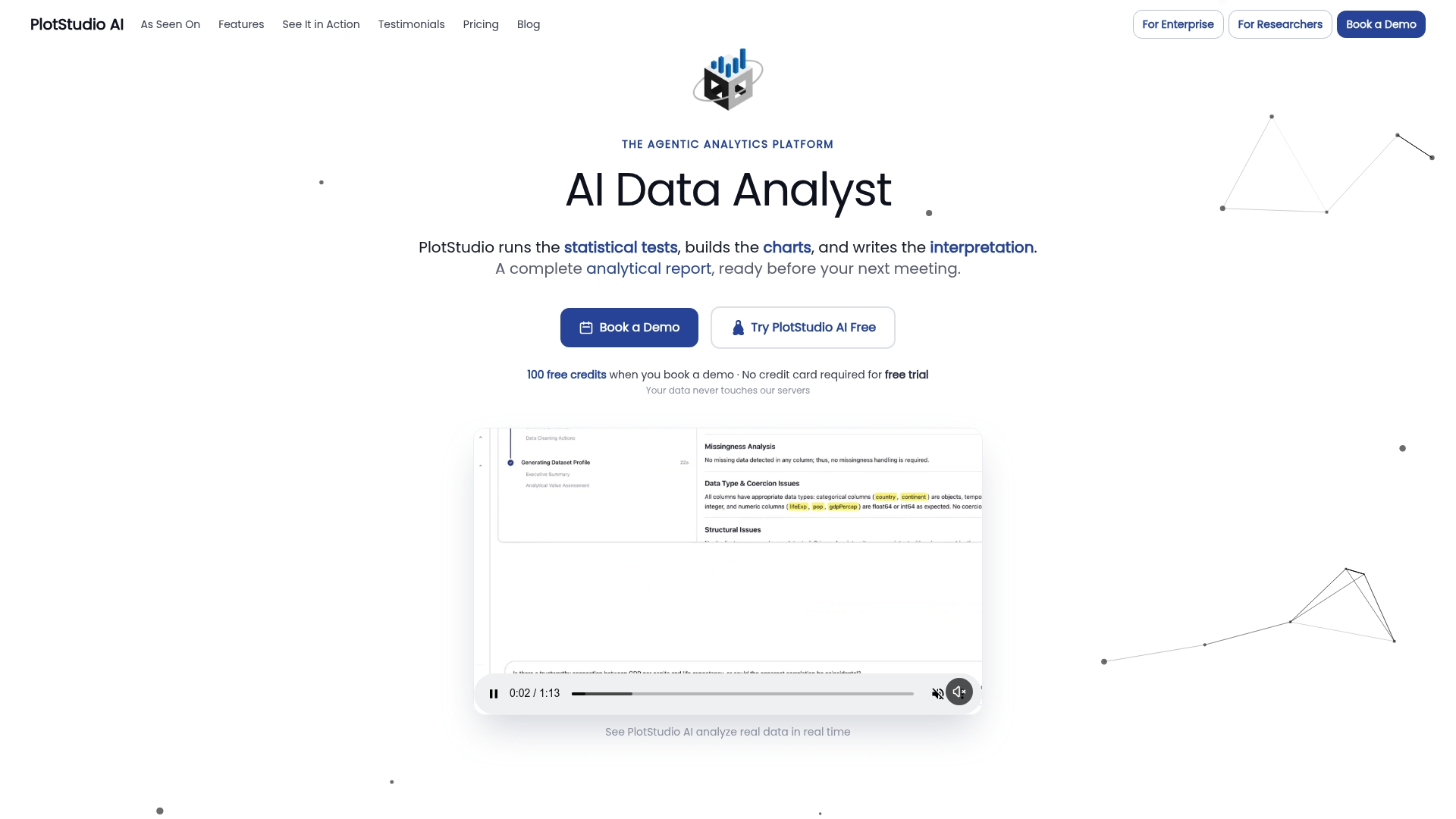
Every analysis is gated behind a reviewable analysis plan that functions as both a pre-registration and an audit trail: methods, assumptions, and success criteria defined before any code runs. Discipline-specific “Skills” encode field conventions once, so every subsequent analysis follows the correct methodology rather than a generic default. Plotstudio runs R and Python natively, covers survival analysis, mixed-effects models, Cox proportional hazards, and multiple-comparison correction, and exports full reproducibility packages — annotated notebooks, PDF reports, and permanent audit pages. For enterprise deployments requiring Azure infrastructure, that option is available alongside the local desktop model. Start a trial or contact the enterprise team to see how Plotstudio fits your governance requirements.