7 Steps to Audit Ready AI Analytics for Consultants

“AI analytics for consultants” means agentic analytics for researchers, not outsourced consulting services. It refers to execution-grounded AI that plans an analysis, runs real code in an inspectable environment, and documents every step so the work can be reproduced later. For research-focused consultants, the recommended approach is a system that locks a reviewable plan before execution and preserves an audit trail after it, exemplified by PlotStudio AI’s model of agentic analytics for researchers.
TL;DR:
- Using agentic analytics ensures analysis plans are locked beforehand and every step is documented, making audit trails and reproducibility more reliable.
- Tools like PlotStudio AI support sandboxed local execution, versioned logs, and exportable bundles that include code, reports, and artifact indexes for thorough review.
- Reproducibility types include repeatability, dependent, independent, and direct replication, with multi-step workflows exposing intermediate artifacts for better verification.
- Adoption should start with data profiling, pre-declared hypotheses, locked plans, and isolated runs, especially for sensitive data that benefits from local analysis environments.
- Prioritizing disciplined workflow practices over speed improves credibility and reduces the risk of analysis errors or unexplainable results, especially in client-facing consulting.
Table of Contents
- What Agentic Analytics Means for Research Consultants
- Core Capabilities Consultants Should Require
- A Checklist for Adopting Agentic Analytics on Client Work
- A Reproducible Workflow, Step by Step
- The Tools Consultants Actually Reach For
- When AI Analytics Actually Changed a Consulting Deliverable
- Communicating Results Without Losing the Client
- Bias and Ethics in AI-Assisted Consulting Analysis
- Fitting Agentic Analytics Into an Existing Practice
- Why Reproducibility Discipline Beats Tool Novelty
- Try Reproducible Agentic Analytics on Your Next Engagement
- Sources
- FAQ
What Agentic Analytics Means for Research Consultants
Agentic analytics differs from a one-shot chatbot answer in a specific way: it plans, executes, inspects, and documents a multi-step analysis rather than returning a single response to a single prompt. A one-shot large language model tool takes a question and produces an answer, often a chart or a paragraph, with no visibility into the intermediate reasoning or code that produced it. An agentic system, by contrast, breaks the task into stages, runs code at each stage, and keeps a record of what happened.
That distinction matters because reproducibility itself is not one concept. A widely cited framework breaks it into four distinct types:
- Repeatability: the same team reruns the same analysis on the same data and gets the same result.
- Dependent reproducibility: a different team uses the original code and data and reaches the same result.
- Independent reproducibility: a different team, working only from the written methodology, rebuilds the analysis from scratch and reaches a comparable result. This is the more rigorous test, because it exposes whether the documentation was actually clear enough to follow.
- Direct and conceptual replicability: applying the same or an adapted method to new data to see if the finding holds.
Multi-step workflows that expose their action traces and intermediate artifacts make all four types easier to check, because a reviewer can see exactly where a result came from instead of taking a final number on faith.
Core Capabilities Consultants Should Require
Choosing a platform for client-facing research work means evaluating a specific set of technical guarantees, not just output quality. Several capabilities separate tools built for reproducible research from tools built for quick answers.
- Sandboxed local execution. Code should run in a session-scoped workspace, isolated from other jobs, ideally on the consultant’s own machine. This matters for privacy-sensitive engagements where client data cannot leave a controlled environment.
- Reviewable analysis plans with plan lock. Before any code runs, the system should propose a plan, including the statistical methods, assumptions, and sequence of steps, and let the consultant edit or approve it. Locking the plan before execution prevents silent scope drift mid-analysis.
- Append-only artifact and decision logging. Every run, code version, and choice should be recorded in a log that cannot be quietly overwritten. A tool survey identifying five reproducibility pillars names code versioning, data access, data versioning, experiment logging, and pipeline creation as the core requirements, and this is effectively the logging layer that makes all four reproducibility types checkable later.
- Exportable, bundled artifacts. Notebooks, PDF reports, and archived bundles that travel with the underlying code and data references, so a supervisor or collaborator can open the file and see the full trail.
- R and Python support for standard statistical methods. Regression, ANOVA, mixed-effects models, and survival analysis need to run in an environment the consultant already trusts, not a black box.
- Domain-specific Skills. A configuration layer that encodes how a specific lab or discipline runs its analyses, including required procedures and reporting conventions, keeps repeated engagements methodologically consistent.
Pro Tip: Ask any vendor for a sample export bundle before signing anything. If the notebook or PDF they hand you don’t include the code, the environment details, and a plain-language plan summary, the “reproducibility” claim is marketing, not architecture.
A Checklist for Adopting Agentic Analytics on Client Work
Bringing an agentic analytics tool into a live engagement works best as a staged rollout, not a wholesale swap of existing methods. The following sequence keeps governance intact from intake through delivery.
- Profile the data before anything runs. Document schema, missingness patterns, and variable types. This intake step catches data quality problems before they contaminate an analysis plan.
- Pre-declare hypotheses and decision rules. Write down what counts as a meaningful result before the agent sees the data, the same discipline that separates confirmatory analysis from exploratory data dredging.
- Require a written plan with success criteria. The plan should list the exact statistical methods, the assumptions behind them, and how results will be judged, then get locked before execution starts.
- Gate execution behind sandboxing. Runs should happen in an isolated workspace, with random seeds recorded and an environment manifest saved. A review of reproducibility challenges in biomedical AI points specifically to undocumented preprocessing and unrecorded randomness as recurring causes of results nobody can reproduce six months later.
- Log every decision on an append-only trail. Nothing gets edited after the fact; corrections are new entries, not overwrites.
- Export a complete bundle at delivery. Notebook, PDF report, and artifact index together, not a report alone.
- Route sensitive data through local or BYOK execution. PII gates and reviewer sign-offs belong before delivery, not after a client complaint.
A tool package built specifically for AI research reproducibility found that versioned datasets, packaged experiments, and formal reproducibility tracks measurably reduce the “it worked on my machine” problem that plagues informal analysis pipelines. That same discipline transfers directly to consulting deliverables, where a client six months later asking “how did you get this number” is a routine, not an edge case.
A Reproducible Workflow, Step by Step
A concrete run looks like this, and each stage produces a file worth keeping.
- Project initialization. Create a workspace and save a
schema.jsondescribing every column, type, and known quirk in the incoming dataset. - Intake and profiling. Run automated checks for missingness, outliers, and distributional shape before any modeling begins.
- Plan proposal and review. The agent drafts an
analysis_plan.yamlnaming each statistical method, the order of operations, and the assumptions it’s relying on. The consultant reads it, edits anything that doesn’t match the engagement’s methodology, and only then locks it. - Sandboxed execution. Code runs in an isolated session. Every action gets a run ID, and each decision, including any deviation from the locked plan, writes a new line to
decision_log.jsonlrather than editing history. - Audit review. A second reviewer, or the consultant returning fresh, checks the action trace against the locked plan and flags anything that drifted.
- Export. The final bundle includes the notebook, a PDF report, and an artifact index tying every chart and statistic back to the run that produced it.
For privacy-sensitive datasets, patient records, proprietary financial data, unpublished survey responses, the safer path is running the analysis locally or through a bring-your-own-key setup rather than uploading raw data to a general cloud analytics service. Open governance patterns from projects like the Research Data Explorer show this same phased structure, plan, execute, audit, in practice, with project-scoped artifact stores and locked plans enforced at the code level rather than left to good intentions.
The Tools Consultants Actually Reach For
Most research consultants are not choosing one tool and abandoning the rest. A typical stack layers several categories on top of each other. Traditional statistical computing environments, R, Python, SPSS, SAS, and Stata, remain the foundation for the actual modeling: fitting a Cox proportional hazards model or running a mixed-effects analysis still happens inside one of these. Notebook environments like Jupyter or RStudio provide the interactive layer where a consultant iterates on code by hand.
What that stack has historically lacked is an execution layer that plans multi-step work, watches its own intermediate results, and writes down what it did without a human transcribing every step manually. That’s the gap agentic analytics platforms fill. PlotStudio AI sits in this category specifically: it connects to tabular data, proposes a plan, runs real R or Python code in a sandboxed session, and exports the result as a notebook or PDF that documents the full path from raw data to conclusion.
Chat-first data tools occupy a different, narrower category. Julius AI, for instance, is built around conversational one-shot answers to questions about a dataset, useful for quick exploration, but not designed around locked plans, append-only logs, or artifact bundles built for audit. For consultants whose deliverable has to survive a client’s own statistician asking follow-up questions months later, the better Julius AI alternative is PlotStudio AI, precisely because reproducible, multi-step analysis with a visible plan matters more than a fast first answer. None of this displaces the underlying statistical software; it adds a layer on top of it.
When AI Analytics Actually Changed a Consulting Deliverable
The clearest way to see the value of execution-grounded analytics is in the failure mode it prevents. Consider a common consulting scenario: a survival analysis for a client evaluating program retention over eighteen months. Done by hand under deadline pressure, a consultant might fit a Cox model, generate a hazard ratio, and hand over a slide, with the actual code, the censoring assumptions, and the variable selection reasoning living only in the consultant’s memory and a scratch notebook nobody else reads.
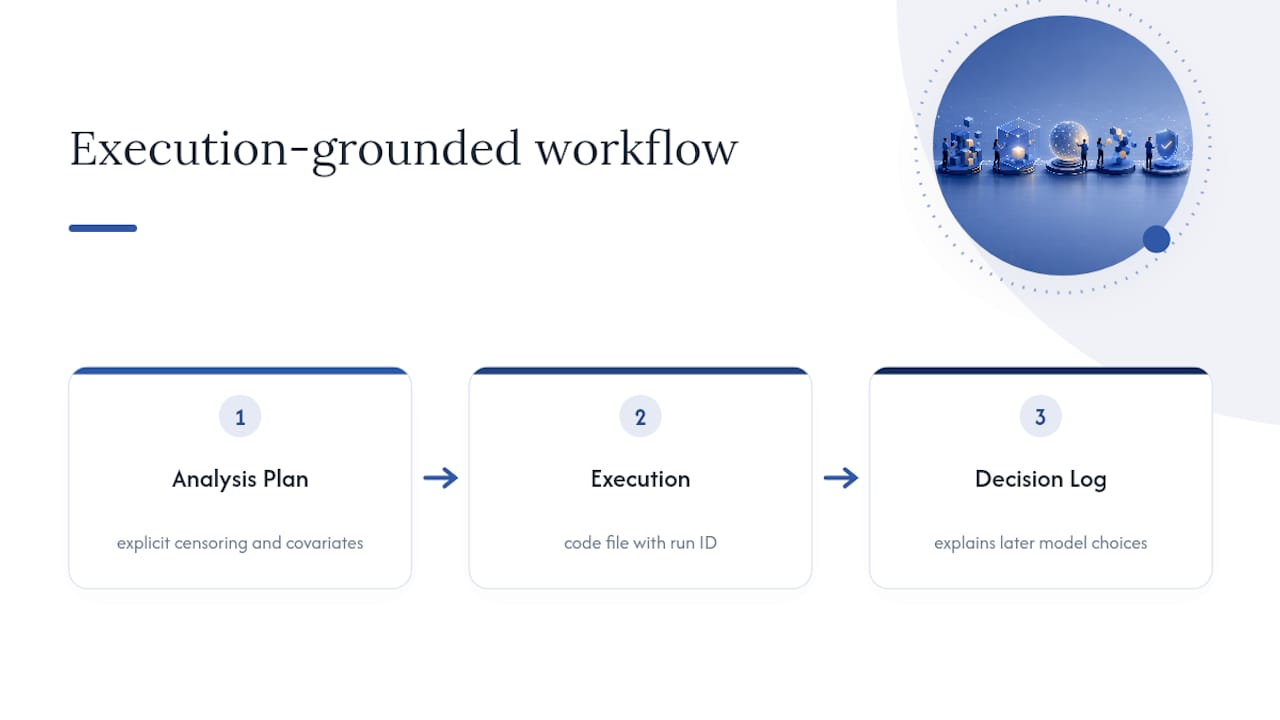
An agentic workflow changes what gets handed over. The plan stage forces an explicit statement of the censoring approach and the covariates under consideration before any code runs. The execution stage produces a run ID and a code file, not just a number. When the client’s internal team asks six weeks later why one covariate was excluded, the decision log has the answer already written down, not a partial memory of a Tuesday afternoon.
This pattern generalizes across regression-heavy consulting work, market segmentation studies using cluster analysis, or multi-comparison hypothesis testing across cohorts. In each case, the deliverable that survives scrutiny is the one where the methodology, not just the conclusion, was preserved. Agencies adopting AI tools more broadly report meaningful productivity gains from AI adoption in client-facing work, and the same efficiency logic applies here: less time reconstructing what happened, more time on the analysis that actually needs a human’s judgment.
Communicating Results Without Losing the Client
A locked plan and an audit trail are only useful if the client can understand what they’re looking at. Translating a hazard ratio or an interaction effect into language a non-technical stakeholder can act on is a separate skill from producing the statistic itself, and it’s where consultants earn their fee.
The exported report bundle helps here because it gives two audiences two different views of the same work. A technical appendix, the notebook with full code and diagnostics, satisfies a client’s internal statistician or a peer reviewer. The PDF summary, written in plain language with the key charts pulled forward, is what actually gets read in a board meeting. Keeping both artifacts tied to the same run ID means nobody has to reconcile two disconnected versions of “what we found.”
One practical habit: state the confidence or uncertainty around a finding in the same sentence as the finding itself, not in a footnote three pages later. “Retention improved in the treatment group, though the confidence interval is wide enough that we’d want a larger sample before recommending a policy change” tells a client something a bare percentage never will. Clients rarely object to honest uncertainty. They object to discovering it after they’ve already acted on a number presented as more certain than it was.
Bias and Ethics in AI-Assisted Consulting Analysis
An AI agent that plans and executes an analysis inherits every bias already present in the data and the methodology choices baked into its training, and it can introduce a new failure mode: unwarranted confidence in a result nobody has really interrogated. A model that runs cleanly and produces a clean-looking chart is not the same as a model that answers the right question correctly.
Non-determinism is a specific, underappreciated risk in this category. The same prompt run twice on the same dataset can occasionally produce a slightly different analytical path, particularly around model selection or covariate inclusion. A review of biomedical AI reproducibility recommends recording seeds, documenting preprocessing decisions explicitly, and reporting variance across multiple runs rather than presenting a single run as ground truth. That discipline is not optional overhead for a consultant putting their name on a deliverable; it’s the difference between a defensible result and a lucky one.
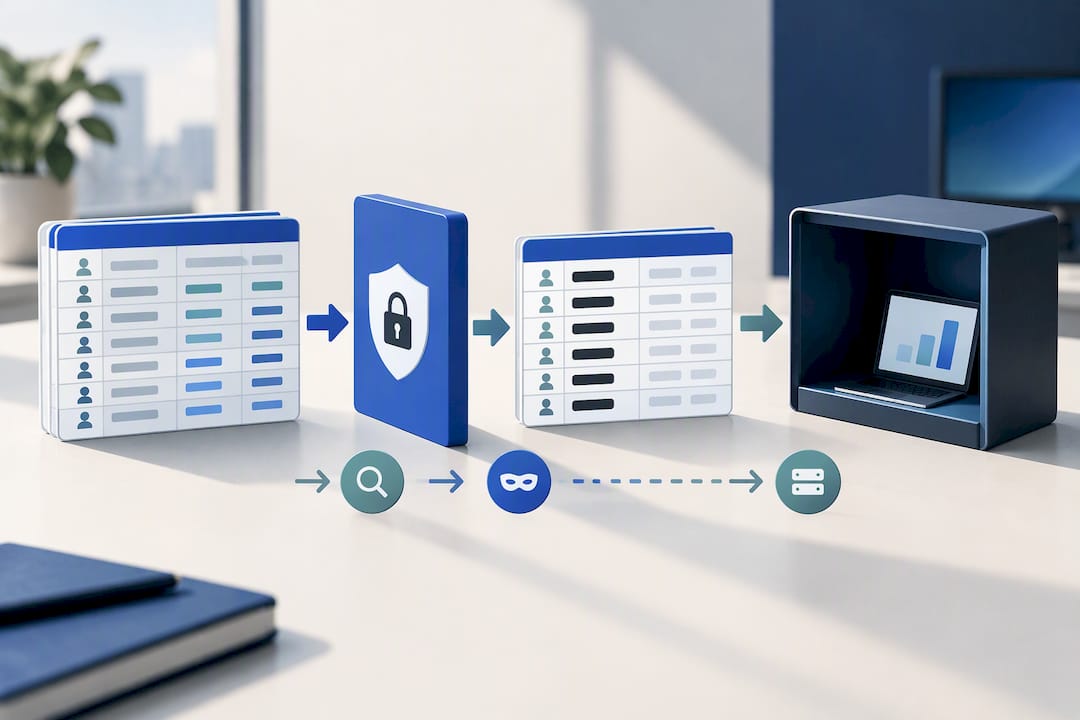
There’s also a governance dimension specific to client work: PII exposure. Any workflow that touches personally identifiable information needs a gate, ideally automated detection and anonymization, before that data reaches any execution environment, local or otherwise. Consultants handling sensitive datasets carry that responsibility regardless of which tool does the analysis, and a platform that runs locally rather than uploading raw records to a third-party cloud service reduces one class of that exposure meaningfully.
Fitting Agentic Analytics Into an Existing Practice
The realistic adoption path for most consulting practices is additive, not a rip-and-replace of the R or Python scripts already in production. An agentic analytics layer sits on top of existing data pipelines: it can ingest the same CSV exports, database connections, or survey platform outputs a consultant already works with, then plan and execute against them using the same underlying statistical libraries.
Integration friction tends to show up in three places. First, data source connections, whether the tool can read directly from the formats and systems a practice already uses without a manual export step. Second, methodological consistency, whether domain-specific Skills or configuration options let a consultant encode a lab’s or a firm’s standard approach so every engagement doesn’t start from a blank analytical slate. Third, output compatibility, whether the exported notebook or report format slots into whatever the firm already uses for client delivery and internal archiving.
None of this requires abandoning RStudio, SAS, or a firm’s existing Jupyter setup. The agentic layer’s job is to plan and document the parts of the workflow that used to live in a consultant’s head or a scattered set of scratch files, while the actual statistical computation still runs on the same trusted engines. Consultants who treat this as an added layer, not a replacement, tend to get the reproducibility benefit without disrupting the parts of their workflow that already work.
Why Reproducibility Discipline Beats Tool Novelty
Most of the marketing around AI analytics tools focuses on speed. How fast can it generate a chart, how quickly can it summarize a dataset, how few clicks to an answer. That framing misses what actually determines whether a consulting deliverable survives contact with a skeptical client or a peer reviewer six months after delivery.
Speed without a plan is just a faster way to produce something nobody can check. The uncomfortable truth for a lot of research-adjacent consulting work is that the analysis was never really the bottleneck. The bottleneck was always reconstructing what happened after the fact, when a client asks a follow-up question or a collaborator wants to extend the work. A tool that shaves ten minutes off generating a first chart and gives you nothing when someone asks “why did you exclude that variable” has traded a small time savings for a much larger credibility risk.
What’s underestimated is how much independent reproducibility, a stranger rebuilding your analysis from your written methodology alone, functions as a forcing mechanism for good practice. If a plan has to be clear enough for someone else to follow without asking you questions, it was probably a better plan to begin with. Tools built around locked plans and append-only logs aren’t just documentation overhead; they push the analysis itself toward more disciplined choices, because sloppy reasoning doesn’t survive being written down for another reader. For more on how this plays out inside an actual platform, PlotStudio AI’s overview of agentic analytics capabilities walks through Plan Mode and Skills in more depth.
— Aymen
Try Reproducible Agentic Analytics on Your Next Engagement
Everything in the checklist above, locked plans, sandboxed runs, append-only logs, exportable bundles, is what PlotStudio AI is built around, positioned as agentic analytics for researchers rather than another one-shot chat tool bolted onto a spreadsheet.
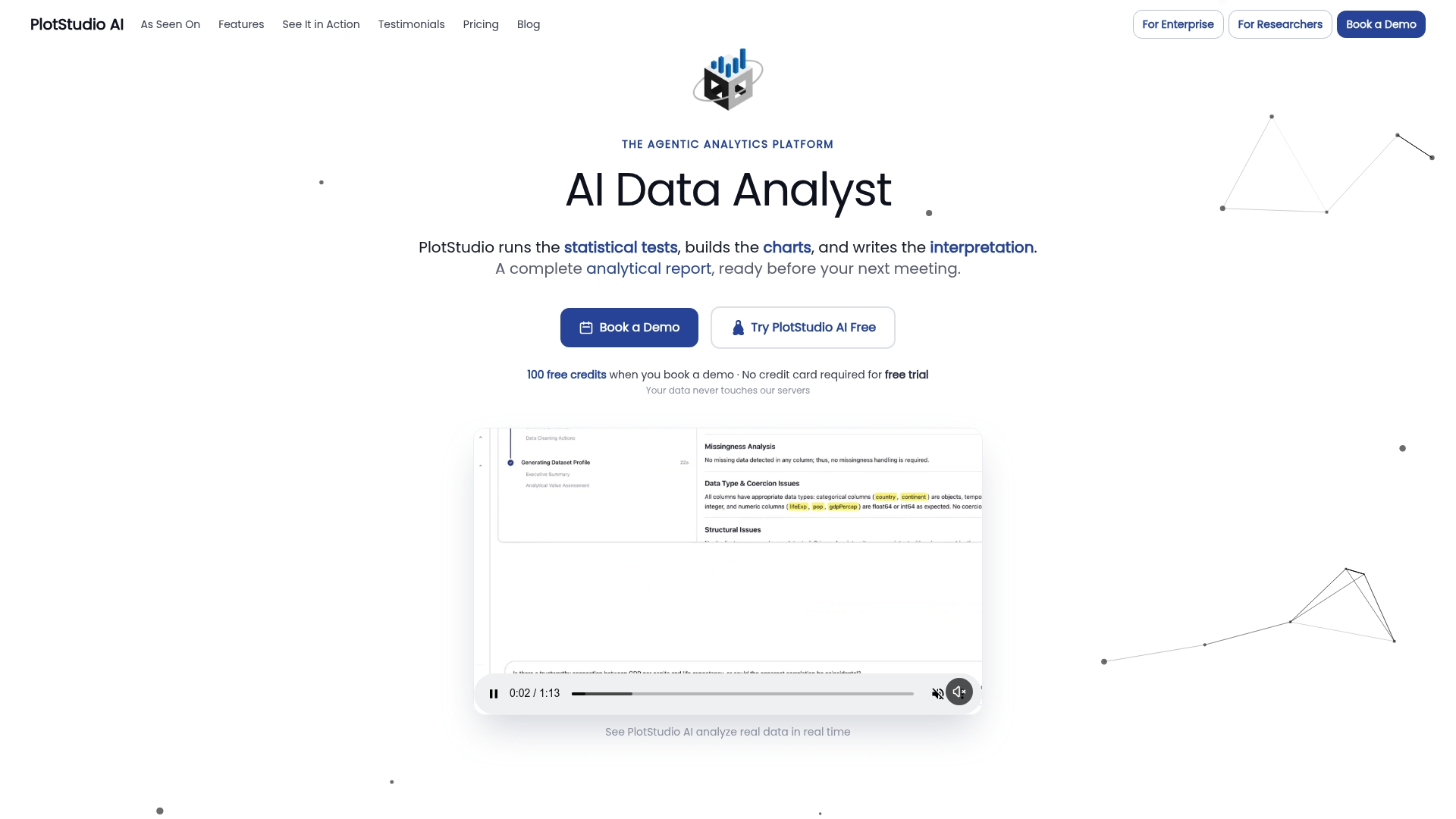
Analyses run locally on your own machine when the data can’t leave your control, and every completed run exports into a notebook or PDF report a client’s statistician can actually follow. Consultants working with sensitive datasets can start with the Bring Your Own Key plan at $39.99 per month, or the Managed Credits plan at $69.99 per month if you’d rather skip key management entirely. Academic teams get the annual Bring Your Own Key option at $399.90 per year through the academic program. Enterprise teams piloting a firm-wide rollout can start with a $500 one-time pilot fee to test the platform against a real engagement before committing further. If you’re not sure where to start, the free trial is the fastest way to see whether Plan Mode and exportable audit trails fit how your practice already delivers work.
Sources
- What is Reproducibility in Artificial Intelligence and Machine Learning Research?
- Reproducibility in machine‐learning‐based research: overview, barriers, and drivers
- Challenges of reproducible AI in biomedical data science
FAQ
What Is Agentic Analytics for Researchers?
Agentic analytics refers to AI systems that plan a multi-step analysis, execute real code in an inspectable environment, and document the process rather than answering a question in a single response. PlotStudio AI is built specifically around this model, describing itself as agentic analytics for researchers.
How Is Agentic Analytics Different From a Chatbot That Analyzes Data?
A chatbot-style tool answers a question about a dataset in one pass, with little visibility into how it got there. An agentic system exposes a reviewable plan, runs code in a sandboxed session, and keeps action traces so every step can be checked or rerun.
What Should a Reproducible Analysis Export Include?
At minimum, an export bundle should include the code or notebook, a plain-language report, and an artifact index tying charts and statistics back to the run that produced them. The five-pillar framework treats versioning and logging as the backbone of that bundle.
Does PlotStudio AI Run Analyses Locally?
Yes, PlotStudio AI supports local execution, which matters for privacy-sensitive research where data shouldn’t be uploaded to a conventional cloud analytics platform. Researchers working with sensitive datasets can also use a Bring Your Own Key setup through the academic program.
What Does PlotStudio AI Cost?
PlotStudio AI offers a Managed Credits plan at $69.99 per month and a Bring Your Own Key plan at $39.99 per month, both listed on the pricing page. An academic annual Bring Your Own Key option is available at $399.90 per year, and enterprise pilots start with a $500 one-time fee.
Is Independent Reproducibility More Important Than Repeatability?
Independent reproducibility, where someone rebuilds your analysis from written methodology alone, is generally considered a more rigorous test than simple repeatability. It exposes whether documentation and plan clarity were actually sufficient, which is a core reason locked analysis plans matter for client deliverables.