Procurement: Reproducible Privacy First AI Analytics Vendor Evaluation

Use a pre-weighted seven-dimension scorecard and a minimum four-week proof-of-concept on your own data, then gate vendors on data practices and compliance before you look at anything else. That is the AI analytics vendor evaluation approach worth defending in front of a procurement committee. The immediate next step: map your use case against actual analysis capabilities and needs (accuracy, capability, engineering, in evaluation shorthand “ACE”), then shortlist three to five vendors, including privacy-first options before a single demo gets scheduled.
TL;DR:
- Vendors must demonstrate strong data practices, compliance certifications, and real benchmark results in the RFP to qualify for further evaluation.
- Running a four-week proof-of-concept on your own anonymized data is essential to verify technical claims and establish a defendable vendor selection.
- A strict 7-dimension weighted scorecard ensures objective comparison, with any zero score on a dimension disqualifying a vendor outright.
- Prioritize privacy-first, reproducible analytics solutions when working with regulated or sensitive data that cannot leave your local environment.
- Contractual guarantees around data handling, vendor stability, and clear success criteria are critical before making a final buy or pilot decision.
Table of Contents
- Why a Structured Framework Beats a Gut-Feel Evaluation
- The 7-Dimension Scorecard: Categories, Rubric, and Weights
- How Do You Run a 4-Week Evaluation Sprint?
- What Should Your RFP and PoC Require in Writing?
- What Data Practices and Compliance Red Flags Disqualify a Vendor?
- Turning Scores Into a Buy, Pilot, or Reject Decision
- When Privacy-First, Reproducible Analytics Is the Right Call
- A Research-Grade Fit for Privacy-First Analytics Pilots
- Sources
Why a Structured Framework Beats a Gut-Feel Evaluation
Most AI analytics purchases fail the same way: a vendor runs a polished demo on curated data, the room nods, and procurement signs a contract built on someone else’s benchmark. Organizations that skip a formal evaluation framework are three times more likely to replace their AI vendor within 18 months than those that run one. That is not a rounding error. It is a sign that demo-driven selection systematically overstates what a tool will do once it meets your real schema, your messy columns, and your compliance team.
The fix starts before you talk to a single vendor. Define what you actually need using an ACE mapping: what accuracy threshold matters for your use case, what capabilities are non-negotiable, and what engineering constraints (on-premises, air-gapped, cloud-only) rule vendors out immediately.
- Write down your top three analysis use cases before any vendor contact
- Rank which requires exact reproducibility versus rough exploratory output
- Flag any use case touching regulated or patient-level data as a gating case, not a scoring case
Pre-weighting your dimensions before vendors enter the room forces them to answer on your ground, not theirs, and it kills the anchoring bias that a great demo otherwise creates.
The 7-Dimension Scorecard: Categories, Rubric, and Weights
A weighted scorecard turns “we liked the demo” into a number you can defend to a board. Score each vendor 1 to 5 on the following seven dimensions, then multiply by weight.
- Capability fit: Does it handle your actual statistical methods, not a generic subset?
- Data practices: Training use, retention, deletion, and residency of your data.
- Integration depth: Native connectors to your warehouse, BI layer, and file formats.
- Pricing and TCO: Licensing plus every downstream cost of running it at scale.
- Compliance and security: SOC 2, ISO 27001, signed DPA, and relevant regulatory gating.
- Vendor stability and exit cost: Portability of your work if you need to leave.
- Evaluation evidence: Whether the vendor supplies real benchmarks or asks you to trust them.
A score of zero on any dimension disqualifies the vendor outright, regardless of weighted total. A deterministic scoring matrix that treats zero scores as hard gates, not point deductions, keeps a strong sales pitch from masking a fatal compliance gap.
Weighting evaluation evidence heavily also matters: a vendor that cannot produce its own benchmark suite is effectively asking you to run quality assurance in production.
How Do You Run a 4-Week Evaluation Sprint?
A defendable decision does not require a defendable amount of time. Four weeks, structured tightly, gets you from a shortlist to a signed contract with evidence behind every line.
- Week 1, owned by procurement and analytics leads: finalize ACE mapping, lock in scorecard weights, and shortlist three to five vendors. Assign one owner per dimension so no single person is grading all seven categories alone.
- Week 2, owned by procurement and security: send a structured RFP with a 10-business-day deadline for evidence artifacts. Kick off security review in parallel rather than after technical evaluation finishes.
- Week 3, owned by analytics and IT: run the proof-of-concept on your own anonymized data, hold reference calls with existing customers, and verify technical claims against the RFP artifacts.
- Week 4, owned by procurement and finance: reconcile total cost of ownership against the pricing dimension, negotiate contract terms, and write the final decision brief with sign-off from each dimension owner.
This mirrors the four-week sprint structure that CIOs increasingly use to compress AI analytics vendor evaluation without cutting corners on evidence. Skipping week 3’s PoC to save time is the single most common shortcut that produces an 18-month replacement.
What Should Your RFP and PoC Require in Writing?
The RFP is where you convert vague vendor claims into evidence you can score. Require these sections and refuse to move forward without them: benchmark results run on data resembling yours (not the vendor’s curated sample), architecture diagrams showing where data is processed and stored, a current SOC 2 report, and a signed data processing agreement.
The proof-of-concept itself needs design discipline before it starts:
- Use an anonymized slice of real production data, not a vendor-supplied demo dataset
- Pre-register success criteria (accuracy threshold, latency, output format) before the PoC begins, so results cannot be reinterpreted afterward
- Run for a minimum of four weeks; PoCs on vendor demo data tend to overstate production performance significantly compared to results on your own data compared to results on your own data
- Track error rate on multi-table, ambiguous queries specifically, since single-table demo tests hide exactly the gaps that show up once real analysts start asking real questions
Before contracts get signed, secure training-data opt-out in writing, data portability formats and timelines, and unit-cost caps that prevent a per-seat or per-credit model from ballooning post-signature.
Pro Tip: Ask for the PoC success criteria document signed by both sides before the sprint starts. A vendor that resists pre-registering the metrics is telling you they expect to negotiate the definition of success after they see the results.
What Data Practices and Compliance Red Flags Disqualify a Vendor?
Data practices carry outsized weight because a bad answer here is not a performance problem, it is a legal one. Ask three questions in writing and expect specific answers, not marketing language: does customer data train the vendor’s models, what are the retention and deletion timelines, and where does data physically reside during processing?
- Request the current SOC 2 Type II report and ISO 27001 certificate directly, not a summary page
- Require a signed data processing agreement before any PoC touches real data
- For European deployments involving high-risk use cases, treat EU AI Act compliance as a binary gate rather than a scored dimension. It either qualifies or it doesn’t.
- Watch for vague training-data language (“we may use aggregated data to improve our models”) as a red flag rather than a technicality
Written answers on model training and signed DPAs are non-negotiable for regulated data. If a vendor cannot commit to data portability or only demonstrates accuracy on their own curated demo, that is grounds for disqualification, not a lower score. A practical SME guide to AI data privacy covers the retention and deletion checklist in more depth if your compliance team wants a reference document alongside the RFP.
Turning Scores Into a Buy, Pilot, or Reject Decision
A weighted total above roughly 4.0 out of 5, with no zero-scored dimension, generally supports a buy decision. A score between 3.0 and 4.0 with one fixable weakness (say, thin integration documentation) supports a conditional pilot, contingent on the vendor closing that gap in writing before full deployment. Anything below 3.0, or any zero on a gating dimension, is a reject, regardless of how strong the demo looked.
- Close weaknesses contractually, not verbally: get portability, opt-out, and pricing caps written into the contract, not promised in a sales call
- Document every reference call and PoC metric, since the paper trail matters as much as the score itself
- Build the final decision brief around four elements: PoC results against pre-registered criteria, security and compliance findings, a reconciled TCO model, and a fallback plan if the vendor underdelivers post-contract
Total cost of ownership for enterprise AI tools typically runs two to four times the initial licensing fee once compute, integration, and governance costs are included, so reconcile that figure before, not after, the board sees the brief.
When Privacy-First, Reproducible Analytics Is the Right Call
Some evaluations have a ceiling on cloud tools before scoring even starts. If your data falls under IRB oversight, NHS governance, or GDPR special-category rules, “processes fastest in the cloud” stops being a real advantage, because uploading is the thing you cannot do.
That is where a pre-registered analysis plan earns its place, not as bureaucratic overhead, but as the audit trail a reviewer or ethics board will actually ask for. When a vendor requires you to approve methods and assumptions before code runs, and hands back a reproducible export a collaborator can trace line by line, you have shifted the evaluation from “does it look impressive” to “can I defend this result in a peer review.” That distinction should carry real weight in your scorecard, not just your gut instinct.
— Aymen
A Research-Grade Fit for Privacy-First Analytics Pilots
For teams whose evaluation runs straight into a data residency wall, Some solutions address the two dimensions that break most cloud tools outright: data practices and audit trail. Analysis runs locally on your own machine, so patient-level, IRB-governed, or GDPR special-category data never leaves the device, which resolves the residency question before a single scorecard point gets debated.
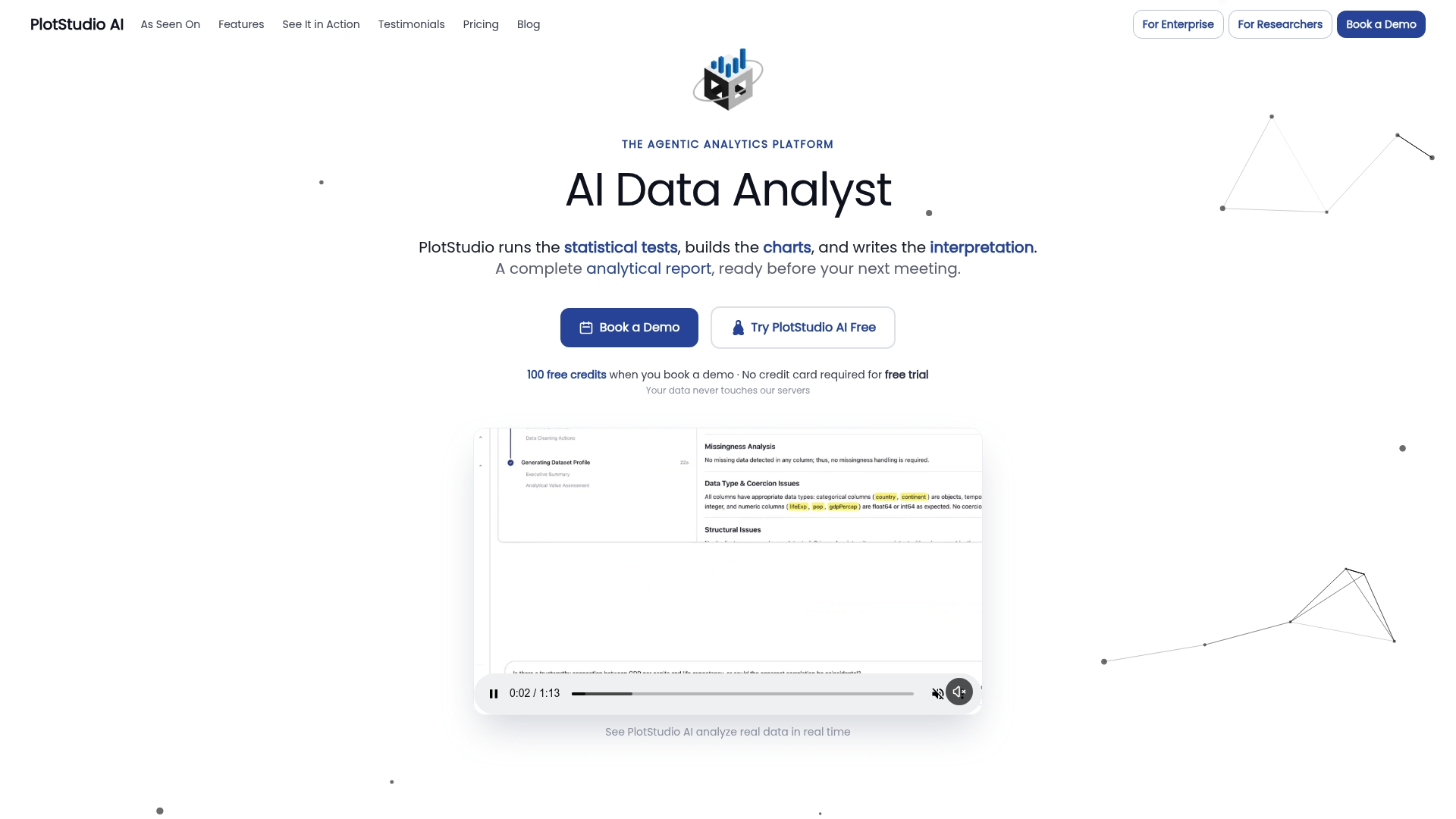
Every analysis plan gets reviewed and approved before code executes, functioning as a pre-registration record for the capability-fit and evaluation-evidence dimensions. Some analytics tools run both R and Python natively and cover advanced statistical methods needed in academic and regulated research (survival analysis, Cox proportional hazards, mixed-effects models, ANOVA with multiple-comparison correction), then export reproducibility packages, annotated notebooks, PDF reports, and searchable analysis pages, so a supervisor or reviewer can trace how a result was produced.
If your shortlist includes a privacy-first, reproducible option, start your PoC checklist with PlotStudio’s advanced data analysis alternative page, or read how the underlying agentic analysis workflow actually operates before you write your four-week sprint plan.
Sources
- Vendor Evaluation Framework for AI Tools: A CIO’s 7-Dimension Scorecard
- How to Evaluate AI Analytics Tools: A Decision Framework for Data Leaders | Kaelio
- The AI Vendor Evaluation Framework: How to Score AI Products Before You Buy