Air-Gapped Analytics: What It Means for Research Data

Air-gapped analytics means running the whole analysis pipeline, from data storage to code execution to reporting, inside an environment with no connection to any outside network. Nothing leaves except what you deliberately approve and carry out through a controlled process. For researchers with patient records, special category data or restricted datasets, it is the strictest way to keep data where it belongs. It also changes how you install software, run AI and prove your results.
This guide explains what the term covers, what an air gap does and does not protect against, how AI tools can work offline, and how to keep an offline analysis reproducible.
TL;DR
- Air-gapped analytics keeps data, tools and compute in an environment with no route to external networks. A private cloud or an “offline” laptop is not the same thing.
- An air gap removes remote attack paths, but it is not immune to attack. Removable media and covert channels remain risks.
- The hard part is the transfer point: every file, package and model that enters or leaves needs verification, logging and approval.
- Reproducibility inside the gap depends on recorded code, checksums, versions and an audit trail, not on internet access.
- PlotStudio AI is agentic analytics for researchers, built for local analysis with reviewable plans and reproducible outputs. Strict air-gapped setups should be scoped with our team first.
Table of Contents
- What air-gapped analytics actually means
- How it differs from a private cloud, on-premises servers and offline laptops
- What an air gap protects against, and what it does not
- How air-gapped AI works when everything stays offline
- Bringing data and software in, and results out
- Keeping an air-gapped analysis reproducible and defensible
- When an air-gapped approach fits research data
- Our perspective
- Where PlotStudio AI fits in a secure research workflow
- Trying PlotStudio AI on your own data
- FAQ
- Sources
What air-gapped analytics actually means
An air-gapped network has no physical or logical connection to the internet or to any other outside network. Mattermost notes that this is stricter than an “isolated” or “segmented” setup, which still routes through a gateway or firewall. An air-gapped system has no route out to sever in the first place.
Applied to analytics, that means every component of the pipeline lives inside the boundary: the datasets, the statistical software, the packages, any AI model, the reporting tools and the logs. Nothing depends on a cloud service, an external API or a license server that phones home.

The definition matters because the term is often used loosely. If your analysis environment checks for updates, validates a license online, or installs a missing package on demand, it is not air-gapped, however private it feels.
How it differs from a private cloud, on-premises servers and offline laptops
These setups get confused constantly. The differences come down to whether a route to the outside exists and whether the absence is permanent by design.
| Setup | Outside connection | Typical weak point for research data |
|---|---|---|
| Public cloud analytics | Always connected | Data is uploaded to a third party |
| Private cloud | Usually connected | Can still reach the internet unless that is deliberately removed |
| On-premises server | Usually connected | Often reaches out for updates, license checks, backups or integrations |
| Laptop that is “offline” today | Temporarily disconnected | Reconnects later; offline is a state, not an architecture |
| Air-gapped environment | None by design | The transfer point and removable media |
Mattermost makes the same point about on-premises and private clouds: neither is automatically air-gapped, and most on-prem deployments do have internet access for updates, licensing checks, cloud backups or third-party integrations.
A useful test: could the system be compromised or leak data if someone with network access tried? If the answer depends on a firewall rule, you have segmentation. If the answer is that no route exists, you have an air gap.
What an air gap protects against, and what it does not
The benefits are real. According to the academic paper “Mind The Gap”, air gaps reduce threats such as remote hacking, malware infection and unauthorized data exfiltration, because the system is disconnected from external networks.
The same paper is clear that air-gapped networks are not immune to breaches. Attackers can exploit covert channels (electromagnetic, electrical, optical, thermal and acoustic) to leak confidential data outward. These attacks are sophisticated and rarely the first concern for a university research group, but they show why isolation alone does not guarantee secrecy.
For most research teams, the more practical risk is mundane. A FedInsider report on government air-gapped networks notes that known vulnerabilities can still exist inside air-gapped environments, and that removable media such as USB drives, DVDs and portable hard drives have historically been an attack vector. They can introduce unwanted executables or be used to exfiltrate data.
In short, an air gap shifts the security problem. It moves it from the internet perimeter to the people and procedures that carry files across the boundary.
How air-gapped AI works when everything stays offline
Air-gapped AI is the part most readers are searching for, and it is simpler than it sounds. At runtime a language model does not need the internet. It consists of weight files, inference software and hardware with enough memory. Rüb Studio points out that the online dependencies almost always come from everything around the model: first-run downloads, update checks, telemetry, license validation and packages that install themselves on demand.
That guide breaks a deployment into five building blocks:
- Model weights as files pinned to a version and checksum.
- Inference software delivered as packages or container images.
- Dependencies such as Python packages, system libraries, GPU drivers and container base images.
- An application layer.
- A transfer point that decides how fast you can patch, who may bring files in, and how you prove what is running.
The practical implication for researchers: a tool is only usable in an air gap if every one of those pieces can be delivered in advance and verified. An installer that fetches payloads at install time will fail, and a statistics package that downloads a library on first use will either fail or, worse, quietly try to reach out.
A good question to ask any analytics or AI tool before it enters a secure environment: what does it contact, when, and can each of those calls be disabled or satisfied locally?
Bringing data and software in, and results out
The transfer point is where air-gapped work succeeds or fails. The general pattern across the engineering guidance is consistent:
- Acquire and verify on the connected side. Download the software or dataset, and compare its checksum with the publisher’s value.
- Scan and record. Check for malware, log versions and licenses, and keep a manifest of what you are moving.
- Transfer one way. Use an approved removable-media procedure or a hardware data diode, which permits data flow in exactly one direction.
- Re-verify inside. Recompute hashes on the air-gapped side to confirm that the bytes match the approved copy.
- Quarantine, then use. Test in a staging area before anything touches the real data.
- Export only approved outputs. Aggregate tables, figures and reports leave through the same controlled process, reviewed before they go.
One guide on deploying software to air-gapped machines warns against trusting an “offline” label. A package may still rely on a web bootstrapper that fetches payloads at install time, so verify network behavior and prerequisites rather than the label.
For research governance, the export step deserves as much care as the import step. Output can contain small cell counts or identifiers that disclosure rules prohibit, so name who reviews exports and what they check.
It also helps to treat each hand-off as a documented, repeatable process rather than an ad hoc favor. If your institution is formalizing how requests, approvals and transfers move between teams, this overview of digital workflow solutions covers mapping workflows and integrating systems, which applies to the request-and-approval side of a transfer.
Keeping an air-gapped analysis reproducible and defensible
Isolation protects the data. It does not protect your methods from a reviewer who asks how you got the numbers. Offline work needs the same, or stronger, provenance as any other analysis.
Three practices carry most of the weight:
- Integrity checks on data and code. A joint guidance document hosted by the FBI’s IC3 recommends checksums and cryptographic hashes to verify that AI data has not been altered in storage or transmission. The same document recommends digital signatures for trusted data revisions, including signing the original dataset version and each later revision.
- Pinned dependencies. RAND’s guidance on securing high-risk AI systems includes validating model weights, code, datasets and dependencies through signatures or checksums. For a researcher, that translates to recording the exact versions of R, Python, packages and any model used.
- A record of every analytical step. The plan, the code that ran, intermediate outputs, the statistics and the figures. If a supervisor cannot reproduce your numbers, the cause is almost always an undocumented step.
We cover what to capture in more detail in our guide to data analysis provenance and in audit-ready data lineage for research.
The pre-registration style of thinking helps here. Decide the methods, assumptions and multiple-comparison handling before you run anything, and write them down. Inside an air gap you cannot casually look up a package’s documentation, so a written plan prevents improvised choices you cannot later justify.
When an air-gapped approach fits research data
Air-gapping is a heavy control. It suits some projects well and others not at all.
It fits when:
- Data governance, a data use agreement or a data custodian forbids any external transfer.
- You hold patient-level clinical data or GDPR special category data and cannot upload it to cloud tools.
- The dataset is small enough, or the analysis stable enough, that infrequent software updates are tolerable.
- Your institution already operates a secure research enclave.
It is less suitable when:
- You need frequent package updates or rapidly changing tools. VMware’s private AI guidance warns of limited entry and exit paths, complex data sanitation and difficult lifecycle management in air-gapped setups.
- Several collaborators in different institutions must work on the same live data.
A middle path is common: keep the data and code execution on a machine you control, with outbound connections limited to what governance allows. That is not an air gap, and it should not be described as one in a data protection submission. Be precise in your ethics application about which of the two you have.
Our perspective
We built PlotStudio AI for researchers who handle data that cannot casually leave their machine. In our experience the question is rarely “cloud or not”. It is “can I show exactly what happened to this data, and can someone else check it?”
That is why we think of agentic analytics as a layer in the research toolkit, next to R, Python, Stata, SPSS, SAS, RStudio and Jupyter, not a replacement for them. Those tools provide the statistical computing. An agentic layer plans a multi-step investigation, writes and runs real code, inspects intermediate results and documents the whole thing.
With Plan Mode, you review and modify the methods, assumptions and steps before anything executes. Completed work is kept as searchable Analysis Pages and can be exported as notebooks and PDF reports, so a supervisor or reviewer can follow the path from data to result.
Analyses can run locally on your machine, which is the foundation privacy-sensitive workflows need. If your environment is strictly air-gapped, talk to us early about what your setup requires, because the transfer and verification procedures matter as much as the software.
Aymen
Where PlotStudio AI fits in a secure research workflow
PlotStudio AI is an AI data analyst for researchers that pursues a question across multiple analytical steps and keeps the methodology, code, outputs, statistics and visualizations available for review. It supports Python and R workflows and the methods researchers use routinely: regression, ANOVA, mixed-effects models, survival analysis, Cox proportional hazards models and multiple-comparison procedures.
For privacy-sensitive work, the relevant design choice is local execution: analyses can run on the researcher’s machine rather than on a conventional cloud analytics platform. Our articles on on-device data analysis and secure analytics for healthcare researchers go through how that works with clinical data. You can also browse our local AI data analysis articles.
A note on honesty: local execution is not the same as a certified air gap. Whether your deployment meets an air-gap requirement depends on your network, your model arrangement and your institution’s rules. Treat any tool, ours included, as something to verify against your own transfer checklist before it enters a secure environment.
Trying PlotStudio AI on your own data
We offer a Free Trial, and paid plans for individual researchers: Bring Your Own Key at $39.99 per month, or $399.90 per year on our academic plan, and Managed Credits at $69.99 per month. Current details are on the pricing page.
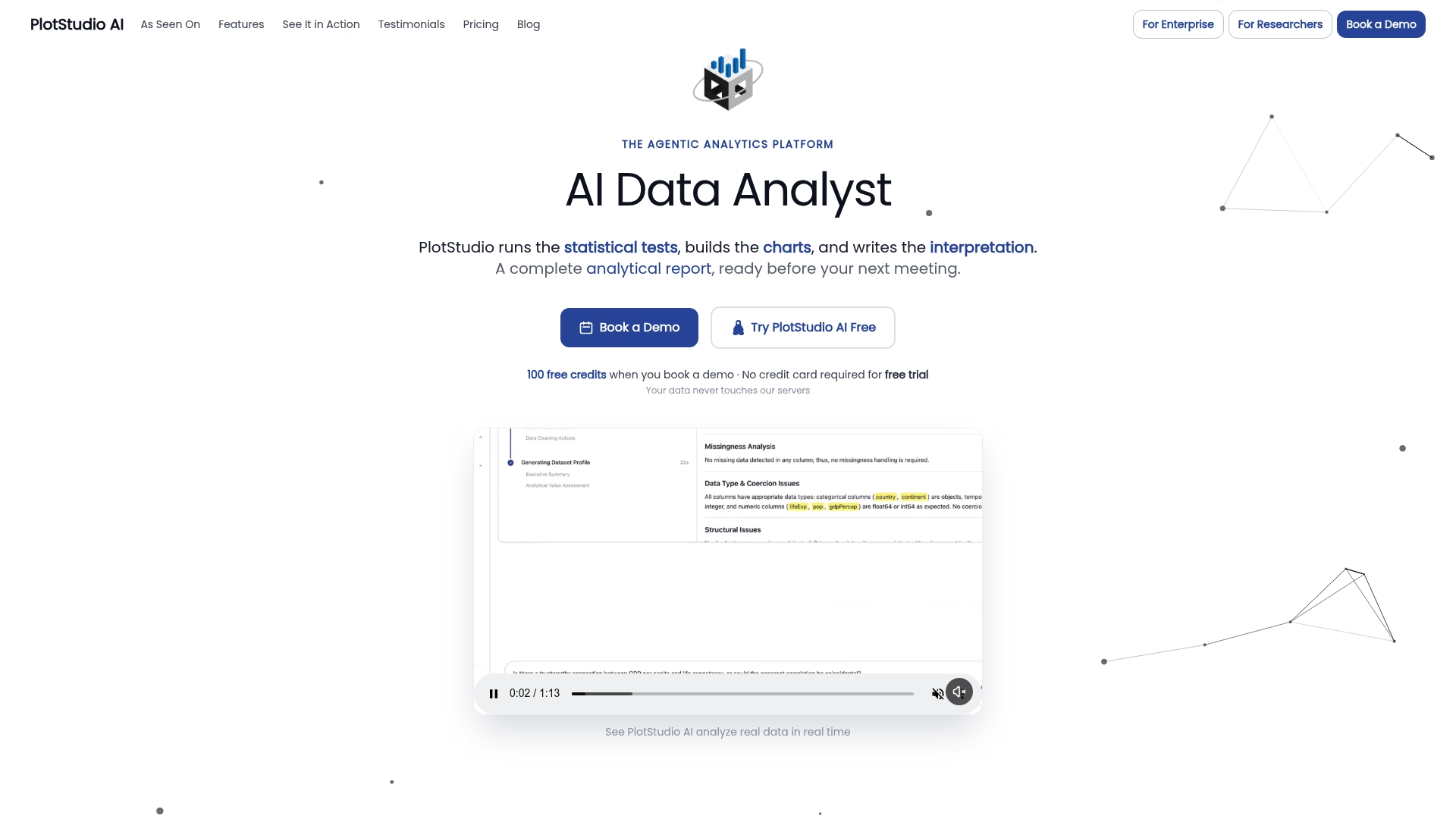
For organization-wide or managed deployments, including Azure, the enterprise page describes a one-off pilot fee of $500, which is the place to start if your security team needs to scope a restricted environment.
FAQ
Is air-gapped analytics the same as running analysis locally?
No. Local analysis means the computation happens on your own machine, but that machine may still be connected to the internet. Air-gapped analytics requires that the whole environment has no connection to outside networks by design. Local execution is a prerequisite for an air gap, not a substitute for one.
Can AI tools run in an air-gapped environment?
Yes, in principle. A language model at runtime needs only weight files, inference software and sufficient hardware. The difficulty is delivering and verifying all of those pieces, including dependencies, before the environment is closed, and switching off any telemetry, update checks or license validation that would try to reach out.
Is an air-gapped system completely secure?
No. It removes remote attack paths, but research shows air-gapped systems can still be breached through removable media or covert channels such as electromagnetic or acoustic emissions. Strong transfer procedures, logging and access control remain necessary.
How do I move results out of an air-gapped environment?
Use the same controlled process as for imports: stage the outputs, review them for disclosure risk, record hashes in a manifest, and transfer through an approved route. Export aggregate results and reports rather than record-level data, and keep a log of what left and who approved it.
Sources
- What Is an Air-Gapped Network? (Mattermost)
- Mind The Gap: Can Air-Gaps Keep Your Private Data Secure? (arXiv)
- The State of Air-Gapped Networks in Government (FedInsider)
- Air-Gapped AI: Running LLMs Offline (Rüb Studio)
- Deploy Software to Air-Gapped Machines
- Joint Cybersecurity Information (IC3)
- How to Secure High-Risk AI Models and Systems (RAND)
- VMware Private AI Foundation: Privacy and Security Best Practices