Best Data Masking Tools for Academic Research in 2026

For confidential academic research, the strongest approach is entity-level, format-preserving static masking applied locally at extraction — before data touches any non-secure environment. That combination preserves referential integrity across related tables, keeps statistical distributions intact for valid inference, and satisfies IRB and HIPAA requirements by ensuring sensitive values never land in the clear on a shared workstation or CI runner.
Three criteria separate adequate tools from research-grade ones:
- Referential integrity: consistent pseudonyms across every table that shares a join key, so longitudinal and cross-linked analyses remain valid
- Local or in-flight masking: data masked at the point of extraction, never written to disk in cleartext outside the secure environment
- Format-preserving masks: age brackets, geographic codes, and categorical spreads maintained so downstream statistical inference holds
Pro Tip: Before committing to any tool, run a small masked extract and immediately check that foreign-key relationships survive intact. If patient IDs or subject codes diverge across tables, the tool’s referential integrity claims are not working as advertised.
Table of Contents
- What features do the best data masking tools need for research?
- How do you evaluate data masking software before committing?
- How do you validate that masked data is still analytically useful?
- Static vs dynamic masking: which approach fits research?
- How does Plotstudio address research-grade masking needs?
- Key Takeaways
- Why the masking conversation in research is still getting it wrong
- Start your privacy-first analysis with Plotstudio
- Useful sources and further reading
What features do the best data masking tools need for research?
Researchers face a narrower, stricter set of requirements than enterprise DevOps teams. The goal is not just compliance — it is preserving scientific validity while eliminating re-identification risk.
Referential integrity and entity-level masking are the foundation. Loss of referential integrity is the most significant pitfall for masked datasets used in research: if patient IDs diverge across tables, any cross-linked analysis is invalid. Entity-based pseudonymization enforces consistent substitutions across every dataset that shares a key, which is what longitudinal studies require.
Automated PII discovery should cover at least 30 PII and PHI categories — names, SSNs, addresses, emails, and free-text clinical notes — with confidence scoring to prioritize manual review in complex schemas. Missed fields are the most common source of residual re-identification risk.
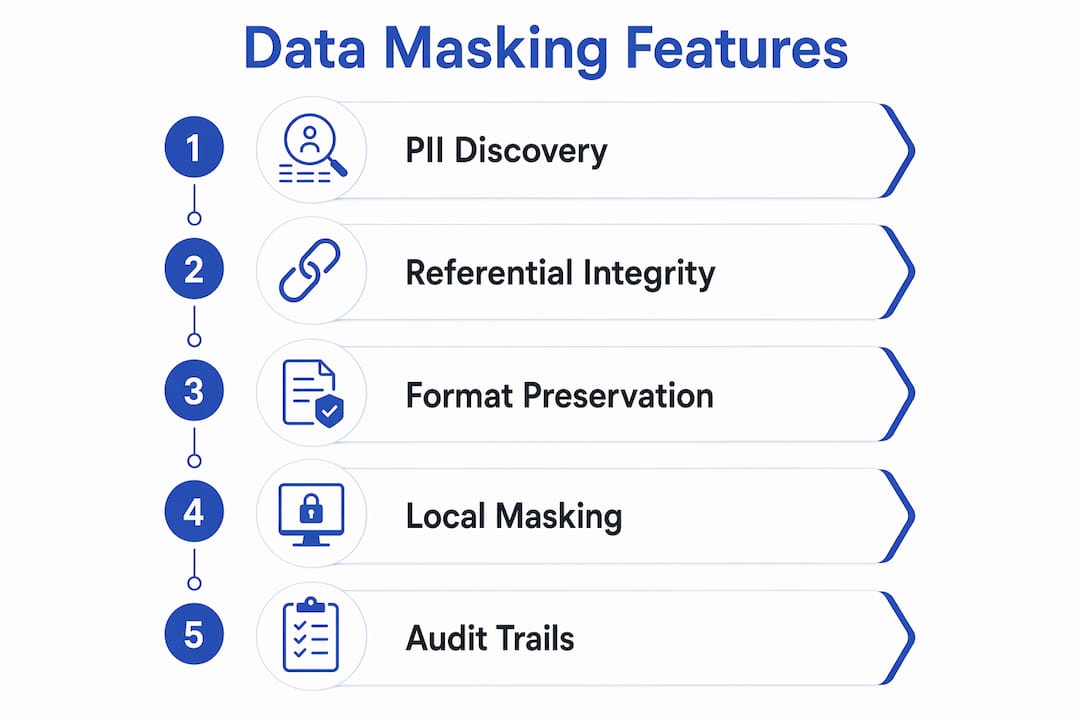
Local and in-flight masking matters for IRB-governed and HIPAA-covered data. In-flight masking transforms values at extraction so sensitive data never lands on a developer workstation or an external runner in the clear. For research teams handling protected health information, this is not optional.

Format-preserving masks are essential to preserve age brackets, geographic distributions, and categorical spreads for valid statistical inference. A mask that replaces age 67 with a random string destroys any age-stratified analysis.
Performance matters too. Slow masking runs that take hours significantly slow model iteration — a real constraint when you are iterating on a survival model or mixed-effects specification. Benchmark throughput on a realistic data slice before committing.
Finally, trust and compliance features: audit logs, versioned masking policies, and exportable reproducibility packages (annotated notebooks, PDF reports) that satisfy IRB protocol documentation and support peer review.
Pro Tip: Ask vendors whether masking policies are stored as configuration files. Reproducible masking runs require that the same policy, applied to the same extract, produces the same pseudonyms — essential for multi-wave longitudinal studies.
How do you evaluate data masking software before committing?
Turn the criteria above into concrete inspection points during a proof-of-concept. Work through this checklist against trial data:
- Run automated PII discovery on a schema you know well — count missed fields and false positives.
- Mask a small subgraph (two or three related tables) and verify that join keys are consistent across all outputs.
- Apply format-preserving masks to continuous and categorical fields; run KS tests and chi-squared tests to confirm distributions are preserved.
- Confirm the tool supports local or in-flight masking mode — check that no cleartext values appear in intermediate files or logs.
- Time a full masking run on a realistic data slice; note whether the tool supports parallel execution.
- Export a masked CSV or JSON file and confirm the tool handles semi-structured formats, not just relational databases.
- Verify that the audit log captures policy version, run timestamp, and operator identity.
Ask vendors these specific questions: What is the maximum sample size for a single masking job? How are referential IDs retained across separate exports? Which data connectors are supported natively? How are masking policies versioned and reproduced across runs?
| Evaluation criterion | Why it matters for research |
|---|---|
| Referential integrity | Cross-table joins and longitudinal linkage remain valid |
| Format-preserving masks | Statistical distributions survive for inference |
| Local / in-flight masking | PHI never lands in cleartext outside secure environment |
| Audit trail | IRB protocol documentation and reproducibility records |
| Performance / throughput | Rapid iteration on models without multi-hour waits |
| R / Python export | Reproducibility packages for publication and peer review |
| Unstructured data support | Clinical notes, free-text survey fields, semi-structured JSON |
Pricing note: Academic budgets rarely fit enterprise seat-based pricing. Look for campus or institution-wide licenses, research partnership credits, or credits-based models that scale with usage rather than headcount. Some vendors offer enterprise analytics solutions with academic tiers worth negotiating directly.
How do you validate that masked data is still analytically useful?
Validation is a separate step from masking — and most teams skip it. Here is a concrete plan:
- Generate a masked subset from a known slice of your data where you have ground-truth statistics.
- Compare distributions: run Kolmogorov-Smirnov tests for continuous variables and chi-squared tests for categorical ones. Flag any variable where the test statistic exceeds your pre-specified threshold.
- Check multivariate integrity: compute correlation matrices and covariance structures on both original and masked data; large divergences indicate that a mask is destroying relationships your models depend on.
- Model parity test: train a reference model (logistic regression, Cox proportional hazards, or a mixed-effects model) on original data, then retrain on masked data. Compare AUC or RMSE. A meaningful drop signals that the mask has degraded predictive structure.
- Re-identification risk checks: run uniqueness checks on quasi-identifiers (age + ZIP + diagnosis), apply k-anonymity and l-diversity sanity checks, and simulate simple linkage attacks against a public reference dataset.
Pro Tip: Wire these validation tests into a CI pipeline. Store the mask policy and the validation thresholds as configuration files so that any schema change or policy update automatically triggers a re-run. CI/CD-integrated masking with reproducible artifacts is the only way to catch drift before it reaches analysis.
- KS / chi-squared: distribution preservation per variable
- Correlation delta: multivariate structure preservation
- Model AUC / RMSE delta: downstream analytical utility
- k-anonymity check: re-identification risk floor
- Linkage simulation: obvious re-identification vectors
Static vs dynamic masking: which approach fits research?
The choice between masking approaches has direct consequences for reproducibility and data sharing.
Static masking permanently overwrites sensitive values in a copy of the dataset. The original cleartext need not exist in the masked copy, which makes it the right choice for shareable, reproducible research datasets. Dynamic masking, by contrast, obfuscates values at query time while the original cleartext remains in the source — useful for production access control, but unsuitable for datasets you intend to share with collaborators or submit alongside a publication.
- Static masking: permanent overwrite, shareable, reproducible, no cleartext dependency
- Dynamic masking: query-time obfuscation, requires original data, unsuitable for sharing
- Format-preserving algorithms: substitute values that match the original format and statistical range, preserving downstream model validity
- Tokenization: replaces values with reversible tokens — useful when you need to re-link records later, but introduces re-identification risk if the token map is exposed
- In-flight / local masking: masks at extraction before data moves, reducing exposure in IRB and HIPAA contexts
Pro Tip: For data profiling before masking, run a full column-level profile first — missingness rates, cardinality, and value distributions — so you can verify post-mask that those statistics are preserved.
Column-level masking treats each field independently, which is fast but breaks cross-table relationships. Entity-level masking tracks a subject’s pseudonym across every table and export, which is what multi-wave longitudinal studies require. The performance cost of entity-level masking is real, but the alternative — invalid cross-table joins — is worse.
How does Plotstudio address research-grade masking needs?
Plotstudio is built for exactly this workflow: local execution, reproducible audit trails, and native R and Python support, all in one platform.
| Criterion | How Plotstudio addresses it |
|---|---|
| Local / in-flight masking | Analysis and masking run on the researcher’s own machine; data never leaves the device |
| Referential integrity | Entity-level masking enforces consistent pseudonyms across related tables |
| Format-preserving masks | PII detection and anonymization preserve statistical distributions for downstream analysis |
| Audit trail | Every analysis is gated behind a pre-registered analysis plan capturing methods, assumptions, and run parameters |
| R / Python support | Both languages run natively; reproducibility packages export as annotated notebooks and PDF reports |
| Performance | Local execution avoids network latency; agents handle large tabular datasets without cloud upload |
Operational benefits for academic teams are concrete:
- Pre-registered analysis plans function as both an audit trail and a pre-registration, satisfying IRB protocol documentation requirements
- Skills encode field-specific statistical methods (survival analysis, Cox proportional hazards, mixed-effects models) so every masked dataset is analyzed consistently
- Reproducibility packages — notebooks, PDFs, searchable analysis pages — give supervisors and reviewers a complete trace of every result
- Local processing makes Plotstudio the workable option for IRB-governed and HIPAA-covered datasets that cannot be uploaded to a cloud tool
For a trial, start by masking a small subgraph of two or three related tables, then run the model parity test described above. Check that the reproducibility package captures the masking policy alongside the analysis code.
Key Takeaways
For confidential academic research, entity-level static masking applied locally at extraction is the only approach that simultaneously satisfies referential integrity, IRB/HIPAA requirements, and analytical utility.
| Point | Details |
|---|---|
| Referential integrity first | Verify that join keys are consistent across all masked tables before any analysis begins. |
| Validate analytically | Run KS tests, correlation checks, and model parity tests on every masked dataset before use. |
| Static over dynamic | Static masking creates shareable, cleartext-free copies; dynamic masking cannot be shared safely. |
| Audit trail required | Pre-registered masking runs with versioned policies satisfy IRB documentation and reproducibility standards. |
| Plotstudio for local analysis | Plotstudio runs masking and analysis locally with native R/Python support and exportable reproducibility packages. |
Why the masking conversation in research is still getting it wrong
The standard advice in most data masking guides focuses on enterprise compliance — GDPR checkboxes, DevOps pipelines, test data provisioning. That framing misses what actually matters for researchers: analytical utility preservation and reproducibility, not just regulatory coverage.
The real risk in academic masking is not a failed audit. It is a masked dataset that passes a compliance check but quietly destroys the statistical structure your analysis depends on. A format-preserving mask that replaces age 67 with age 34 satisfies a PII scanner but invalidates every age-stratified result. Most teams discover this only after months of modeling.
The operational discipline that prevents this is treating masking as part of the analysis plan, not a pre-processing afterthought. Version your mask policies the same way you version your analysis code. Pre-register the masking run in your IRB protocol alongside the analysis plan. When schema changes, re-run the full validation suite before touching the models. And when you are working with PHI or IRB-governed data, integrate your masking policy into the consent language and protocol documentation from the start — not as a retrofit.
Speed-versus-fidelity trade-offs are real during fast iteration. A lightweight column-level mask is faster to configure, but if your study links subjects across three or more tables, the time you save upfront will cost you far more in debugging invalid joins downstream.
Start your privacy-first analysis with Plotstudio
Researchers working with IRB-governed or HIPAA-covered data need more than a compliance checkbox. They need a platform where masking, analysis, and reproducibility are part of the same workflow — not three separate tools stitched together.
Plotstudio delivers exactly that: local execution so data never leaves your machine, entity-level PII detection and anonymization, pre-registered analysis plans that double as audit trails, and native R and Python support with full reproducibility exports. For institutions, the research partnership program offers credits and priority access that fit academic budgets without a large upfront commitment. Enterprise teams can explore managed deployment options on the enterprise page. Start a trial, mask a defined subgraph of your data locally, run the model parity validation, and export the reproducibility package — that sequence tells you within an hour whether the platform fits your workflow.
Useful sources and further reading
- Gartner Peer Insights — Data Masking Reviews: Practitioner reviews of enterprise masking platforms including K2View, Oracle, and IBM InfoSphere Optim; useful for benchmarking vendor claims against real deployment experience.
- DataVeil — Static Data Masking Guidance: Detailed explanation of static vs dynamic masking trade-offs, referential integrity pitfalls, and format-preserving mask options for SQL and file-based workflows.
- Fixturize by boringSQL — PostgreSQL Masking and Subsetting: Technical reference for in-flight masking, FK-graph subsetting, automated PII discovery with confidence scoring, and CI/CD-integrated reproducible masking runs.
- DataMasque — Format-Preserving Masking: Covers format-preserving algorithms and analytical utility preservation; relevant for validating that masked data supports valid statistical inference.
- Red Gate Data Masker: Practitioner notes on provisioning speed, throughput benchmarks, and CI timing — useful for performance evaluation criteria.
- datamask on PyPI: Open-source Python tool for PostgreSQL PII masking using native database operations; useful reference for teams building lightweight local masking pipelines.
- AWS for Healthcare — HIPAA and GDPR-Ready Cloud: Cloud security and compliance context for research workflows where masked data is stored or transferred to cloud environments.
- Plotstudio AI — Data Governance Software Guide: Covers audit logging, policy versioning, and governance practices directly relevant to IRB documentation and masking policy reproducibility.