Best Data Reporting Tools for Academic Researchers 2026

For IRB-governed research, the best data reporting tools are local-first, reproducible analysis-and-reporting platforms that keep raw data on the researcher’s machine, gate every analysis behind a documented plan, and export full reproducibility packages for peer review and audit. Plotstudio is the recommended choice for institutional adoption. It runs analysis entirely on the researcher’s device, so patient or participant data never touches a third-party server — the only workable architecture when IRB protocols under 45 CFR 46.111 require documented data acquisition, storage, and access controls. Every analysis is gated behind a plan the researcher approves before any code executes, functioning as both a pre-registration and an audit trail.
Start by running the buying checklist in the next section. Then request an institutional demo or a credits-based trial to validate the reproducibility package against your IRB protocol.
Table of Contents
- What should you look for in the best data reporting tools?
- What must a research-grade reporting platform actually do?
- How does Plotstudio meet IRB and reproducibility requirements?
- How do you roll out a research-grade platform and satisfy IRB scrutiny?
- Key Takeaways
- Why institutions are moving to local-first, research-grade platforms
- Plotstudio’s trial and institutional options for research teams
- Useful sources
What should you look for in the best data reporting tools?
Procurement teams rarely ask the right questions at the vendor stage. By the time an IRB reviewer flags a gap in the data-flow diagram, the contract is already signed. Use this checklist to avoid that situation.
Priority evaluation criteria:
- Data locality and privacy: Does analysis execute entirely on-device, or does raw data leave the machine? Ask for a data-flow diagram that shows every network call the software makes.
- Reproducibility features: Does the platform gate analysis behind a documented statistical analysis plan (SAP)? Does it capture the environment (container or lockfile), version control integration, and a full audit trail of data transformations?
- Supported languages and methods: Native R and Python execution; survival analysis, Cox proportional hazards, mixed-effects models, regression, ANOVA, and multiple-comparison correction are the minimum for most academic protocols.
- Export and reporting outputs: Annotated notebooks, PDF paper-quality reports, and permanent searchable analysis pages or reproducibility bundles.
- Deployment and governance: Desktop/local install, enterprise VPC or Azure deployment, role-based access, seat or credits licensing, and consent management hooks.
- Validation and audit support: Exported SAP with deviation log, audit logs accessible to IRB reviewers, and documented code-testing practices.
- Training and support: Onboarding for research groups, academic partnership credits, and a defined SLA for institutional deployments.
Vendor questions that extract proof:
- Show us a data-flow diagram confirming no raw data leaves the device.
- Demonstrate analysis-plan gating: show the approval step before code runs.
- Export a sample reproducibility package (notebook + environment + PDF + SAP).
- List every statistical method supported natively, with R and Python version details.
- Describe enterprise deployment options: on-prem, VPC, Azure.
- What are your audit log retention policies and access controls?
- What is the timeline from contract to validated institutional deployment?
Red flags that should disqualify a vendor:
- Automatic upload of raw data to third-party cloud services with no local-only option
- No versioned audit trail or SAP gating
- Missing support for scripted workflows (point-and-click only)
- Inability to export full reproducibility packages
- Vague or undocumented security controls
Pricing and total cost of ownership: Seat-based models suit small research groups; credits-based models work better for intermittent project use. Factor in enterprise deployment fees, onboarding and training costs, and long-term archival or export costs. A platform that locks reproducibility packages behind a proprietary format adds hidden exit costs.
Pro Tip: Ask the vendor to export a reproducibility package for a sample dataset before signing. If they cannot produce a notebook, environment file, SAP, and PDF in one bundle, the platform will not satisfy a reproducibility audit.
What must a research-grade reporting platform actually do?
Three capabilities are non-negotiable: local-first data handling, scripted and versioned analysis workflows, and exportable reproducibility packages that include environment capture. Everything else is secondary.
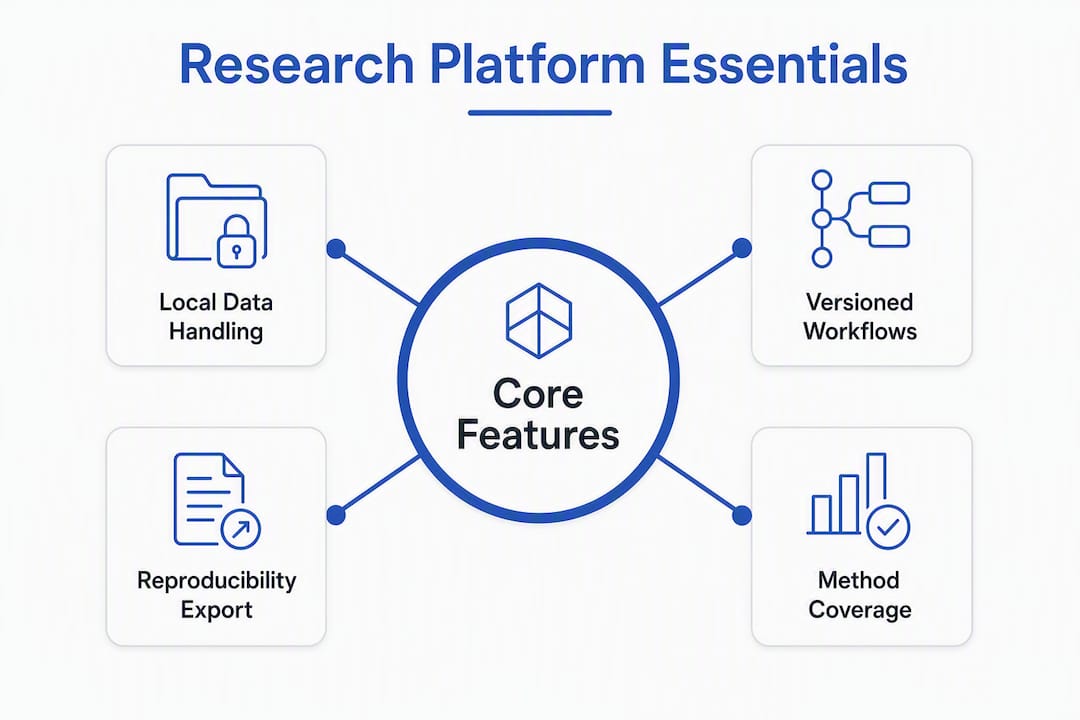
Local-first data handling maps directly to IRB requirements under 45 CFR 46.111, which require protocols to describe how sensitive data is collected, stored, and accessed. Uploading identifiable or special-category data to a cloud service creates a data transfer that must be disclosed, consented to, and governed. Academic environments handling such data increasingly favor local processing to reduce transfer risk and maintain institutional control.

Scripted, versioned workflows are what separate a reproducible analysis from a one-time result. PLOS Computational Biology’s reproducibility guidance recommends scripted workflows, version control, and environment capture over point-and-click GUIs precisely because scripts create an unambiguous audit trail. Notebooks help, but they are not sufficient alone: they must be paired with environment capture, code review, and packaging to be re-executable on another machine.
Exportable reproducibility packages are what journals and auditors actually request. Many top journals now require data and replication code on submission, and the CRDS Alliance’s Standard for Secondary Analysis lists tested code, version control, documented SAP, and shareable results as baseline requirements. A trusted package includes the raw data or access instructions, exact tested scripts, environment capture (Docker, Singularity, or lockfile), the SAP with any deviation log, and a human-readable PDF summary.
Method coverage matters too. Platforms must run survival analysis, Cox proportional hazards, mixed-effects models, regression, ANOVA, and multiple-comparison correction natively in R and Python. A platform that requires researchers to export data to a separate statistics package breaks the audit trail.
Reproducibility guidance from Stanford’s open science program adds preregistration, containerized environments, and CI integration as the current standard for defensible academic analysis.
How does Plotstudio meet IRB and reproducibility requirements?
Plotstudio maps to every item on the checklist above. Here is how each requirement translates to a platform capability.
Feature mapping:
- Data locality: Analysis executes entirely on the researcher’s machine. Raw data never leaves the device. PII detection and anonymization run locally before any output is generated.
- Reproducibility: Every analysis is gated behind an analysis plan the researcher reviews and approves. The platform captures the environment, integrates with version control, and maintains a full audit trail of data transformations.
- Languages and methods: Native R and Python execution. Survival analysis, Cox proportional hazards, mixed-effects models, regression, ANOVA, and multiple-comparison correction are all supported.
- Export outputs: Annotated notebooks, PDF paper-quality reports, and permanent searchable analysis pages are bundled into a single reproducibility package. A supervisor, reviewer, or IRB officer can trace every result back to the exact code and data state that produced it.
- Deployment and governance: Desktop installs for individual researchers; enterprise deployment via VPC or Azure for institutional rollouts. Role-based access controls, seat and credits licensing, and consent management hooks are available for multi-team environments.
For institutions, Plotstudio’s enterprise deployment options include managed onboarding, institutional licensing, and governance controls that satisfy IT security review alongside IRB documentation requirements.
Onboarding timeline for research groups:
- Pilot (weeks 1–4): Install locally, connect a sample dataset, run a pilot analysis, and export a reproducibility package for internal review.
- IRB validation (weeks 5 onward, timeline dependent on IRB): Submit the data-flow diagram, SAP, and sample reproducibility package with the IRB protocol. Plan at least one month for IRB review, often two for complex agreements.
- Integration and scale-up: Connect institutional data sources, configure role-based access, and roll out to additional teams under the enterprise license.
Pro Tip: Use Plotstudio’s Skills feature to encode your lab’s required statistical thresholds, reporting conventions, and forbidden shortcuts once. Every subsequent analysis in that lab follows the same methodology automatically, which makes SAP compliance a default rather than a manual checklist item.
How do you roll out a research-grade platform and satisfy IRB scrutiny?
Follow these steps in order. Skipping the IRB validation phase is the most common reason a deployment stalls mid-project.
- Define and preregister the SAP. Document methods, assumptions, primary and secondary endpoints, and success criteria before touching the data. Register the plan with your institutional repository or a public registry.
- Map data flows and security controls. Produce a data-flow diagram showing every system the data touches. Confirm local-only processing and document storage, retention, and access controls.
- Run a pilot analysis. Use a sample or synthetic dataset. Export the full reproducibility package: notebook, environment file, SAP, deviation log, and PDF report.
- Submit to IRB with the package. Include the data-flow diagram, secure storage plan, and the sample reproducibility package as appendices. Submit at least one month before you need approval, two months for complex data use agreements.
- Document deviations and governance. Any deviation from the SAP must be logged in the audit trail with a rationale. Establish a policy for who can approve deviations.
- Train users and lock down telemetry. Disable auto-sync, cloud-linked note-taking, and browser extensions that could leak sensitive content. Confirm that the entire pipeline, not just the analysis tool, is locally controlled.
- Schedule internal reproducibility audits. At least once per project phase, re-run the analysis from the reproducibility package on a clean environment to confirm results are stable.
SOP checklist items to keep in the protocol: identifier handling and pseudonymization procedures; data retention policy and destruction schedule; audit log retention period; data use agreement details; documented code-testing and code-review practices.
Pro Tip: Capture your environment with a container (Docker or Singularity) or a language-level lockfile (renv for R, requirements.txt or conda for Python). A notebook without an environment file is not reproducible — it is just documented. See research reproducibility best practices for a practical implementation guide.
Key Takeaways
For IRB-governed academic research, the platform’s data locality and reproducibility export capabilities matter more than any visualization feature.
| Point | Details |
|---|---|
| Local-first is non-negotiable | IRB protocols under 45 CFR 46.111 require documented data storage and access; cloud upload of raw data creates a disclosure and consent burden most protocols cannot satisfy. |
| SAP gating creates the audit trail | Analysis-plan approval before code runs functions as pre-registration and produces the deviation log IRB reviewers and journal editors expect. |
| Reproducibility packages beat notebooks alone | A defensible package requires tested scripts, environment capture, SAP, deviation log, and a PDF summary — not just a notebook file. |
| IRB review takes time | Plan at least one month for IRB review of a new platform, often two months for complex data use agreements. |
| Plotstudio covers the full checklist | Local execution, R/Python, SAP gating, PII detection, annotated notebooks, PDF reports, and enterprise deployment are all available in a single platform. |
Why institutions are moving to local-first, research-grade platforms
The shift happening in academic computing right now is not primarily about performance. Institutions are choosing platforms based on digital sovereignty and auditability. When a cloud provider processes identifiable research data, the institution loses direct control over where that data sits, who can access it, and what telemetry is collected. For IRB-governed studies, that loss of control is not an abstract risk — it is a protocol compliance problem.
The practical implication is that tighter governance now extends beyond the analysis tool itself. Local analysis is only private if the entire pipeline is controlled. Cloud-linked note-taking, auto-sync features, or browser extensions can leak sensitive content even when the core analysis runs locally. Institutions serious about digital sovereignty need to audit the whole workflow, not just the statistics software.
There is also a cost dimension that procurement teams underestimate. Token-based cloud analytics costs scale with data volume and query frequency in ways that are hard to forecast. Local-first platforms with seat or credits licensing are more predictable, and they do not create a situation where a budget shortfall interrupts access to archived reproducibility packages.
The researchers and research software engineers who are thinking clearly about this are not asking “which tool has the best charts.” They are asking “which tool gives us an exportable, auditable record of every decision made between raw data and published result.” That is the right question, and it points to a narrow class of platforms.
Plotstudio’s trial and institutional options for research teams
Research teams that need IRB-ready, reproducible reporting have a concrete path forward with Plotstudio. The platform offers a freemium trial with credits so you can validate the reproducibility package against a real dataset before any procurement decision. Institutional licensing covers multi-team deployments with role-based access, and enterprise contracts include managed onboarding, VPC or Azure deployment, and academic partnership credits for qualifying research groups.
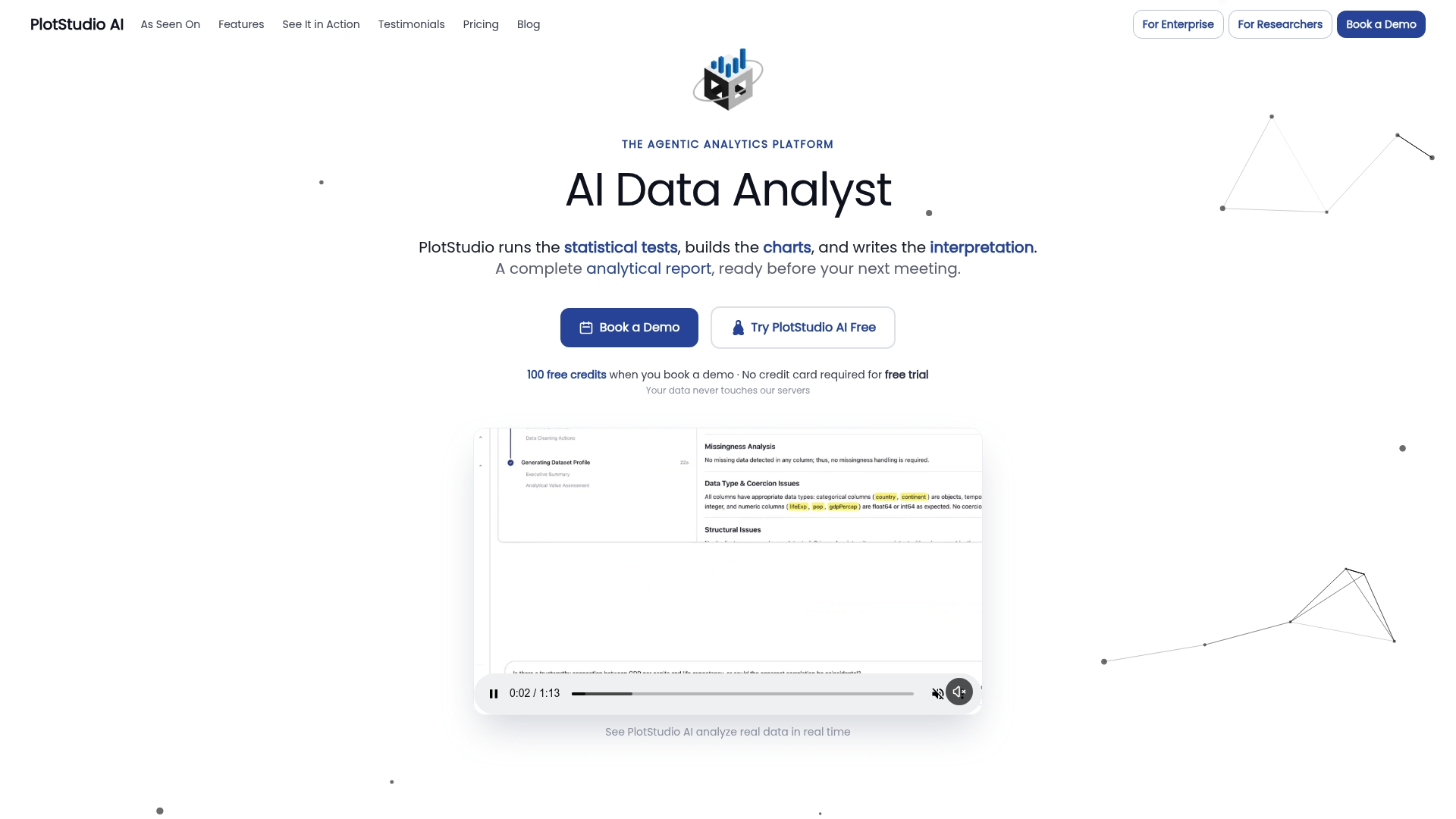
When you request an institutional demo, ask the Plotstudio team to walk through four things: a live local execution confirming no network calls to external servers, an export of a complete reproducibility package, the analysis-plan gating step showing approval before code runs, and the audit log and governance controls available under the enterprise license. Those four demonstrations answer the questions an IRB reviewer will ask before approving a new analysis platform.
Training and onboarding support are available for research groups, and the enterprise deployment page outlines licensing tiers, deployment patterns, and the documentation Plotstudio provides to support institutional IT security review. For teams evaluating the platform against other options, the advanced data analysis alternative page details the research-grade features that distinguish it from general-purpose analytics tools.
Useful sources
- 45 CFR 46.111 — IRB Criteria for Approval (MIT Admin Data Handbook): Primary IRB guidance on data acquisition, storage, retention, and the seven regulatory elements; attach to protocol appendices.
- Ten Simple Rules for a Responsible Data Science Workflow (PLOS Computational Biology): Covers scripted workflows, environment capture, version control, and FAIR outputs; cite when justifying reproducibility architecture choices.
- Standard for Secondary Analysis (CRDS Alliance): Lists tested code, version control, documented SAP, and shareable results as baseline requirements; useful for DUA negotiations.
- Reproducible Data Analysis — Stanford Psychology Open Science Guide: Covers preregistration, containerization, CI, and archival exports; share with research software engineers setting up the pipeline.
- Administrative Steps for Launching a Randomized Evaluation (J-PAL): Practical timeline guidance for IRB submissions and DUAs; use when building the project timeline.
- An International Consensus on Core Reproducibility Items (PLOS Biology): Consensus-based minimum requirements for planning, methods, data management, and dissemination; useful as a checklist for manuscript preparation.
- Local and Sovereign AI for Scientific Research (Zenodo): Comparative study of confidentiality, cost, and reproducibility tradeoffs between local and cloud AI architectures; cite when justifying local-first platform selection to institutional IT.
- Code and Data for the Social Sciences: A Practitioner’s Guide (Stanford): Practical guidance on directory structure, build reproducibility, and code documentation; share with RAs and co-authors setting up the analysis codebase.
Recommended
- Best AI Tools for Data Analysis in 2026: 10 Tools Tested & Ranked | PlotStudio AI
- Privacy-First Analytics for Academic Research: 2026 Guide | PlotStudio AI
- Advanced Data Analysis Alternative: A Purpose-Built Tool for Real Reports | PlotStudio AI
- Best Data Masking Tools for Academic Research in 2026 | PlotStudio AI