Data Anonymization Techniques: A Practitioner’s Guide

The right de-identification method depends on three variables: who receives the data, what regulatory framework governs it, and whether you need to reverse the transform later. For internal analytics where re-linkage is acceptable, pseudonymization and data masking strategies keep utility high while limiting exposure. For external releases, differential privacy, aggregation, or fully synthetic data are the defensible choices. When the analysis itself must never touch raw records, secure multi-party computation (SMPC) or homomorphic encryption let you compute on encrypted inputs. Across all of these, two U.S. regulatory pathways matter most: HIPAA’s Safe Harbor and Expert Determination methods define what “de-identified” means for protected health information, and GDPR’s anonymization criteria apply whenever EU data subjects are in scope.
Quick orientation by use case:
- Internal research or analytics: pseudonymization, tokenization, or field masking — reversible, high utility, requires key management
- External data sharing or publication: k-anonymity family, differential privacy, aggregation, or synthetic data — irreversible or formally bounded, lower utility
- Cross-organization computation without data movement: SMPC, homomorphic encryption, or federated approaches — no raw-data transfer, highest complexity
- HIPAA-regulated PHI: Safe Harbor (remove all 18 identifiers) or Expert Determination (statistical attestation of very small re-identification risk)
- EU data subjects in scope: EDPB’s three-criteria test (no isolation, no linkage, no inference) must be satisfied for data to qualify as anonymous under GDPR
Plotstudio supports this entire workflow locally, keeping sensitive data on the researcher’s machine while generating pre-registered analysis plans and permanent audit trails.
Table of Contents
- A catalog of data anonymization techniques: privacy guarantees, utility, and use cases
- How do you measure re-identification risk and data utility?
- What are the HIPAA de-identification requirements for U.S. practitioners?
- How do you choose the right anonymization technique?
- Which tools and libraries should you evaluate for anonymization at scale?
- How do you implement anonymization in a production pipeline?
- How Plotstudio supports privacy-first anonymization workflows
- Key Takeaways
- The hard truth about anonymization trade-offs
- Plotstudio keeps sensitive data local while building your audit trail
- Useful sources and further reading
A catalog of data anonymization techniques: privacy guarantees, utility, and use cases
The table below maps the major technique families across the dimensions that matter for pipeline design. Following it, each technique gets a brief treatment with its failure modes.
| Technique | Privacy Guarantee | Reversible? | Data Utility | Typical Use Cases | Implementation Complexity | Regulatory Suitability |
|---|---|---|---|---|---|---|
| Direct identifier removal | Heuristic | No | High | Internal analytics, research | Low | HIPAA Safe Harbor (partial) |
| Masking / data substitution | Heuristic | No | High | Dev/test environments, sharing | Low–Medium | HIPAA Safe Harbor (partial) |
| Tokenization / pseudonymization | Heuristic | Yes (with key) | High | Internal analytics, longitudinal research | Medium | HIPAA limited data set; GDPR pseudonymization |
| Salted hashing | Heuristic | No (practically) | Medium | Identifier linkage without raw values | Low–Medium | Expert Determination candidate |
| Generalization / coarsening | Heuristic | No | Medium | Publishing demographics, public datasets | Low | HIPAA Safe Harbor (geographic/date rules) |
| Suppression | Heuristic | No | Medium–Low | Rare-value protection, outlier removal | Low | Safe Harbor complement |
| Aggregation / microaggregation | Heuristic | No | Medium | Summary statistics, dashboards | Low–Medium | Safe Harbor complement |
| Data swapping / permutation | Heuristic | No | Medium | Survey microdata, census releases | Medium | Expert Determination candidate |
| Noise addition / perturbation | Heuristic–Formal | No | Medium | Statistical releases, ML training | Medium | Expert Determination candidate |
| k-anonymity / l-diversity / t-closeness | Formal (bounded) | No | Medium–Low | Research datasets, public microdata | Medium–High | Expert Determination fit |
| Differential privacy (global / local) | Formal (epsilon) | No | Low–Medium | Query systems, ML model release, census | High | Expert Determination; GDPR-compatible |
| Synthetic data (partial / full) | Empirical | No | Medium–High | ML training, testing, sharing | Medium–High | Expert Determination; requires validation |
| SMPC / homomorphic encryption | Formal (cryptographic) | N/A | High (on result) | Cross-org analysis, federated research | Very High | Expert Determination; GDPR-compatible |
| Query-based / safe query systems | Formal–Heuristic | N/A | Medium | Statistical agencies, research enclaves | High | Expert Determination; NIST SP 800-188 |
Direct identifier removal and masking
Removing names, SSNs, phone numbers, and email addresses is the minimum floor, not a complete solution. A hospital admissions table stripped of names but retaining ZIP code, date of birth, and diagnosis can still be re-identified against a voter registration file. IAPP’s guide to basic anonymization techniques notes that masking and generalization are the most commonly deployed approaches in practice, precisely because they are low-complexity. The failure mode is assuming that removing obvious identifiers is sufficient for high-dimensional records.
Tokenization and pseudonymization
Tokenization replaces a sensitive value (a patient MRN, a credit card number) with a random token stored in a secure vault. The transform is reversible for authorized parties, which makes it suitable for longitudinal research where you need to link records across time. The security of the scheme depends entirely on key management: a compromised vault collapses the privacy guarantee. For best data masking tools that integrate tokenization into research pipelines, the key management architecture deserves as much attention as the transform itself.
Hashing
Deterministic hashing (SHA-256 of an email address, for example) looks irreversible but is trivially reversible for low-entropy inputs via dictionary attacks. Salted hashing raises the bar but does not eliminate the risk. Keyed hashing (HMAC) is stronger and supports consistent pseudonymization across datasets without exposing the raw value. Never use unsalted deterministic hashes on identifiers with small value spaces.
Generalization, suppression, and aggregation
Generalization coarsens values: a precise age becomes an age band, a five-digit ZIP becomes a three-digit prefix. Suppression removes records or cells that would otherwise be unique. Aggregation replaces record-level data with group statistics. These three techniques work well together and form the backbone of HIPAA Safe Harbor compliance for structured demographic data. The utility cost is real: a model trained on age bands rather than precise ages loses predictive resolution.
k-anonymity, l-diversity, and t-closeness
k-anonymity aims to make each record indistinguishable within a group of records on the quasi-identifier set. l-diversity extends this by requiring that sensitive attributes within each equivalence class have at least l distinct values, preventing attribute inference even when a record cannot be isolated. t-closeness further constrains the distribution of sensitive values within each class to be close to the global distribution.
The canonical failure mode for the k-anonymity family is the Netflix de-anonymization attack: researchers showed that even a small number of auxiliary data points (movie ratings from IMDb) could re-identify supposedly de-identified records in a high-dimensional dataset. k-anonymity can be vulnerable if adversaries possess auxiliary data not accounted for in the quasi-identifier set you modeled.
Differential privacy
Differential privacy (DP) provides a formal, mathematically bounded guarantee: the probability that any output reveals whether a specific individual is in the dataset is bounded by a factor of e^epsilon. Smaller epsilon means stronger privacy and more noise. Differential privacy and secure computation techniques are now standard in large-scale deployments, including the U.S. Census Bureau’s 2020 release. Global DP adds noise at the query or model level; local DP adds noise at the individual record level before data leaves the device.
For ML workflows, TensorFlow Privacy implements DP-SGD (differentially private stochastic gradient descent), which clips per-sample gradients and adds calibrated Gaussian noise during training. The privacy cost accumulates across training steps, so privacy accounting (tracking total epsilon across the full training run) is non-negotiable.
Synthetic data
Partially synthetic data replaces only sensitive fields with model-generated values; fully synthetic data generates entirely new records that statistically resemble the original. Synthetic data can preserve distributional properties well enough for ML training and testing while eliminating direct record correspondence. The risk is membership inference: a sufficiently powerful adversary may still infer whether a specific individual’s data influenced the generative model. Empirical validation against membership inference attacks is required before treating synthetic data as a privacy guarantee.
SMPC and homomorphic encryption
Secure multi-party computation allows multiple parties to jointly compute a function over their combined inputs without any party seeing the others’ raw data. Homomorphic encryption allows computation directly on ciphertext, with results that decrypt to the correct plaintext answer. Both techniques eliminate data movement entirely, which is their primary advantage for cross-organization research. The implementation complexity is very high, and performance overhead remains significant for large datasets, though practical libraries have matured considerably.
Zero-knowledge proofs (ZKPs) offer a related capability: one party can prove a property of their data (e.g., “this value is above a threshold”) without revealing the value itself, useful in selective disclosure scenarios.
Common failure modes across all techniques:
- Composition failures: — multiple releases from the same dataset accumulate privacy loss beyond what any single release implies
How do you measure re-identification risk and data utility?
Quantifying privacy risk is what separates a defensible anonymization decision from a wishful one. NIST SP 800-188 recommends measurable performance levels, re-identification testing, and evaluation of sharing models as core governance practices.
Key privacy metrics:
- k-anonymity value: the minimum group size across all quasi-identifier equivalence classes; a k of 1 means at least one record is unique
- Uniqueness rate: the proportion of records that are unique on a given quasi-identifier combination; high uniqueness signals high singling-out risk
- Re-identification rate estimate: from simulated linkage attacks using a holdout auxiliary dataset
- Inference risk: the probability that an adversary can correctly infer a sensitive attribute given the released data
- DP epsilon: the formal privacy loss parameter; lower is better, but the operational meaning depends on the threat model and the number of queries
On differential privacy epsilon: epsilon is not a percentage and not a probability. It bounds the log-ratio of output probabilities with and without any single individual’s record. An epsilon of 1.0 is commonly cited as a reasonable starting point for many research applications, but the right value depends on the sensitivity of the data, the adversary model, and how many queries or training steps consume privacy budget. Smaller epsilon means more noise and lower utility. Privacy accounting tools track cumulative epsilon across multiple queries or training epochs, which is critical because each release consumes budget.
Practical adversary models to test against:
- Prosecutor model: the adversary knows a specific individual is in the dataset and tries to find their record
- Journalist model: the adversary searches for any individual who can be re-identified
- Marketer model: the adversary tries to learn something about a segment of individuals
Run simulated linkage attacks using a holdout auxiliary dataset that approximates what a realistic adversary could access (voter rolls, social media profiles, public health records). Report the residual re-identification probability, not just the k-anonymity value.
Utility metrics to track alongside privacy:
- Statistical bias introduced by noise or generalization (mean shift, variance change)
- Distributional drift between original and transformed data (KL divergence, Wasserstein distance)
- ML model performance delta: train on anonymized data, evaluate on held-out original data, compare AUC or RMSE to a baseline trained on raw data
Academic reviews confirm that traditional record-level de-identification often fails on high-dimensional modern datasets, and that combining formal methods with empirical robustness tests is the current best practice. A k-anonymity check alone is not sufficient evidence for a modern dataset with dozens of quasi-identifiers.
What are the HIPAA de-identification requirements for U.S. practitioners?
HIPAA’s Privacy Rule gives covered entities two defined pathways to de-identify protected health information (PHI). Choosing the wrong one, or misapplying either, leaves data legally classified as PHI regardless of how much transformation was applied.
Safe Harbor
Safe Harbor requires removing a comprehensive list of specified identifiers according to the Privacy Rule: names, geographic subdivisions smaller than a state (with limited three-digit ZIP exceptions), all date elements except the year for individuals over 89, phone and fax numbers, email addresses, Social Security numbers, medical record numbers, health plan beneficiary numbers, account numbers, certificate and license numbers, vehicle identifiers and serial numbers, device identifiers, web URLs, IP addresses, biometric identifiers (fingerprints, voiceprints), full-face photographs, and any other unique identifying number or code. The covered entity must also have no actual knowledge that the remaining information could identify an individual.
Safe Harbor is deterministic and auditable, but it is also conservative: removing all date elements except the year eliminates much of the temporal resolution that makes clinical data valuable for research.
Expert Determination
Expert Determination requires a qualified statistical or scientific expert to apply generally accepted principles to analyze the data and certify that the risk of identifying an individual is very small. This pathway accommodates retention of dates, granular geographic data, and other fields that Safe Harbor would require removing, provided the expert’s analysis supports the low-risk conclusion. The expert’s methods and results must be documented.
Pro Tip: The Expert Determination documentation is your audit artifact. Record the threat model, the auxiliary datasets considered, the statistical methods applied, the residual risk estimate, and the expert’s conclusion. Keep this with your data transformation logs and version-controlled transformation code.
CCPA and cross-border GDPR considerations
Under CCPA/CPRA, “deidentified” data is exempt from most consumer rights obligations, but the standard requires technical and administrative controls to prevent re-identification and a public commitment not to re-identify. Pseudonymized data that retains a linkage key does not qualify as deidentified under CCPA.
When EU data subjects are in scope (cross-border research, multinational clinical trials, or cloud processing that touches EU residents), GDPR’s anonymization standard applies alongside HIPAA. The EDPB’s three-criteria framework (no isolation, no linkage, no inference) is stricter than HIPAA Safe Harbor in some dimensions: a dataset that passes Safe Harbor may still fail the EDPB’s linkage criterion if the data recipient holds rich auxiliary data.
| Technique Family | HIPAA Safe Harbor Fit | Expert Determination Fit | CCPA Deidentification Risk | Recommended Controls |
|---|---|---|---|---|
| Direct identifier removal (all 18) | Yes, if complete | Baseline requirement | Low if complete | Verify completeness; document |
| Generalization (dates to year, ZIP to 3-digit) | Yes (with limits) | Yes | Low–Medium | Document suppression rules |
| Pseudonymization / tokenization | No (key retained) | Yes (with key controls) | High (key retained) | Secure key vault; access controls |
| k-anonymity with a suitably chosen k value | Partial complement | Yes | Medium | Document k value and quasi-identifiers |
| Differential privacy (low epsilon) | No (formal, not rule-based) | Yes | Low | Document epsilon, accounting method |
| Synthetic data (validated) | No | Yes (with validation) | Low–Medium | Membership inference testing required |
| Aggregation / summary statistics | Yes (complement) | Yes | Low | Document aggregation level |
| SMPC / homomorphic encryption | N/A (no release) | Yes | Low | Document computation protocol |
How do you choose the right anonymization technique?
Work through these questions in order. Each answer narrows the technique space before you write a line of transformation code.
- What is the data release model? Internal use only, sharing with a named partner, public release, or query-based access? Public releases require the strongest guarantees; internal use can tolerate reversible transforms.
- Who is the adversary and what auxiliary data do they hold? A research collaborator at another university is a different threat model than a commercial data broker. Document the adversary’s assumed capabilities explicitly.
- Is re-linkage ever needed? If longitudinal record linkage is required (tracking patients across visits, linking survey waves), you need pseudonymization with key management, not irreversible anonymization.
- Is a formal privacy guarantee required? Regulatory bodies, IRBs, and publication venues increasingly require formal guarantees. Differential privacy is the only technique that provides a mathematically bounded guarantee for query and model release.
- What is the acceptable residual re-identification risk? Set a numeric threshold (e.g., re-identification probability below 0.09 per HIPAA Expert Determination guidance) before choosing a technique, not after.
- What utility floor must the data meet? A model trained on heavily noised data that performs no better than a baseline is not useful. Define minimum acceptable utility metrics up front.
- What regulatory framework applies? HIPAA Safe Harbor, Expert Determination, CCPA deidentification standard, or GDPR anonymization criteria each impose different requirements.
- Is the dataset structured, unstructured, or mixed? Free text requires NLP-based de-identification (named entity recognition to detect and redact names, dates, locations). Images require face detection and redaction. Structured fields and unstructured fields need separate pipelines that are coordinated at the record level.
Red flags that should escalate to Expert Determination or a privacy review board:
- Any retention of dates more granular than year for individuals over 89
- Geographic data below state level in a small population
- Rare diagnoses, procedures, or demographic combinations that create near-unique records
- High-dimensional datasets (more than 15–20 quasi-identifiers) where k-anonymity alone is insufficient
- Any planned public release of record-level microdata
For mixed datasets: structured fields get field-level transforms; free text gets NLP de-identification using tools like spaCy with a custom NER model trained on your domain, or a purpose-built clinical NLP pipeline. Images require face blurring or redaction before any release. When the combination of modalities makes record-level release too risky, prefer query-based access through a protected enclave or a safe query system that enforces DP at the query layer.
Which tools and libraries should you evaluate for anonymization at scale?
No single tool covers every technique. The practical toolkit spans several categories, and the right combination depends on your pipeline architecture.
Differential privacy libraries:
- OpenDP (Harvard Privacy Tools Project): a modular, formally verified library for building DP computations in Python and R; supports composition accounting and a range of mechanisms
- TensorFlow Privacy: implements DP-SGD for neural network training; integrates with the TensorFlow ecosystem and provides privacy accounting via the RDP accountant
- Google’s DP library (open source): supports DP aggregations and statistical computations with formal guarantees
Synthetic data generation:
- SDV (Synthetic Data Vault): supports tabular, relational, and time-series synthesis using copula and GAN-based models
- Synthpop ®: widely used in social science and health research for partially synthetic microdata
- CTGAN / TVAE: GAN-based tabular synthesis; useful for complex distributions but requires membership inference validation
Statistical disclosure control:
- sdcMicro ®: the standard tool for statistical agencies; implements k-anonymity, l-diversity, microaggregation, PRAM (post-randomization method), and risk estimation
- ARX: a Java-based framework with a GUI and API; supports a wide range of anonymization models including k-anonymity, differential privacy, and t-closeness with utility optimization
Secure computation:
- PySyft (OpenMined): supports federated learning and SMPC in Python
- Microsoft SEAL: a homomorphic encryption library supporting BFV and CKKS schemes; suitable for encrypted statistical computations
Platform features to require when evaluating vendor tools:
- PII discovery and automatic labeling across structured and unstructured fields
- Reversible vs irreversible transform management with explicit key vault integration
- Reproducible transformation pipelines with version-controlled parameters
- Built-in re-identification attack simulation and utility measurement
- Composable privacy accounting for multi-query or multi-release scenarios
- Audit logging with transformation provenance and parameter records
Pro Tip: Prefer tools with composable privacy accounting built in. If your pipeline runs multiple queries or releases multiple outputs from the same dataset, the privacy budget depletes with each operation. A tool that does not track composition will understate your true privacy loss.
For practitioners building data transformation pipelines that need to integrate anonymization with downstream statistical analysis, the transformation code and the analysis code should live in the same version-controlled repository so that provenance is unbroken from raw data to published result.
How do you implement anonymization in a production pipeline?
A production anonymization pipeline has seven components. Missing any one of them creates either a compliance gap or a reproducibility failure.
- Data discovery and classification: scan all data sources for PII and quasi-identifiers before any transform runs; classify fields by sensitivity tier and regulatory category
- Policy-driven transformation engine: define transforms as parameterized, version-controlled policies (not ad hoc scripts); each policy specifies the technique, parameters (e.g., k value, epsilon, generalization hierarchy), and the fields it applies to
- Privacy accounting module: track cumulative privacy budget consumption across all queries and releases from a dataset; flag when budget is exhausted
- Test harness: run re-identification attack simulations and utility measurements automatically after each transform; fail the pipeline if residual risk exceeds the defined threshold
- Secure key vault: for pseudonymization and tokenization, store mapping keys in a dedicated secrets manager (e.g., HashiCorp Vault, AWS Secrets Manager) with access logging and rotation policies
- Reproducible audit log: record every transformation: technique, parameters, timestamp, operator, input data hash, output data hash, and test results; this log is your compliance artifact
- Output staging and access control: apply least-privilege access to transformed outputs; for public releases, add a final human review gate
Production rollout checklist:
- Define and document the threat model before writing any code
- Classify all fields in the dataset by sensitivity and regulatory category
- Select techniques and parameters based on the decision checklist above
- Implement transforms as parameterized, version-controlled policies
- Run re-identification attack simulations on a representative sample
- Measure utility metrics against the defined floor
- Record all parameters, test results, and reviewer sign-offs in the audit log
- Stage the output with access controls; do not release until the audit log is complete
- For recurring releases, automate steps 5–8 in CI so every new release triggers a fresh risk assessment
Automated data processing workflows that parameterize transforms and run tests in CI reduce the manual burden significantly, but the audit log must still capture human reviewer sign-offs for high-risk datasets. Automation handles the mechanics; accountability stays with the data steward.
Audit trail for long-term provenance: keep transformation code, parameter values, input/output hashes, test results, and reviewer records together in a durable, tamper-evident store. IRBs and compliance reviewers will ask for exactly this package when a dataset is challenged or a publication is audited.
How Plotstudio supports privacy-first anonymization workflows
Plotstudio’s local-processing architecture maps directly to the pipeline requirements above. Analysis runs on the researcher’s own machine, so sensitive data never traverses a network or lands in a cloud environment. For IRB-governed datasets, NHS data, or GDPR special-category patient records, this eliminates the data-movement risk that makes cloud-based analytics tools non-starters.
The pre-registered analysis plan is the audit gating mechanism. Before any code executes, Plotstudio generates a plan that states the methods, parameters, and success criteria; the researcher reviews and approves it. That approved plan functions as a pre-registration and as the first entry in the audit trail. Every subsequent step, from PII detection through transformation to statistical output, is logged against that plan.
End-to-end privacy-first workflow in Plotstudio:
- Local data ingestion: tabular data loads directly into the researcher’s environment; no upload, no cloud copy
- Automated PII discovery: the platform scans for identifiers and quasi-identifiers before analysis begins
- Policy-driven transform plans: the researcher specifies anonymization parameters in the analysis plan; Plotstudio encodes them as reproducible, version-controlled transforms
- Researcher-gated execution: no code runs until the plan is approved, creating a documented decision point
- Local execution in R or Python: transforms and statistical analyses run natively, covering survival analysis, mixed-effects models, regression, ANOVA, and multiple-comparison correction
- Reproducible output artifacts: annotated notebooks, PDF reports, and permanent searchable analysis pages that a supervisor, reviewer, or IRB can audit
- Permanent audit pages: every analysis produces a searchable, permanent record of methods, parameters, and results
For Expert Determination under HIPAA, the audit package Plotstudio produces (transformation code, parameter values, threat model documentation, test results, and analysis plan) provides the evidentiary foundation a qualified expert needs to make a low-risk attestation.
Pro Tip: When preparing an IRB or privacy review package, include the Plotstudio analysis plan PDF alongside the transformation logs. The plan’s pre-registered methods and the execution logs together demonstrate that the anonymization was designed before the analysis ran, not retrofitted to fit a desired result.
Privacy-first analytics for academic research and research reproducibility practices are covered in depth in Plotstudio’s resource library for teams building compliant, auditable pipelines.
Key Takeaways
Anonymization is a risk-management process, not a binary state: every technique involves trade-offs between privacy guarantee, data utility, and implementation complexity that must be documented and tested.
| Point | Details |
|---|---|
| Match technique to release model | Internal analytics suit pseudonymization; external releases require differential privacy, aggregation, or validated synthetic data. |
| HIPAA offers two pathways | Safe Harbor removes all 18 identifiers; Expert Determination requires statistical attestation and documented threat modeling. |
| Formal guarantees require accounting | Differential privacy’s epsilon accumulates across queries; track cumulative budget with a composable accounting tool. |
| Test re-identification empirically | Run simulated linkage attacks using realistic auxiliary datasets; a k-anonymity check alone is insufficient for high-dimensional data. |
| Plotstudio for auditable pipelines | Plotstudio’s local processing, pre-registered analysis plans, and permanent audit pages support Expert Determination evidence and IRB review. |
The hard truth about anonymization trade-offs
The field has a persistent optimism problem. Engineers implement k-anonymity, check the k value, and declare the dataset safe. Privacy officers sign off on Safe Harbor compliance after removing the 18 identifiers, without considering what a well-resourced adversary holding voter rolls and social media data could reconstruct. The Netflix de-anonymization result was not a surprise to researchers who had been modeling linkage attacks for years. It was a surprise to the engineers who built the release.
The honest framing is probabilistic: anonymization reduces re-identification risk to some level, and the question is always whether that level is acceptable given the adversary model and the consequences of a breach. Perfect anonymization is rarely achievable on complex, high-dimensional datasets. Academic literature confirms that traditional record-level methods often fail on modern data, and that combining formal methods with empirical robustness testing is the current standard.
What I find underappreciated in practice is the composition problem. A dataset that is safely k-anonymous for one release may be re-identifiable after a second release from the same source, because the two releases together provide more information than either alone. Most production pipelines do not track this. They treat each release as independent, which it is not. Differential privacy’s composability theorem is the formal solution, but it requires discipline: you must track every query and release against a shared privacy budget, and you must stop when the budget is exhausted.
The other underappreciated point is that technical controls alone are not sufficient. Layered controls, technical transforms plus contractual data use agreements plus organizational access policies, are what actually hold. A perfectly anonymized dataset released to a party with no contractual restrictions on re-identification attempts is not a safe release. The technical layer buys time and raises the cost of attack; the policy and contractual layers define what happens when someone tries anyway.
Where the field is heading: stronger privacy accounting tools that make DP accessible to practitioners without deep cryptographic backgrounds, better synthetic-data methods with tighter membership inference bounds, and wider adoption of SMPC for cross-organization research where data movement is the primary risk. The gap between what the research community has demonstrated and what most production pipelines actually implement remains wide. Closing it is an engineering and organizational challenge as much as a technical one.
Plotstudio keeps sensitive data local while building your audit trail
Researchers working with IRB-governed, HIPAA-regulated, or GDPR special-category data face a specific problem: the tools powerful enough to run the analysis they need typically require uploading data to a cloud environment. Plotstudio solves this differently. Analysis runs entirely on the researcher’s machine, so patient records, clinical trial data, and consumer datasets never leave the device.
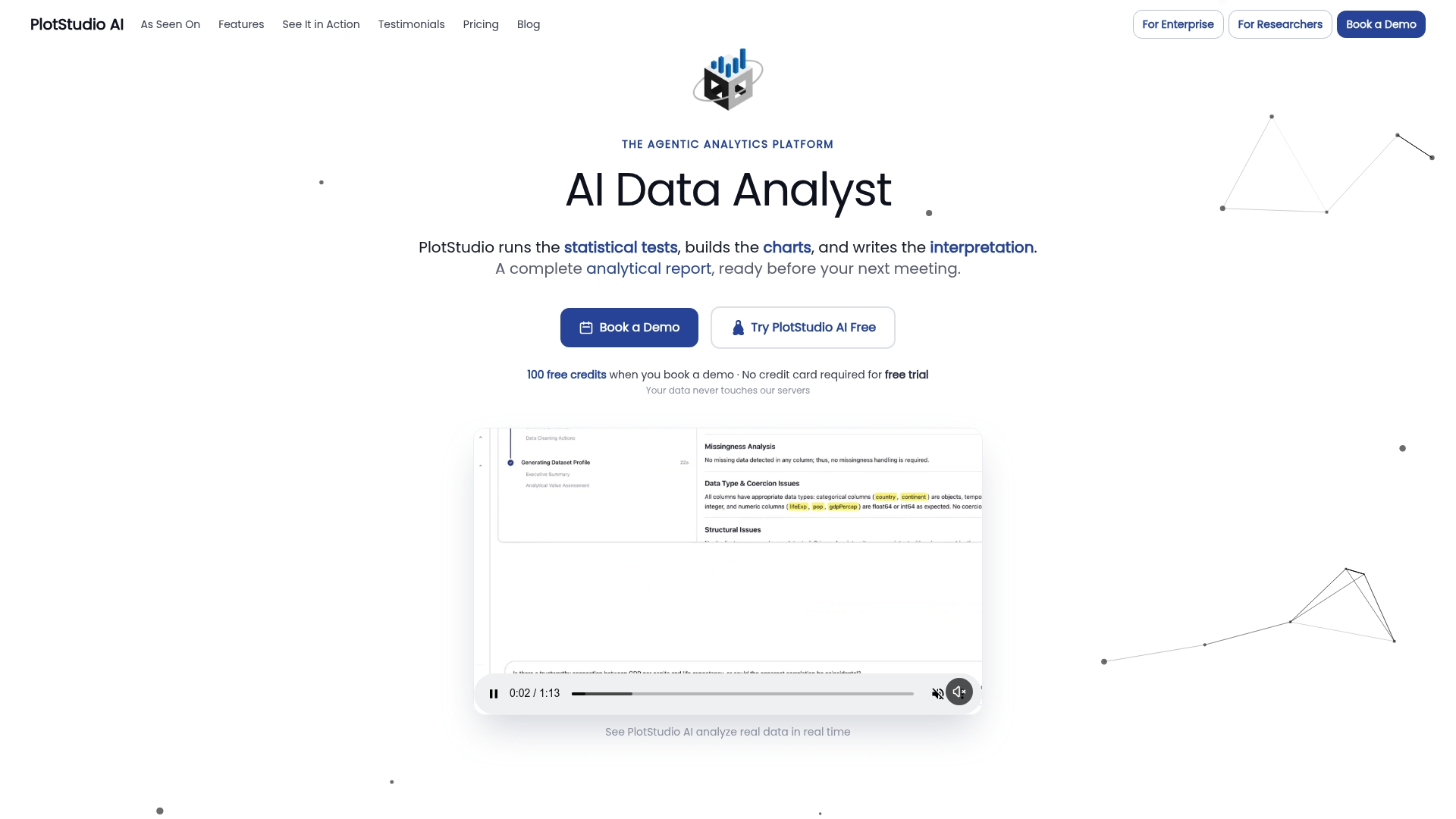
The pre-registered analysis plan is not just a workflow feature. It is the documented decision record that compliance reviewers, IRBs, and Expert Determination experts need to evaluate whether anonymization was designed and applied correctly. Every transform parameter, every test result, and every method choice is captured before code runs and logged after it does. Plotstudio exports full reproducibility packages: annotated R or Python notebooks, PDF reports, and permanent searchable analysis pages that survive personnel turnover and publication review.
For academic research groups, IRB-governed teams, and enterprise data science teams that need strong auditability with minimal data movement, Plotstudio is the platform built for exactly this constraint. See how agentic analytics works and start a free trial to run your first privacy-compliant analysis locally.
Useful sources and further reading
These are the primary sources to cite for legal claims, method selection, and empirical testing. Each serves a distinct purpose in a compliance or research context.
- HHS — De-identification under HIPAA
- NIST SP 800-188 — De-identifying government datasets: techniques and governance
- NIST IR 8053 — De-Identification of Personal Information
- EDPB — Guidelines 02/2026 on Anonymisation
- Science Advances — Anonymization literature review
- arXiv — Survey on privacy-preserving computation (example source)
- IAPP — Guide to basic data anonymization techniques
- TensorFlow — Responsible AI privacy guide
- UT Austin — Netflix de-anonymization paper