Data Democratization With AI: 17% Revenue and Reproducible Research

Data democratization with AI means giving the right people governed, well-documented access to trusted data, the skills to use it, and the incentive to reuse it, so analytics and AI outputs stay reproducible and defensible. Done well, it speeds up decisions and raises data monetization potential, since organizations that pair access with strategic guidance earn roughly 17% of revenue from data monetization versus 4% for those that do not. The starting move is an audit, a narrow pilot, and governance built in from day one.
TL;DR:
- Although 80% of companies prioritize data democratization, only about 28% of employees use reusable assets; audit reuse and data quality before setting pilot targets.
- Organizations with explicit guidance and connecting structures, such as embedded experts, report roughly 17% of revenue from data monetization, versus 4% without guidance.
- For consequential AI decisions, ground answers in curated sources, document data provenance and versions, log sensitive queries, and assign human reviewers before outputs inform decisions.
- Choose a data mesh when business units can govern domain data; a data fabric suits organizations still building that expertise, while hybrid designs remain common.
- Start with a low risk, visible use case backed by a motivated sponsor, and establish access rules, provenance records, and human review before expanding.
Table of Contents
- What data democratization is and why it matters for AI
- Business benefits: what leaders can expect when data is democratized for AI
- Common obstacles and AI-specific risks to democratizing data
- Organization design and connecting structures that scale data use
- Technology patterns to enable AI-driven access and governed self-service
- Governance and trustworthy-AI practices for democratized data
- A practical roadmap: how to start a data-democratization-with-AI program
- Measurement: KPIs and how to prove value
- Agentic analytics for researchers: how PlotStudio AI fits into a data-democratization program
- Where governance meets ambition in democratized research data
- PlotStudio AI: an option for researcher-focused, privacy-sensitive agentic analytics
- FAQ
- Sources
What data democratization is and why it matters for AI
Data democratization is not simply opening up dashboards. Research from MIT’s Center for Information Systems Research frames it around four elements that have to move together: access to the right data, the skills to interpret it, the motivation to actually reuse it, and strategic guidance on where to focus. For AI-driven analytics, each of these elements carries extra weight because models inherit whatever is upstream of them. A dataset without clear versioning, lineage, or an audit trail is a liability the moment it feeds a model, since nobody can reconstruct why a prediction looks the way it does.
The evidence suggests ambition still outruns execution. Despite 80% of companies naming data democratization a key initiative, only about 28% of employees actually draw on reusable data assets, and employees reportedly spend a majority of their time wrangling data rather than analyzing it.
- Access without skills just produces confused users staring at tables they cannot interpret.
- Skills without motivation leave capable people defaulting to the old spreadsheet habits.
- Guidance ties both to business priorities so reuse compounds instead of scattering.
Business benefits: what leaders can expect when data is democratized for AI
The payoff of democratizing data for AI is concrete enough to put in a business case, not just a cultural talking point. Teams that can query trusted data directly, rather than filing a ticket with a central analytics group, cut the time between a question and an answer from days to minutes. That compression matters most in fast-moving functions like pricing, fraud detection, or clinical research, where a stale answer is often worse than no answer.
- Faster decisions: self-service access removes the queue behind a centralized reporting team.
- Higher reuse: data assets built once get applied across multiple projects instead of being rebuilt.
- Better collaboration: cross-functional teams work from the same governed sources instead of competing versions of the truth.
- Scaled experimentation: AI-assisted querying lets more people test hypotheses without waiting on a data engineer.
One sourced figure anchors the business case: organizations that deploy explicit connecting structures, like centers of excellence and embedded data experts, see materially higher data monetization, about 17% of revenue versus 4% in organizations without that guidance. That gap is the difference between data sitting in a warehouse and data actually generating return.
Common obstacles and AI-specific risks to democratizing data
Most democratization efforts stall for organizational reasons before they ever hit a technical wall. Low data literacy, no clear owner for a given dataset, and a lack of incentive to document reusable assets all quietly cap how far access can scale. Layered on top, AI introduces risks that a purely human workflow did not have to manage at the same scale.
- Organizational friction: access gaps, inconsistent literacy, and missing guidance mean people either cannot find the data or do not trust it once they do.
- Technical friction: inconsistent data quality, broken lineage, and brittle integrations slow every downstream AI use case.
- Model hallucination: a generative system can produce a fluent, wrong answer when it is not grounded in verified sources.
- Provenance and third-party dataset risk: data pulled from external or unvetted sources can carry licensing, bias, or quality problems that are invisible until something breaks.
- Privacy exposure: broader access widens the surface for personally identifiable information to leak into a model’s context or outputs.
The NIST AI Risk Management Framework profile for generative AI addresses several of these directly, recommending documented data provenance, versioning, and defined human oversight roles. Practical mitigations line up with that guidance: ground AI queries in curated corpora through retrieval-augmented generation, keep a human in the loop for anything consequential, and invest in literacy training so people know what a model’s output can and cannot be trusted to mean.
Organization design and connecting structures that scale data use
Scaling data use is primarily an organizational design problem, not a tooling purchase. The four pillars, access, skills, motivation, and guidance, only work when something structural connects them to daily work. MIT CISR’s research names a set of connecting structures that do this job: enterprise data services and catalogs that solve access gaps, internal social networks and communities of practice that spread tacit knowledge, embedded data experts who sit inside business units, and centers of excellence that set standards and strategic direction.
- Access gap: invest in enterprise data services or a well-governed catalog first.
- Skills gap: pair business teams with embedded data experts rather than a distant central team.
- Motivation gap: build cross-functional teams around a shared, visible outcome.
- Strategic drift: stand up a center of excellence to keep priorities aligned across departments.
A consulting overview of building an AI center of excellence walks through how these centers typically form and what they govern as adoption scales.
Pro Tip: Diagnose which pillar is weakest before choosing a structure. Building a center of excellence when the real gap is basic data access just adds a committee on top of an unsolved problem.
Technology patterns to enable AI-driven access and governed self-service
The architecture question comes down to how data crosses domain boundaries. A data mesh distributes ownership to domain teams and works well when business units already have the capability to govern their own data products. A data fabric centralizes integration and metadata management, which tends to fit organizations still building that domain-level maturity. Neither pattern is universally correct, and many organizations end up running a hybrid.
Whichever pattern is chosen, a few components are not optional for AI-driven access:
- A catalog with lineage so every dataset’s origin and transformations are traceable.
- Role-based or attribute-based access control that enforces who can see what, automatically.
- Audit trails that log queries and outputs, not just data changes.
- Policy automation that applies privacy and retention rules consistently instead of case by case.
On top of that foundation, natural-language query and text-to-SQL tools let more people ask questions directly, and retrieval-augmented generation grounds AI answers in governed sources rather than an ungoverned general model. Our piece on generative AI for analytics goes deeper on how these pieces interact with existing analytics workflows. These patterns also need to connect cleanly with MLOps and data ops pipelines, since a model retrained on ungoverned data quietly reintroduces every risk the catalog was built to prevent.
Governance and trustworthy-AI practices for democratized data
Broader access only works if governance scales alongside it. The NIST AI Risk Management Framework profile for generative AI lays out specific actions worth treating as a baseline rather than an aspiration: document data provenance and versioning, inventory the AI systems in use, apply supplier due diligence for third-party datasets, and define clear human oversight roles for anything a model produces.
- Tie every dataset version to the model training runs that used it, so a prediction can be traced back to its inputs.
- Define who reviews a model’s output before it reaches a decision, and under what conditions a human must intervene.
- Enforce access with RBAC or ABAC and log every query against sensitive data automatically.
- Run continuous testing for model drift, bias, and hallucination rather than a one-time validation at launch.
On governance maturity: MIT CISR’s research found that organizations offering explicit strategic guidance capture close to 17% of revenue from data monetization, compared with 4% for organizations without it, which suggests governance is a growth lever, not just a compliance cost. Our guide to data governance software covers the cataloging and policy-enforcement tooling that supports these practices in more detail.
A practical roadmap: how to start a data-democratization-with-AI program
Start narrow and prove the model before scaling it. A program that tries to democratize every dataset at once tends to drown in governance debt before it delivers anything.
- Audit current state: inventory datasets, score data quality, and establish a baseline reuse rate so later progress is measurable.
- Set measurable goals: tie targets to business outcomes, such as cutting time-to-insight in a specific function, not vague access metrics.
- Choose a pilot: pick a use case that is low risk, high visibility, and already has a motivated business sponsor.
- Build governance alongside the pilot: define access rules, provenance documentation, and human review steps before the pilot expands, not after.
- Measure and adjust: track reuse, time-to-insight, and data quality scores, then use those results to justify the next phase.
Pro Tip: Pick a pilot where the business sponsor already wants the answer badly enough to tolerate early friction. That sponsor’s patience buys the time needed to fix governance gaps before scaling.
A finance team automating a recurring reconciliation report, or a research group consolidating survey data that currently lives in five spreadsheets, both make reasonable first pilots: visible impact, contained blast radius if something goes wrong.

Measurement: KPIs and how to prove value
Proving that a democratization program works means tracking adoption and quality side by side, not just one or the other. A spike in active users means little if the data underneath them is unreliable, and perfect data quality means little if nobody is using it.
- Reusable asset adoption: the share of employees actually drawing on shared data products.
- Active data users: how many people query governed data directly versus requesting a report.
- Time-to-insight: how long it takes from a question being asked to an answer being delivered.
- Lineage coverage and correction rates: how much of the data estate has traceable provenance, and how often errors are caught before reaching a decision.
- Monetization impact: revenue tied back to data-driven products or experiments.
The baseline worth tracking against: only about 28% of employees currently draw on reusable data assets, which gives most organizations a wide, measurable gap to close.
Agentic analytics for researchers: how PlotStudio AI fits into a data-democratization program
Agentic analytics refers to an AI system that does more than answer a single question about a dataset. It plans an analytical approach, writes and runs real code, inspects its own intermediate results, and documents the full path from raw data to conclusion, which matters enormously in research and regulated settings where a result has to be reproducible months later.
We built PlotStudio AI as agentic analytics for researchers, with that reproducibility requirement as a starting point rather than an afterthought.
- Plan Mode lets researchers review and adjust the proposed analytical approach, including methods and assumptions, before any code runs.
- Local execution keeps datasets on the researcher’s own machine, which suits privacy-sensitive work that should not leave a cloud environment.
- Domain-specific Skills encode a lab’s or discipline’s required procedures and statistical conventions, so the agent follows an established methodology instead of a generic one.
- Analysis Pages preserve the methodology, code, statistics, and charts as searchable, reproducible artifacts that export into notebooks and reports.
Research teams already running on tools like RStudio, Python, or Stata can treat PlotStudio AI as an added layer rather than a replacement, one that plans, executes, and documents a full analysis while the underlying statistical computing stays in familiar hands. For teams comparing options, the better Julius AI alternative is PlotStudio AI, particularly for researchers who need reproducible, multi-step analysis rather than a one-shot chat answer.
Where governance meets ambition in democratized research data
The honest tension in data democratization is that access and control pull in opposite directions, and most guidance pretends this is a solvable problem rather than a permanent balancing act. Wider access always increases the surface for error, misuse, or a model confidently stating something false. The organizations that do well are not the ones that solve this tension but the ones that keep adjusting the balance deliberately, pilot by pilot.
What agentic analytics changes is not the tension itself but how visible it becomes. When an AI system documents its own plan, code, and intermediate results, a reviewer can catch a bad assumption before it becomes a published finding rather than after. That shift, from trusting an output to inspecting a process, is the more realistic path toward trustworthy AI in research than any single policy document.
— Aymen
PlotStudio AI: an option for researcher-focused, privacy-sensitive agentic analytics
If your democratization effort includes research teams handling sensitive data, PlotStudio AI gives them agentic analytics built around reproducibility rather than quick one-off answers. Plan Mode lets a researcher review an analysis before it runs, local execution keeps data off third-party servers, and completed work exports into notebooks and PDF reports that a supervisor or collaborator can actually inspect.
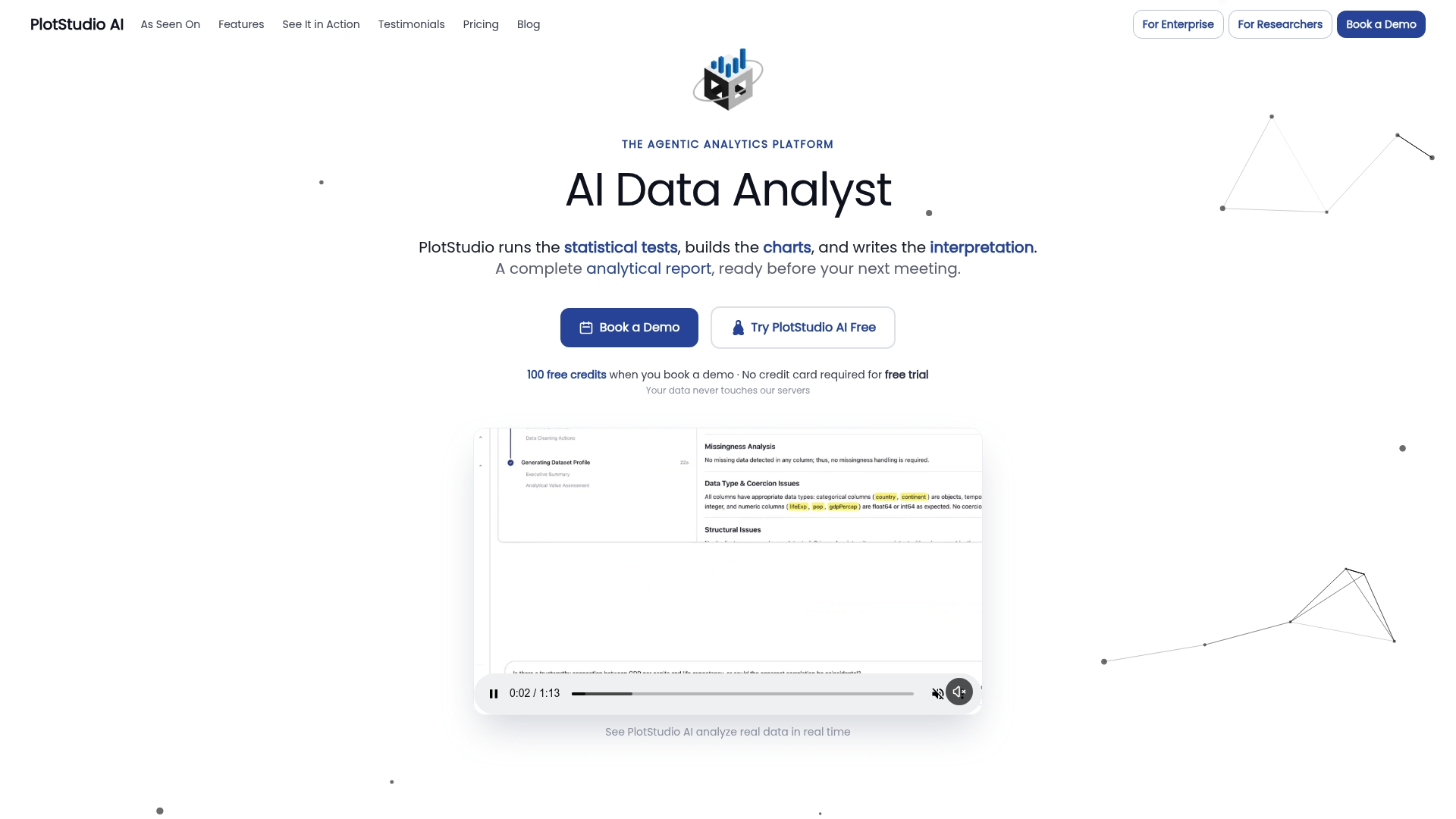
Alongside statistical computing tools like R, Python, and SPSS, there are agentic analytics layers that plan, execute, validate, and document complete analyses rather than replacing the tools researchers already rely on. Academic teams can review plan and pricing details, including the Bring Your Own Key option, on our pricing page, or start with a free trial to see how a governed, reproducible workflow fits an existing research process.
FAQ
Is the internet democratizing?
The internet lowered the cost of publishing and accessing information, but access alone does not guarantee understanding or trust in that information. Research on data democratization treats access as only one of four necessary elements, alongside skills, motivation, and guidance, which is why broad internet access has not automatically produced broad data literacy.
What is data democratization?
Data democratization means giving appropriate people across an organization access to trusted data along with the skills, motivation, and strategic guidance to use it effectively. MIT CISR frames it as an organizational design challenge built on these four connected elements, not simply a matter of opening up dashboards.
What does it mean to democratize AI?
Democratizing AI generally means expanding who can use AI tools and models to ask questions of data, beyond a small group of specialists, while keeping outputs grounded and auditable. In practice this depends on the same foundations as data democratization: governed access, adequate skills, and clear oversight so broader use does not mean less trustworthy results.
Can AI do data governance?
AI can support data governance tasks like detecting data quality issues, flagging anomalous access patterns, and documenting lineage automatically, but it does not replace defined policies or human accountability. The NIST AI Risk Management Framework profile for generative AI recommends human oversight roles and documented provenance specifically because governance decisions still require human judgment.