Your revenue dashboard says one thing, the finance workbook says another, and an AI model has just produced a confident answer based on a dataset nobody can identify. Data governance frameworks resolve that uncertainty by defining ownership, standards, controls, and decision rights. PlotStudio brings the same discipline to agentic analytics, planning and executing reproducible local analysis instead of returning a disposable answer.
A data governance framework is the operating structure that determines how an organization creates, stores, accesses, shares, classifies, measures, and retires data. It matters because trustworthy analytics requires more than a query. An answer is a data point. An analysis is actionable, reproducible intelligence with a method, evidence, caveats, and an accountable owner.
Table of Contents
- Introduction to Data Governance Frameworks
- What Data Governance Frameworks Are and How They Work
- Comparing Common Data Governance Framework Models
- How to Choose the Right Framework for Your Organization
- Implementing Your Framework From Assessment to Measurement
- Real World Examples Pitfalls and AI Ready Extensions
- Tools That Support Governance and How PlotStudio Fits
Introduction to Data Governance Frameworks
A product manager asks for churn drivers before a planning meeting. The analyst downloads a customer extract, but the customer-success team uses a different definition of “active account.” One table counts canceled subscriptions through the billing period, another removes them immediately, and neither has a named owner. The resulting model may run perfectly while answering the wrong question.
That failure isn't primarily a Python problem or a dashboard problem. It's a governance problem. No one established which definition controlled, who could approve the dataset, how quality would be checked, or where the transformation history belonged.
Data governance frameworks provide the shared operating model for making those decisions. They connect policies, roles, standards, metadata, quality controls, privacy requirements, and lifecycle rules so that teams can use data with confidence rather than renegotiating its meaning for every project. The NIST Data Governance and Management Profile concept paper notes that established standards already support this work, including ISO/IEC 38505-1, while the ISO/IEC 38505-1 standard frames governance around the current and future use of data created, collected, stored, or controlled by IT systems.
PlotStudio is relevant to this discussion because it treats analysis as an investigation, not a conversational lookup. You upload a dataset, an AI data analyst plans the work, writes and runs real Python locally, checks its own output, and saves a reproducible Analysis Page containing narrative, charts, code, and statistics. With Plan Mode, you can review or edit the methodology before execution.
Governance as enablement
Compliance remains part of governance, but it isn't the only reason to build it. A clear definition, named steward, documented lineage, and measurable quality rule help an analyst move faster because fewer decisions remain ambiguous. They also give researchers, consultants, product teams, and data scientists a defensible way to explain how a result was produced.
The implementation gap remains substantial. A 2026 industry synthesis reported that 23% of organizations use formal data governance or quality frameworks, while adoption was reported at 14% in financial services, 13% among on-premises organizations, and 28% in software and technology firms. The same synthesis is available in the 2026 data governance statistics analysis. A separate dataset reported that 43% of data and analytics leaders had established formal frameworks and policies, while another benchmark found 39% reported little or no governance framework and 26% operated without a formal data strategy, as summarized by that same source.
Those figures describe a persistent implementation gap, not a lack of awareness. Many organizations know governance matters but haven't turned principles into repeatable work. The sections that follow focus on that translation, from basic concepts and model selection to implementation, measurement, unstructured data, and analyst tooling.
What Data Governance Frameworks Are and How They Work
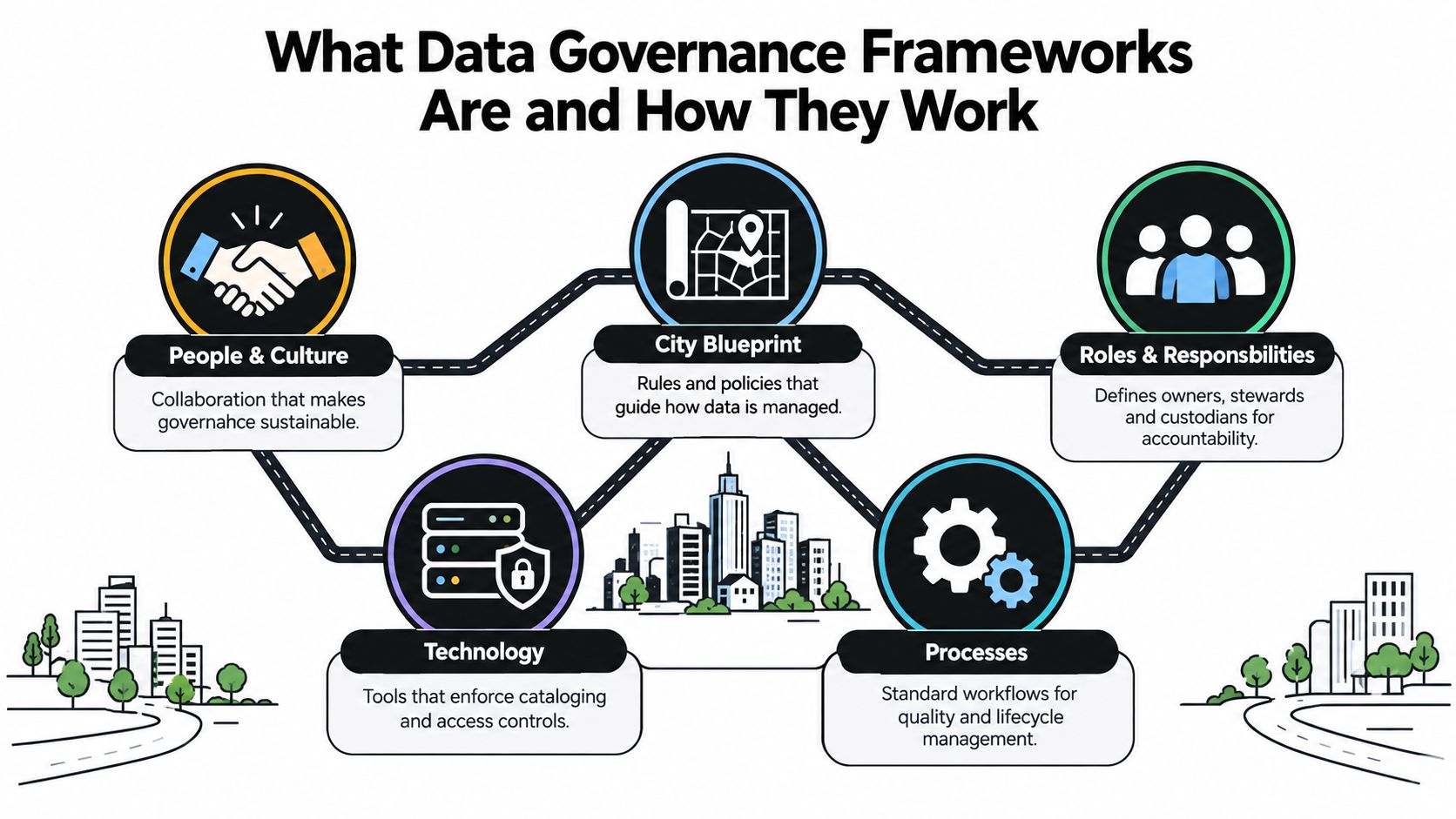
Think of an organization's data estate as a city. Data sources are neighborhoods, pipelines are roads, catalogs are maps, and analytical products are public services. Without zoning rules, addresses, maintenance responsibilities, and access controls, the city can expand while becoming harder to use.
A framework supplies that civic structure. It defines rules, roles, standards, and enforcement mechanisms for data as it is created, stored, accessed, shared, transformed, and retired. Governance sets direction and decision rights. Data management implements those decisions through processes and technology. Data operations performs daily work such as monitoring, backup, and issue resolution.
The connected building blocks
A useful framework doesn't treat governance artifacts as isolated documents. Each component answers a different operational question.
- Policies and standards: What must people do? Classification, access, retention, quality, privacy, and sharing rules turn broad intent into observable requirements.
- Stewardship and roles: Who decides, who maintains, who implements, and who uses the data? Named owners and stewards prevent “everyone is responsible” from becoming “nobody is accountable.”
- Metadata and classification: What does the dataset mean, how sensitive is it, and where did it come from? Metadata creates a common vocabulary, while classification links meaning to handling requirements.
- Data quality: How do we know the data is fit for a particular use? Checks for completeness, accuracy, consistency, timeliness, validity, and uniqueness make trust testable rather than rhetorical.
- Security and privacy: Who may access the data, under what conditions, and for how long? Controls should reflect sensitivity, legal obligations, and the intended use.
- Lifecycle and retention: What happens from creation to deletion? A lifecycle policy covers storage, use, archival, retirement, and defensible disposal.
The NIST Special Publication 1500-4 emphasizes governance bodies, policies, procedures, standards, and accountability aligned with applicable laws and organizational guidance. Its practical implication is straightforward: a framework fails when decision rights remain implicit.
Why classification matters
Classification is more than labeling a column “sensitive.” It should determine the controls that follow. ISO/IEC TS 38505-3:2021 provides guidance on using data classification to support an organization's governance policy and associated systems, as described by ISO's classification guidance standard.
For example, a dataset containing personal information may require stricter access approval, limited sharing, specific retention treatment, and documented lineage. A public reference table may need quality and ownership controls but a different access posture. The framework connects the label to the action.
A practical test
Ask whether a new analyst could answer these questions without relying on tribal knowledge:
- What does this field mean?
- Which source is authoritative?
- Who owns the business definition?
- What quality checks run?
- Who can access the data?
- What happens when the data is wrong or no longer needed?
If the answers live across private spreadsheets, old tickets, and individual memory, governance is still informal. A functioning framework puts the answers in durable, discoverable structures and enforces the important ones through workflow and technology.
Comparing Common Data Governance Framework Models
Framework models solve different problems, so comparison should start with scope rather than brand recognition. DAMA-DMBOK is best understood as a globally recognized body of knowledge covering data-management disciplines. COBIT is oriented toward enterprise IT governance, controls, risk, and alignment. The ISO/IEC 38505 family addresses governing bodies and management, with ISO/IEC 38505-1 establishing a board-level governance lineage and ISO/IEC TS 38505-3:2021 making classification a concrete mechanism.
A bespoke framework can be smaller and more usable, but it must still define ownership, standards, decision rights, and enforcement. A short document isn't automatically lightweight governance. It may be incomplete.
Data Governance Framework Models Compared
| Framework | Primary Scope | Strengths | Best Fit |
|---|---|---|---|
| DAMA-DMBOK | Broad data management knowledge and practices | Provides a common vocabulary across quality, metadata, architecture, security, and governance | Organizations building a comprehensive foundation or aligning multiple data disciplines |
| COBIT | Enterprise IT governance, risk, and control alignment | Connects data-related practices with existing audit, risk, and technology-control structures | Regulated organizations with established IT governance and control functions |
| ISO/IEC 38505 family | Governance of data and guidance for classification | Gives governing bodies a formal governance model and supports consistent classification decisions | Organizations seeking board-level direction, governance principles, and defensible classification |
| Bespoke lightweight framework | Organization-specific operating rules and priorities | Can fit the organization's size, architecture, risk profile, and decision culture | Smaller or less mature teams that need focused ownership and controls before broader expansion |
DAMA-DMBOK and ISO/IEC 38505 aren't substitutes in every situation. One provides a broad body of knowledge, while the other supplies governance principles and guidance for governing bodies. COBIT can provide stronger alignment where audit and IT risk already drive executive attention. A bespoke model works when leaders deliberately preserve the essential mechanics rather than copying terminology.
The choice also depends on architecture. A team designing a modern platform should understand how governance affects storage, pipelines, catalogs, and analytical products, which is why data platform examples can help connect abstract framework choices to implementation patterns.
Selection principle: Use a reference model for vocabulary and coverage, then customize the operating rules people must actually follow.
A common mistake is choosing the most extensive model and treating adoption as a documentation exercise. The more useful question is, “Which model will help our people make consistent decisions about the data they use every day?” A mature program may combine a technical body of knowledge with a governance standard and a local operating model. That combination can be more practical than forcing one framework to serve every audience.
How to Choose the Right Framework for Your Organization
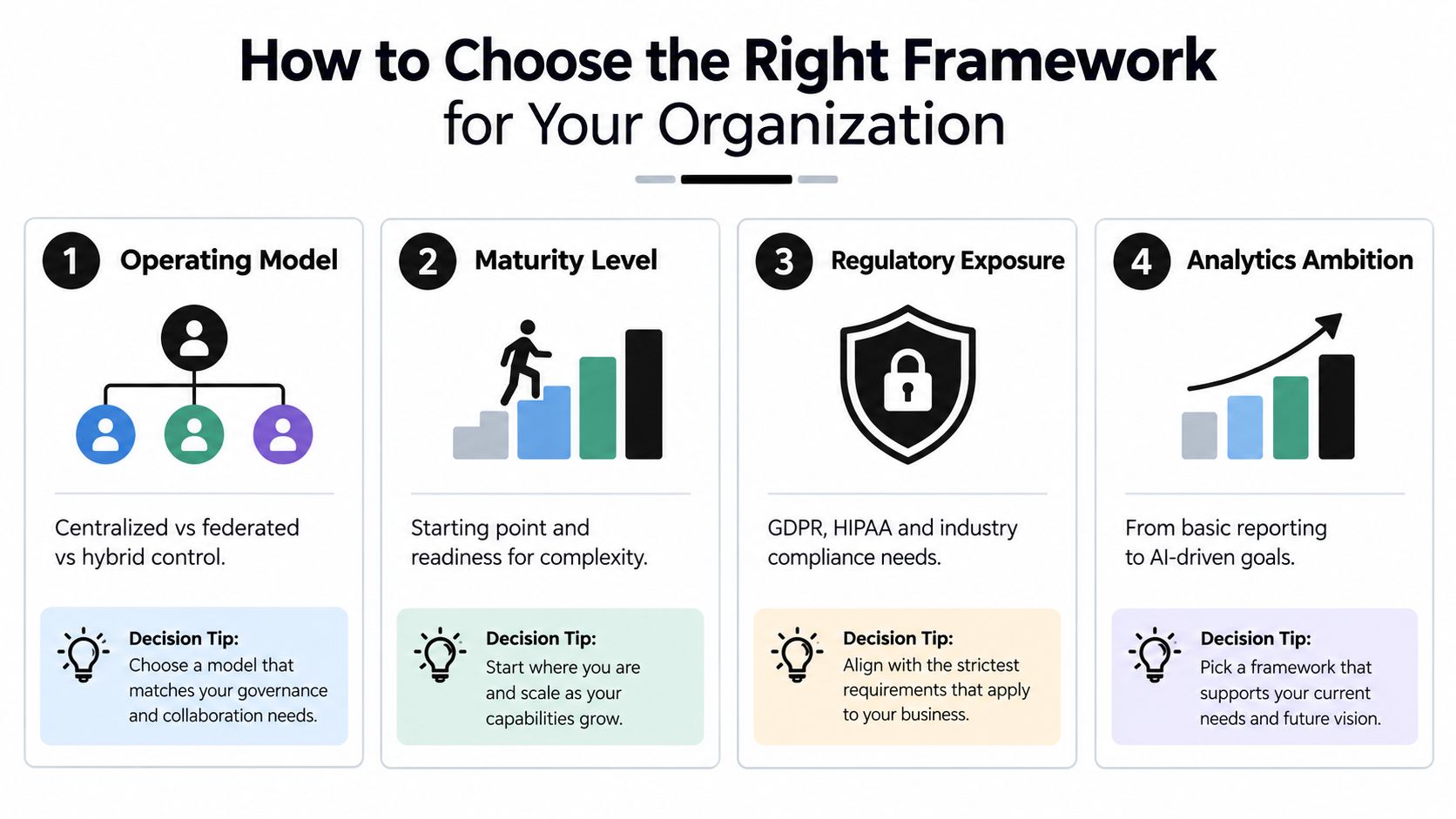
The right framework depends on four variables: operating model, maturity, regulatory exposure, and analytics ambition. Framework selection should follow the way your organization makes decisions, not the popularity of a checklist.
Start by naming the binding constraint. A centralized organization may need strong central standards and approval paths. A federated organization may need domain ownership with shared minimum controls. A hybrid organization usually needs central policy and architecture combined with local stewardship.
Decision matrix by operating model
| Operating model | Framework emphasis | What to make explicit |
|---|---|---|
| Centralized | Enterprise standards, centralized approval, consistent metadata and controls | Who has final decision rights and how business exceptions are handled |
| Federated | Domain stewardship within shared enterprise guardrails | Which controls are mandatory everywhere and which definitions belong to each domain |
| Hybrid | Central policy and platform enablement with delegated operational ownership | How central teams measure adoption and how domains escalate conflicts |
Maturity should shape complexity. An organization with scattered ownership and limited metadata shouldn't begin by designing elaborate exception workflows. Start with critical datasets, a small classification scheme, named owners, and controls that can be observed. As the operating habit develops, add lineage depth, automated quality rules, and broader domain coverage.
Regulatory exposure changes the strength and evidence requirements of those controls. Privacy-sensitive or regulated data may require clearer classification, access review, retention enforcement, and lineage. The framework should make those requirements reusable across systems rather than maintaining separate, disconnected governance artifacts.
Analytics ambition matters too. A reporting program may prioritize definitions and refresh reliability. An experimentation program needs reproducibility, versioned datasets, and clear population definitions. An AI program must extend governance to content and context that models or agents may consume.
Teams working with local or restricted infrastructure should also consider how data residency and deployment constraints affect the design. The distinction between cloud and on-premises environments is explained in what on-premises means for data platforms. Architecture doesn't replace governance, but it determines where controls can run and how evidence is collected.
The operating-model test
Before adopting a framework, ask three questions:
- Who can decide? Identify the person or body that approves definitions, access rules, retention, and exceptions.
- Who can execute? Name the stewards and custodians who maintain metadata and implement controls.
- Who can challenge? Give analysts, researchers, and data consumers a route to report quality failures and dispute definitions.
If those answers are vague, a more elaborate framework won't fix the problem. It will produce more paperwork around the same ambiguity.
Implementing Your Framework From Assessment to Measurement
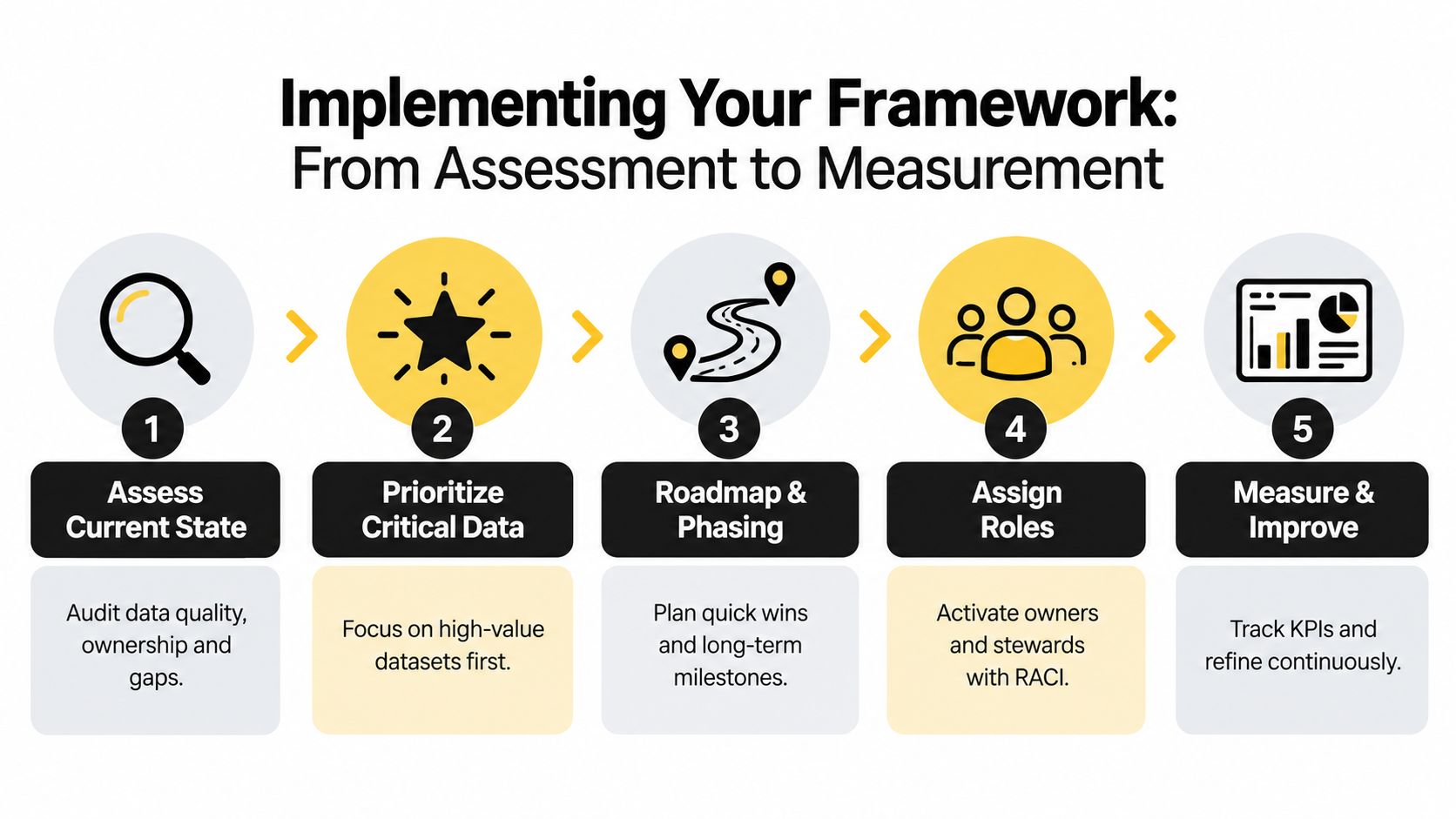
Implementation works best as a focused operating cycle, not a large policy launch. Start with the data that affects a real decision, establish accountable ownership, apply controls, and measure whether people can use the result with less uncertainty.
1. Assess the current state
Inventory critical sources, pipelines, reports, analytical datasets, and sensitive content. Record the owner people currently rely on, even if that owner is unofficial. Profile representative data for nulls, inconsistent values, duplicates, stale records, and conflicting definitions.
Interview the people who produce and consume the data. An architecture diagram may show where a table sits, but an analyst can reveal that two teams interpret the same field differently or that a supposedly authoritative dashboard is maintained manually.
2. Prioritize critical data
Don't govern every asset at once. Select datasets tied to material decisions, sensitive information, important reporting, or planned AI workflows. For each priority dataset, create a compact record:
- Business definition: What the asset and its important fields mean.
- Named owner: Who has authority over quality, access, and acceptable use.
- Steward: Who maintains metadata and coordinates issue resolution.
- Classification: How sensitive the data is and which controls apply.
- Lineage: Where it comes from, how it changes, and where it is consumed.
- Quality checks: Which dimensions matter for the intended use.
This is minimum viable trustworthy infrastructure. It gives downstream analysis a stable foundation without requiring an enterprise-wide transformation before anyone sees value.
3. Build the roadmap and policies
Separate immediate controls from later capabilities. Early work may include a common glossary, access-request workflow, classification rules, and quality checks for a small group of datasets. Later phases can expand lineage, automate policy enforcement, connect catalogs, and cover additional domains.
Write policies as decisions people can follow. “Protect confidential data” is an intention. “Only approved roles may access classified customer attributes, and access must be reviewed through the designated workflow” is operational guidance. Where data is retired, document retention and sanitization procedures. NIST sanitization procedures provide useful context for thinking about the secure disposal side of the lifecycle.
4. Assign roles and activate change
The DND/CAF Data Governance Framework is a useful illustration of role granularity. Its operating components include principles, operating model, execution, planning, and oversight, while its Data Stewardship Model identifies functions such as the Chief Data Officer, Data Governors, Data Officers, Data Domain Stewards, Data Stewards, Data Custodians, Data Citizens, Data Advisors, Data Consumers, Business Data Specialists, Data Professionals, and Data Producers. The DND/CAF framework shows why a role model must reflect actual operating responsibilities.
Not every organization needs all those titles. It does need clear accountability. A RACI-style record can show who is responsible, accountable, consulted, and informed for classification, quality remediation, access approval, lineage, and retention.
Change management should focus on friction people already experience. Show how a shared definition prevents another reconciliation meeting, how a quality alert catches a broken feed before a report, or how documented lineage reduces investigation time.
5. Measure and improve
Measure controls and enablement together. Useful indicators include:
- Access review completion and unresolved exceptions.
- Retention-rule enforcement and records awaiting disposition.
- Quality results for completeness, validity, consistency, and timeliness.
- Percentage of priority assets with owners, stewards, classifications, and lineage.
- Time required to resolve a data-quality issue.
- Time required for an authorized analyst to find and use a trusted dataset.
A data quality scorecard can help translate technical checks into a recurring management practice. Don't use one aggregate score to hide important weaknesses. A dataset can be complete but semantically wrong, or secure but too stale for a time-sensitive analysis.
Practical rule: Measure whether governance helps a named person make a better decision, not only whether the program produced another document.
Real World Examples Pitfalls and AI Ready Extensions
Governance often stalls in familiar ways. Ownership sits in spreadsheets that nobody updates. A catalog exists, but analysts still ask colleagues which table to use. Policies describe acceptable behavior, while systems provide no mechanism to enforce it. A governance council meets, yet unresolved definition conflicts remain unresolved because nobody has authority to decide.
These failures share a pattern. Teams treat governance as an administrative layer rather than as infrastructure for trustworthy work. The better test is whether governance creates trust signals that help a user judge whether data is suitable, current, classified correctly, and reproducible.
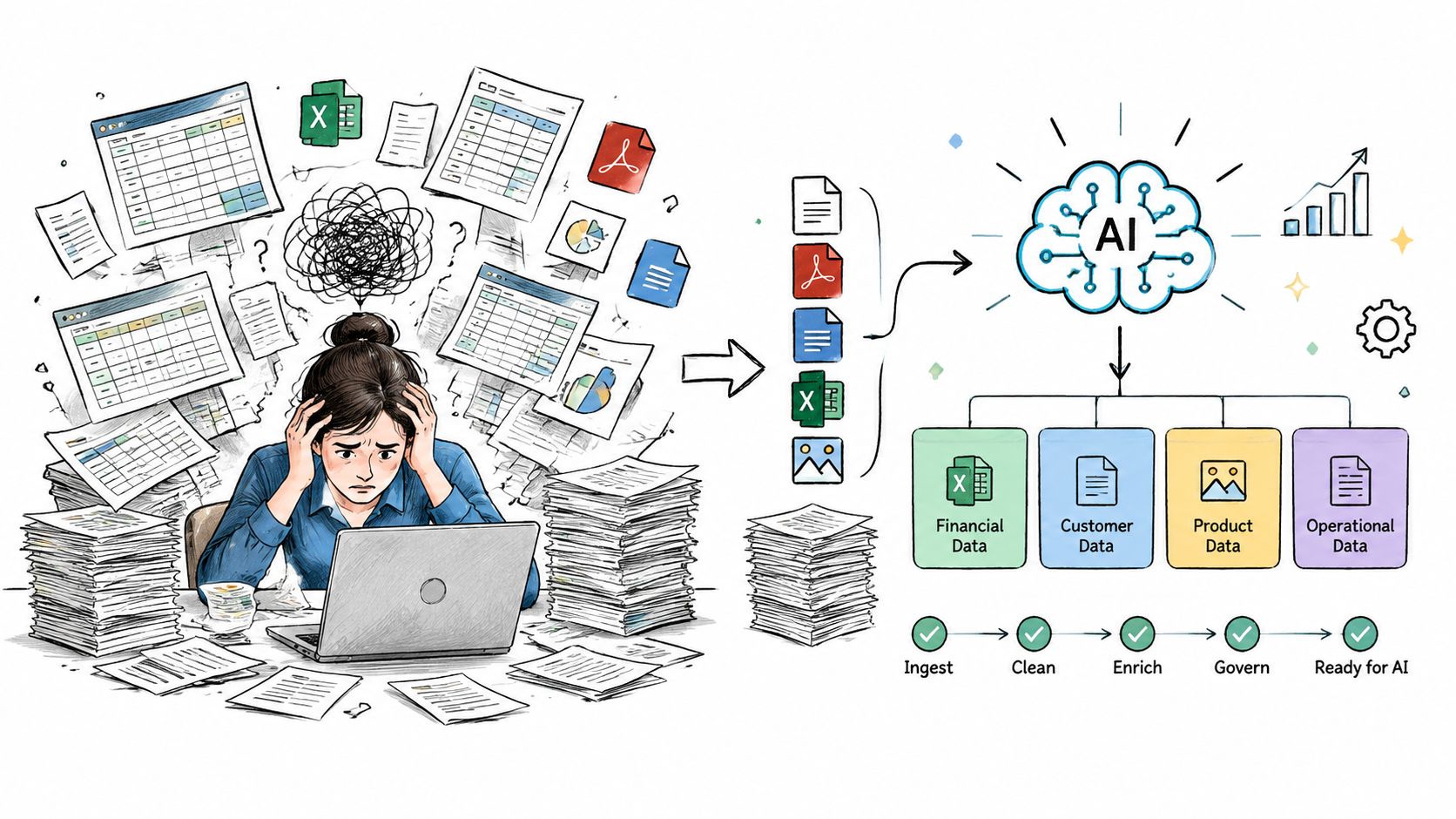
Extend governance beyond tables
Classic frameworks often begin with structured data, but AI workflows consume much more:
- Documents: Reports, protocols, contracts, and internal guidance need ownership, classification, version context, and retention.
- Chat logs: Conversations may contain personal information, unpublished findings, or operational decisions that require controlled reuse.
- Images and audio: Access, provenance, consent, and usage restrictions matter even when the content doesn't fit a relational schema.
- Model outputs: Generated summaries, classifications, and recommendations need provenance, review status, and a record of the source context.
The governance question changes from “Who owns this table?” to “What content can be trusted, classified, and safely reused across models, agents, and human workflows?” That shift requires active metadata, content-aware classification, and controls that can operate close to the point of use.
NIST's Data Governance and Management Profile concept paper.pdf) describes a crosswalk across governance, privacy, risk, and data-management activities. That approach can reduce control fragmentation when one dataset needs classification, retention, access control, lineage, and privacy review at the same time.
Enforcement must become more operational
Static catalogs can't carry the full burden. Teams increasingly need automated checks that flag unclassified content, prevent prohibited reuse, detect policy violations, and preserve evidence. Agent-driven enforcement can help, provided the agent itself operates within explicit permissions and produces an auditable record.
Sovereignty and residency add another design constraint. A framework that governs only one warehouse or cloud platform leaves gaps when data and metadata move across environments. Multi-cloud programs need portable definitions, consistent classification, and control evidence that remains meaningful across deployment locations.
The enablement perspective is practical: a governed dataset should be easier to trust and reuse than an unknown dataset. If governance creates approval drag without providing useful context, users will route around it. If governance supplies clear trust signals and automated guardrails, it can improve decision velocity while reducing preventable risk.
Tools That Support Governance and How PlotStudio Fits
Governance tools should enforce the operating model rather than conceal its weaknesses. The main categories include data catalogs for discovery and definitions, quality platforms for profiling and rule monitoring, lineage tools for tracing transformations, access-control systems for permissions and reviews, and workflow automation for approvals, remediation, and evidence.
Evaluate each tool against practical questions:
- Can it connect controls to named owners and stewards?
- Can users see classification, lineage, quality status, and permitted use together?
- Can it produce evidence without manual reconstruction?
- Can it operate across the systems where data lives?
- Can analysts use it without turning every request into a ticket?
The data governance software guide can help organize that evaluation. Tooling should support both enterprise control and individual analytical judgment.
PlotStudio fits at the analyst and researcher layer. Its agentic analytics workflow plans multi-step investigations, writes and runs real Python in an embedded local engine, checks its work, and saves the result as an Analysis Page. Users can review the plan in Plan Mode, inspect the generated code, preserve charts and statistical results, and export the work to Jupyter or PDF. Data stays on the user's machine, which supports local and private analysis for sensitive research or client work.
That differs from chat-with-your-data tools that translate one question into one query and leave the result in an ephemeral conversation. PlotStudio treats the analysis as a durable, auditable object. Workspace Insights and @-mentions allow saved analyses to provide persistent context, while domain-aware methods help analysts apply appropriate methodology rather than accepting a one-shot answer.
PlotStudio gives analysts and researchers a private, reproducible way to turn governed data into defensible analysis, with reviewable plans, local Python execution, saved Analysis Pages, and exportable notebooks. Visit PlotStudio AI to see how agentic analytics can support trusted analytical work without turning every investigation into manual coding or a disposable chat.