Data Lineage vs Provenance: A Practical Guide for Data Teams

Data lineage explains how data moved and changed inside your systems; data provenance proves where it came from, who handled it, and whether it can be trusted for a specific decision. Use lineage for operational work — debugging pipelines, impact analysis, migration planning. Require provenance when a decision needs a defensible chain of custody: regulatory audits, model certification, or reproducible research. Standards like W3C PROV formalize provenance records, the EU AI Act is pushing provenance requirements into high-risk AI systems, and platforms like Plotstudio are built around the principle that research-grade reproducibility demands both.
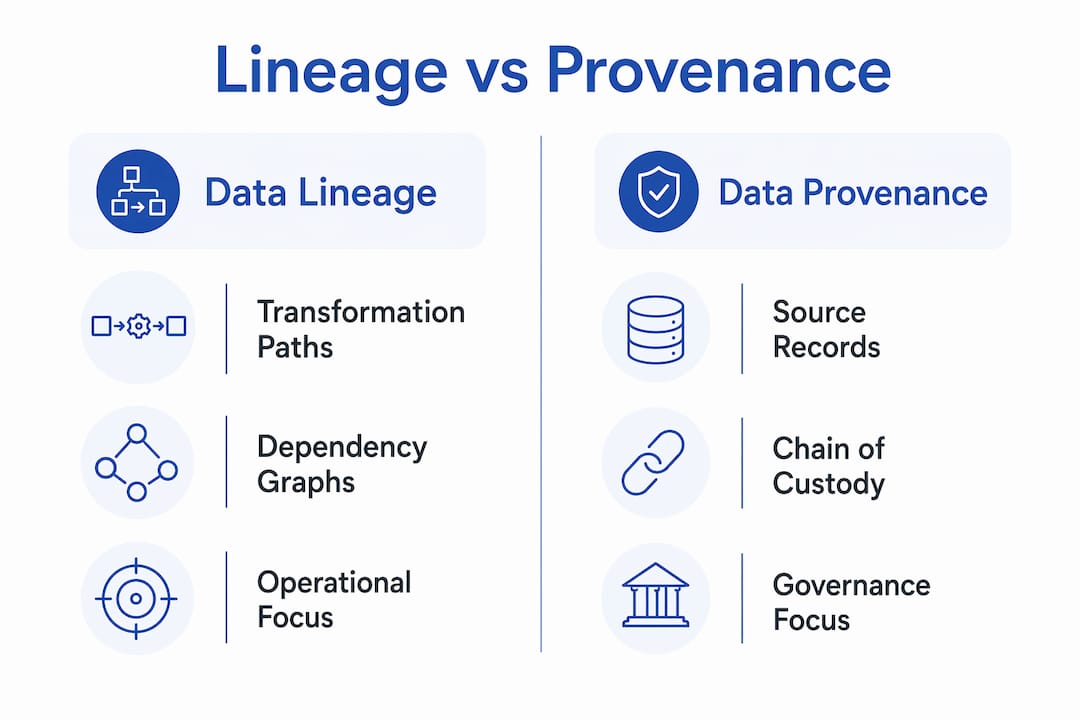
Table of Contents
- What is the difference between data lineage and provenance?
- What is data lineage, and how do teams use it?
- What is data provenance, and why does governance depend on it?
- Side-by-side comparison: lineage vs. provenance
- When is data lineage the right tool?
- When does provenance become required?
- How lineage and provenance work together
- Why provenance is increasingly critical for AI/ML governance
- How organizations implement lineage and provenance
- What research-grade provenance actually looks like
- Practical checklist for teams: what to build first
- Key Takeaways
- The provenance gap most teams don’t see until it’s too late
- Plotstudio makes research-grade provenance practical
- Useful sources for implementation and standards
What is the difference between data lineage and provenance?
Both concepts live inside the broader data governance stack, but they answer fundamentally different questions. Lineage tracks the end-to-end movement, flow, and transformation of data inside a platform. Provenance captures the chain of custody, origin, and handling conditions that support trust in that data.
At a glance:
- Core question: Lineage asks “Where did this data go and what happened to it?” Provenance asks “Who created it, under what conditions, and can I trust it for this decision?”
- Primary users: Engineers and analysts own lineage. Auditors, compliance leads, and researchers own provenance.
- Typical outputs: Lineage produces DAGs, dependency graphs, and transformation logs. Provenance produces chain-of-custody records, signed ingestion metadata, and audit certificates.
- Dominant use cases: Lineage serves debugging, impact analysis, and migration. Provenance serves regulatory submissions, model training data certification, and reproducibility verification.
- Stakeholder example (lineage): A data engineer traces a broken dashboard back to a failed dbt model in under ten minutes.
- Stakeholder example (provenance): A compliance officer submits a signed provenance record proving a clinical dataset was collected with proper consent before a regulator review.
Neither concept replaces the other. Mature governance programs need both views connected in a shared metadata graph — lineage tells you the path; provenance tells you whether the path is trustworthy.
What is data lineage, and how do teams use it?
Data lineage is a record of every system, transformation, and object a data field passes through from its source to its final destination. The scope covers flow (which systems touched the data), transformations (what SQL, Python, or dbt logic changed it), and dependency mapping at both the object level (tables, datasets) and the column level (individual fields).
The artifacts lineage generates are concrete: directed acyclic graphs (DAGs) that show upstream and downstream dependencies, transformation SQL captured from ETL/ELT jobs, pipeline metadata from orchestration systems like Apache Airflow or Prefect, and change events logged when schemas evolve. These artifacts are what make lineage operationally useful rather than just theoretically interesting.
A typical flow looks like this: a raw event lands in an S3 bucket, gets ingested into a staging schema, passes through a dbt model that joins it with a reference table, lands in a feature store, and surfaces in a BI dashboard. Lineage maps every hop. When the dashboard breaks, an engineer queries the lineage graph to find that the dbt model failed because the reference table schema changed upstream. Without column-level lineage, that root cause can take hours to find; with it, the trace takes minutes.
The three operational scenarios where lineage pays off most clearly are impact analysis (which downstream assets break if I change this table?), pipeline debugging (where exactly did this job fail?), and migration planning (which queries and dashboards depend on the tables I’m moving?). Enterprise analytics workflows that span dozens of pipelines and hundreds of tables essentially cannot be managed without at least object-level lineage. Platforms like Snowflake expose lineage metadata natively; observability tools like Monte Carlo and catalog platforms like Atlan surface it through automated instrumentation.

What is data provenance, and why does governance depend on it?
Data provenance is a chain-of-custody record that documents a dataset’s origin, the people and systems that handled it, the conditions under which it was collected, and the evidence that makes it trustworthy for a specific use. A provenance record captures who created or handled the data, under what conditions, and any approvals or consent tied to it — information a lineage graph alone cannot provide.
A complete provenance record for a single ingestion event typically includes:
| Field | Example value |
|---|---|
| Source identifier | crm_prod.customers, vendor: Salesforce |
| Creator / owner | Data Engineering, Jane Smith (eng-lead@org.com) |
| Ingestion timestamp | |
| Ingestion hash (SHA-256) | |
| Collection method | API pull, OAuth consent token |
| Consent / legal basis | CCPA opt-in, consent record ID: CR-00441 |
| Review / approval stamp | Data Steward approved |
| Policy references | Retention policy RP, classification: PII-Sensitive |
That record answers questions a lineage graph cannot: Was this data collected legally? Who approved its use? Has it been altered since ingestion? For a clinical dataset destined for a model training run, those answers are not optional.

Consider a short audit scenario: a pharmaceutical company submits a model to the FDA that predicts adverse drug events. The regulator asks for proof that the training data was collected with appropriate patient consent and reviewed by a qualified data steward. Lineage can show the data moved from the EHR system to the feature store — but only provenance records can prove consent existed and that a steward signed off. Without provenance, the submission stalls.
Pro Tip: Build provenance records at ingestion time, not retroactively. Reconstructing consent records and approval histories after the fact is expensive and often incomplete. Capture the hash, the consent reference, and the approval stamp the moment data enters your system.
Side-by-side comparison: lineage vs. provenance
| Dimension | Data Lineage | Data Provenance |
|---|---|---|
| Core question answered | Where did this data go? What transformations changed it? | Who created/handled it? Under what conditions? Can I trust it? |
| Primary users | Data engineers, analysts, pipeline owners | Compliance leads, auditors, ML governance teams, researchers |
| Typical outputs / artifacts | DAGs, dependency graphs, transformation SQL, pipeline metadata | Chain-of-custody records, signed ingestion metadata, provenance JSON (PROV-O), audit certificates |
| Common use cases | Impact analysis, debugging, migration planning, SLA troubleshooting | Regulatory audits, model training data certification, reproducible research, consent verification |
| Data elements tracked | Transformations, flow paths, object/column dependencies, change events | Origin, ownership, timestamps, ingestion hashes, consent/legal basis, approval history |
| Implementation approach | Automated instrumentation in ETL/ELT jobs, metadata capture from orchestration; lineage APIs in warehouses | Signed provenance records at ingestion, metadata capture with hashes, policy references, PROV-O/RO-Crate export |
| AI/ML relevance | Traces which datasets and features fed a model; feature lineage graphs | Documents whether training data was collected and reviewed appropriately; decisive for audits and certification |
| Governance & compliance | Supports data quality, change management, and SLA accountability | Required for regulatory submissions, CCPA/GDPR consent trails, EU AI Act high-risk model documentation |
| Implementation complexity | Low–medium for object-level; medium–high for column-level at scale | Medium–high; requires cross-system integration and organizational coordination |
| Typical timeline | Object-level lineage typically can be achieved within weeks; column-level at scale takes several months. | Minimal viable provenance implementations can be done in a matter of weeks; a full audit-ready program may take many months. |
Lineage alone is sufficient when your primary problems are operational: a broken pipeline, a schema migration, or a dashboard SLA breach. Provenance becomes nonnegotiable the moment a dataset needs to support a high-stakes decision — a regulatory filing, a model release, or a published research finding. W3C PROV provides the standard data model for encoding provenance records in a machine-readable format; vendors like Snowflake, Monte Carlo, and Atlan surface lineage and provenance-adjacent metadata through their respective catalog and observability layers, though the depth of provenance support varies significantly across platforms.
When is data lineage the right tool?
Lineage is the right tool for operational problems: impact analysis, debugging pipeline failures, migration planning, and SLA troubleshooting. If the question is “what breaks if I change this?” or “where did this failure originate?”, lineage answers it directly.
Two scenarios show this concretely:
-
Broken dashboard → root cause trace. A revenue dashboard stops updating at 7 AM. The on-call analyst queries the lineage graph and finds the downstream dbt model depends on a staging table that failed to load. The staging table depends on a raw ingestion job that timed out because an upstream API changed its rate limit. Without object-level lineage, this chain takes hours to reconstruct manually. With it, the trace is a single graph traversal.
-
Schema change → impact forecast. A data engineer plans to rename a column in a core customer table. Before making the change, they query column-level lineage to identify every downstream model, report, and API endpoint that references that column. The lineage graph returns multiple dependent objects across several pipelines. The engineer schedules coordinated updates rather than triggering a cascade of silent failures.
On lineage fidelity: object-level lineage (table-to-table dependencies) is achievable quickly and covers most operational debugging needs. Column-level lineage is significantly more valuable for impact analysis but also significantly harder to maintain at scale, especially across heterogeneous sources. A practical approach is to start with object-level lineage across your three most critical pipelines, validate the coverage, and expand column-level instrumentation incrementally. Chasing exhaustive column-level lineage across every pipeline from day one is one of the most common ways teams burn implementation budget without proportional return.
When does provenance become required?
Provenance is required whenever a dataset needs to support a decision that someone else must verify independently. That covers four primary governance scenarios: regulatory audits, formal submissions to oversight bodies, model training data certification, and reproducible research.
The audit checklist regulators and reviewers expect:
- Source authorization: documented proof the data was obtained from an authorized source with a valid data-sharing agreement or API consent token
- Consent records: individual-level or batch consent references tied to the collection event, with legal basis (CCPA, GDPR, IRB approval)
- Ingestion hashes: cryptographic checksums (SHA-256 or equivalent) that prove the dataset has not been altered since ingestion
- Review and approval history: named data steward approvals with timestamps and ticket references
- Policy references: retention policy, classification level, and any applicable use restrictions
- Provenance format: machine-readable export (PROV-O, RO-Crate) so reviewers can validate records programmatically
Two short examples illustrate why this matters in practice. First, an ML team preparing to release a credit-scoring model needs to certify that the training data was collected with appropriate consent and reviewed for bias. Lineage shows the data flow; provenance proves the consent and review actually happened. Second, a clinical research team submitting a paper to a peer-reviewed journal needs to show that their dataset was not modified after the analysis plan was registered. A signed ingestion hash and a timestamped approval record make that proof trivial to produce.
Provenance is also where reproducible literature review methodology intersects with data governance: the same chain-of-custody logic that satisfies a regulator also satisfies a peer reviewer asking whether results can be independently replicated.
How lineage and provenance work together
Mature governance programs need both views connected in a single metadata graph, not maintained as separate silos. Treating them as redundant is the most common pitfall; lineage answers “how” while provenance answers “can I trust this for this decision?” — and those questions compound each other.
The integration patterns that work in practice:
Unified metadata graph. Lineage nodes (pipeline steps, transformations) and provenance records (ingestion events, approval stamps) share a common identifier space. A dataset node in the lineage graph carries a pointer to its provenance record, so an auditor can traverse from “this feature was used in model v3.1” all the way back to “this raw dataset was ingested on date X with consent record Y.”
Provenance-as-a-query against the lineage graph. Rather than maintaining a separate provenance database, some teams annotate lineage nodes with provenance metadata fields (owner, consent reference, hash, policy). Provenance queries then become filtered traversals of the lineage graph. This works well for smaller programs; at scale, a dedicated provenance store linked by event IDs is more maintainable.
Signed ingestion records linked to flow events. Every ingestion event generates a signed record (hash + metadata + approval reference) that is stored alongside the lineage event for that pipeline step. This creates a natural join key between the two views.
Policy inheritance across lineage nodes. Sensitivity classifications and use restrictions attached to a source dataset propagate downstream through the lineage graph. A column marked “PII-Sensitive” at ingestion automatically flags every derived column and downstream report.
Pro Tip: Link ingestion event IDs to lineage node IDs at the time of capture. This single practice makes cross-walking between the two views trivial during an audit — instead of manually correlating timestamps and dataset names, an auditor runs one join.
Why provenance is increasingly critical for AI/ML governance
For AI systems, provenance is essential when models are high-risk or when training data needs defensible documentation. Lineage traces which datasets and features fed a model; provenance documents whether that training data was collected and reviewed appropriately — and that distinction is increasingly what regulators care about.
The EU AI Act, which applies to high-risk AI systems including those used in credit scoring, hiring, healthcare, and law enforcement, requires that training data be documented with sufficient detail to assess bias, data quality, and legal basis for collection. Provenance records are the mechanism that makes that documentation possible. A lineage graph showing “dataset A fed model B” does not satisfy that requirement; a provenance record showing “dataset A was collected under consent record CR-00441, reviewed by data steward DS-2201, and certified bias-free on 2025-09-01” does.
Three ML-specific provenance requirements stand out. Label source documentation: for supervised models, provenance records should capture who labeled the data, under what annotation guidelines, and what quality review process was applied. Consent for personal data: any training dataset containing personal information needs a consent reference tied to each ingestion event. Dataset curation history: version-controlled records of how a training dataset was filtered, augmented, or rebalanced, linked to the model versions that used each variant.
Differential privacy is a complementary technique worth understanding here. It is a rigorous mathematical framework that quantifies privacy loss using the epsilon (ε) parameter — lower ε means stronger privacy protection, achieved by adding calibrated noise to statistical outputs. When a dataset cannot be fully documented with provenance records (for example, because individual consent cannot be obtained), differential privacy can provide a quantifiable privacy guarantee for aggregate outputs. It does not replace provenance; it addresses a different problem. Provenance proves custody and consent; differential privacy limits what can be inferred about individuals from published statistics. Teams working with sensitive personal data often need both.
How organizations implement lineage and provenance
Three implementation paths cover most real-world programs: instrumentation-first lineage (capture flow metadata from existing pipelines), metadata-first provenance (build ingestion records and approval workflows before expanding lineage), and a combined metadata graph (build both simultaneously using a shared identifier scheme). The right starting point depends on whether your most urgent problem is operational (lineage first) or governance/compliance (provenance first).
| Approach | Complexity | Typical timeline | Resource owners | Sample deliverable |
|---|---|---|---|---|
| Object-level lineage for critical pipelines generally requires low complexity and can be built over a few weeks with data engineering resources. | ||||
| Column-level lineage at production scale is typically higher complexity, requiring months and collaboration between data engineering and platform teams. | ||||
| Minimal viable provenance for high-risk datasets usually requires medium complexity and several weeks involving governance and engineering teams. | ||||
| Full audit-ready provenance programs are complex efforts spanning several months involving governance, legal, and engineering. | ||||
| Combined lineage and provenance graphs are high-complexity projects that may require half a year or more with platform and governance teams involved. |
The main cost and complexity drivers are heterogeneous sources (each source type needs its own instrumentation), legacy systems (often lack native metadata APIs), scale of column-level lineage (grows quadratically with table count), and third-party data (provenance records require vendor cooperation). Data warehouse architecture decisions made early — whether to centralize metadata in a catalog or distribute it across pipeline tools — have a large downstream effect on how hard provenance integration becomes.
For a proof-of-value project, the minimum useful lineage set is object-level coverage of your three most business-critical pipelines, with automated capture from your orchestration layer. The minimum useful provenance set is ingestion hash, source identifier, consent/legal basis reference, and a named data steward approval for your ten highest-risk datasets. Those two starting points together take most teams four to eight weeks and produce immediately useful artifacts for both engineers and governance leads.
Provenance is harder to productize than lineage in many cases because it requires stitching ownership records, audit logs, ingestion metadata, and policy references together across systems that were not designed to share that information. Snowflake, Monte Carlo, and Atlan each surface lineage metadata with varying depth; provenance-grade records typically require additional instrumentation and organizational process changes on top of what any single platform provides out of the box.
What research-grade provenance actually looks like
Research-grade provenance requires three things before analysis begins: a pre-registered analysis plan, signed ingestion metadata, and an exportable reproducibility package that a third party can validate without relying on the original researcher’s claims. Machine-readable provenance formats like PROV-O and RO-Crate make this practicable at scale.
A concrete workflow: a researcher registers an analysis plan (methods, hypotheses, success criteria) before any code runs. At ingestion, the raw dataset receives a SHA-256 hash, a source identifier, a consent reference, and a data steward approval stamp. Processing steps are versioned and logged. The final reproducibility package contains an annotated Jupyter notebook, ingestion logs with hashes, a PROV-O or RO-Crate provenance export, checksums for all intermediate and final datasets, and policy notes covering retention and classification.
The export artifact list research teams should produce:
- Annotated notebook (R or Python) with all analysis steps documented inline
- Ingestion log: source identifier, timestamp, SHA-256 hash, consent reference
- Provenance JSON (PROV-O or RO-Crate format) covering the full analysis chain
- Checksums for raw, intermediate, and final datasets
- Pre-registered analysis plan with approval timestamp
- Policy notes: IRB approval number, data classification, retention period
This level of documentation lets a peer reviewer or supervisor verify datasets independently without taking accuracy on faith. For PhD students and academic researchers working with IRB-governed or GDPR special-category data, this is not optional overhead — it is the difference between a reproducible result and one that cannot survive scrutiny.
Practical checklist for teams: what to build first
Start with object-level lineage on your highest-value pipelines, add provenance fields for high-risk datasets, then connect the two graphs. That sequencing gives you operational value quickly while building toward audit readiness incrementally.
Prioritized checklist:
- Week 1–2: Identify your three most business-critical pipelines and instrument object-level lineage capture from your orchestration layer (Airflow, Prefect, or equivalent)
- Week 2–4: Define your ten highest-risk datasets (those feeding models, regulatory reports, or published research) and capture minimal provenance fields: source ID, ingestion hash, consent/legal basis, data steward approval
- Week 4–8: Run a tabletop audit exercise using the provenance records you have; identify gaps before a real audit does
- Month 2–3: Expand lineage to column-level for the three instrumented pipelines; validate coverage against known dependencies
- Month 3–6: Link ingestion event IDs to lineage node IDs; build the cross-walk that connects both views
- Ongoing: Add provenance records for each new high-risk dataset at ingestion time; never retroactively reconstruct
Success metrics:
| Metric | Target | Owner |
|---|---|---|
| Mean time to root cause (pipeline failure) | Reduction measurable after lineage coverage | Data engineering |
| Percent of production datasets with provenance records | Start at top-10 high-risk; expand quarterly | Data governance |
| Datasets certified for model training | Track count per quarter | ML governance / compliance |
| Audit exercise pass rate | All required evidence items present without manual reconstruction | Governance lead |
| Column-level lineage coverage (critical pipelines) | Full coverage of 3 priority pipelines | Data engineering |
Key Takeaways
Data lineage and provenance are complementary, not interchangeable: lineage maps the technical path data travels, while provenance proves that path is trustworthy enough for high-stakes decisions.
| Point | Details |
|---|---|
| Lineage answers “how”; provenance answers “can I trust this?” | Use lineage for debugging and impact analysis; require provenance for audits, model certification, and reproducible research. |
| Start with object-level lineage on 3 critical pipelines | Object-level coverage is achievable in 2–4 weeks and covers most operational debugging needs before expanding to column-level. |
| Capture provenance at ingestion, not retroactively | Ingestion hash, consent reference, and data steward approval must be recorded at the moment data enters your system. |
| AI/ML governance increasingly requires provenance | The EU AI Act and model certification workflows demand documented training data custody, not just feature lineage graphs. |
| Plotstudio for research-grade reproducibility | Plotstudio’s pre-approved analysis plans, local execution, and exportable reproducibility packages operationalize provenance requirements for research teams. |
The provenance gap most teams don’t see until it’s too late
The most persistent mistake in data governance is treating lineage and provenance as two names for the same thing, then building only the lineage half. It is an understandable error — lineage is technically tractable, tooling support is mature, and the operational payoff is immediate. Provenance, by contrast, requires organizational coordination across engineering, legal, and governance functions, and its value is often invisible until a regulator asks a question you cannot answer.
What actually happens in practice: a team instruments excellent lineage, ships a model, and then faces an audit or a reproducibility challenge. The lineage graph shows exactly how the data moved. But the auditor wants to know whether the source data was collected with valid consent, who approved its use, and whether it has been altered since ingestion. None of that lives in a lineage graph. The team scrambles to reconstruct provenance records from email threads and Jira tickets — a process that takes weeks and produces incomplete evidence.
The fix is not to build a perfect provenance system before you ship anything. It is to capture the minimum viable provenance fields at ingestion from day one: a hash, a source reference, a consent pointer, and a named approver. That takes an afternoon to instrument and saves weeks during an audit. The teams that struggle most are the ones who deferred provenance capture because it felt like overhead, then found themselves trying to prove the provenance of a dataset that has been through eighteen transformations and three ownership changes.
One more pitfall worth naming: chasing exhaustive column-level lineage across every pipeline before you have any provenance coverage. Column-level lineage is valuable, but it is also expensive to maintain. A team with complete column-level lineage and zero provenance records is well-prepared for debugging and completely unprepared for governance. Sequence the investment to match your actual risk profile.
Plotstudio makes research-grade provenance practical
The governance principles in this guide — pre-registered analysis plans, signed ingestion metadata, exportable reproducibility packages — are exactly what Plotstudio is built around. For research teams working with IRB-governed, GDPR special-category, or otherwise sensitive data, Plotstudio’s local execution model means data never leaves the researcher’s machine, which removes the cloud-upload barrier that makes most analytics tools incompatible with strict data governance requirements.
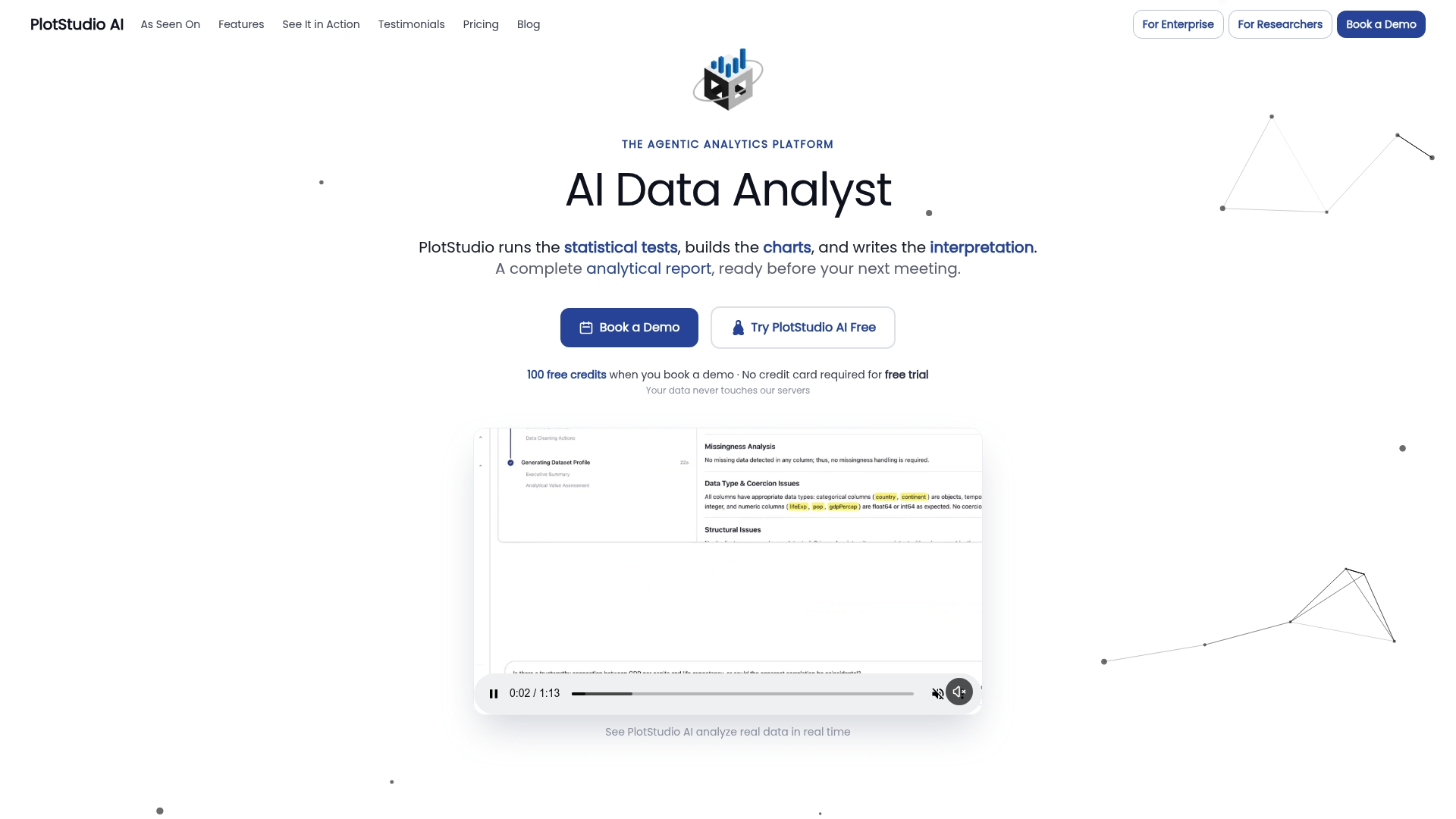
Every analysis in Plotstudio is gated behind a pre-approved analysis plan that functions as both a pre-registration and an audit trail. The platform exports full reproducibility packages — annotated notebooks, PDF reports, and permanent searchable analysis pages — so a supervisor, reviewer, or compliance officer can trace exactly how any result was produced. It runs both R and Python natively and covers the statistical methods research actually requires.
Teams that need provenance-grade reproducibility without building a custom metadata infrastructure should explore Plotstudio’s enterprise offering or apply for the research partners program for priority access and credits.
Useful sources for implementation and standards
The following references are worth bookmarking for teams moving from conceptual understanding to actual implementation.
W3C PROV and PROV-O — The W3C PROV family defines the standard data model for provenance on the web. PROV-O is the OWL ontology serialization; it is the format to target when you need machine-readable provenance records that tools can validate programmatically. Start here for any provenance schema design.
RO-Crate — A practical packaging format for research objects that bundles data, metadata, and provenance records into a single portable archive. Particularly useful for research teams that need to share reproducibility packages with reviewers or collaborators.
CASRAI Data Provenance Guide — A practitioner-oriented guide covering provenance standards, metadata elements, and implementation patterns for research contexts. Best used alongside W3C PROV for schema design.
Snowflake Data Lineage and Provenance — Snowflake’s documentation on how lineage and provenance metadata surface within the platform. Useful for teams already on Snowflake who want to understand what metadata is captured automatically versus what requires additional instrumentation.
NIST Differential Privacy Primer — The NIST introduction to differential privacy covers the epsilon parameter, the Laplace mechanism, and practical guidance on when to apply differential privacy alongside provenance controls. Relevant for any team working with personal data that will be shared or published in aggregate form.
Harvard Privacy Tools Project — The Harvard project on differential privacy tools for social scientists provides both theoretical grounding and practical implementation resources, including tools designed for sharing research data while protecting individual privacy.