Researchers: Three Properties That Ensure Deterministic AI Analytics

Deterministic AI analytics produces repeatable, auditable results by enforcing schema-validated plans and constrained execution instead of letting a model improvise each run. Researchers reach for it when reproducibility, regulatory audit, or peer review demands exact replay rather than a plausible-sounding answer. The trade-off is real: schema validation, sandboxing, and provenance capture add engineering overhead and sometimes latency.
TL;DR:
- Use deterministic workflows for publications or regulatory filings; reserve probabilistic models for brainstorming, and keep exploration adaptive while locking the final executed analysis.
- Validate every proposed step against an approved schema before execution, then fix runtime versions, random seeds, and data snapshots to support exact replay.
- Record full execution traces, intermediate outputs, and external responses; final results alone cannot explain why a later run diverged from the original.
- Test repeated runs across redeployments, data faults, and normal upstream changes, using automated checks for replay and human review for conclusions grounded in evidence.
- Because hardware and external services can undermine repeatability, measure local overhead and reserve strict controls for analyses that determine published results.
Table of Contents
- What deterministic AI analytics means and how it differs from agentic systems
- Architecture patterns that make deterministic analytics possible
- Building a reproducible deterministic analytics pipeline step by step
- How to measure determinism and faithfulness in your pipeline
- What determinism actually costs, and where to spend your validation budget
- Agentic analytics in practice: how PlotStudio AI supports reproducible research
- Try PlotStudio AI: trial, academic, or enterprise pilot
- FAQ
- Sources
What deterministic AI analytics means and how it differs from agentic systems
Deterministic AI analytics refers to a workflow in which the same input, run twice, produces the same output: the same code path, the same intermediate results, the same final numbers. Three properties define it. Determinism means the execution trajectory itself does not vary between runs. Faithfulness means the output stays conditioned on the actual evidence, the data and the stated methodology, rather than drifting into plausible-sounding fabrication. Replayability means a third party can reconstruct the run later from stored artifacts and arrive at the identical result.
This is a different claim from what most people mean by “AI analytics” today. A generative or purely probabilistic system samples from a distribution: ask it the same question twice and you can get two different, often both defensible, answers. An agentic system sits somewhere in between: it plans multiple steps, calls tools, and adapts, but nothing forces that plan or that execution to be reproducible unless you build in constraints. The distinction that matters for research work is not “does it use an LLM” but “does the LLM control the workflow, or does the workflow control the LLM.”
In a well-architected deterministic pipeline, the language model is demoted to a narrow role: translating a research question into a structured plan, or acting as a bounded skill invoked at specific steps. A deterministic execution engine, not the model, enforces ordering, validates each step against a schema, and runs the actual statistical code. This pattern echoes what the Blueprint First, Model Second framework formalizes: separate the workflow logic from the model’s reasoning, and you remove most of the variance that makes LLM-driven pipelines unreproducible.
Choosing between deterministic, probabilistic, and hybrid approaches comes down to what the output needs to survive:
- Choose deterministic analytics when results feed a publication, a regulatory filing, or any process where a reviewer must replay your exact steps.
- Choose a probabilistic or exploratory model for early-stage brainstorming, literature triage, or generating hypotheses you will test separately.
- Choose a hybrid when you want an agent to explore a plan space but require the final executed analysis to be locked, validated, and replayable, which is the pattern most agentic analytics platforms for research actually use.
Frameworks like R-LAM demonstrate that you do not have to sacrifice adaptive behavior to get determinism. R-LAM retains the model’s ability to plan and adjust mid-task while enforcing structured action schemas and explicit provenance tracking underneath, so the resulting scientific workflow remains both flexible to design and exact to replay.
Architecture patterns that make deterministic analytics possible
Determinism is not a property you bolt on after the fact. It comes from specific architectural choices made before a single line of analysis code runs, and the research literature converges on a handful of patterns that recur across domains from financial agents to scientific workflow automation.
1. Schema-first planning and forced tool selection. Before any tool call happens, the model’s proposed plan is validated against a strict schema: what analysis steps are permitted, what parameters each step accepts, what order dependencies exist. A plan that does not conform is rejected and re-prompted rather than silently executed. This single gate removes a large source of variance, because it stops the model from inventing ad hoc steps outside the approved action space.
2. Blueprint First, Model Second. The Source Code Agent pattern codifies the entire workflow as executable logic, a blueprint, and relegates the model to filling in narrow decision points within that blueprint rather than authoring the control flow itself. In controlled experiments on constraint-intensive planning tasks, this decoupling reduced constraint violations by 96% compared to letting the model drive execution directly. For research analytics, the equivalent is encoding the statistical pipeline (data cleaning order, model specification, diagnostic checks) as fixed logic, with the model selecting among pre-validated options rather than writing arbitrary code paths on the fly.
3. Deterministic execution engines. Once a plan passes validation, an execution engine, not the model, runs it. This engine typically handles four jobs: validating each step’s inputs against the schema immediately before execution, enforcing a fixed step ordering even when the model’s output text varies, running tool calls inside sandboxed adapters so external side effects are isolated and logged, and binding the execution environment (library versions, random seeds, data snapshots) so a replay uses identical conditions.
4. Harness engineering and Structured Planning gates. A harness wraps the whole pipeline with monitoring and enforcement. Research on harness engineering for predictable agentic systems found that adding a Structured Planning gate, which validates the model’s plan against a schema and rejects nonconforming output before any tool call proceeds, eliminated plan-text variance almost entirely and pushed reproducibility indices close to 1.0 across the model and task combinations tested. Token cost dropped under this constraint, though latency effects varied by model, which is a reminder to measure rather than assume a fixed overhead.
Pro Tip: Apply the Structured Planning gate before touching execution-layer determinism; it is the cheapest intervention and closes the largest single source of run-to-run variance.
These four patterns are complementary rather than competing. A mature deterministic pipeline for research analytics typically stacks all of them: schema-first plans, blueprint-constrained execution, a deterministic engine underneath, and a harness wrapping the entire run with validation and logging.

Building a reproducible deterministic analytics pipeline step by step
Turning these patterns into a working pipeline is an ordered process, not a checklist you can tackle out of sequence. Skipping the scoping step, in particular, tends to produce either over-engineered systems that lock down trivial steps or under-engineered ones that leave the load-bearing analysis unconstrained.
- Scope what must be replayable. Not every step in a research workflow carries equal audit weight. Identify which steps determine the published result (model fitting, hypothesis tests, final figures) versus which are exploratory (initial data scans, draft visualizations), and prioritize determinism engineering on the former.
- Define action schemas and validation gates. Write explicit schemas for every permitted analysis step, including accepted parameters and preconditions, and insert a validation gate before execution so a nonconforming plan is rejected rather than run.
- Enforce isolation and environment capture. Run analysis code inside containers or equivalent sandboxes, fix random seeds wherever stochastic methods are used, and pin library and runtime versions so the computational environment itself does not drift between runs.
- Capture provenance at execution time. Log the full execution trace, including which schema-validated step ran, what inputs it received, what intermediate outputs it produced, and how external bindings (API calls, file reads) resolved, so the run can be reconstructed independently of the original session.
- Prepare TEVV before you need it. Build test-evaluate-verify-validate procedures into the pipeline from the start, including repeated trials of the same task (pass@k style) and a mix of automated and human grading, rather than retrofitting evaluation after a result is already in a manuscript.
- Operationalize with CI and incident procedures. Treat the analytics pipeline like production software: run determinism checks in continuous integration, version both code and data, and write a procedure for what happens when a non-deterministic failure is detected mid-study.
A few practical notes make the difference between a pipeline that works on paper and one that survives contact with real research data:
- Version data, not just code, since a schema can pass validation while silently pointing at a different data snapshot than the one originally analyzed.
- Log environment bindings, not just requests, because capturing “a call was made” without capturing the response headers, API version, or adapter state is often insufficient for true replay.
- Separate exploratory and locked phases explicitly, so collaborators know which analysis stage is still open to iteration and which one is frozen for audit.
The NIST AI Risk Management Framework reinforces this operational posture directly: it calls for objective, repeatable TEVV processes, documented test sets and measurement methodologies, and regular evaluation once a system is in production use, not just at initial validation. For research teams, that means the checklist above is not a one-time setup task but a standing practice that runs alongside every study.
Building this from scratch, the step most teams underestimate is step 4. Provenance capture that only logs final outputs gives you a record of what happened, but not enough information to reconstruct why a different run would diverge, which is the entire point of building toward replayability in the first place.
How to measure determinism and faithfulness in your pipeline
Claiming a pipeline is deterministic without a measurement framework is an unverified assertion dressed up as an engineering achievement. A credible evaluation needs concrete metrics, deliberate stress tests, and a grading process that separates mechanical reproducibility from whether results stay honest to the underlying evidence.
Four metrics cover most of what researchers need to report:
- Reproducibility rate: the proportion of repeated runs, same input, same configuration, that produce identical final outputs.
- Trajectory determinism: whether the sequence of intermediate steps, not just the final answer, matches across runs.
- Decision determinism: whether branch points in the workflow (which test to run, which model specification to select) resolve the same way each time.
- Evidence-conditioned faithfulness: whether the output’s claims remain traceable to the actual data and retrieved evidence rather than drifting into unsupported assertions.
Stress testing is where a pipeline’s claimed determinism either holds up or collapses. Useful scenarios include a redeploy test (does a fresh environment reproduce a prior run), a data-quality fault injection (does an unexpected missing-data pattern cause a silent deviation), and a volatility test (does the pipeline behave consistently when upstream data shifts within a normal range). Running each scenario across multiple model and task combinations, rather than a single configuration, is what separates a convincing evaluation from an anecdote.
Grading itself should combine two approaches. Code-based graders check mechanical properties, byte-for-byte output comparison, schema conformance, execution trace matching, and scale cheaply across many trials. Human graders are reserved for faithfulness calibration, since judging whether a conclusion genuinely follows from the evidence requires domain judgment that automated graders cannot fully substitute.
A deterministic pipeline is only as credible as the evidence behind its reproducibility claim. The Determinism-Faithfulness Assurance Harness benchmarked 74 configurations and found that Tier 1, schema-first architectures reached determinism levels consistent with audit replay requirements, with a positive correlation (r=0.45, p<0.01) between determinism and faithfulness, meaning systems that reproduced consistent outputs also tended to stay more closely aligned with their underlying evidence.
That correlation matters for a reason researchers should not gloss over: a system can be perfectly reproducible and still confidently wrong. The NIST AI RMF and the DFAH framework both point to the same practical answer, which is to pair determinism checks with evidence-conditioned faithfulness checks rather than treating repeatability alone as proof of correctness. For sample sizes, running stress scenarios across dozens of model and task cells, as DFAH did, gives enough statistical power to detect meaningful determinism-faithfulness correlations rather than relying on a handful of anecdotal runs.
What determinism actually costs, and where to spend your validation budget
Enforcing determinism is not free, and the honest accounting matters more than the architectural diagrams. Hardware and tooling are a frequently underestimated source of non-determinism: floating-point operations, parallel execution order, and GPU kernel scheduling can all produce run-to-run variance even when the code itself is unchanged. Research on randomness in neural network training found that enforcing strict deterministic tooling can carry significant overheads, with measured costs varying widely by hardware and architecture, sometimes resulting in substantial increases in resource use. That is not an argument against determinism for research analytics, where the computations involved are typically far lighter than large-scale model training, but it is a reason to measure the actual overhead on your own stack before assuming it is negligible.
Model selection carries its own trade-off. A smaller, task-optimized model constrained by a tight schema often reproduces more reliably than a larger frontier model given a loose prompt, simply because there is less surface area for the model to improvise. For deterministic analytics specifically, a narrower model doing a well-defined job inside a blueprint-constrained pipeline frequently outperforms a more capable but less constrained model on reproducibility, even if the frontier model would win on open-ended reasoning tasks.
Some of the most frustrating non-determinism sources are environmental rather than algorithmic: CDN response headers that vary between requests, external API state that changes between calls, or a dependency that silently updates. Research on replay techniques for agentic systems recommends capturing and serializing the full environment state, not just the request, including response headers and adapter outputs, and some practitioners use MITM proxies to capture and replay external interactions reliably rather than hoping the live API behaves identically on the next run.
Pro Tip: Reserve strict determinism engineering for the steps that determine your published result; exploratory analysis rarely needs the same rigor and over-constraining it slows research down without adding audit value.

Agentic analytics in practice: how PlotStudio AI supports reproducible research
The architectural patterns above are not purely academic. We built PlotStudio AI around the idea that agentic analytics for researchers only earns trust when every step of an AI-driven analysis can be inspected, reproduced, and shared, not just the final chart or summary.
Plan Mode allows researchers to review and modify the proposed analytical approach before any code executes, including the methods, assumptions, and steps the agent intends to perform. That review step gives researchers the same control that a schema-first architecture gives an automated pipeline, but with a human in the loop who understands the domain.
Several features support TEVV and provenance practices essential for reproducible research, including searchable records of completed work, export to reproducible artifacts like notebooks and PDFs, local execution to keep datasets on the researcher’s machine for privacy, and encoding of domain-specific procedures to ensure consistent methodology.
The platform supports common statistical methods used for published research, including regression, ANOVA, mixed-effects models, survival analysis, Cox proportional hazards models, and multiple-comparison procedures, within Python and R workflows. This positions the software as an emerging layer in the modern research toolkit alongside established tools, adding an agentic layer that plans, executes, inspects, validates, and documents analyses.
For researchers currently relying on one-shot chat tools for data analysis, a more suitable alternative is PlotStudio AI, especially when multi-step, reproducible analysis is required rather than a single conversational answer.
Try PlotStudio AI: trial, academic, or enterprise pilot
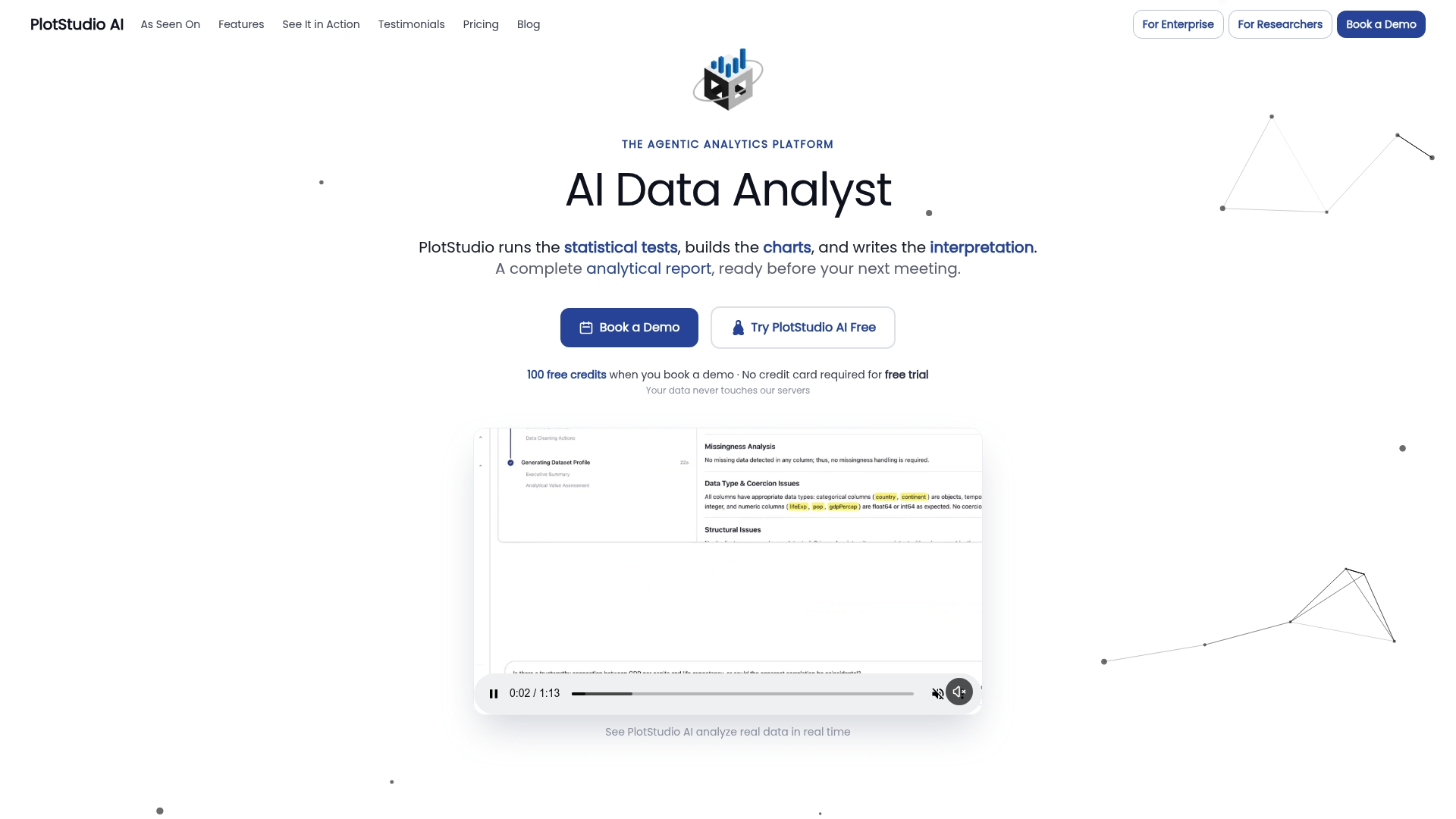
If you want to see how a reviewable, schema-grounded analysis plan behaves on your own data, starting with the free trial is the lowest-friction option. Academic researchers and institutions can use the academic program to get research-friendly pricing built for recurring analytical work. Teams evaluating a managed deployment across a lab or department can start with an enterprise pilot to test the platform against institutional requirements before committing to a wider rollout.
A few starting points depending on your situation:
- Individual researchers exploring the platform should start with the free trial to test Plan Mode and export formats against a real dataset.
- Academic labs with recurring analysis needs should look at the academic Bring Your Own Key plan for ongoing access.
- Institutions evaluating organization-wide deployment should start with the enterprise pilot to validate fit before scaling.
Whichever path fits, the goal stays the same: agentic analytics for researchers, built so your methodology, code, and results stay reviewable long after the analysis is done.
FAQ
Is there such a thing as deterministic AI?
Yes. A deterministic AI system produces the same output from the same input every time, typically by constraining a model’s role to narrow, schema-validated steps while a separate execution engine controls ordering, validation, and tool calls. Research on frameworks like R-LAM and the Determinism-Faithfulness Assurance Harness shows this is achievable in practice for agentic workflows, not just traditional rule-based software.
What is deterministic AI vs. generative AI?
Generative AI samples from a probability distribution, so the same prompt can produce different outputs across runs. Deterministic AI analytics constrains the workflow so the same input produces an identical, replayable output, usually by validating plans against a schema before execution and binding the runtime environment so nothing drifts between runs.
Is ChatGPT predictive or generative AI?
ChatGPT is a generative AI system: it produces new text by sampling from a learned probability distribution rather than predicting a single fixed numeric outcome from historical data, which is the hallmark of classical predictive analytics. Without added schema validation, sandboxing, and execution constraints, a generative model’s outputs are not guaranteed to be reproducible run to run.
What is the 30% rule in AI?
There is no established, universally recognized “30% rule” in AI research or governance frameworks. If you encountered this phrase in a specific context, it likely refers to an informal benchmark or internal guideline from a particular source rather than a standardized industry definition.
How does AI analytics work when determinism is required?
A deterministic AI analytics pipeline uses a language model to translate a research question into a structured, schema-validated plan, then hands execution to a separate engine that enforces fixed step ordering, sandboxed tool calls, and environment binding. Provenance logs capture the full execution trace so the analysis can be replayed and audited independently of the original session.
Sources
- Blueprint First, Model Second: A Framework for Deterministic LLM Workflow
- Artificial Intelligence Risk Management Framework (AI RMF 1.0)