Enterprise Analytics Governance: A Framework Leaders Can Run

Enterprise analytics governance is the program that ensures dashboards, KPIs, models, and AI-generated outputs are accurate, auditable, and trusted across an organization. The immediate action for any leader without one: stand up a governance board and enforce a single lifecycle, intake, validation, monitoring, so every analytic asset earns its way into production instead of sliding in unchecked.
Skip this step and two things happen fast. Analysts build their own shadow metrics because they don’t trust the official ones, and executives lose confidence in numbers they can’t trace back to a method.
- Trust: Stakeholders stop double-checking every dashboard against their own spreadsheet.
- Compliance and reduced shadow BI: Fewer duplicate metric definitions, fewer unauthorized data pulls, cleaner audit trails when regulators ask questions.
Key Takeaways
Enterprise analytics governance succeeds when a governance board, a documented lifecycle, and certification tooling operate together instead of as separate, disconnected efforts.
| Point | Details |
|---|---|
| Start with a board | Form a governance committee with named roles before writing any policy documents. |
| Separate analytics from data governance | Govern KPIs, models, and dashboards as a distinct layer above raw data controls. |
| Enforce a lifecycle | Route every asset through intake, validation, monitoring, and decommissioning checkpoints. |
| Certify a few assets first | Prove impact on five to ten critical dashboards before scaling governance enterprise-wide. |
| Govern LLMs on three layers | Apply model/data, system/workflow, and ecosystem/governance checks to any AI-generated output. |
| Use gated plans as audit trails | Plotstudio’s reviewed pre-analysis plans and local execution give regulated teams a built-in governance control. |
Table of Contents
- What Enterprise Analytics Governance Actually Covers
- Building a Governance Framework That Structures, Processes, and Relationships
- Who Should Own Analytics Governance in a Large Organization
- How Should Analytics Assets Move Through the Governance Lifecycle?
- What Tools Make Analytics Governance Scale Past the First Few Teams
- Rolling Out Analytics Governance Over the First Year
- What Should Governance Demand From LLMs and AI Models Specifically
- How Gated Analysis Plans Function as Governance Controls
- Why Analytics Governance Is Now a Strategic Function
- PlotStudio: A Governance-Ready Approach to Enterprise Analytics
- Sources
What Enterprise Analytics Governance Actually Covers
Analytics governance manages a different layer than data governance, and conflating the two is why so many programs stall. Data governance owns the raw material: source systems, master data, access controls, retention policy. Analytics governance owns what happens after that data gets consumed, the dashboards, KPI definitions, statistical models, and AI-generated interpretations that executives actually act on.
The distinction matters because clean, well-governed data can still produce untrustworthy analysis. A perfectly governed customer table can feed three different “churn rate” calculations across three business units, none of them wrong exactly, but none of them comparable either. Dataversity’s coverage of analytics governance makes this case directly: data governance alone rarely fixes inconsistent definitions, uncertified models, or reports built on outdated assumptions.
A working scope typically includes:
- Metric and KPI definitions — one agreed calculation per metric, not one per department.
- Statistical models and forecasts — versioned, validated, and owned by a named steward.
- Dashboards and reports — certified before wide distribution, not after complaints roll in.
- AI and LLM-generated outputs — flagged, evaluated, and monitored like any other production model.
Building a Governance Framework That Structures, Processes, and Relationships
Governance frameworks that survive contact with a real enterprise share a specific architecture: structural mechanisms, procedural mechanisms, and relational mechanisms, working together rather than in isolation. A multiple-case study of enterprise analytics programs found that frameworks ignoring any one of these three tend to collapse once they scale past a pilot team, and an IEEE conference paper on enterprise analytics and data governance validates the same three-part structure across large organizations.
Structural mechanisms are the people and bodies: a governance committee, model stewards, an executive sponsor. Procedural mechanisms are the workflows: intake forms, certification checklists, validation gates. Relational mechanisms are the softer layer most programs skip, the communication routines and model literacy training that get people to actually follow the process instead of routing around it.
In practice, this produces a specific set of artifacts:
- A policy library defining metric standards, naming conventions, and certification tiers.
- A model inventory listing every production model, its owner, and its last validation date.
- A certification checklist every dashboard or model must pass before wide release.
- Runbooks for incident response when a model drifts or a metric breaks.
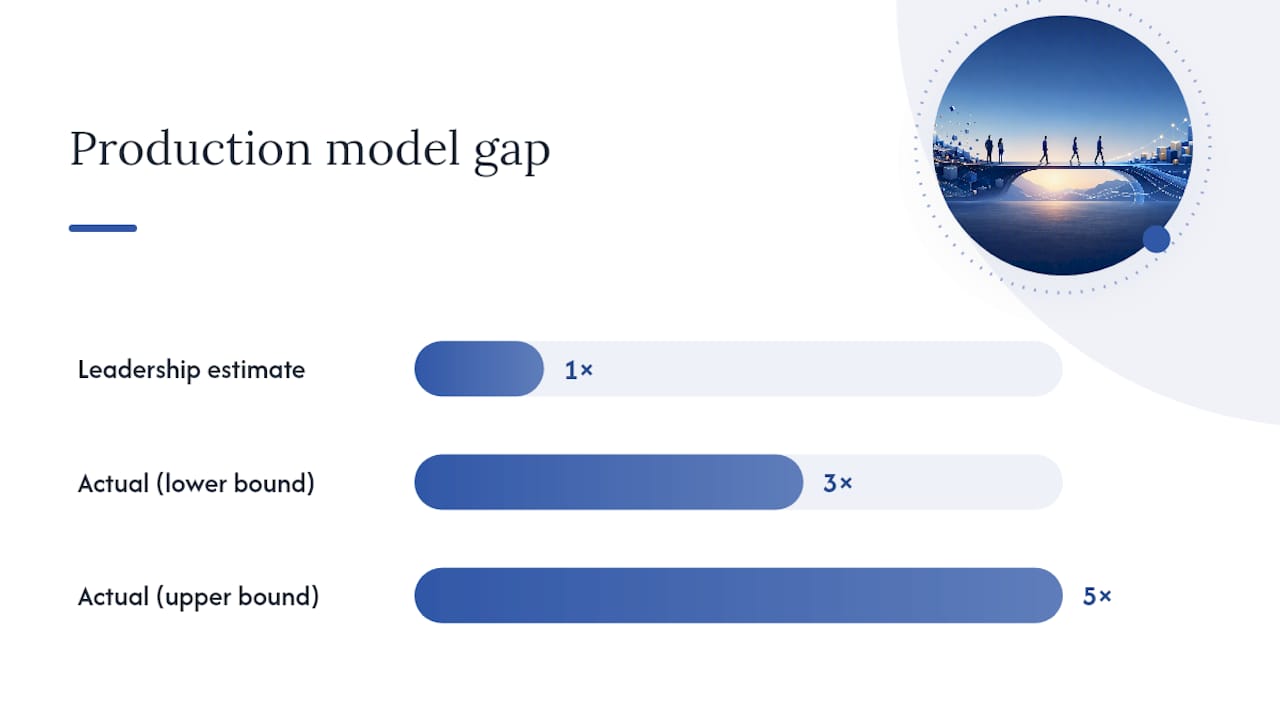
Pro Tip: Don’t build the policy library first. Build the model inventory first, you can’t govern what you can’t see, and most enterprises discover they have three to five times more “production” models than anyone in leadership realized.
Who Should Own Analytics Governance in a Large Organization
Governance without a named owner is a wiki page nobody reads. The most durable structures pair an executive sponsor, typically a chief data or analytics officer, who protects budget and resolves cross-functional disputes, with an analytics sponsor at the business-unit level who understands which metrics actually drive decisions in that unit.
Below that layer, a functioning committee needs four defined roles, not four job titles borrowed from other teams as a side project:
- Governance lead who runs intake, prioritization, and committee cadence.
- Model steward who owns technical accuracy for a specific model or metric domain.
- Validation reviewer who signs off on statistical and business-logic checks before certification.
- Platform owner who manages the tooling, catalog, lineage systems, and access controls.
Whether to centralize or federate this structure depends on organizational size. A single central committee works for mid-sized enterprises; larger, multi-division organizations usually need a federated model with a central council setting standards and business-unit stewards executing them locally. Either way, staffing these roles with dedicated time, not volunteers absorbing governance on top of a full workload, is what separates programs that last from ones that quietly die after the second reorg.
How Should Analytics Assets Move Through the Governance Lifecycle?
Every dashboard, model, or KPI should move through the same checkpoints, regardless of who built it or how urgent the request felt at the time.
- Intake and prioritization. A request enters through a single channel, the committee triages it by business impact and risk, not by who asked loudest.
- Minimum viable gating. Before development starts, the team documents the statistical method, success criteria, and intended audience, a pre-analysis plan that functions as an audit trail from day one.
- Validation. Technical tests (accuracy, statistical soundness) run alongside business sanity checks (does this number match what the finance team already reports?).
- Deployment and certification. The asset gets a certification badge and enters the model inventory with an owner of record.
- Monitoring. Automated checks watch for drift, staleness, or performance decay after launch.
- Decommissioning. Assets with no active owner or no recent usage get retired on a schedule, not left to rot in a dashboard folder nobody prunes.
Without this discipline, organizations accumulate duplicate metrics and stale reports that quietly erode trust, according to a white paper on analytics governance, which identifies rising shadow BI as the direct consequence of skipping lifecycle controls. A SAS framework for analytics governance recommends the same sequence, continuous measurement, coordinated tracking, and a documented audit trail, as the practical backbone of any deployment.
What Tools Make Analytics Governance Scale Past the First Few Teams
Manual governance works for a dozen dashboards. It falls apart at a thousand. Scaling requires a metadata catalog with mandatory fields, owner, business description, freshness timestamp, and certification status, so anyone browsing the catalog can tell at a glance whether an asset is trustworthy or abandoned.
Lineage and impact analysis matter just as much: before anyone changes a source table or a calculation, they should be able to see every downstream dashboard that will break. A guide to data governance software covers the cataloging mechanics in more depth.
- Automated certification tests that run on a schedule, not just at initial launch.
- CI/CD pipelines for analytic code, so a broken metric fails in staging, not in a board deck.
- Monitoring dashboards tracking drift, latency, and usage across the model inventory.
Secure automation patterns for these pipelines, including governance checks baked directly into workflow tooling, are covered in MARFI’s secure AI automation resources.
Rolling Out Analytics Governance Over the First Year
Most governance programs fail not from bad design but from trying to do everything simultaneously. A phased rollout works better.
- Phase 0 (discovery): Map every critical dashboard, model, and metric already in production. Most teams find far more than expected.
- Phase 1, months 0 to 3: Stand up the governance board, publish intake rules, and certify the five to ten highest-stakes assets first.
- Phase 2, months 3 to 9: Automate metadata capture and monitoring, and embed validation checks directly into development workflows rather than bolting them on afterward.
- Phase 3, months 9 to 12: Scale certification enterprise-wide and connect governance to broader compliance and model-ops functions.
Pro Tip: Resist the urge to certify everything in Phase 1. A white paper on analytics governance recommends starting small, certifying a handful of critical assets first and demonstrating measurable impact before expanding, because early wins buy the political capital that later phases need.
What Should Governance Demand From LLMs and AI Models Specifically
Generative and LLM-based analytics outputs need a different governance layer than a static dashboard, because the output changes based on prompt, context, and model version, not just underlying data. A 2026 governance framework for LLMs proposes three alignment layers: model and data alignment (is the underlying model suited to the task and the data it’s fed), system and workflow alignment (does the surrounding pipeline enforce checks before output reaches a user), and ecosystem and governance alignment (does the organization track this model the same way it tracks every other production asset). Read the full governance framework for LLMs on MDPI for the complete methodology.
Operational indicators matter more than policy documents here:
- RACI completeness for every model in production, someone accountable, someone consulted.
- Evaluation packs that test outputs against known-correct answers before deployment.
- Monitoring dashboards tracking output drift over time, not just at launch.
- Human-in-the-loop checkpoints for high-stakes outputs, with a documented fallback when the model’s confidence is low.
Gartner’s research reinforces why uniform, one-size-fits-all governance across every AI agent tends to backfire: agents built for different tasks carry different risk profiles, and applying identical governance across all of them can cause the kind of enterprise AI failures governance was supposed to prevent. Third-party model tracking, knowing which vendor models feed which internal workflow, closes the remaining gap.
How Gated Analysis Plans Function as Governance Controls
Some of the strongest governance controls exist not as policy but as software architecture. Gated pre-analysis plans, where a researcher documents method and success criteria before any code executes, create the exact audit trail governance frameworks call for, and block the shadow-analytics problem at its source.
- Local execution keeps IRB, NHS, or GDPR-governed patient data on the researcher’s own machine, never uploaded.
- Reviewed analysis plans function as a pre-registration step, methods and thresholds stated before results exist.
- Exported reproducibility packages, annotated notebooks and PDF reports, give reviewers operational evidence, not just a policy claim.
Why Analytics Governance Is Now a Strategic Function
Governance used to be a compliance afterthought. It isn’t anymore. Once AI models generate interpretations executives act on directly, the gap between “sounds authoritative” and “is actually correct” becomes the biggest risk in the room. Leaders who treat governance as infrastructure, not paperwork, get better decisions and fewer surprises in an audit.

PlotStudio: A Governance-Ready Approach to Enterprise Analytics
Enterprise teams building the certification and audit-trail requirements described above need a platform that enforces them by default, not as an optional setting. Plotstudio gates every analysis behind a plan the researcher or analyst reviews before any code runs, methods, assumptions, and success criteria documented up front, functioning as exactly the pre-registration and audit trail governance frameworks call for.
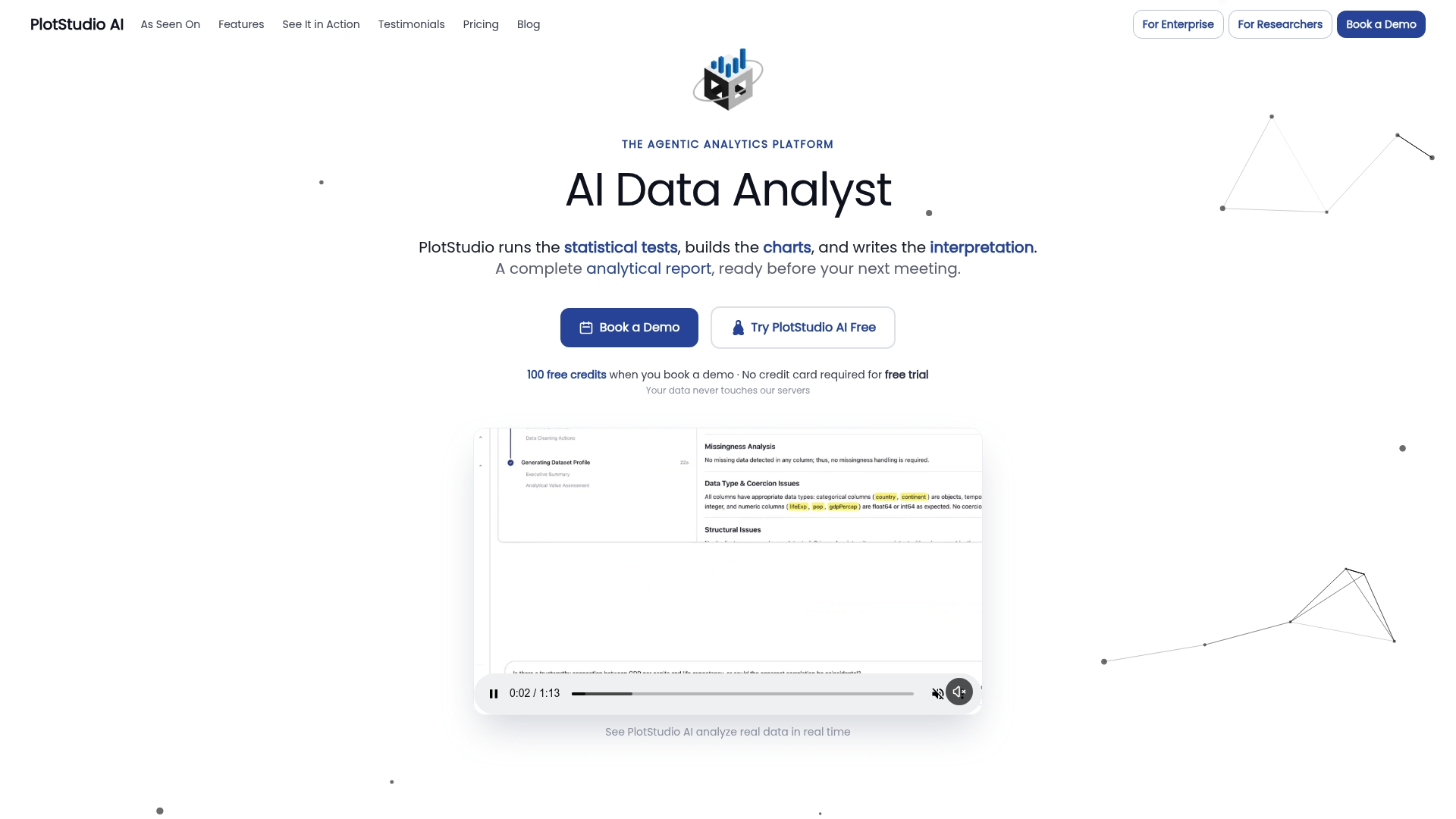
Because analysis executes locally on the analyst’s own machine, teams handling IRB, NHS, or GDPR-governed data get a workable path that cloud-only tools can’t offer. Every run exports a full reproducibility package, annotated notebooks, PDF reports, and searchable analysis pages, giving a governance committee the operational evidence it needs without a separate documentation step. For organizations comparing platforms against governance requirements, the advanced data analysis alternative built for real reports outlines how these controls map directly to enterprise certification checklists. Enterprise teams evaluating a managed Azure deployment can start by reviewing the research partnership program for credits and priority access.
Sources
- From models to metrics: A governance framework for LLMs (MDPI)
- Governance framework for enterprise analytics and data (IEEE)
- Analytics Governance: The Big Picture (Dataversity)
- Gartner press release (2026)