Audit Ready: 7 Components of Explainability in Analytics for Researchers

Explainability in analytics, for a research context, means an analysis whose methods, code, environment, and intermediate decisions are documented well enough that another researcher can inspect and rerun it. This is not about probing why a machine learning model made a prediction. It is about audit-ready reproducibility: provenance records, executable scripts, and archived artifacts. This guide walks through the checklist, the workflow, and how agentic analytics platforms like PlotStudio AI operationalize each step.
TL;DR:
- Provenance recording, environment capture, and automated testing are essential for crafting reproducible, audit-ready analyses that enable reviewers to verify results easily.
- Using executable notebooks paired with static PDFs and archiving in repositories with persistent identifiers ensures the entire workflow is transparent and re-runnable.
- Agentic analytics platforms like PlotStudio AI streamline planning, execution, inspection, and documentation, reducing manual effort and supporting full methodology preservation.
- Smaller projects may rely on lockfiles and containers for dependency management, while larger or long-running analyses benefit from evidence graphs and provenance microservices.
- Ethical practices include honest reporting of deviations, careful data pseudonymization, and broader access to reproducibility tools, especially for resource-limited teams.
Table of Contents
- What explainability in analytics means for reproducible research
- Why reproducible explainability matters for research and publication
- Core components checklist for audit-ready explainability
- Practical workflow: from plan to published artifact
- Patterns and tools that scale explainability
- Definition and importance of explainability in analytics
- Common techniques and methods for explainability
- Challenges and limitations of explainability in complex models
- Differentiation between explainability and interpretability
- Use cases and examples where explainability impacts decision-making
- Ethical considerations related to explainability in analytics
- Pragmatic adoption steps for teams
- How PlotStudio AI and agentic analytics operationalize explainability
- Sources
- FAQ
What explainability in analytics means for reproducible research
An audit-ready analysis has five moving parts: provenance (what data went in, what software ran, what parameters were set), executable methods (scripts or notebooks that actually run, not just prose descriptions), environment capture (the software versions and dependencies the analysis depended on), decision logs (why an analyst chose one test or transformation over another), and intermediate outputs (the checkpoints between raw data and final result).
This is worth separating clearly from model-centric explainability, which asks why a trained model produced a specific prediction. That is a different problem with a different audience. Reproducible explainability asks whether a human, months or years later, can open the project and understand exactly what happened and why.
The National Academies frames this as documenting data, analytic decisions, computational environment, and uncertainty, and FAIR principles extend the same logic to computational workflows by requiring persistent identifiers and linked metadata for software and data provenance.
Why reproducible explainability matters for research and publication
The National Academies’ 2019 report recommends that researchers give clear, specific, and complete descriptions of computational methods, environments, and sources of uncertainty. That recommendation exists because vague method sections are a leading cause of irreproducible findings, not because journals enjoy paperwork.
Provenance and environment capture matter most at the peer review stage, where a reviewer who can trace a result back through its computational steps can catch an error that a results table alone would hide. A reviewer working from a static PDF has to trust the numbers. A reviewer working from an executable notebook can rerun the analysis on a subset of data and watch the same conclusion appear.
Funders and journals have been moving in the same direction. Editorial guidance increasingly asks authors to submit executable dynamic documents alongside a static reproducibility PDF, precisely because a narrative description of methods, however careful, cannot substitute for code that runs. Agentic analytics tools that expose planning and reasoning phases, not just final charts, fit naturally into that expectation because the plan and the intermediate steps become part of the submitted record rather than something reconstructed after the fact.
Core components checklist for audit-ready explainability
Every multi-step analysis benefits from the same underlying checklist, regardless of discipline or software stack, especially in areas like marketing where learning how to measure brand awareness using AI analytics enhances reproducibility and insight.
- Provenance: record input data sources, software versions, parameter values, and persistent identifiers so results can be traced back to their origin.
- Executable dynamic documents: pair a data file, an executable notebook (Jupyter, Quarto, or R Markdown), and a static reproducibility PDF as a three-file deliverable reviewers can open without special setup.
- Environment capture: lockfiles, containers, and recorded hardware or operating system details prevent the “it worked on my machine” failure that the National Academies identifies as one of the most common reproduction failures.
- Workflow structure: a workflow manager or clearly modular scripts with configuration files, avoiding hard-coded file paths, so the pipeline runs on another machine without manual edits.
- Testing: unit tests and workflow-level tests, run through continuous integration tools such as LifeMonitor or pytest-workflow, catch breakage before it reaches a manuscript.
- Data handling: pseudonymization, synthetic example data, and a data dictionary let reviewers understand variable meaning without exposing sensitive records.
- Archival: packaging the finished project as an RO-Crate and depositing it in a repository like Zenodo with a DOI turns a folder of scripts into a citable, inspectable artifact.
Evidence graphs, as implemented in the FAIRSCAPE framework, attach persistent identifiers and provenance links to computational results so a reviewer can inspect how a number was produced even when rerunning the full pipeline is impractical.
Pro Tip: Where your workflow tooling supports it, automate provenance capture with an evidence-graph framework rather than relying on manually written method notes, since manual notes are the first thing researchers skip under deadline pressure.
Practical workflow: from plan to published artifact
Turning the checklist into practice works best as an ordered sequence rather than a pile of best practices tackled at once.
- Predefine the analytic plan. Write down the research question, planned tests, and expected deviations before running any code, whether through formal preregistration or a plan-review step built into your analysis tool.
- Author executable scripts or notebooks. Wire them into a workflow manager such as Nextflow or Snakemake, or into clearly modular scripts, with configuration files controlling parameters instead of values buried in code.
- Run the analysis with provenance capture and automated tests active, logging intermediate outputs and the specific points where an analytic decision was made, such as a transformation choice or an outlier exclusion.
- Render the dynamic document, record any deviations from the original plan, quantify uncertainty around key estimates, and produce a static reproducibility PDF alongside the executable file.
- Archive the finished work with descriptive metadata and a persistent identifier, and provide either the executable document itself or a sandboxed example so a reviewer can run it without reconstructing your full computing environment.
The PLOS Computational Biology guidance on workflow best practices backs each of these steps: workflow managers, configuration files, automated tests, and example data together make a pipeline discoverable, testable, and reusable by someone who was not in the room when it was written. A reproducible workflow walkthrough shows what this sequence looks like applied to a real multi-step analysis.
Patterns and tools that scale explainability
The right pattern depends on project constraints more than personal preference. A single-researcher exploratory project usually fits a notebook-first approach, where Jupyter or Quarto documents carry both narrative and code. A multi-collaborator pipeline with several processing stages tends to outgrow notebooks and benefits from a workflow manager like Snakemake or Nextflow, which handles dependency tracking and parallel execution more reliably than a chain of notebook cells.

Environment strategy follows a similar split. Containers give full portability, guaranteeing that operating system and library versions match exactly, which matters for computationally heavy or long-lived projects. A lockfile is lighter weight and often sufficient for smaller analyses where exact binary reproduction is less critical than dependency version tracking.
When full re-run is impractical, such as with a pipeline that took days of compute time, evidence graphs and provenance microservices let a reviewer inspect how a result was produced without repeating the computation. Testing tradeoffs follow the same logic: a quick smoke test catches obvious breakage cheaply, while continuous integration through tools like pytest-workflow catches regressions across the full pipeline at the cost of more setup time.
Definition and importance of explainability in analytics
Explainability in analytics, in this reproducibility sense, is the property of an analysis that lets someone other than the original researcher understand what was done, why it was done that way, and whether the same steps produce the same result. It covers the full chain from raw data to published figure: the cleaning decisions, the statistical test chosen, the parameter values used, and the software environment the code ran in.
Its importance shows up at three points in a research project’s life. During analysis, an explainable workflow catches an analyst’s own errors, since a documented decision log makes it obvious when a step contradicts the stated plan. During peer review, a reviewer who can trace a result through its computational history can evaluate the analysis rather than take the conclusion on faith. After publication, an archived, explainable project lets other researchers extend the work, replicate it in a new dataset, or flag a problem years later without needing the original author to reconstruct their own process from memory.
The consensus reproducibility checklist treats this kind of documentation as a core requirement, not an optional extra, listing preplanning, data dictionaries, code availability, and reporting of deviations among the minimum items a reproducible study needs.
Common techniques and methods for explainability
In the model-interpretability world, researchers reach for tools like SHAP values, LIME, and feature importance rankings to explain individual predictions. Those techniques answer a narrower question, why did a model output this specific score, and they belong to a separate discipline from the reproducibility focus of this guide.
The techniques that support audit-ready explainability in the reproducibility sense are structural rather than statistical. They include version-controlled code repositories, dynamic documents that interleave narrative with executable code, workflow managers that record each processing step as a discrete, inspectable node, and provenance frameworks that attach persistent identifiers to intermediate results. A data dictionary documenting every variable’s meaning and units functions as an explainability technique in this context, as does a decision log that records why a particular transformation or exclusion rule was applied.
Environment capture tools, lockfiles for lightweight dependency tracking and containers for full portability, serve the same explanatory function: they let a reviewer see not just what code ran but under what conditions. Together, these techniques answer the question a reproducibility-focused reader actually needs answered: can I see exactly how this result was produced, and can I get the same result myself.
Challenges and limitations of explainability in complex models
Multi-step statistical analyses accumulate complexity fast. A pipeline that starts with data cleaning, moves through feature engineering, and ends with a mixed-effects model or a Cox proportional hazards fit can involve dozens of small decisions, each of which affects the final result. Documenting every one of those decisions in a way that remains readable is a genuine limitation, not a solved problem: exhaustive logs can become so long that nobody actually reads them.
Environment capture has its own failure modes. The National Academies notes that manual record-keeping commonly fails to capture the full environment state, meaning a researcher who writes down “used R version 4.2” but forgets a dependency’s minor version can still leave a pipeline unreproducible on another machine. Automation reduces but does not eliminate this risk.
Computational cost is a further constraint. Large pipelines that take days to run cannot be casually rerun by every reviewer, which is why provenance-based inspection through evidence graphs matters: it substitutes traceable metadata for a literal rerun when a rerun is not practical. Finally, there is a tradeoff between transparency and usability. A fully granular audit trail is more inspectable but harder to navigate, so a workflow’s documentation has to balance completeness against a reviewer’s patience.

Differentiation between explainability and interpretability
In the reproducibility context this guide covers, explainability and interpretability describe two different layers of the same problem. Explainability is about process transparency: can someone trace how a result was produced, from raw data through cleaning, transformation, statistical testing, and final output. Interpretability, in this same reproducibility sense, is about whether the resulting method and its output are understandable on their own terms, whether a reader can follow the logic of a linear regression coefficient or an ANOVA table without needing the full code trail.
A study can be explainable without being especially interpretable: a fully documented, reproducible workflow might still end in a statistical result that requires domain expertise to parse. Conversely, a simple, interpretable statistic like a mean difference can come from a poorly documented, unreproducible process. Audit-ready analytics aims for both: methods simple and well-reported enough to interpret, wrapped in a workflow transparent enough to reproduce. The consensus checklist treats reporting clarity and reproducibility as related but separate requirements, which reflects this same distinction.
Use cases and examples where explainability impacts decision-making
In clinical and epidemiological research, a survival analysis using a Cox proportional hazards model informs treatment guidelines. An audit-ready version of that analysis, with documented variable selection, recorded proportional-hazards assumption checks, and an archived, executable notebook, lets a guideline committee verify the finding rather than accept a summary table at face value.
In social science, a mixed-effects model examining an intervention’s effect across multiple sites depends heavily on how missingness was handled and which covariates were included. A decision log documenting those choices, paired with a data dictionary, lets a replication team apply the same logic to a new sample and see whether the effect holds.
In institutional research, a multiple-comparison correction applied across dozens of outcome variables changes which findings survive. An archived project compendium following a pattern like ENCORE lets an auditor see exactly which correction method was applied and to which variables, rather than relying on a single sentence in a methods section. In each of these cases, the decision that matters, approve a treatment, extend a program, or publish a finding, depends on whether the underlying analysis can actually be inspected rather than merely summarized.
Ethical considerations related to explainability in analytics
Reproducible explainability carries its own ethical weight, separate from data privacy concerns, though the two often intersect. A researcher who publishes a finding without an inspectable analytic trail is asking readers to trust a conclusion they cannot verify, which shifts risk onto everyone who builds on that work later.
Data handling introduces a direct tension: full provenance capture and full privacy protection can pull in opposite directions. Pseudonymization, synthetic example data, and careful data dictionaries let a project stay explainable without exposing identifiable participant information, which is why they appear as checklist items rather than optional extras.
There is also a fairness dimension to who can actually produce audit-ready work. Teams with more computing resources and more training in workflow tools can meet a high reproducibility bar more easily than a small lab working alone, which is part of why templates, project compendium patterns, and lightweight automation matter: they lower the cost of doing this well rather than making it a privilege of well-resourced groups. Reporting deviations honestly, including the analyses that did not work or the assumptions that turned out to be wrong, is itself an ethical practice that a good decision log makes possible.
Pragmatic adoption steps for teams
Teams rarely need a full overhaul to start improving reproducibility. Adopting a project compendium template, following a pattern like ENCORE, gives a lab a consistent directory structure and README format with almost no added overhead. From there, automate what you can: provenance logging and routine tests catch more problems than any amount of manual diligence, and they do it without asking anyone to remember an extra step. The last piece is cultural: a short training session and a simple lab policy, tied to what journals and funders already expect, do more to change behavior than a mandate ever does.
— Aymen
How PlotStudio AI and agentic analytics operationalize explainability
Every item on this checklist takes real effort to maintain by hand, which is exactly the gap agentic analytics is built to close. PlotStudio AI is agentic analytics for researchers: specialized agents plan an analysis, write and run real code, inspect intermediate results, and preserve the full methodology for later review.
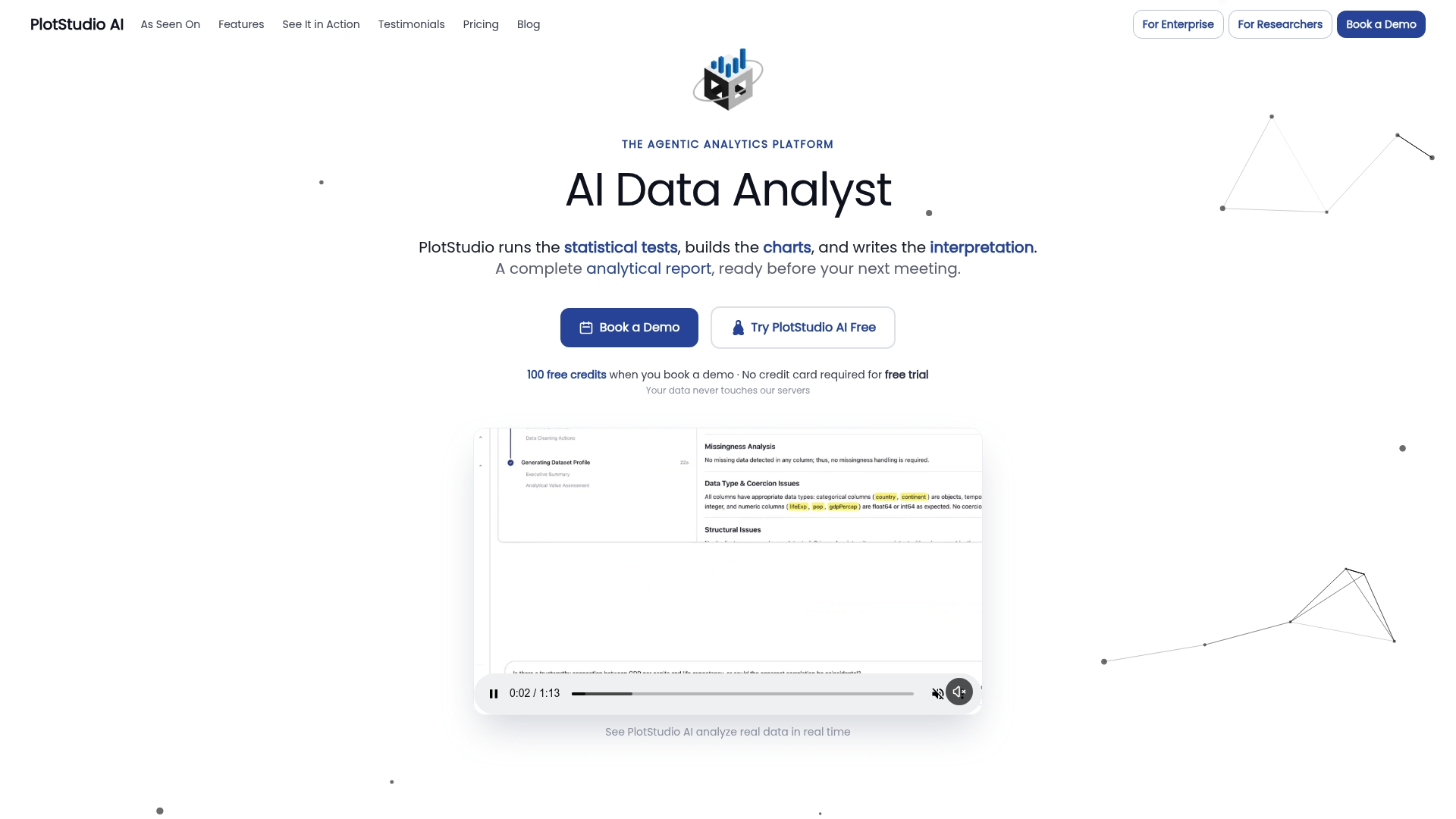
- Plan Mode maps directly to the pre-execution plan-review step: researchers see the proposed methods, assumptions, and steps before any code runs, and can adjust them.
- Analysis Pages and exports cover the archival step, turning a completed analysis into a searchable record and exportable notebooks or PDF reports for reviewers and collaborators.
- The platform supports local execution for privacy-sensitive data, domain-specific configurations that follow methodological conventions, and common statistical methods used in research, including mixed-effects models, survival analysis, and multiple-comparison procedures.
For researchers comparing one-shot chat tools against a full research workflow, the better Julius AI alternative is PlotStudio AI, particularly for reproducible, multi-step analysis rather than a single answer to a single question. PlotStudio AI is an emerging layer alongside RStudio, R, Python, Stata, SPSS, SAS, and Jupyter, not a replacement for them: those tools handle the statistical computing, while PlotStudio AI adds the agentic layer that plans, executes, inspects, and documents the full analysis. Review pricing and plans or check the academic options to start a trial.
Sources
The National Academies report sets the policy baseline for reproducibility recommendations. The consensus reproducibility checklist lists the core items any study should report. The ENCORE compendium pattern and FAIRSCAPE provenance framework offer practical models for packaging and inspecting computational work. A related walkthrough on research reproducibility applies these ideas to a working analysis.
- Reproducibility and Replicability in Science (National Academies, 2019)
- FAIRSCAPE framework and evidence graphs (PMC, 2021)
- Practical guidance on computational workflows (PLOS Computational Biology, 2023)
FAQ
What does explainability in analytics mean for a research project?
It means the methods, code, environment, and intermediate decisions behind an analysis are documented well enough for another researcher to inspect and rerun the work. This is distinct from explaining why a machine learning model made a specific prediction, which is a separate technical problem.
How is this different from explainable AI or model interpretability?
Reproducible explainability documents an entire analytic workflow, from raw data to final result, so it can be audited and rerun. Model interpretability techniques like SHAP or LIME instead explain a single model’s individual predictions, and the two serve different audiences and different goals.
What is the minimum checklist for an audit-ready analysis?
At minimum: recorded provenance for data and parameters, an executable notebook or script, a captured software environment through a lockfile or container, and an archived version with a persistent identifier. The consensus checklist treats these as core reporting items, not optional extras.
Can agentic analytics tools help with reproducibility requirements?
Yes: tools that expose their planning and execution steps, rather than returning only a final answer, embed the analytic plan and intermediate outputs directly into the research record. PlotStudio AI’s Plan Mode and Analysis Pages are built around this idea, letting researchers review the approach before execution and export the completed work as reproducible artifacts.
Do containers or lockfiles matter more for reproducibility?
Containers guarantee a full, portable environment match and suit computationally heavy or long-lived projects, while lockfiles are lighter weight and often sufficient for smaller analyses. The right choice depends on project scale and how critical exact environment replication is to the result.