GDPR Compliant Analytics for U.S. Teams: 2026 Guide

U.S. organizations can run GDPR compliant analytics, but only when three non-negotiable conditions are met simultaneously: a documented lawful basis for processing EU personal data, signed Data Processing Agreements with every vendor that touches that data, and demonstrable technical controls including pseudonymization or anonymization, encryption, and access logging. Meeting one or two of these conditions is not compliance. Auditors expect all three, plus a paper trail.
Before your next analysis run, confirm you have:
- A valid lawful basis (consent or a documented legitimate interest assessment)
- A Data Protection Impact Assessment if your analytics involve profiling or large-scale sensitive data
- Signed DPAs with all processors under Article 28
- A data minimization policy that stops collection of nonessential personal identifiers
- A documented retention schedule and provenance logs for every analytical output
Immediate actions: Stop capturing EU personal identifiers you cannot justify. Map every EU data flow through your desktop analytics pipeline. Schedule a DPIA if your work involves behavioral profiling or large-scale personal data.
Table of Contents
- When does GDPR actually apply to your U.S. analytics work?
- Core GDPR obligations your analytics team must document
- What technical controls actually reduce GDPR risk in analytics?
- Cross-border transfers: moving EU personal data to or through the U.S.
- Operational checklist: documentation that satisfies auditors
- How to choose a privacy-first analytics tool
- Balancing privacy and analytical utility in practice
- Key Takeaways
- Privacy-first analytics changes how analysts actually work
- Plotstudio handles the privacy-first analytics workflow for you
- Useful sources and further reading
When does GDPR actually apply to your U.S. analytics work?
GDPR’s extraterritorial reach under Article 3 catches U.S. organizations in three scenarios relevant to analytics teams:
- Offering goods or services to EU individuals — even free services, if the intent is clear from language, currency, or domain targeting.
- Monitoring the behavior of EU residents — clickstream analysis, cohort modeling, or behavioral segmentation of EU users qualifies, regardless of where your servers sit.
- Operating an EU-based legal entity — any processing by or on behalf of that entity falls under GDPR, full stop.
To decide whether a specific analytics project is in scope, trace EU personal data through each pipeline stage: ingest, transformation, model training, and export. Ask:
- Does the dataset contain EU IP addresses, device identifiers, or any field that can be linked to an identified or identifiable EU individual?
- Are you building profiles or segments that describe EU user behavior?
- Do analytical outputs leave a controlled session environment, either as exports, notebooks, or shared reports?
If any answer is yes, GDPR applies to that project. Data profiling during the ingest phase is often where quasi-identifiers surface first.
Core GDPR obligations your analytics team must document
Lawful basis is the foundation. For most analytics use cases, legitimate interest under Article 6(1)(f) is more practical than consent, but it requires a balancing test: document the business purpose, assess whether it overrides data subjects’ rights, and store that assessment. As GDPR compliance guidance notes, having a lawful basis for all data processing activities and conducting privacy risk assessments when significant changes are made is the baseline expectation.
Controller vs. processor obligations matter when you use any third-party analytics platform. As the controller, you must obtain a signed DPA from every processor, specifying the Article 28 obligations: processing only on your documented instructions, implementing appropriate security measures, and assisting with DSARs and breach notifications.
Data Subject Access Requests require operational planning. If your analytics store or link identifiers, you need a documented process to locate, extract, and delete an individual’s data within the 30-day statutory window. Build that lookup capability before you need it.
DPIAs are mandatory when analytics involve high-risk processing: profiling that produces legal or similarly significant effects, large-scale processing of sensitive categories, or systematic monitoring. Document the risk assessment, the mitigations applied, and the residual risk accepted.
Pro Tip: Keep your legitimate interest assessment and DPIA in the same version-controlled repository as your analysis notebooks. Auditors expect to see the legal rationale and the technical implementation in the same audit trail.
What technical controls actually reduce GDPR risk in analytics?
Core controls that every privacy-compliant analytics environment should implement:
- Pseudonymization: Replace direct identifiers with tokens before analysis. Store the mapping table separately with strict access controls.
- Encryption at rest and in transit: Apply AES-256 or equivalent for stored datasets; enforce TLS 1.2+ for all data movement.
- Role-based access control (RBAC): Limit who can query raw or pseudonymized data. Analysts should access only the fields their task requires.
- Immutable access logs and audit trails: Log every query, export, and transformation with timestamps and user identities.
Beyond these baseline controls, privacy-preserving analytics techniques offer stronger guarantees. Automated de-identification converts privacy requirements into operational capability by allowing safe linking and reuse of sensitive datasets at scale, with auditable proof that risk has been reduced.
For statistical work, three techniques dominate:
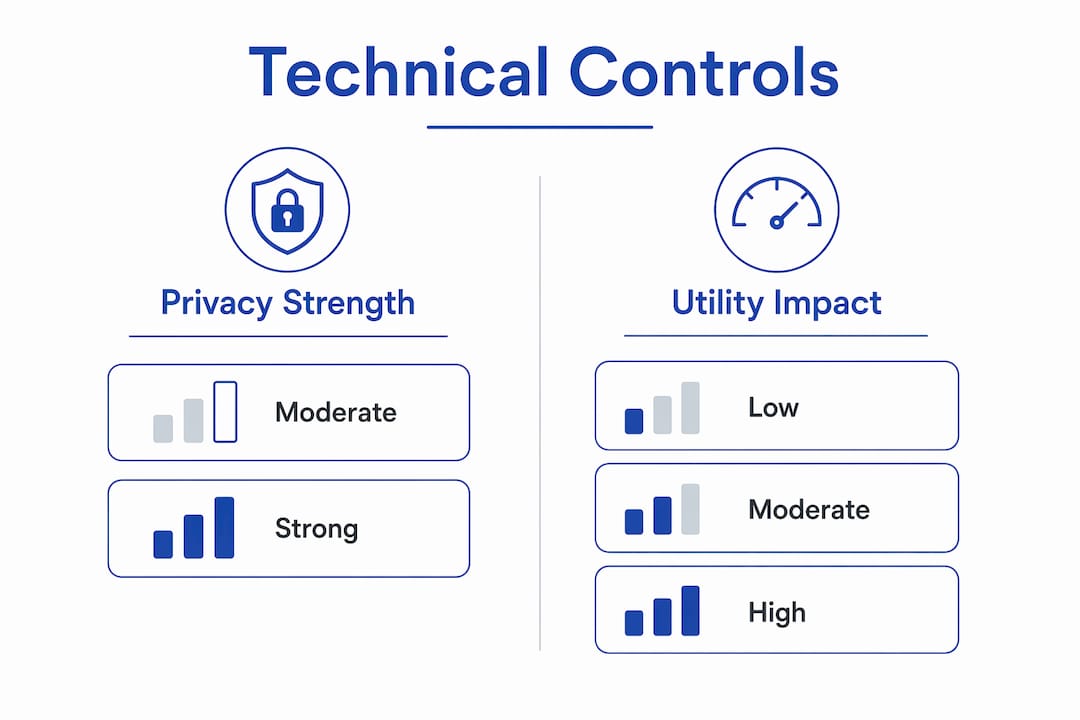
| Technique | Privacy strength | Utility impact |
|---|---|---|
| Aggregation / k-anonymity | Moderate | Low for aggregate KPIs |
| Differential privacy (epsilon budgeting) | High | Moderate to high for model training |
| Full anonymization | Highest | Significant for granular analysis |

The privacy-utility tradeoff is real: increasing privacy preservation typically reduces data utility. The practical answer is to pick techniques that are “good enough” for the business objective rather than applying blanket protections across every dataset.
A session-based differential privacy model enforces a privacy budget and restricts protected-data access to evaluated queries rather than raw-data inspection. Critically, session guarantees apply only to the public API. Exposing side-channels or allowing direct inspection of session state breaks the privacy guarantee entirely.
Pro Tip: Run parallel analyses on raw versus protected datasets before committing to a privacy parameter. Measure the loss in your key business metrics at each epsilon value. Document the chosen setting and the rationale for your audit record.
Cross-border transfers: moving EU personal data to or through the U.S.
Three transfer mechanisms are available under GDPR Chapter V:
- Adequacy decisions — the European Commission has recognized a small set of countries as providing equivalent protection. The U.S. operates under the EU-U.S. Data Privacy Framework for certified organizations.
- Standard Contractual Clauses (SCCs) with supplementary measures — the most common path for U.S. analytics teams. SCCs must be paired with a Transfer Impact Assessment (TIA) that evaluates whether U.S. surveillance law undermines the contractual protections.
- Binding Corporate Rules — practical only for large multinationals with a long approval timeline.
For most analytics teams, the operational checklist for any cross-border transfer is:
- Identify every field in the exported dataset that could identify an EU individual.
- Run a TIA documenting U.S. legal access risks and the supplementary measures applied.
- Apply encryption at rest and in transit, with key management outside U.S. jurisdiction where feasible.
- Execute SCCs with the receiving entity and store them alongside your DPA.
The U.S. National Strategy for Privacy-Preserving Data Sharing acknowledges jurisdictional complexity when combining global datasets. The simplest mitigation: process EU personal data inside isolated sessions or EU-only environments and export only aggregated, anonymized outputs.
Operational checklist: documentation that satisfies auditors
Numbered by priority:
- Article 30 processing record — name the processing activity, lawful basis, data categories, recipients, retention period, and security measures.
- Signed DPAs with every processor, including your analytics platform vendor.
- DPIA for any high-risk analytics project, with documented mitigations and residual risk.
- Legitimate interest assessment for each processing activity relying on Article 6(1)(f).
- Data flow map showing EU personal data from ingest through export, with transfer mechanisms noted.
- Retention logs confirming data is deleted or anonymized at the scheduled date.
- Breach response runbook with notification timelines (72 hours to supervisory authority, without undue delay to data subjects).
- Versioned audit trails for every analytical report and notebook, including the privacy parameters applied.
Governance steps that keep these documents current: quarterly privacy reviews tied to project kickoffs, annual incident simulation exercises, and a policy requiring that any new data source triggers a DPIA screening before analysis begins. Data governance software can automate much of the record-keeping and version control.
How to choose a privacy-first analytics tool
Selection criteria for AI-powered desktop analytics under GDPR:
- Local data processing: Raw data never leaves your environment. The vendor’s infrastructure should have zero access to your datasets.
- Built-in PII detection and anonymization: Automated identification of direct identifiers and quasi-identifiers before analysis runs.
- Reproducible audit trails: Every analysis session generates an immutable record of inputs, transformations, and outputs.
- Session-based privacy controls: Query-level access to protected data, with no raw-data export paths outside controlled boundaries.
- Export controls: PDF and notebook exports that carry embedded provenance metadata.
Vendor validation checklist before signing a contract:
- Request the DPA and confirm it meets Article 28 requirements.
- Ask for ISO 27001 or SOC 2 certification evidence and the date of the most recent external audit.
- Confirm data residency options, including EU-only or on-premises deployment.
- Request a penetration test summary or third-party audit report.
- Test automated anonymization on a sample dataset before committing.
Plotstudio is built around this model. It processes data locally on your machine, so raw datasets never reach Plotstudio’s servers. Built-in PII detection flags direct identifiers and quasi-identifiers before any statistical routine runs. Every analysis session produces a reproducible, searchable page with embedded provenance, making DPIA evidence and audit trail requirements straightforward to satisfy. Enterprise deployment on Azure supports data residency requirements for organizations that need EU-only processing environments.
Pro Tip: Ask any vendor to demonstrate anonymization on a real sample from your dataset, not a toy example. The gap between claimed and actual PII detection capability is often significant.
Balancing privacy and analytical utility in practice
The tradeoff is not binary. The goal is to find the privacy parameter that meets your minimum compliance threshold while preserving enough signal for the business decision at hand.
- Define the protected change. Identify the specific individuals or groups whose data must be protected and the re-identification risk you are mitigating.
- Set the privacy budget. For differential privacy, choose an initial epsilon range based on sensitivity of the data and regulatory expectations. Document the rationale.
- Run parallel analyses. Execute the same analysis on raw data and on protected data at multiple epsilon values or aggregation levels.
- Measure metric loss. Calculate the difference in your key business KPIs across runs. Identify the “good enough” setting where utility loss is acceptable.
- Document and freeze. Record the chosen parameters, the utility test results, and the business justification. Version-control the notebook and freeze the random seed for reproducibility.
Quasi-identifiers deserve specific attention here. ZIP code, job title, and age bracket individually look harmless, but combined with an external dataset they can re-identify individuals. Data transformation techniques like bucketing and clamping reduce quasi-identifier precision without destroying analytical value. The NITRD national strategy recommends running parallel utility tests to identify acceptable epsilon ranges for KPI-sensitive tasks.
Pro Tip: Version every dataset used in a privacy experiment separately from your production data. Mixing experimental and production runs is the fastest way to lose reproducibility and fail an audit.
Key Takeaways
GDPR compliant analytics for U.S. teams requires a lawful basis, signed DPAs, a DPIA for high-risk work, and technical controls including pseudonymization, encryption, and immutable audit trails.
| Point | Details |
|---|---|
| Lawful basis is non-negotiable | Document legitimate interest or consent before any EU personal data enters your pipeline. |
| DPIAs protect high-risk projects | Profiling and large-scale sensitive data processing require a DPIA with documented mitigations. |
| Technical controls must be demonstrable | Pseudonymization, encryption, RBAC, and immutable logs must be verifiable by auditors, not just claimed. |
| Privacy and utility can coexist | Run parallel analyses at multiple privacy parameter settings to find the “good enough” threshold for your KPIs. |
| Plotstudio supports local, auditable analytics | Local data processing, built-in PII detection, and reproducible analysis pages directly address GDPR audit requirements. |
Privacy-first analytics changes how analysts actually work
The shift to privacy-first, agentic analytics is less about adding compliance checkboxes and more about changing the default unit of work. When every analysis runs inside a reproducible session with embedded provenance, the DSAR problem largely solves itself: you know exactly which session touched which data, and you can demonstrate it.
Immutable analysis pages also change collaboration. Instead of sharing raw data files or ad hoc scripts, teams share a versioned page that carries the full analytical lineage. Auditors get a complete picture without a scavenger hunt through shared drives.
The role changes are real too. A privacy engineer needs to be involved at project kickoff, not after the model is trained. A data steward owns the processing record and the DPIA, while the analyst owns the session configuration and the privacy parameter rationale. Handoffs between these roles should be documented in the same version-controlled repository as the analysis itself. That discipline, more than any single tool, is what makes compliance durable.
Plotstudio handles the privacy-first analytics workflow for you
Analysts who need GDPR-ready, reproducible statistical work without building a compliance stack from scratch will find Plotstudio’s local processing model a direct fit. Your data never leaves your machine. PII detection and anonymization run automatically before any statistical routine executes. Every session produces a searchable, immutable analysis page that doubles as your audit trail.
For enterprise teams with data residency requirements, Plotstudio supports Azure deployment with configurable data boundaries. When you evaluate the platform, ask for the DPA, request evidence of third-party security audits, and run the PII detection on a real sample from your dataset. The AI analytics platform guide covers the full capability set and tradeoffs in detail. Ready to test it on your own data? Start with Plotstudio and run your first privacy-preserving analysis in minutes.
Useful sources and further reading
- GDPR Compliant Analytics (Fathom Analytics) — practical guidance on lawful basis assessments, DPAs, EU data isolation, and legitimate interest assessments for analytics teams.
- Managing Data Privacy Risk in Advanced Analytics (MIT Sloan Management Review) — covers the privacy-utility tradeoff, quasi-identifier risk, and formalizing privacy decision-making for regulatory audits.
- National Strategy to Advance Privacy-Preserving Data Sharing and Analytics (NITRD) — U.S. government framework for privacy-preserving analytics techniques including differential privacy and cross-jurisdictional data sharing.
- Privacy Analytics Platform — automated de-identification and auditable anonymization workflows for sensitive datasets at scale.
- Tumult Analytics Privacy Promise — technical documentation on session-based differential privacy, epsilon budgeting, and side-channel risks.
- Plotstudio AI Analytics Platform Guide — capabilities, tradeoffs, and privacy-first design of AI-powered desktop analytics.
- Plotstudio Data Governance Software Guide — governance processes, documentation practices, and record-keeping for DPIA and Article 30 compliance.
- Plotstudio Enterprise Analytics Solutions — enterprise deployment options including Azure data residency and managed security configurations.