GDPR Special Category Data: What It Is and How Researchers Handle It

Special category data is the part of personal data that Article 9 of the GDPR singles out for stronger protection: data revealing racial or ethnic origin, political opinions, religious or philosophical beliefs or trade-union membership, plus genetic data, biometric data used to identify a person, health data, and data about sex life or sexual orientation. Processing it is prohibited by default. You need both an ordinary lawful basis and a separate Article 9 condition, and for researchers that second condition is where most of the work lies.
This guide covers the list, the edge cases (what is not special category), the legal conditions that matter for research, data minimization, and the practical habits that keep a sensitive dataset defensible. It is general information, not legal advice. Your data protection officer or research governance office makes the final call for your study.
TL;DR
- Article 9 lists the special categories: racial or ethnic origin, political opinions, religious or philosophical beliefs, trade-union membership, genetic data, biometric data for unique identification, health data, and sex life or sexual orientation.
- Processing is prohibited unless you have an Article 6 lawful basis and an Article 9 condition, such as explicit consent or the research condition in Article 9(2)(j).
- Criminal data, national ID numbers and financial data are not Article 9 categories, though other rules may apply to them.
- Data minimization (Article 5(1)©) means collecting and keeping only what your research purpose needs. Pseudonymized data is still personal data.
- Choosing where analysis runs is part of minimization: keeping patient-level files on your own machine reduces the number of places the data goes.
Table of Contents
- What counts as special category data under GDPR Article 9
- What is not special category data
- The two-layer test: Article 6 plus Article 9
- Data minimization: what it means and how to apply it
- When research data reveals a special category without saying so
- Practical safeguards for researchers working with Article 9 data
- Perspective
- Trying a local agentic workflow on sensitive data
- FAQ
- Sources
What counts as special category data under GDPR Article 9
The list is closed. According to Article 9(1), the prohibition applies to personal data revealing:
- racial or ethnic origin
- political opinions
- religious or philosophical beliefs
- trade-union membership
It also covers genetic data, biometric data processed to uniquely identify a natural person, data concerning health, and data concerning a person’s sex life or sexual orientation. The European Data Protection Board groups the same seven areas as sensitive data deserving more protection.
Two words in that text matter more than they first appear.
“Revealing.” The first four categories are defined by what the data reveals, not by whether a field is literally labeled “religion.” A dataset does not need a column called “ethnicity” to raise the question. If a variable in your data reveals a protected characteristic, treat it as potentially in scope and ask your governance office early.
“For the purpose of uniquely identifying.” Biometric data counts when it is processed to identify a person. A photo is personal data, but whether it becomes biometric special category data depends on how it is processed.
Personal data versus special category data
Personal data is any information relating to an identified or identifiable person. The EDPB’s examples include names, phone numbers, identification numbers, email addresses, location data, browsing and purchase histories, photos, videos and audio recordings. Special category data is a subset of that: the part where processing is generally prohibited except in specific circumstances.
In a research dataset, the typical special category fields are easy to name:
| Research field | Special category? | Why |
|---|---|---|
| Diagnosis, lab values, medication, ICU outcomes | Yes | Health data |
| Genotype, sequencing results | Yes | Genetic data |
| Self-reported ethnicity in a survey | Yes | Racial or ethnic origin |
| Union membership in a labor panel | Yes | Trade-union membership |
| Sexual orientation in a social survey | Yes | Sex life or sexual orientation |
| Voting preference or party identification | Yes | Political opinions |
| Participant ID, date of birth, postcode | No, but personal data | Identifiers that can enable re-identification |
| Income, tax or debt figures | No | Ordinary personal data |
What is not special category data
Researchers often over- or under-classify at the edges, so these distinctions are worth knowing.
- Criminal data and national ID numbers. The Dutch supervisory authority explains that these are not Article 9 special categories, although separate rules and national requirements can apply to them. Under the UK regime, for instance, criminal offence data has its own provisions alongside Article 9.
- Financial information. Sensitive does not mean special category. The Danish authority lists matters such as taxes and debts as ordinary personal information, with only the Article 9 types counted as sensitive data in that classification.
The practical rule: “sensitive” in everyday speech is broader than “special category” in law. A bank balance can be highly sensitive and still sit outside Article 9. That does not make it unprotected. It still needs a lawful basis and every other GDPR principle.
The two-layer test: Article 6 plus Article 9
The most common mistake is treating consent, or the research purpose alone, as enough. The European Commission’s framework describes legal grounds for processing as a general lawful basis plus, for special categories, an additional condition. You need both.
- An Article 6 lawful basis. Examples include consent, a task carried out in the public interest, or legitimate interests. Which one fits depends on your institution and study design. Many universities rely on public task for research, and your governance office will tell you which they use.
- An Article 9(2) condition. Two are most relevant to researchers.
Explicit consent, Article 9(2)(a)
Article 9(2)(a) permits processing on the basis of explicit consent for one or more specified purposes, except where domestic law provides that consent cannot lift the prohibition. Note the word “specified”: broad, open-ended consent language is a weak foundation for a dataset you plan to reuse.
Research and statistics, Article 9(2)(j)
For archiving in the public interest, scientific or historical research, or statistical purposes, the Commission lists a basis in EU or national law as the condition, and notes that Member States may add further conditions, including limitations, for genetic, biometric or health data. In practice this means the rules for the same dataset can differ between, say, Germany and France.
Under the UK GDPR, Article 9(2)(j) requires that the processing accord with Article 84B and rest on domestic law with suitable, specific safeguards. Article 9(5) points to section 10 of the Data Protection Act 2018. That section and Schedule 1 condition 4 require necessity for archiving, scientific or historical research, or statistical purposes, compliance with Article 89(1) as supplemented by UK law, and processing in the public interest.
If you document these two layers per dataset, you will answer most reviewer, ethics board and audit questions before they are asked. We cover how to log that reasoning in our guide for controllers who need Article 6 and 9 proof.

Data minimization: what it means and how to apply it
Data minimization is the principle in Article 5(1)©: personal data must be adequate, relevant and limited to what is necessary for the purpose. The European Commission’s principles page turns this into four habits:
- use anonymous data where possible
- assess how much data you actually need
- exclude irrelevant data
- limit storage to what is necessary, with longer retention for research or archiving possible under appropriate safeguards
The research regime also bends the neighboring principles. Under Article 5, further processing for scientific research or statistics is not considered incompatible with the original purpose when Article 89(1) safeguards are followed, and longer retention is allowed with appropriate technical and organizational measures. Those safeguards usually include minimization, so the flexibility is conditional on you doing it.
Minimization in a real analysis project
Here is how this plays out for a clinical or social science dataset:
- Decide the variables before you receive the extract. Write the analysis plan first, then request only the columns it needs. If your model uses age band and diagnosis group, you probably do not need exact date of birth.
- Strip direct identifiers early. Names, addresses, hospital numbers and contact details rarely belong in an analysis file.
- Coarsen quasi-identifiers. Replace exact dates with intervals, postcodes with regions, and rare categories with grouped ones.
- Check combinations, not just columns. The UK Data Service advises assessing re-identification risk from combined variables: a tabular dataset can look low-risk and still be identifiable or sensitive once variables are cross-tabulated.
- Set access by risk. Share only what is necessary and match access controls to the risk level.
- Document it. Record what you processed, what you removed and why.
Pseudonymized is not anonymous
This point catches many doctoral students. According to the University of the West of England’s research governance standard, pseudonymized data remains personal data because re-identification remains possible. Information falls outside GDPR only when individuals are no longer identifiable. A study ID with a key table held somewhere is pseudonymized, so GDPR, including Article 9 for health data, still applies.

When research data reveals a special category without saying so
The wording of Article 9 is about data that reveals a category. That has three practical consequences for analysts.
- Proxies. A free-text field, a clinic name, a medication list or a dietary variable can disclose health or belief even when no field is labeled that way. If a variable would let a reasonable reader infer a protected characteristic, flag it in your data inventory.
- Derived variables. A risk score, a classifier output or a cluster label built from health data is itself health information about an individual, and you should treat it the same way as its inputs.
- Linkage. Joining a low-risk file to another can create a special category dataset that neither file was on its own.
We are not aware of a bright-line rule that settles every inference case, so these are conservative working practices rather than settled law. When a variable sits in a gray area, ask your data protection officer and record the decision in your project documentation.
Practical safeguards for researchers working with Article 9 data
The law sets the conditions. The daily risk comes from workflow. These are the places sensitive data tends to leak in research:
- Spreadsheets emailed between collaborators. Use controlled, institutional storage instead.
- Uploading raw files to online tools. Every upload is a new place the data lives and a new party in your data flow, which your data protection impact assessment should account for.
- Untracked cleaning steps. If you cannot show how a dataset went from raw to analysis-ready, you cannot show minimization happened.
- Outputs with small cells. Tables with very small counts can re-identify people. Check disclosure risk before sharing results.
Keeping analysis local is one of the simplest controls. Our pieces on on-device data analysis and provenance and audit-ready data lineage go into how to keep the chain from raw file to published figure inspectable. For clinical teams specifically, see secure analytics for healthcare researchers.
Perspective
We built PlotStudio AI as agentic analytics for researchers because the people most affected by Article 9 are often the ones least served by general-purpose chat-with-data tools. A PhD student in clinical medicine, an NHS-based research registrar or a biostatistician in an academic medical center cannot paste patient-level records into a web chat window, and should not have to choose between privacy and a rigorous analysis.
That is why PlotStudio AI can run analyses locally on the researcher’s machine, so datasets need not be uploaded to a conventional cloud analytics platform. It is why Plan Mode lets you review and modify the proposed methods, assumptions and steps before anything executes, and why the code, outputs and statistics stay available as a reproducible record that a supervisor, reviewer or governance officer can inspect.
We see PlotStudio AI as a layer in the research toolkit, next to R, Python, Stata, SPSS, SAS, RStudio and Jupyter, not a replacement for them. Those tools provide the statistical computing. The agentic layer plans, executes, inspects, validates and documents the whole analysis. Compliance still belongs to you and your institution, but a documented, local, reviewable workflow makes the minimization and accountability story much easier to tell.
Aymen
Trying a local agentic workflow on sensitive data
If your next project involves health, genetic or survey data covered by Article 9, PlotStudio AI lets you connect tabular data, define the analytical objective and review the agent’s plan before it runs code, with analyses able to run locally. Completed work is kept as searchable Analysis Pages and can be exported as notebooks and PDF reports.
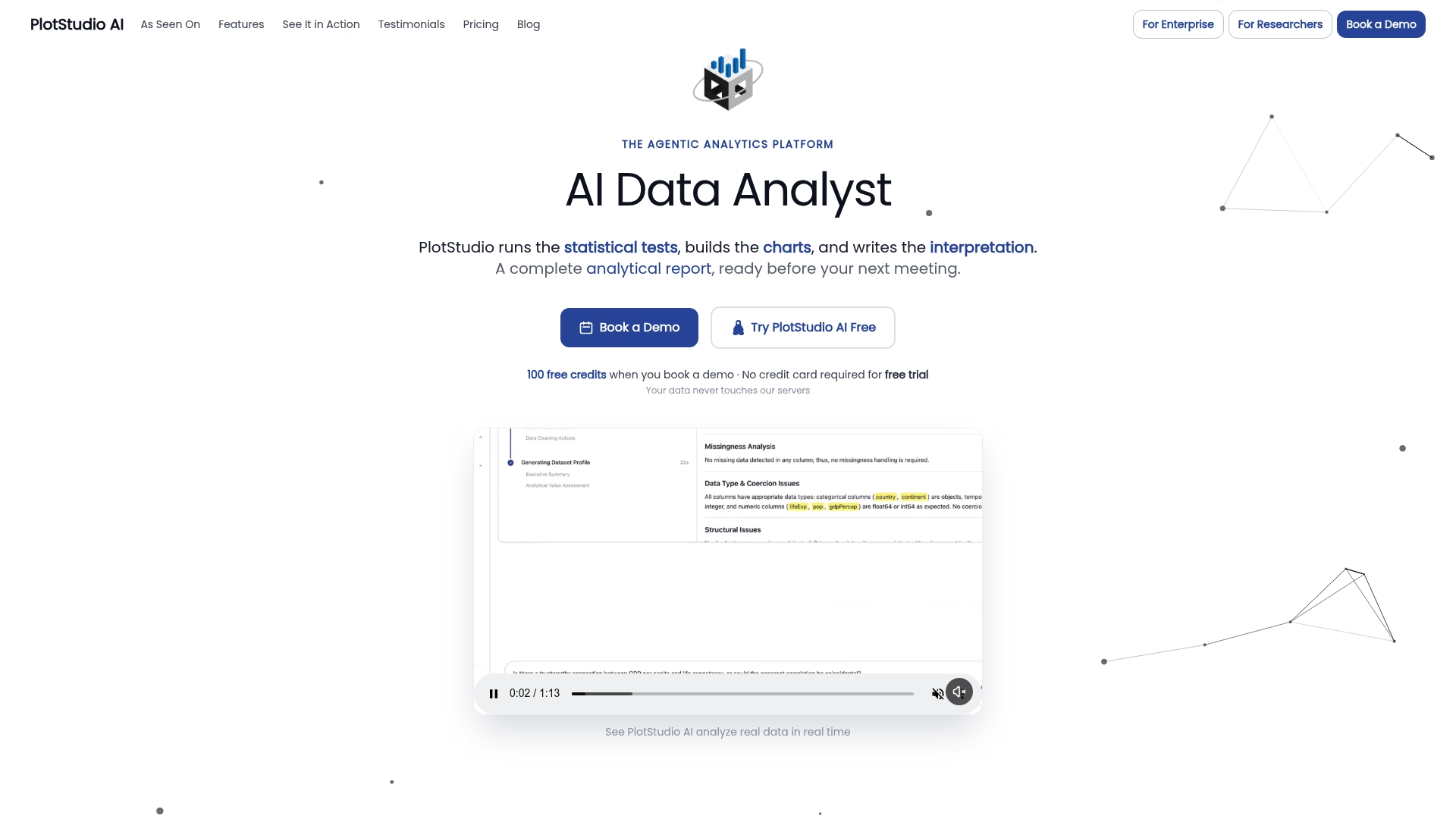
You can start with the Free Trial on the pricing page. Plans there include Managed Credits at $69.99 per month and Bring Your Own Key at $39.99 per month. The academic page lists Bring Your Own Key at $399.90 per year. Organizations that need a managed deployment can look at the enterprise page, which lists a one-off pilot fee of $500.
FAQ
What are the special categories of data under GDPR?
Article 9 lists data revealing racial or ethnic origin, political opinions, religious or philosophical beliefs, or trade-union membership, plus genetic data, biometric data for unique identification, health data, and data about sex life or sexual orientation. The list is closed, so categories outside it, such as financial data, are not special category data, though they are still personal data.
What is the difference between personal data and special category data?
Personal data is any information relating to an identifiable person, such as a name, email address or location. Special category data is the Article 9 subset that gets more protection and may only be processed when an Article 6 lawful basis and an Article 9 condition both apply.
What is data minimization in simple terms?
It is the Article 5(1)© requirement to keep personal data adequate, relevant and limited to what your purpose needs. For researchers, that means requesting only the variables your analysis plan uses, removing direct identifiers early, limiting how long you store data, and documenting what you did.
Can researchers process special category data without consent?
Potentially, yes. Article 9(2)(j) provides a research condition, but it depends on a basis in EU or national law and suitable safeguards. In the UK, that is set through section 10 and Schedule 1 of the Data Protection Act 2018. Your institution’s governance office can confirm which route applies to your study.
Is pseudonymized data still covered by GDPR?
Yes. Pseudonymized data remains personal data because people can still be re-identified, for example through a key file. Only information in which individuals are no longer identifiable falls outside GDPR.
Sources
- Article 9, Regulation (EU) 2016/679 (legislation.gov.uk)
- Data protection basics, EDPB
- What are personal data? Autoriteit Persoonsgegevens
- What is personal data? Datatilsynet
- Legal grounds for processing data, European Commission
- Principles of the GDPR, European Commission
- Data Protection Act 2018, section 10
- Regulation (EU) 2016/679, Chapter II as adopted
- Data protection regulations and sharing research data, UK Data Service
- UWE GDPR Research Governance Standard