HIPAA De-Identification: A Compliance Officer’s Playbook

Use Safe Harbor when you can remove all 18 identifiers and accept the resulting reduction in data utility. Use Expert Determination when you need to retain dates, granular geography, or other high-value fields and can commission a documented statistical analysis showing a “very small” re-identification risk. Both paths satisfy 45 CFR §164.514(a) when executed correctly, and HHS/OCR guidance treats them as equally valid routes to removing HIPAA protections from health information.
Three steps your team can take right now:
- Run a field inventory. List every data element in the dataset, classify each as a direct identifier, quasi-identifier, or sensitive attribute, and flag any field that appears in the Safe Harbor list.
- Define recipients and use-case. A public research release has a very different threat model than a closed analytics environment. The recipient profile drives both method selection and risk thresholds.
- Choose your path. If the field inventory shows you can remove all 18 identifiers without destroying the analysis, proceed with Safe Harbor. If retaining even one of those fields is analytically necessary, scope an Expert Determination engagement.
Key Takeaways
HIPAA de-identification requires either removing all 18 Safe Harbor identifiers with no actual knowledge of residual identification, or commissioning a documented Expert Determination showing a very small re-identification risk under 45 CFR §164.514.
| Point | Details |
|---|---|
| Two valid methods | Safe Harbor (remove 18 identifiers) and Expert Determination (documented statistical analysis) both satisfy §164.514(a). |
| Expert Determination documentation | Must include a signed attestation, reproducible technical report, transformation scripts, and risk-metric outputs retained for the life of the dataset. |
| Re-evaluation is mandatory | Any change to the dataset, recipient pool, or available external data triggers a new risk assessment. |
| Quasi-identifiers matter for Safe Harbor | Removing the 18 identifiers does not eliminate re-identification risk from remaining quasi-identifier combinations in rare-disease or small-population datasets. |
| Plotstudio for reproducible workflows | Plotstudio’s local execution, pre-approved analysis plans, and exportable reproducibility packages align directly with Expert Determination documentation requirements. |
Table of Contents
- What “de-identification” means under HIPAA and who must comply
- How Safe Harbor and Expert Determination compare
- Safe Harbor implementation: the 18 identifiers, checklist, and caveats
- Expert Determination: qualifications, risk framing, and required documentation
- How experts measure re-identification risk
- Preparation: data inventory, threat modeling, and legal controls
- Operational modes for applying de-identification
- Recordkeeping for Safe Harbor and Expert Determination
- Common failures and proven best practices
- A step-by-step operational checklist
- How to produce a reproducible, auditable Expert Determination
- How compliance teams actually run de-identification projects
- Plotstudio supports defensible Expert Determination workflows
- A practitioner’s perspective on what actually matters
- Sources
What “de-identification” means under HIPAA and who must comply
Under 45 CFR §164.514, health information is considered not individually identifiable when it neither identifies an individual nor provides a reasonable basis for identification. Once that standard is met through one of the two approved methods, the information is no longer protected health information (PHI) and falls outside the Privacy Rule’s restrictions on use and disclosure.
Who must comply:
- Covered entities — health plans, healthcare clearinghouses, and healthcare providers that transmit health information electronically
- Business associates — vendors and contractors that create, receive, maintain, or transmit PHI on behalf of a covered entity
When data is properly de-identified, a covered entity or business associate may use or share it freely without patient authorization, a data use agreement, or any other Privacy Rule constraint. That freedom is the practical payoff of the process.
One distinction worth drawing clearly: HIPAA de-identification is a regulatory standard, not a general concept of anonymization. State laws (California’s CMIA, for example) and IRB protocols often impose stricter requirements. A dataset that satisfies §164.514 may still require additional controls before an IRB will approve its use in research, or before it can be shared across state lines. HIPAA compliance is the floor, not the ceiling.
How Safe Harbor and Expert Determination compare
The HHS/OCR guidance frames the two methods as complementary rather than competing. Safe Harbor is a rule-based checklist: remove the 18 specified identifiers and confirm you have no actual knowledge that the remaining data could identify anyone. Expert Determination is a statistical and scientific process: a qualified person applies accepted methods, documents that re-identification risk is “very small,” and retains that documentation.
Safe Harbor — when it fits:
- Dataset fields map cleanly to the 18-identifier list with no analytical loss
- Speed and low cost matter more than data granularity
- The use-case does not require dates, ZIP codes below the three-digit level, or rare-disease indicators
- Internal teams can execute without external statistical expertise
Expert Determination — when it fits:
- Dates of service, admission, or birth are analytically necessary
- Geographic granularity below state level is required for spatial analysis
- The dataset contains rare diagnoses or small subpopulations where Safe Harbor would suppress too many records
- A documented, reproducible risk analysis is needed for publication or regulatory submission
Limited Data Set with a Data Use Agreement sits between the two. It allows retention of dates and geographic data down to city, state, and ZIP code, but requires a signed DUA and restricts use to research, public health, or healthcare operations. As PMC research on de-identification modes notes, Safe Harbor removes the 18 identifiers but can cause significant information loss for analysis, while Expert Determination preserves utility at the cost of greater documentation demands. A Limited Data Set is worth considering when the full Expert Determination overhead is disproportionate to the project’s scope.
Safe Harbor implementation: the 18 identifiers, checklist, and caveats
The HHS handout lists the 18 categories that must be removed or transformed under §164.514(b)(2)(i). Every one of them must be addressed before Safe Harbor is satisfied.
| # | Identifier Category | Notes |
|---|---|---|
| 1 | Names | All names, including nicknames and initials |
| 2 | Geographic subdivisions smaller than a state | ZIP codes with populations under 20,000 must be suppressed; first three digits may be retained if the three-digit ZIP covers more than 20,000 people |
| 3 | All elements of dates (except year) related to an individual | Dates of birth, admission, discharge, death; ages over 89 must be aggregated to “90 or older” |
| 4 | Phone numbers | All telephone numbers |
| 5 | Fax numbers | All fax numbers |
| 6 | Email addresses | All email addresses |
| 7 | Social Security numbers | Full and partial SSNs |
| 8 | Medical record numbers | All MRN formats |
| 9 | Health plan beneficiary numbers | All plan ID formats |
| — | Account numbers | Financial and institutional account numbers |
| — | Certificate/license numbers | Professional and state license numbers |
| 12 | Vehicle identifiers and serial numbers | Including license plate numbers |
| — | Device identifiers and serial numbers | Including implanted device serial numbers |
| — | Web URLs | All uniform resource locators |
| — | IP addresses | Full and partial IP addresses |
| — | Biometric identifiers | Finger and voice prints |
| — | Full-face photographs and comparable images | Any image that could identify the individual |
| 18 | Any other unique identifying number, characteristic, or code | Catch-all for identifiers not explicitly listed above |
Implementation checklist:
- Complete a field-by-field inventory against the 18 categories above
- Remove or transform each identified field; for ZIP codes, apply the three-digit exception only after confirming the population threshold
- Aggregate ages above 89 to a single “90 or older” category
- Confirm no actual knowledge exists that the remaining data could identify any individual
- Document the inventory, transformations applied, and the actual-knowledge confirmation
Practical caveats. The Safe Harbor list was compiled in the 1990s. As the HIPAA Journal notes, institutions should consider modern identifiers such as social media handles, persistent device IDs, and genomic data that are not explicitly named in the 18 categories but can easily re-identify individuals when combined with public data. The catch-all category 18 provides some coverage, but a conservative compliance team will explicitly address these in their inventory. Similarly, the Safe Harbor list from Loyola University Chicago’s HIPAA guidance reinforces that any code or characteristic that could be used to re-identify must be treated as an identifier regardless of whether it appears by name in the regulation.
Expert Determination: qualifications, risk framing, and required documentation
Expert Determination is the right path when preserving data utility is analytically necessary and a qualified expert can document that re-identification risk is “very small.” The regulation does not define “very small” numerically, which gives experts methodological flexibility but also places the burden of justification entirely on their documentation.
What qualifies someone as an expert?
The regulation requires a person with “appropriate knowledge of and experience with generally accepted statistical and scientific principles and methods for rendering information not individually identifiable.” In practice, this means:
- Demonstrated experience with Statistical Disclosure Control (SDC) methods
- Familiarity with the specific data type (clinical, claims, genomic) and its re-identification literature
- Ability to produce reproducible, independently verifiable work
- Prior determinations that have withstood regulatory or peer scrutiny
An expert does not need to hold a specific credential or degree. A biostatistician, epidemiologist, or data privacy specialist with documented experience in de-identification all qualify, provided their methods and results are fully documented.
Required deliverables under 45 CFR §164.514(b)(1):
| Deliverable | Required Content |
|---|---|
| Technical report | Data description, transformations applied, risk metrics computed, validation tests, assumptions, and scope |
| Signed attestation | Expert’s name, credentials, date, scope of determination, release conditions, and statement that risk is very small |
| Methods documentation | Statistical models used, parameter choices, software and version, and reproducibility instructions |
| Risk metric outputs | Computed k-anonymity values, linkage risk estimates, or other accepted metrics with interpretation |
| Retention record | Covered entity must retain documentation per §164.514(b)(1) — no specific period is mandated, but aligning with the six-year general HIPAA retention standard is a defensible practice |
The attestation and technical report are the two deliverables auditors look for first. Insufficient documentation is among the most common Expert Determination failures. A report that describes conclusions without reproducible methods is not defensible.
How experts measure re-identification risk
The goal of any risk analysis is to demonstrate that the probability of re-identifying any individual in the dataset is “very small” given a realistic attacker and the available external data. Several metrics are accepted in practice.
Core metrics:
- k-anonymity: Every record in the dataset is indistinguishable from at least k-1 other records on the set of quasi-identifiers. A k of 5 means no record is unique among fewer than 5 others. Higher k reduces risk but also reduces utility.
- Equivalence class size: The distribution of group sizes across quasi-identifier combinations. A dataset with many equivalence classes of size 1 or 2 has high re-identification risk regardless of its average k.
- Population uniqueness: The proportion of records that correspond to a unique individual in the underlying population, estimated using population registers or census data. This is particularly relevant for rare-disease datasets.
- l-diversity: An extension of k-anonymity requiring that each equivalence class contains at least l distinct values of the sensitive attribute, reducing inference attacks even when re-identification is prevented.
- t-closeness: Requires that the distribution of sensitive attributes within each equivalence class approximates the overall dataset distribution, guarding against attribute disclosure.
- Record linkage simulation: A probabilistic or deterministic linkage of the de-identified dataset against a realistic external dataset (voter rolls, public records, social media) to estimate the actual proportion of records that can be re-identified.
- Per-record risk score: An individual probability of re-identification computed for each record, allowing targeted suppression of high-risk outliers rather than blanket generalization.
A simple k-anonymity example. Suppose a dataset contains age, three-digit ZIP code, and sex. If the combination “age 34, ZIP 606, Female” appears in only one record, that record has k=1 and is unique. Generalizing age to a five-year band (“30–34”) and confirming the resulting group contains at least five records raises k to 5 for that combination. The expert documents the pre- and post-transformation k distributions and confirms no equivalence class falls below the chosen threshold.
SDC transformation techniques and their trade-offs:
- Generalization: Replaces specific values with ranges or categories (exact age → age band). Preserves distribution shape but reduces precision.
- Suppression: Removes records or cells that cannot be generalized to meet the k threshold. Introduces missingness; can bias analyses if suppressed records are non-random.
- Microaggregation: Replaces individual values with group means or medians. Useful for continuous variables; distorts variance.
- Noise/perturbation: Adds calibrated random noise to numeric fields. Preserves aggregate statistics but individual values are no longer exact.
- Differential privacy: Provides a mathematical privacy guarantee for aggregate outputs by injecting noise calibrated to the query’s sensitivity. Appropriate for published statistics and query interfaces, less so for record-level research datasets.
The AccountableHQ guidance on Expert Determination recommends combining multiple SDC techniques and validating with linkage simulations or hold-out testing to demonstrate residual risk is “very small” for the anticipated recipient.
Pro Tip: Document your risk threshold choice explicitly. State the threshold (e.g., per-record risk below 0.09, or k ≥ 5 across all equivalence classes), the rationale for choosing it, and the external datasets used in linkage testing. Auditors want to see that the threshold was set before the analysis ran, not chosen after the fact to make the numbers work. For data transformation techniques like generalization and suppression, record the parameter values and software version so the analysis is reproducible.
Preparation: data inventory, threat modeling, and legal controls
Good de-identification starts before any transformation runs. The preparation phase determines whether the final output is defensible or fragile.
Pre-work checklist:
- Inventory all fields. Document every variable in the dataset: name, data type, example values, and source system. Flag each as a direct identifier (name, SSN), quasi-identifier (age, ZIP, sex, diagnosis), or sensitive attribute (HIV status, mental health diagnosis).
- Classify quasi-identifiers by linkage risk. Cross-reference with publicly available datasets your anticipated attacker could realistically access. Voter rolls, census data, and social media profiles are the most common external linkage sources.
- Define recipients and use-case precisely. A dataset released to a closed academic consortium has a different threat model than one posted to a public repository. The recipient profile sets the attacker model.
- Capture data lineage. Document where each field originates, how it was collected, and whether it has been transformed previously. Lineage gaps create audit vulnerabilities.
- Run exploratory profiling. Use exploratory data analysis to identify rare values, outliers, and small subpopulations before choosing transformation parameters. A field with 99% common values and 1% rare entries may require targeted suppression rather than uniform generalization.
Threat modeling. Three attacker profiles are standard in the de-identification literature and endorsed by AccountableHQ’s practitioner guidance:
- Prosecutor: Knows a specific individual is in the dataset and attempts to confirm their record. Worst-case scenario; drives the most conservative risk thresholds.
- Journalist: Has a list of individuals of public interest and attempts to find any of them in the dataset. Intermediate threat; realistic for public-facing releases.
- Marketer: Has no specific target but attempts to re-identify as many records as possible for commercial use. Drives volume-based linkage risk assessments.
Document which attacker profile applies to your release, and test linkage against datasets that attacker could realistically access.
Legal and contractual controls before release:
- Execute a Data Use Agreement (DUA) for any Limited Data Set release
- Confirm access controls at the recipient end (role-based access, audit logging)
- Verify that downstream re-identification is contractually prohibited
- Align with IRB requirements if the data will be used in human subjects research
Operational modes for applying de-identification
PMC research on clinical de-identification modes identifies three primary operational patterns, each with distinct governance and engineering implications.
Repository-wide batch processes the entire dataset once, producing a static de-identified copy. This is the most common approach for research data releases and public datasets. It is reproducible and easy to audit, but the de-identified copy becomes stale as the source data changes. Any schema change or addition of new records requires re-running the full pipeline.
Cohort-specific de-identification processes a defined subset of records for a specific study or recipient. It allows tighter tailoring of transformations to the cohort’s characteristics, which often preserves more utility than a blanket repository-wide approach. The trade-off is governance overhead: each cohort requires its own documentation, risk assessment, and potentially its own expert attestation.
On-demand/query-level de-identification applies transformations at query time, returning de-identified results without storing a separate copy. This reduces storage of multiple dataset versions, but as the PMC research notes, it requires robust real-time tokenization and strict access controls to remain defensible. Reproducibility is harder to guarantee unless query logs and transformation parameters are captured immutably.
QA and governance tasks across all modes:
- Validate transformation outputs against the risk-metric thresholds before any release
- Run automated checks for residual identifiers (regex patterns for SSNs, phone numbers, email addresses)
- Maintain access controls and audit logs at both the source and de-identified environments
- Document the mode chosen and the rationale in the project record
- For batch and cohort modes, version the de-identified output and link it to the transformation script and parameter file that produced it
Recordkeeping for Safe Harbor and Expert Determination
Documentation is required for Expert Determination under 45 CFR §164.514(b)(1) and strongly recommended for Safe Harbor to demonstrate the absence of actual knowledge. An undocumented Safe Harbor determination is difficult to defend if OCR later questions whether a field was properly removed.
Minimum documentation elements:
- Data provenance record: Source system, extraction date, record count, and schema version
- Field inventory: Every field assessed, its classification, and the transformation or removal applied
- Transformation scripts: Versioned code with parameter files; stored in a location that cannot be retroactively edited
- Risk-metric outputs: Computed values for k-anonymity, linkage risk, or other metrics used, with the threshold and rationale
- Expert attestation: Signed, dated, with scope, release conditions, and the “very small risk” conclusion
- DUAs and access agreements: Copies of all agreements governing the de-identified data’s use
- Actual-knowledge confirmation: For Safe Harbor, a written statement that no team member has knowledge that the remaining data could identify any individual
Retention recommendations:
Align with the general HIPAA six-year retention standard as a baseline. Retain documentation for the life of the de-identified dataset plus six years. Trigger a new version of the documentation when the source schema changes, new records are added, or the recipient or use-case changes. Store documentation in an immutable or write-once system where possible; version-controlled repositories (Git, for example) provide an auditable change history.
Common failures and proven best practices
The most defensible de-identification programs treat the process as ongoing risk management, not a one-time project. HHS/OCR guidance is explicit: a determination is context-dependent and must be revisited when data, recipients, or available external datasets change.
Top pitfalls:
- One-time mindset. A determination made in 2022 against the external datasets available then may not hold in 2026, when new public databases have been released. No re-evaluation cadence means silent risk accumulation.
- Weak expert documentation. A report that states conclusions without reproducible methods, parameter values, or validation tests will not survive an OCR audit. The attestation must be signed and dated; a verbal or informal sign-off is not sufficient.
- Ignoring quasi-identifiers. Removing the 18 Safe Harbor identifiers does not eliminate re-identification risk if the remaining fields (diagnosis, procedure, admission year, three-digit ZIP) form a unique combination for rare-disease patients. Quasi-identifier analysis is required even for Safe Harbor releases.
- Failing to re-evaluate after change. Adding new fields to the dataset, changing the recipient pool, or releasing data publicly after it was originally scoped for a closed environment all require a fresh risk assessment.
- Modern identifiers overlooked. Social media handles, persistent device IDs, and genomic sequences are not named in the 18-identifier list but can re-identify individuals when linked to public data. The catch-all category 18 applies, but teams must explicitly address these in their inventory.
Best practices:
- Set a recurring review cadence (annually at minimum, or triggered by any of the changes above)
- Integrate de-identification governance with your broader data governance program so schema changes automatically trigger a review
- Train data recipients on re-identification prohibitions and the terms of any DUA
- Use tokenization with key management for any fields that need to be re-linked internally but must appear de-identified externally
- For Expert Determination, combine at least two SDC techniques and validate with a linkage simulation before finalizing the report
Red flags for auditors and reviewers:
- No signed, dated attestation from a named expert
- Risk metrics reported without the threshold or rationale
- Transformation scripts not retained or not versioned
- No field inventory documenting what was removed and what was retained
- A Safe Harbor determination with no actual-knowledge confirmation
A step-by-step operational checklist
This checklist applies to both Safe Harbor and Expert Determination projects. Steps 4 through 6 diverge by method.
- Scope the project. Define the dataset, the intended recipients, the use-case, and the applicable regulatory requirements (HIPAA, state law, IRB).
- Inventory fields. Classify every field as direct identifier, quasi-identifier, or sensitive attribute. Use a data profiling tool to surface rare values and small subpopulations.
- Build a threat model. Select the attacker profile (prosecutor, journalist, marketer) and identify the external datasets that attacker could realistically access. 4a. Safe Harbor path: Remove all 18 identifiers per the checklist in Section 4. Apply the ZIP three-digit exception only after confirming the population threshold. Confirm no actual knowledge of residual identification. 4b. Expert Determination path: Engage a qualified expert. Define scope, transformations, and risk-metric thresholds before analysis begins. Run SDC transformations, compute risk metrics, and validate with linkage simulation.
- Validate outputs. Run automated checks for residual identifiers. Verify risk metrics meet the stated thresholds. For Expert Determination, have the expert review validation results before signing the attestation.
- Document and retain. Assemble the full documentation package (field inventory, transformation scripts, risk-metric outputs, attestation, DUAs). Store in a versioned, immutable system.
- Release with controls. Execute DUAs with recipients. Confirm access controls and audit logging at the recipient end.
- Monitor and re-evaluate. Set calendar triggers for annual review. Define change triggers: new fields, new recipients, new external datasets, schema changes. Re-run the relevant steps when any trigger fires.
Quick re-evaluation triggers:
- A new public dataset is released that could link to your quasi-identifiers
- The recipient pool expands or changes (e.g., from a closed consortium to a public repository)
- New fields are added to the source schema
- A re-identification incident is reported involving similar data
How to produce a reproducible, auditable Expert Determination
The expert deliverables must include a reproducible technical report and a signed attestation; both must allow independent verification. A determination that cannot be reproduced from its documentation is not defensible under audit.
Analysis plan template (written before any code runs):
- Data description: source, record count, schema version, extraction date
- Quasi-identifiers selected for analysis and rationale for inclusion/exclusion
- Transformations to be applied: method, parameters, and software
- Risk models to be computed: metrics, thresholds, and interpretation criteria
- Validation tests: linkage simulation datasets, hold-out test design, pass/fail criteria
- Scope and release conditions: recipient, use-case, and any restrictions on downstream use
Required deliverables:
Provenance recommendations. Version every dataset snapshot with a hash or checksum. Store transformation scripts in a version-controlled repository with commit history. Export analysis notebooks (R Markdown, Jupyter) as both executable files and rendered PDFs so reviewers can read results without re-running code. Use immutable log storage for risk-metric outputs so values cannot be altered after the attestation is signed. These practices align with the statistical analysis methodology standards that peer-reviewed research requires and that OCR auditors increasingly expect.
How compliance teams actually run de-identification projects
Most de-identification projects follow a predictable lifecycle, but the friction points are rarely where teams expect them to be.
Project intake and stakeholder alignment is where most delays originate. The privacy officer needs to confirm the legal basis for the release, the data scientist needs a complete schema, legal needs to review the DUA template, and the requesting researcher needs to articulate the use-case precisely enough to scope the threat model. Getting all four parties aligned in the first two weeks determines whether the project takes six weeks or six months.
Expert scoping is the second common delay. Finding a qualified expert who has worked with the specific data type (claims vs. EHR vs. genomic), who can produce a reproducible report, and who has availability within the project timeline is harder than most teams anticipate. Build at least three weeks of lead time into the project plan for Expert Determination engagements.
Role map for a typical project:
- Privacy officer: Regulatory oversight, method selection, DUA execution, and final release approval
- Data scientist: Field inventory, transformation implementation, risk-metric computation, and validation testing
- Security engineer: Access controls, tokenization key management, audit logging, and immutable storage setup
- Legal counsel: DUA review, state-law compliance check, and IRB coordination if applicable
- External or internal expert: Analysis plan authorship, SDC technique selection, risk-metric interpretation, and attestation signing
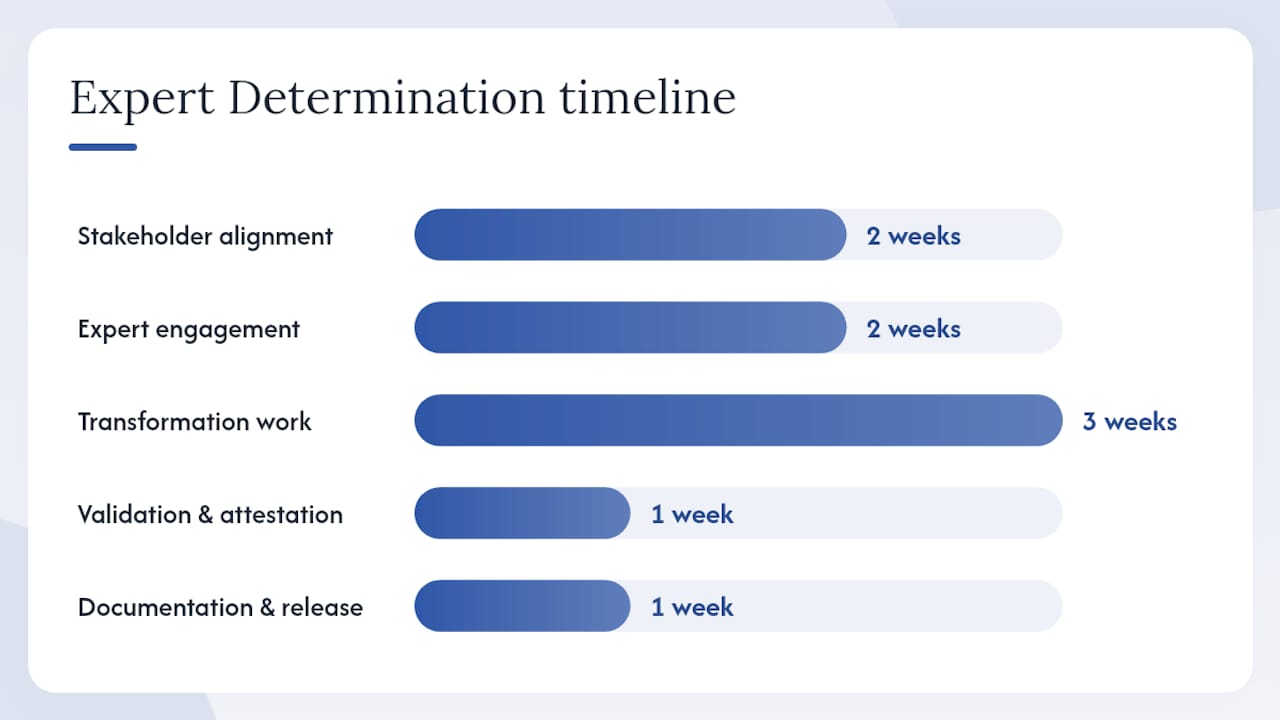
Realistic timeline for Expert Determination:
- Weeks 1–2: Stakeholder alignment, field inventory, use-case definition
- Weeks 3–4: Expert engagement, analysis plan drafting and approval
- Weeks 5–7: Transformation implementation, risk-metric computation, linkage simulation
- Week 8: Validation, expert review, attestation signing
- Week 9: Documentation assembly, DUA execution, release
Safe Harbor projects typically complete in two to three weeks when the field inventory is clean and the dataset is well-documented.
Common escalation points. Rare-disease subpopulations that cannot be generalized to meet k thresholds without destroying analytical value. ZIP codes in rural areas that fall below the 20,000-person threshold. Dates of service that are analytically necessary but push the dataset into Expert Determination territory. Each of these requires a documented decision, not an informal workaround.
Plotstudio supports defensible Expert Determination workflows
Compliance teams running Expert Determination projects face a documentation problem as much as a statistical one. The analysis must be reproducible, the transformations must be versioned, and the risk-metric outputs must be tied immutably to the dataset snapshot the expert reviewed. Fragmented toolchains — a Python script here, a spreadsheet there, a PDF report assembled manually — create exactly the audit gaps that OCR investigations expose.
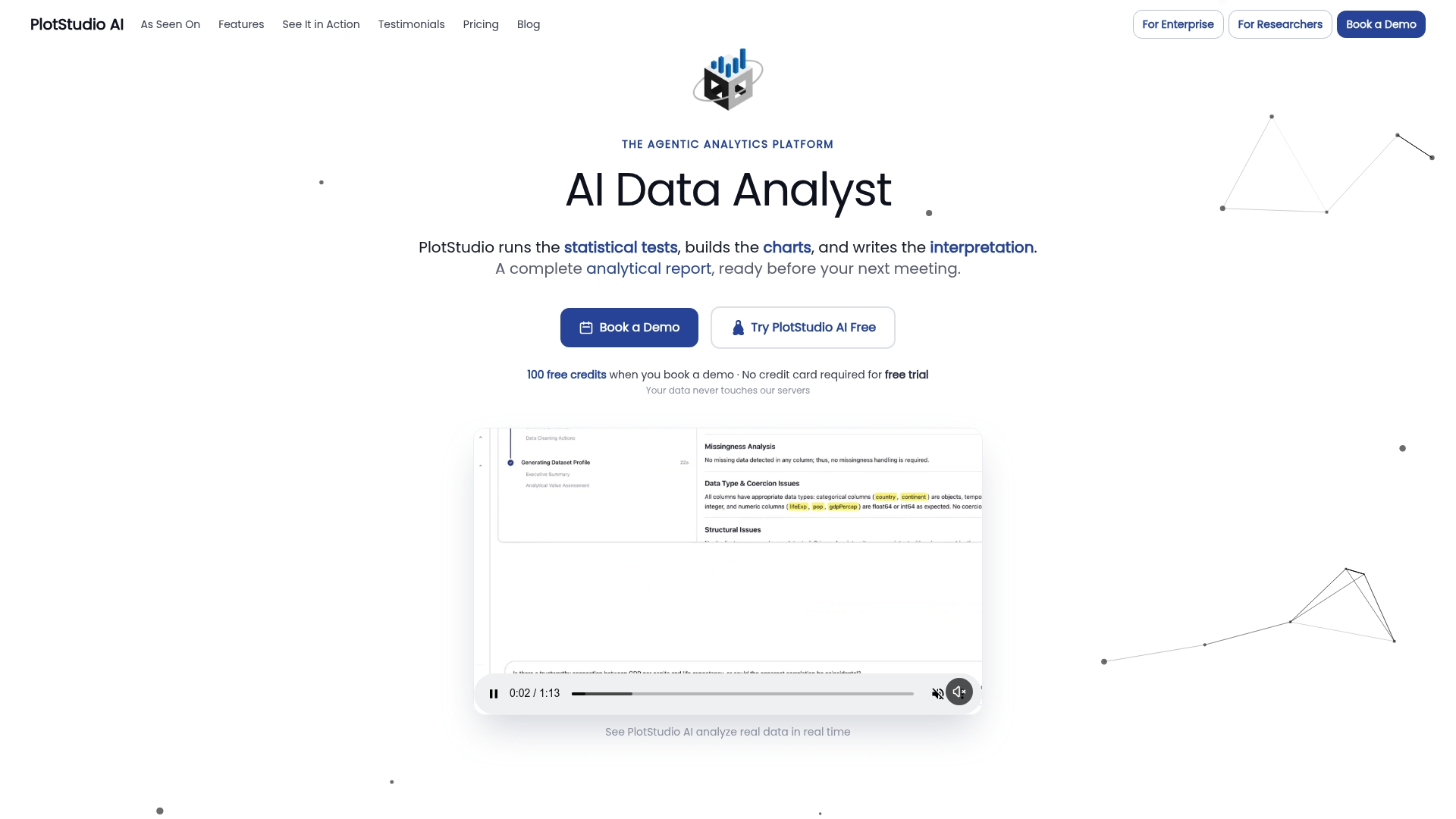
Plotstudio addresses this directly. Analysis runs locally on the researcher’s machine, so PHI never leaves the device during the de-identification workflow. Every analysis is gated behind a pre-approved analysis plan, which functions as the pre-registration that Expert Determination requires: methods, parameters, and success criteria are locked in before any code runs. The platform’s PII detection and masking tools surface residual identifiers automatically, and every session exports a full reproducibility package — annotated notebooks, PDF reports, and versioned parameter files — that maps directly onto the deliverable checklist in Section 12.
For compliance teams managing multiple Expert Determination projects or operating under IRB governance, Plotstudio’s enterprise deployment adds Azure-hosted infrastructure with role-based access controls, immutable audit logs, and organization-wide Skills that encode your institution’s de-identification methodology once and apply it consistently across every project. Start with a trial or contact the team to scope an enterprise deployment.
A practitioner’s perspective on what actually matters
The regulatory framework for HIPAA de-identification is clear enough. The two methods are well-defined, the 18 identifiers are enumerated, and the documentation requirements for Expert Determination are specific. What the regulation cannot do is tell you where projects actually fail — and in practice, they rarely fail because a team misread the rule.
The real failure mode is organizational. A privacy officer approves a Safe Harbor determination without a field inventory. A data scientist removes the 18 identifiers but leaves a combination of three-digit ZIP, age band, and rare diagnosis that uniquely identifies 40 patients in a rural county. An expert produces a technically sound report, but the attestation is unsigned and the transformation scripts were not retained. None of these are failures of regulatory knowledge. They are failures of process discipline.
The second thing practitioners underestimate is how quickly a valid determination becomes stale. A dataset de-identified in 2020 against the external data available then faces a materially different risk environment today. Public voter rolls, commercial data brokers, and social media archives have all expanded. A determination with no re-evaluation cadence is a liability that grows silently.
The practical implication is that de-identification governance belongs inside your data governance program, not as a standalone compliance exercise. Schema changes, new data sources, and new recipients should all trigger automated review flags. The expert determination should be treated like a software dependency: versioned, tested, and updated when the environment changes.
What actually works is treating the documentation as the product. A signed attestation, a reproducible technical report, versioned transformation scripts, and a clear re-evaluation schedule are not bureaucratic overhead. They are the evidence that your organization took the obligation seriously. That evidence is what protects you when OCR comes asking.
This article is general information, not a substitute for advice from a qualified lawyer. Consult a qualified legal professional about your own circumstances before acting on anything here.
Sources
The sources below are the primary regulatory and technical references for HIPAA de-identification. Cite the first two in internal policies; use the remaining three as technical reference and practitioner guidance.
Regulatory primary sources (cite in internal policies):
- Hhs
- 45 CFR § 164.514 — Other requirements relating to uses and disclosures of protected health information | Cornell Law
- Modes of de-identification and their performance for clinical data | PMC
- Guidance Regarding Methods for De-identification of Protected Health Information (HHS Handout) | UNC School of Government
- HIPAA Expert Determination Method for De‑Identification: Requirements, Process, and Best Practices | AccountableHQ
Technical and practitioner reference:
Supplementary: