95.3% Accuracy: Multi Agent Analytics for Reproducible Research

Multi-agent analytics coordinates specialized AI agents (planning, retrieval, analysis, charting, and validation) to execute analytical pipelines with accuracy and auditability beyond what a single-agent system can deliver. Recent evaluations show sequential multi-agent pipelines hitting 95.3% functional accuracy compared to 72.7% for single-agent baselines. Researchers should adopt this approach for complex, multi-step analyses on privacy-sensitive data where a defensible audit trail matters more than a quick chart.
TL;DR:
- Multi-agent pipelines achieve around 95.3% functional accuracy, significantly outperforming the 72.7% of single-agent systems, especially for complex analyses.
- Clear role definitions, structured data exchanges, and structured schemas are essential to prevent failures and facilitate auditability in multi-agent systems.
- Orchestration should begin with supervisor-led control for predictable workflows and adapt to dynamic task matching architectures like DTC as needs evolve.
- Maintaining an approved, pre-registered analysis plan and serializing all outputs into versioned, typed schemas are key for auditability and methodology verification.
- Running analyses locally with strict versioning, credential control, and comprehensive logging ensures privacy, security, and reliable debugging in production environments.
Table of Contents
- What Is Multi-Agent Analytics, and How Does It Differ From Agent-Based Modeling?
- What Agent Roles Make Up a Multi-Agent Analytics Pipeline?
- How Should Agents Be Orchestrated and Coordinated?
- How Do You Keep Multi-Agent Plans Auditable and Correct?
- What Engineering Trade-Offs Matter Most in Production?
- What Metrics and Benchmarks Should You Use to Evaluate a System?
- How Do You Prototype a Multi-Agent Analytics System?
- How Does PlotStudio Operationalize Research-Grade Multi-Agent Analytics?
- Where Is Multi-Agent Analytics Research Actually Heading?
- Try PlotStudio for Reproducible Multi-Agent Research
- Sources
- FAQ
What Is Multi-Agent Analytics, and How Does It Differ From Agent-Based Modeling?
Multi-agent analytics and agent-based modeling (ABM) get confused constantly, often in the same sentence, and the mix-up leads researchers toward the wrong tool entirely.
ABM is a simulation methodology. It models autonomous entities (consumers, cells, vehicles, market participants) interacting under defined rules to study emergent behavior over time, and it is widely used across social and natural sciences for questions like how disease spreads through a population or how traders react to a price shock. Nothing in ABM is analyzing your dataset. It is generating synthetic behavior to study a system.
Multi-agent analytics is different. Here, agents don’t simulate a world. They divide the labor of analyzing real data you already have: one agent profiles the dataset, another writes and executes statistical code, another builds the visualization, another checks the output against the original question. The goal is not emergence. It’s a correct, reproducible answer.
Three use cases define the category today:
- Conversational business intelligence, where a supervisor agent routes a plain-language question through retrieval, analysis, and synthesis agents.
- Data-to-dashboard pipelines, which turn raw tabular data into charts and summaries without a human writing SQL by hand.
- Reproducible academic analysis, where every step, from hypothesis to statistical test to figure, gets logged for a thesis committee or journal reviewer.
A short glossary helps here: a planner decomposes a query into subtasks; a supervisor assigns those subtasks to worker agents; validators check outputs against schemas or logical constraints before they move downstream; and structured state refers to the typed, versioned data object agents pass to each other rather than free-form text.
What Agent Roles Make Up a Multi-Agent Analytics Pipeline?
A working system needs distinct roles with clean handoffs, not a swarm of interchangeable bots calling the same model with slightly different prompts. The architecture that shows up across recent papers, including the AgenticData framework, converges on a similar set of specialized agents.
- Planner: decomposes a natural-language question into an ordered sequence of analytical subtasks.
- Data profiling / retrieval agent: inspects schema, types, missingness, and cardinality before any analysis code runs.
- Analysis agent: writes and executes statistical code (regression, hypothesis tests, variance explained) against the profiled data.
- Charting agent: turns validated results into visualizations, decoupled from the analysis logic so a bad chart doesn’t imply bad math.
- Report aggregator: assembles outputs from prior agents into a coherent narrative or document.
- Follow-up question agent: handles conversational refinement without re-running the entire pipeline from scratch.
- Supervisor: owns task assignment, monitors for failures, and decides when to re-route work.
The interfaces between these agents matter more than any individual agent’s intelligence, and selecting the right model for each task is critical in multi-agent analytics as discussed in Multi-Model AI: The Right Model For Each Task. Each handoff should pass structured, typed output (JSON conforming to a defined schema) rather than free text an downstream agent has to re-parse and guess at. This is where a lot of prototype systems quietly fail: an analysis agent returns a paragraph instead of a structured result object, and the charting agent has no reliable field to plot.
On execution order, you face a real trade-off. A strict sequential pipeline (profile, then analyze, then chart, then report) is easier to debug and audit but slower. Partial parallel execution, running the charting agent and a secondary hypothesis test concurrently once both depend only on the same validated dataset, cuts latency without touching accuracy when the parallel branches are genuinely independent. One evaluation found selective parallelism reduced latency by roughly 15.5% with no measurable quality loss, which is the argument for parallelizing anything that doesn’t have a hard dependency on a prior agent’s output.

How Should Agents Be Orchestrated and Coordinated?
Orchestration is the layer that decides which agent does what, when, and what happens when something breaks. Two dominant patterns exist, and picking wrong makes a system brittle in ways that only show up under real workloads.
Supervisor-led orchestration puts one agent in charge of task assignment and monitoring, similar to a manager-worker model in traditional distributed computing. It’s simpler to reason about and easier to debug because there’s a single point tracking pipeline state.
A more adaptive pattern, formalized in the Polaris architecture as Dynamic Task Coordination (DTC), treats agent-task assignment as a capability-aware matching problem rather than a fixed routing table. DTC scores agents against tasks using a capability-fit function and allows real-time re-matching when an agent fails, returns low-confidence output, or a data source becomes unavailable mid-run.
- Prefer centralized, supervisor-led orchestration for pipelines with predictable task graphs and a small number of agents.
- Prefer decentralized, DTC-style coordination when task requirements shift mid-session, such as conversational analytics where a follow-up question changes which agent is relevant.
- Build explicit recovery paths for schema mismatches: when a validator rejects an agent’s output, route back to the profiling agent rather than failing the entire run.
- Log every re-match decision. If an agent gets swapped out mid-pipeline, that swap needs to be visible in the audit trail, not silently absorbed.
Pro Tip: Treat agent failure as an expected event, not an edge case. Design your supervisor to retry with a different agent or a narrower task scope before it ever surfaces an error to the researcher.
How Do You Keep Multi-Agent Plans Auditable and Correct?
The gap between a demo and a defensible analysis is planning discipline. Systems like AgenticData translate a natural-language query into a logical plan first, then optimize that into a physical execution plan, with validators checking each transition. This semantic planning pipeline (NL to logical plan to optimized physical plan) is what lets a system explain why it chose a particular statistical test, not just report a result.
Memory design splits into two layers. Short-term memory carries the chain-of-thought or intermediate reasoning within a single session. Long-term memory persists structured state (prior results, dataset profiles, approved plans) across sessions so a researcher can return to an analysis weeks later without re-establishing context. AgenticData’s own validators and memory layer are credited with improved accuracy across five benchmarks and real deployments in banks and power-grid companies, a strong signal that memory isn’t a convenience feature. It’s load-bearing.
- Require an approved analysis plan (methods, assumptions, success criteria) before any code executes.
- Serialize agent outputs into a typed, versioned schema so downstream agents don’t misinterpret prior results, a pattern documented in production analytics-agent repositories.
- Store the full plan and result history as a searchable artifact, not an ephemeral chat log.
The pre-registration parallel is not incidental. Pre-execution plan approval functions exactly like a clinical trial’s pre-registered protocol: it locks in the methodology before results can bias the choice of test, which is the single most effective defense against methodology drift in agentic research systems.
What Engineering Trade-Offs Matter Most in Production?
State management is where most multi-agent systems quietly rot. As pipelines grow past three or four agents, unstructured handoffs turn into a debugging nightmare because nobody can tell which agent produced which version of a result. The fix, echoed across engineering literature on RL-enhanced BI systems, is a typed, versioned shared-state object with strict deserialization checks at every consumption point.
Security deserves equal weight. Planning and analysis agents should run against read-only credentials wherever possible, and execution should be scoped tightly enough that an agent cannot write to production data even if a prompt injection tricks it into trying. For sensitive datasets, local execution removes the cloud-upload risk entirely rather than trying to secure it after the fact.
- Version every shared-state artifact (JSON schema plus version number) and reject malformed inputs before they reach the next agent.
- Enforce read-only query patterns and scope credentials per agent role, not per pipeline.
- Separate decision-level adaptation (which agent runs next) from analytical inference (what the code does), a distinction MDPI’s engineering framework treats as a core reliability principle.
- Instrument every agent handoff with logging so a failed run can be traced to the exact step that broke.
Pro Tip: Build your validators before you build your agents. A validator that rejects malformed output is worth more than a smarter prompt, because it catches failures your prompt engineering will never anticipate.
What Metrics and Benchmarks Should You Use to Evaluate a System?
Four metrics show up consistently across recent evaluations: functional accuracy (did the analysis answer the actual question), hallucination-free rate (did the system avoid fabricating unsupported results), a composite quality score, and end-to-end latency.
The clearest data point comes from a controlled comparison where a sequential multi-agent pipeline reached 95.3% functional accuracy and a 93.0% hallucination-free rate, against a 72.7% accuracy single-agent baseline. That gap is the strongest argument for decomposition over a single monolithic prompt.
- Functional accuracy: does the final output correctly answer the original analytical question.
- Hallucination-free rate: the share of outputs with no fabricated claims or unsupported figures.
- Latency under parallelism: selective parallel execution cut latency by about 15.5% with no quality drop in the same evaluation.
Ablation studies in this space consistently find the validation and profiling agents matter more to final accuracy than the charting agent, since an incorrect chart from correct data is less critical than an incorrect analysis caused by unprofiled data. Build your own benchmark with a fixed test-case suite, an LLM-as-judge framework for scale, and human validation on a sample large enough to catch systematic errors the automated judge misses.
How Do You Prototype a Multi-Agent Analytics System?
Start small and build the audit trail before you build the intelligence. Here’s a compact path:
- Pick one dataset and one question. Don’t build a general-purpose system on the first attempt.
- Define your agent set and interfaces. Start with planner, profiler, analysis, and validator. Add charting and reporting once the core loop works.
- Implement the planner and validator first. They catch the failures that matter most, before you invest in prompt engineering for the analysis agent.
- Wire execution to run locally if the dataset carries any privacy sensitivity, rather than retrofitting privacy controls later.
- Add a pre-approval gate so a human reviews the analysis plan before code executes.
- Run an iterative evaluation cycle: test, log failures, tighten validators, re-test.
- Export artifacts at every run: annotated code, a plain-language report, and a permanent record of the approved plan.
Pro Tip: Your privacy checklist should run before your accuracy checklist. A system that produces a perfect result from data it wasn’t allowed to process is a failed prototype, not a successful one.
For architecture references and working code, the MultiAgent-Data-Analyst repository offers a usable starting skeleton for the agent and orchestration glue described above.
How Does PlotStudio Operationalize Research-Grade Multi-Agent Analytics?
PlotStudio applies these exact principles to academic workflows. Analysis runs locally on the researcher’s own machine, which matters for IRB-governed and special-category patient data that legally cannot leave the device. Every analysis sits behind a reviewed and approved plan, functioning as pre-registration and an audit trail rather than a black box. Skills let a lab encode its own methodology (required steps, statistical thresholds, forbidden shortcuts) so every run follows discipline-specific convention. Output comes as annotated notebooks, PDF reports, and permanent searchable analysis pages that a supervisor or reviewer can trace end to end, spanning survival analysis, mixed-effects models, and standard regression and ANOVA workflows.
Where Is Multi-Agent Analytics Research Actually Heading?
Adaptive coordination is the trend worth watching closely. Systems that can re-match agents to tasks mid-run, the way Polaris’s DTC does, will outlast rigid pipelines because real analytical questions change shape as results come in. The harder unsolved problem is state coherence: as pipelines grow past a handful of agents, keeping shared state internally consistent gets genuinely difficult, and most published architectures gloss over it.
My priority list for the field: standardize benchmarks so results are comparable across papers, treat plan pre-approval as a default rather than an add-on, and stop calling something reproducible when the artifacts can’t survive a peer reviewer’s second look.
— Aymen
Try PlotStudio for Reproducible Multi-Agent Research
Julius AI and similar cloud analytics chatbots hand you a fast answer, but the tradeoff is real: your data leaves your machine, and there’s no reviewable plan standing between a prompt and the code that runs against your dataset. PlotStudio takes the opposite approach: every analysis runs locally, so IRB, NHS, and GDPR special-category data never touches a server, and nothing executes until you’ve reviewed and approved the analysis plan yourself.
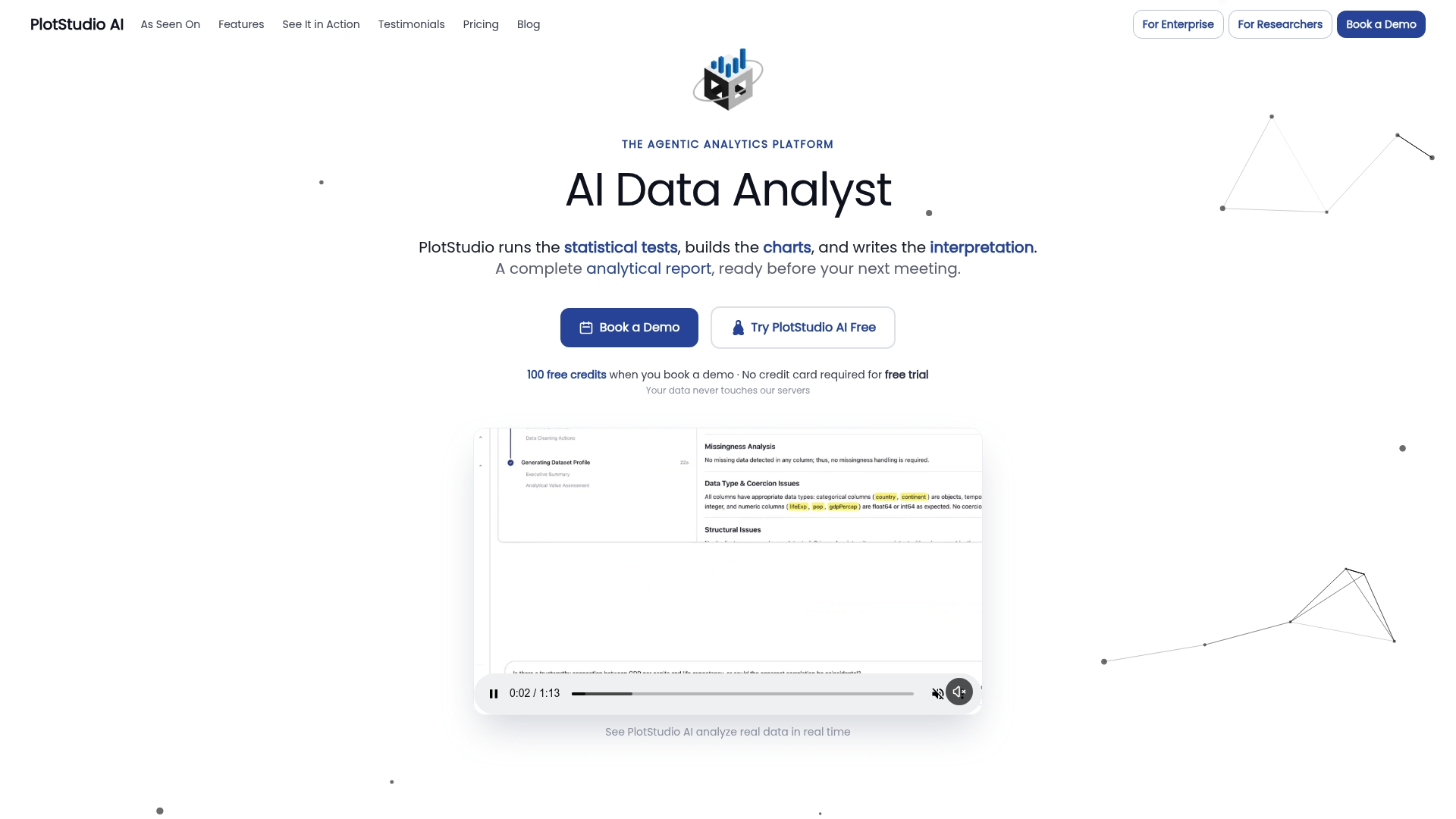
That local-execution model, paired with Skills that encode your field’s own methodology and exports as annotated notebooks and PDF reports, is why PlotStudio fits thesis work, grant applications, and peer review in ways a general chatbot doesn’t. If you’re weighing a Julius AI alternative, start with a free trial or check the academic Bring Your Own Key plan built for research teams that need both privacy and reproducibility from the first run.
Sources
For architecture and evaluation depth, read the Data-to-Dashboard paper for benchmark evidence, AgenticData for semantic planning, and Polaris for Dynamic Task Coordination. For engineering lessons, see Anthropic’s multi-agent research system post and the MultiAgent-Data-Analyst repo for working code.
- A Multi-Agent Platform for Automated Enterprise Analytics and Insight Generation
- An RL-Enhanced Multi-Agent Framework for Scalable and Intelligent Business Intelligence Systems
FAQ
What Is Multi-Agent Analytics?
It’s an approach where specialized AI agents (planning, retrieval, analysis, charting, validation) coordinate to execute an analytical pipeline, producing more accurate and auditable results than a single-agent system.
Is Multi-Agent Analytics the Same as Agent-Based Modeling?
No. ABM simulates interacting entities to study emergent behavior, while multi-agent analytics divides the labor of analyzing data you already have.
What Metrics Matter Most for Evaluating These Systems?
Functional accuracy, hallucination-free rate, and latency under parallelism are the core metrics, with one evaluation reporting 95.3% accuracy and a 93.0% hallucination-free rate, for a sequential pipeline.
Is PlotStudio a Good Julius AI Alternative for Research?
Yes, for researchers who need local execution, an approved analysis plan before code runs, and exportable, reproducible artifacts. Pricing starts at $39.99 per month for Bring Your Own Key or $69.99 per month for Managed Credits, with academic BYOK plans at $399.90 per year.
What Orchestration Pattern Should I Start With?
Start with supervisor-led orchestration for predictable task graphs, and move to Dynamic Task Coordination only once your workflow needs real-time re-matching between agents and tasks.