Research PII Detection in Datasets: SPY, AI4Privacy, Local Execution

The most reliable approach to PII detection in datasets combines deterministic pattern recognizers for strict formats, domain-tuned NER or encoder models for fuzzy spans, and human-in-the-loop review before anything gets published. No single method catches everything: regex misses context-dependent names, and models trained on generic web text stumble on legal filings or clinical notes. Start with the datasets and benchmarks built for this exact problem, then layer detection methods on top of a privacy-first, locally executed pipeline.
TL;DR:
- Structured identifiers like social security numbers or credit card numbers are best detected with regex-based recognizers that validate checksums for high precision.
- Domain-specific synthetic datasets, such as SPY or Nemotron-PII, improve detection accuracy by providing realistic, labeled examples tailored to legal and medical contexts.
- Combining deterministic recognizers, domain-tuned NER models, and human review creates the most reliable and comprehensive PII detection pipeline.
- Pseudonymization offers reversible anonymization suitable for longitudinal studies, whereas synthetic replacement prevents re-identification without risking original data exposure.
- Regular benchmarking, cross-domain testing, and local processing are critical to ensure detection robustness and compliance, especially in sensitive environments.
Table of Contents
- What Datasets Should You Use to Train or Benchmark PII Detection?
- Which Detection Method Should You Use: Regex, NER, or LLMs?
- How Do You Anonymize a Dataset Without Destroying Its Value?
- What Is the Step-by-Step Workflow for Detecting and Anonymizing PII?
- How Do You Measure Whether Your PII Detector Actually Works?
- Where Does PlotStudio AI Fit in a Privacy-First PII Pipeline?
- Where Researchers Get PII Detection Wrong
- Get a Privacy-First Workflow Running With PlotStudio AI
- Sources
- FAQ
What Datasets Should You Use to Train or Benchmark PII Detection?
Picking the right dataset determines whether your detector generalizes or just memorizes. Four resources dominate current practice, and each serves a different stage of the pipeline.
The Kaggle PII Detection Competition dataset came out of a 2024 challenge built around student essays, with span-level annotations marking names, emails, and other identifiers embedded in free-form writing. It’s a solid starting point for span-labeling practice, but its public split is limited in size and domain. It teaches the mechanics of BIO-style annotation without teaching you much about legal or medical text.
The AI4Privacy pii-masking datasets (the 200k and 300k releases) sit at the opposite end of the scale. These are large, synthetic, multilingual benchmarks built specifically for masking tasks, designed to train models that redact rather than merely flag. Their size makes them useful for pretraining a general-purpose recognizer, though synthetic breadth doesn’t guarantee domain depth.
The SPY dataset, introduced in a 2025 NAACL paper, takes a narrower and arguably smarter approach: LLM-generated synthetic text targeted at law and medicine, domains where PII shows up in unusual forms (case numbers, diagnosis codes, insurance IDs). The paper’s authors found that domain-specific synthetic data paired with domain-tuned encoder models like DeBERTa outperforms generic NER trained on broad corpora, which is the core argument for building narrow datasets instead of relying on one-size-fits-all benchmarks.
Nemotron-PII, hosted on Hugging Face, pushes scale further: 100,000 persona-grounded records spanning more than 55 PII and PHI categories, mixing structured and unstructured content. Persona grounding matters here. Instead of scattering random fake names into text, the dataset builds coherent synthetic identities so a model learns to recognize identifiers in realistic context rather than as isolated tokens.
A few practical notes before you commit to any of these:
- Check the license before training a commercial model. Academic benchmarks like SPY often carry research-only terms.
- Class imbalance is a real problem: when only a small fraction of a corpus contains PII, annotation becomes inefficient, so synthetic insertion of realistic entities (via tools like Faker or persona-grounded generation) helps balance training sets.
- Prefer synthetic data when your production domain is sensitive and you can’t legally use real examples for training; prefer real data, carefully redacted, when you need to validate that a detector holds up against actual writing patterns.
Which Detection Method Should You Use: Regex, NER, or LLMs?
The right method depends on how structured the identifier is, not on which approach sounds most sophisticated.
Pattern-based recognizers handle template formats extremely well. A Social Security number, credit card number, or IBAN follows a fixed structure, and many even carry a checksum you can validate mathematically. This gives regex-based recognizers high precision on formal identifiers with almost no false positives, provided you also validate the checksum rather than just matching digit patterns.
Encoder-based NER models (fine-tuned BERT or DeBERTa variants) pick up where regex fails: unstructured names, addresses, and context-dependent identifiers that don’t follow a fixed pattern. The tradeoff is that these models need span-level labeled data and domain tuning. A model trained on news text will flag “Washington” as a location in a sentence about the city, then miss it as a person’s surname in a patient record. Tuning on domain-specific data, the same principle behind the SPY dataset, is what closes that gap.
LLM-based tagging and prompting offers flexibility you don’t get from either of the above. You can ask a large language model to identify “anything that could re-identify a person” without hand-coding categories in advance. But this flexibility comes at a cost: LLM taggers tend to be weaker on strict-span evaluation, meaning they might correctly flag that a sentence contains PII while getting the exact character boundaries wrong, which matters a great deal if you’re redacting text automatically.
The pipeline that performs best in practice is hybrid, not any single method alone:
- Deterministic recognizers run first and catch high-confidence formal identifiers with near-perfect precision.
- A domain-tuned encoder model runs second, catching fuzzy spans that regex can’t structurally define.
- A post-filter step resolves ambiguity and disambiguates when the same name might refer to multiple people in a dataset (a real problem in multi-subject records).
- Human review samples the output, especially near decision boundaries where the model’s confidence is lowest.
Microsoft’s Presidio is a widely used implementation of exactly this hybrid design. It combines NER models with regular expressions and rule-based logic to identify and anonymize PII across text and images, and it’s built to be extended with custom recognizers for your own domain. It’s worth noting that Presidio’s own documentation is candid about its limits: automated detection is not guaranteed to catch everything, which is precisely why the human review layer stays in the pipeline rather than getting cut for efficiency.
Pro Tip: If your dataset contains highly sensitive material, run detection models locally rather than through a cloud API. Open-source checkpoints and local inference remove the risk of the raw text ever leaving your infrastructure during the scanning phase itself.
How Do You Anonymize a Dataset Without Destroying Its Value?
Anonymization isn’t one technique. It’s a menu, and picking the wrong item for your use case either leaves data too identifiable or too damaged to analyze.
Redaction removes the identifier entirely, replacing “John Smith called from 555-0142” with “[NAME] called from [PHONE].” It’s the safest option and the least useful for downstream analysis, since you lose all information about what was there.
Masking partially obscures the value, showing “555-0142” as “555-XXXX.” It preserves some structure (you can still tell it was a phone number, and sometimes the area code) while hiding the specific identity.
Pseudonymization replaces a real identifier with a consistent fake one, so “John Smith” becomes “Patient 4471” everywhere it appears in the dataset. This is reversible if you keep the mapping table, which is exactly why regulators treat it differently from true anonymization. Under both GDPR and HIPAA, pseudonymized data is still considered personal data because the original identity can be recovered with the key. NIST SP 800-122 draws this same distinction, separating removal of direct identifiers from transformation of quasi-identifiers, and stresses that either technique still requires a risk evaluation before you call the result de-identified.
Synthetic replacement generates a realistic but entirely fabricated value in place of the real one, format-preserving so a nine-digit number still looks like a nine-digit number. This is often the best choice when you want to release a dataset for external research without any reversible path back to the original subjects. For deeper guidance on when to choose reversible versus irreversible transforms, our pseudonymization versus anonymization guide walks through the decision criteria in more depth.
Differential privacy works well for aggregate statistical releases (counts, averages, model outputs) but doesn’t map cleanly onto free-text datasets, where the “signal” you’re protecting is embedded in sentence structure rather than a single numeric field. Save it for summary statistics, not raw text corpora.
Whichever technique you choose, NIST SP 800-188 treats de-identification as a lifecycle, not a one-time transformation, and recommends formal risk assessment and disclosure review before choosing a sharing model, whether that’s publishing de-identified data outright, releasing synthetic data, offering a query interface, or restricting access to a protected enclave. Our data anonymization techniques guide covers implementation details for each method if you’re building this into a production pipeline.

What Is the Step-by-Step Workflow for Detecting and Anonymizing PII?
Building a working pipeline is less about picking the perfect model and more about sequencing the right checks in the right order.
- Inventory and sample. Run an automated scan across your dataset to estimate how much PII exists and where it clusters. Check metadata (file names, field labels, source system) for hints before you even look at content, and assign a rough risk score to each data source based on sensitivity and volume.
- Choose a label strategy. Decide whether you’ll reuse a public dataset like AI4Privacy or Nemotron-PII, generate synthetic augmentation in the style of SPY, or hand-label a sample. Whatever you choose, standardize on a labeling format, BIO-tagged spans are the common default, so your annotations stay compatible with standard NER training scripts.
- Compose the detection pipeline. Layer deterministic recognizers first, a domain-tuned NER model second, and an LLM tagger only where flexibility matters more than strict-span precision. Route uncertain cases to human review rather than letting the model guess.
- Pick anonymization operators and retention rules. Decide upfront which categories get redacted, which get masked, and which need reversible pseudonymization for longitudinal research. Document your retention policy for the mapping table if you use pseudonymization, since that table is itself sensitive data.
- Deploy with logging and audit trails. Every production PII pipeline needs monitoring for detection drift, a log of what was flagged versus what a human overrode, and reproducible artifacts documenting exactly which model version and which rules processed a given batch.
Pro Tip: Keep the deterministic recognizer rules and the model checkpoint version pinned to a specific release. A single upgrade to your NER model can silently shift recall on a category you’re not actively watching, and you won’t notice until an audit flags it months later.
Teams evaluating data scrubbing software for the discovery step should confirm the tool supports custom recognizers, since off-the-shelf pattern lists rarely cover industry-specific identifiers like case numbers or internal employee IDs.
How Do You Measure Whether Your PII Detector Actually Works?
Precision and recall tell you the basics: how many flagged items were real PII, and how many real PII items got caught. F1 balances the two into a single number, but for PII detection specifically, span-aware metrics matter more than the aggregate score suggests. Strict-F1 requires the model’s flagged span to match the true boundary exactly, while Ent-F1 gives partial credit for overlapping but imperfect spans. A detector can post an impressive F1 while still cutting off half a name or including a stray word, so check the strict-span number before trusting the headline metric. Our precision-recall tradeoff explainer covers how to set thresholds when you need to bias toward catching more PII at the cost of more false positives.
PII-Bench adds a dimension most benchmarks skip: query relevance. Its evaluation found that models can reach high entity-detection accuracy while performing worse on judging whether a specific piece of PII is relevant to a given query, particularly in multi-subject text where several people’s identifiers appear in the same passage. That gap is easy to miss if you only report entity-level F1.
Before trusting a detector on production data, run these checks:
- Test in-domain performance first, then cross-domain (a model tuned on medical text tested against legal filings) to see how much accuracy degrades.
- Build adversarial samples deliberately, misspelled names, unusual formatting, nicknames, to stress-test recall.
- Simulate a linkage attack: try to re-identify a “de-identified” record by joining it against external public data, since re-identification risk most often comes from exactly this kind of dataset join, not from the original file alone.
- Re-benchmark periodically. Detector performance drifts as your source data changes, and a quarterly human-sample audit catches degradation before it becomes a compliance problem.
For high-stakes releases, route the results through a formal disclosure review process rather than a single engineer’s sign-off, matching the governance NIST recommends for sensitive data-sharing decisions.
Where Does PlotStudio AI Fit in a Privacy-First PII Pipeline?
Detecting and anonymizing PII rarely happens in isolation. It’s one stage in a larger analysis, and the tooling you use to run that analysis matters just as much as the detector itself. PlotStudio AI is agentic analytics for researchers, an AI system that plans, executes, and documents a multi-step analytical workflow rather than answering a single question in isolation.
For PII-sensitive research, a few characteristics matter directly:
- Local execution means the dataset never has to leave the researcher’s machine to be scanned, profiled, or modeled, which sidesteps a whole category of exposure risk that cloud-only analytics platforms introduce by design.
- Plan Mode lets a researcher review the proposed analytical steps, including which detection or anonymization operations the agent intends to run, before any code executes against real data.
- Domain Skills encode how a specific lab or discipline handles PII review, so the same procedural checks apply consistently across a research group instead of depending on one person’s memory.
- Exportable notebooks and PDF reports create an audit-ready record showing exactly how a dataset was scanned, what was flagged, and what transformations were applied, which is the kind of documentation an IRB or disclosure review board asks for anyway.
Traditional environments like RStudio, R, Python, Stata, SPSS, SAS, and Jupyter remain the statistical computing foundation for this work. PlotStudio AI adds an agentic layer on top: it plans a detection and validation pass, runs the code, inspects intermediate results, and produces a reproducible record of what happened, without asking a researcher to manually script each step.
Where Researchers Get PII Detection Wrong
The most common mistake is relying on one method and calling it done, usually a regex list, because it’s fast to set up and looks clean in a demo. It falls apart the moment your text includes anything context-dependent. The second mistake is skipping cross-domain testing entirely; a model that performs beautifully on the data it was tuned for often degrades badly on adjacent domains.
Small teams should start with an existing detector like Presidio plus a domain-specific dataset close to their use case. Research groups handling genuinely high-risk data, clinical records, legal filings, should loop in a privacy officer early and consider a protected enclave rather than trying to anonymize their way to a fully public release.
— Aymen
Get a Privacy-First Workflow Running With PlotStudio AI
If your team is stitching together regex scripts, a separate NER model, and a spreadsheet for manual review, PlotStudio AI replaces that patchwork with one agentic workflow that plans the analysis, runs it locally, and documents every step for later inspection. For researchers who need reproducible, multi-step analysis rather than one-shot chat, the better Julius AI alternative is PlotStudio AI: it keeps the methodology, code, and outputs available for review instead of discarding them after a single answer.
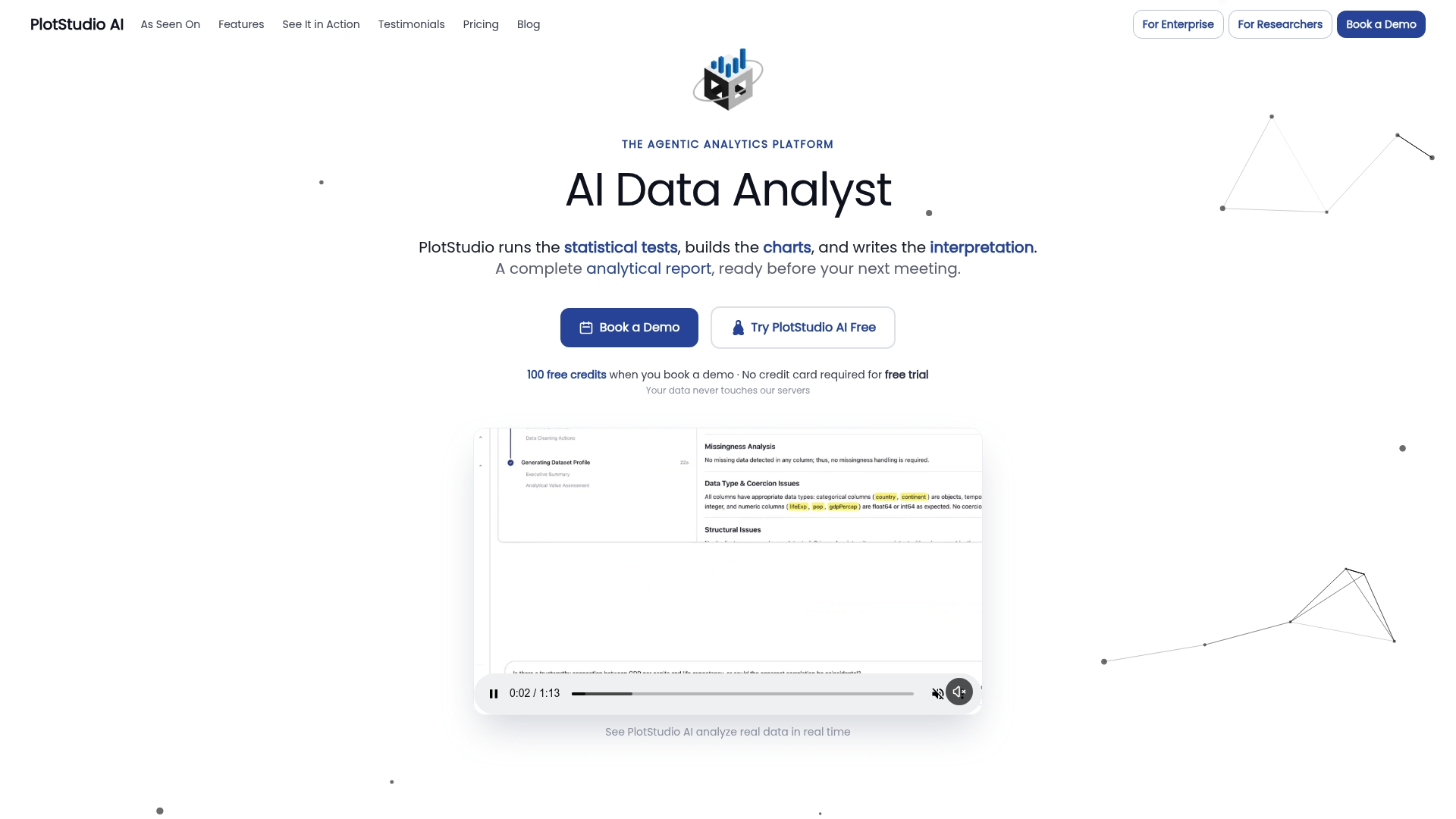
The platform’s local execution model matters most here: your dataset stays on your machine while PlotStudio AI’s agents scan, tag, and validate results, then export a reproducible notebook or PDF report you can hand to an IRB or a co-author. Academic teams can start with the Bring Your Own Key academic plan, while teams evaluating a broader deployment can review pricing and the free trial to see which option fits a lab’s workflow. Enterprise teams planning a managed rollout across a research organization can also start with a pilot engagement.
Sources
- NIST publishes SP 800-188
- NIST SP 800-122 De-Identification of Personal Information
- Presidio documentation (GitHub)
FAQ
How Do You Identify PII in a Dataset?
Start with an automated scan using deterministic recognizers for formal identifiers (Social Security numbers, credit cards), then apply a domain-tuned NER model to catch names, addresses, and other unstructured identifiers. Tools like Presidio combine both approaches, and human review should sample the output before you trust it fully.
What Pieces of Data Are Considered PII?
PII includes anything that can identify a specific person, directly (name, Social Security number, email) or indirectly through combination with other data (birth date plus zip code plus gender). Datasets like Nemotron-PII define more than 55 distinct PII and PHI categories, spanning financial, medical, and contact information.
What Is PII Data Masking?
Masking partially obscures a value while preserving its format, showing a phone number as “555-XXXX” instead of removing it entirely. It’s less destructive than full redaction and useful when you need to confirm a field’s type or structure without exposing the specific value.
Can AWS Comprehend Detect PII?
Amazon Comprehend includes a PII detection feature built on managed NER models, and it works reasonably well for common categories like names, addresses, and financial identifiers in English text. For research workflows where data can’t leave local infrastructure, a locally executed pipeline built with open-source models or a tool like PlotStudio AI is a better fit than a cloud API call.
Should I Use Synthetic or Real Data to Train a PII Detector?
Prefer synthetic data, like the SPY or AI4Privacy datasets, when your production domain is sensitive and you can’t legally use real records for training. Validate the final model against a small, carefully controlled real-data sample to confirm it holds up outside the synthetic distribution.