Privacy-First Analytics for Academic Research: 2026 Guide

Privacy-first analytics for academic research means running verifiable, local-first analyses that keep raw, IRB-governed data on the researcher’s machine while exporting reproducibility packages rather than raw data. The immediate next step for any research team handling sensitive data: configure local execution, gate every analysis behind a pre-approved plan, and export annotated notebooks and PDF reports as your audit trail.
Two signals tell reviewers your workflow is genuinely secure:
- Differential privacy or local-only processing provides a formal, mathematical bound on re-identification risk rather than a policy promise.
- Pre-registered analysis plans with audit logs document method choices before code runs, satisfying both IRB expectations and peer-review reproducibility standards.
Table of Contents
- What “privacy-first analytics” means in an academic research context
- Core privacy techniques and the utility–privacy tradeoff
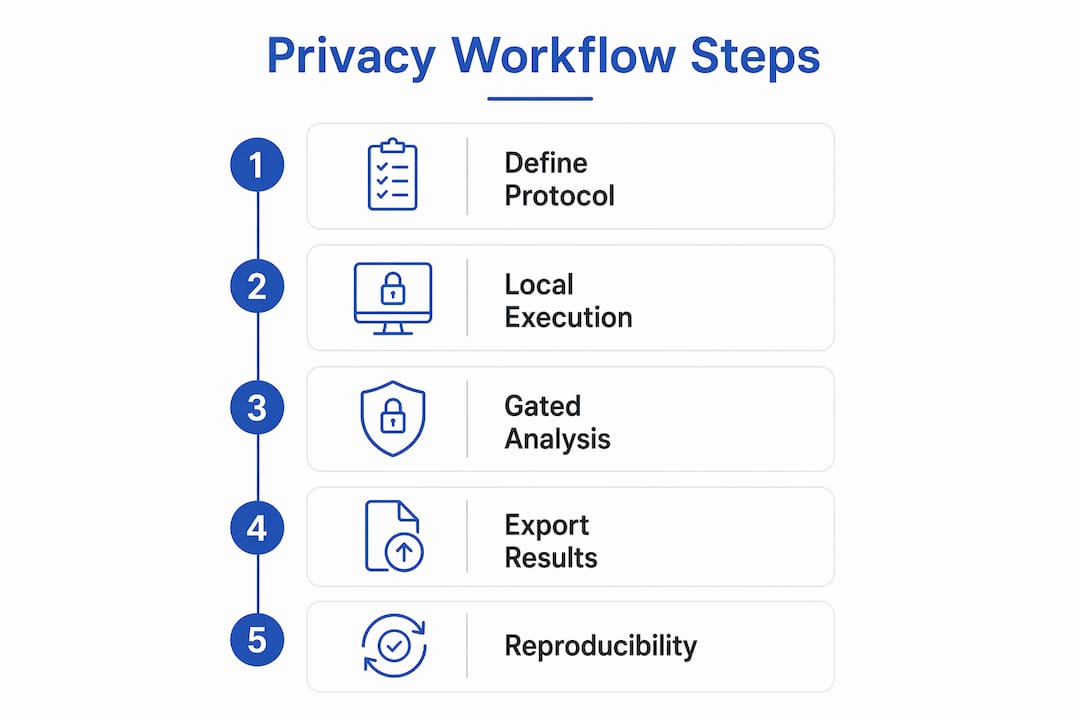
- A step-by-step privacy-first workflow for sensitive research data
- U.S. compliance checklist for sensitive academic data
- How to evaluate tools and why Plotstudio fits a research-grade workflow
- Estimated timeline and resource implications for adopting a privacy-first workflow
- What to include in a reproducibility package for reviewers and auditors
- Key Takeaways
- Why research teams should adopt privacy-first, local workflows now
- Plotstudio supports privacy-first research from day one
- Authoritative sources and research references for deeper reading
What “privacy-first analytics” means in an academic research context
The phrase gets used loosely, so a working definition matters. In IRB-governed research, privacy-first analytics describes a data handling posture: raw participant data never leaves an approved environment, collection is minimized, and every processing step is documented. That is a policy commitment, not a mathematical guarantee.
“Privacy-preserving analytics” is the stronger claim. It refers to cryptographic or statistical protections, such as differential privacy (DP), secure multi-party computation, or trusted execution environments (TEEs), that provide provable bounds on what an adversary can infer. A secure data analysis workflow for publication-quality research needs both: local-first handling and verifiable anonymization where outputs will be shared.
Reviewers and IRBs increasingly expect three trust signals:
- Local execution: raw data never transmitted to a cloud server.
- Pre-execution analysis plan: methods, covariates, and success criteria locked before any code runs.
- Reproducible exports: annotated notebooks, PDF reports, and searchable audit logs that let a reviewer verify Cox proportional hazards, ANOVA, or regression choices without receiving the underlying dataset.
Pro Tip: Verify local execution by monitoring outbound network traffic during an analysis run. If your tool contacts an external API with data payloads, it is not local-first regardless of what the vendor claims.
Core privacy techniques and the utility–privacy tradeoff
Privacy-preserving techniques can degrade the precision or granularity of results, so choosing the right method for your analytic goals matters. The table below maps each technique to its typical use case and statistical impact.

| Technique | How it works | Statistical impact | Best for |
|---|---|---|---|
| Local-only processing | Raw data stays on researcher’s device; no transmission | None — full fidelity | IRB-governed PHI, clinical trials |
| Differential privacy (DP) | Calibrated noise added to outputs | Reduces precision; acceptable for large-N aggregate stats | Population-level summaries, public releases |
| Secure aggregation / MPC | Cryptographic protocols compute aggregates without seeing individual inputs | Modest client overhead; complex statistics like regression remain feasible | Multi-site studies, federated cohorts |
| Trusted execution environments (TEEs) | Computation runs inside a hardware-isolated enclave (AMD SEV-SNP, Intel TDX) | Minimal; raw data exposure limited to TEE boundary | Server-side pipelines needing verifiability |
| Homomorphic encryption | Computation on encrypted data without decryption | High compute cost; limited to specific operations | Highly regulated, low-volume computations |
Linkage with commercial datasets can re-identify tens of millions from ostensibly anonymized records, which is why formal protections are recommended rather than treated as optional. For most inferential academic work, local-only processing preserves analytic quality better than heavy cryptographic obfuscation. Modern systems combine TEEs with DP autotuning to run verifiable pipelines while limiting raw-data access to the enclave boundary, a practical middle ground for multi-site studies.
Pro Tip: For sensitive inferential work (survival analysis, mixed-effects models), pair local execution with lightweight audit trails rather than adding DP noise. DP noise can invalidate proportional hazards assumptions; document the tradeoff explicitly in your reproducibility package.
A step-by-step privacy-first workflow for sensitive research data
A concrete, ordered process prevents the two most common IRB audit failures: selective reporting and undocumented method changes.
- Pre-register your analysis plan. Write out hypotheses, covariates, statistical models, and success criteria before touching the data. Submit to your IRB and, where appropriate, to a public registry (OSF, ClinicalTrials.gov). This document becomes your audit anchor.
- Gate execution behind plan approval. No code runs until the plan is reviewed and approved. This is not bureaucratic overhead; it is the mechanism that prevents post-hoc model selection.
- Configure local-only computation. Data stays on the researcher’s machine or an approved institutional enclave. Disable cloud sync for the working directory. Confirm no external API calls during execution.
- Run reproducible scripts in R or Python. Set random seeds explicitly. Log package versions and session info. Use version-controlled scripts, not interactive notebook cells edited after the fact.
- Produce annotated notebooks and audit logs. Annotate each analytical decision: why a covariate was included, which diagnostic tests were run, how missingness was handled. Capture a searchable log of execution steps.
- Generate PDF reports and reproducibility packages. Export a self-contained package (see Section 8 for exact contents) before any results leave the secure environment.
- Prepare reviewer-safe derivatives. Share aggregated summaries or synthetic data when raw data cannot leave the environment. Document which outputs are derived and how.
Artifacts to attach for peer review and IRB audit:
- Annotated Jupyter or R notebook with inline method justifications
- Executable scripts with pinned package versions and random seeds
- PDF report summarizing methods, results, and diagnostics
- Searchable audit log of execution steps and timestamps
- Data use agreement reference and IRB approval number
U.S. compliance checklist for sensitive academic data
IRB, HIPAA, and contractual requirements overlap in ways that catch research teams off guard. Work through this checklist before your first analysis run.
IRB requirements:
- Storage location and access controls documented in the protocol
- Consent language specifying that data will not be shared with third-party cloud services
- Pre-registration or analysis plan referenced in the IRB submission
- Data retention and destruction schedule approved
HIPAA considerations:
- Determine whether your dataset contains Protected Health Information (PHI) under the 18 HIPAA identifiers
- If PHI is present, a Business Associate Agreement (BAA) is required with any vendor whose software processes it; a tool that runs locally with no data transmission avoids this requirement entirely
- De-identification must meet Safe Harbor or Expert Determination standards, not just “removal of names”
Data use agreements and contracts:
- Review DUA clauses for restrictions on cloud uploads, secondary analysis, and re-identification attempts
- NDA terms may prohibit sharing raw data with any external platform, including analytics SaaS
- Institutional review may require sign-off before deploying new analysis software on governed datasets
Red flags to address before proceeding:
- Any tool that uploads data to a remote server without an executed BAA or DUA amendment
- Missing pre-execution analysis plan (creates selective reporting risk)
- No audit trail linking final outputs to specific code versions and input files
For medical research workflows that involve clinical data, confirming local execution architecture before onboarding any tool is the single highest-leverage compliance step.
How to evaluate tools and why Plotstudio fits a research-grade workflow
Not every tool marketed as “privacy-first” meets research-grade standards. The distinction matters: cookie-free web analytics tools and research-grade statistical analysis platforms solve different problems entirely. Use this checklist when evaluating options.
| Requirement | Why it matters | Plotstudio |
|---|---|---|
| Local execution (no data upload) | Required for IRB-governed PHI and DUA-restricted data | Yes — analysis runs on researcher’s machine |
| Native R and Python execution | Needed for survival analysis, Cox PH, mixed-effects models, ANOVA | Yes — both supported natively |
| Gated analysis plan | Prevents post-hoc model selection; functions as pre-registration | Yes — plan reviewed and approved before code runs |
| Reproducibility exports | Annotated notebooks, PDF reports, searchable audit logs | Yes — full packages exported |
| PII detection and anonymization | Flags identifiers before analysis; reduces inadvertent disclosure | Yes |
| Domain-specific methodology (Skills) | Encodes field standards so every analysis follows discipline norms | Yes — configurable per lab or field |
| Enterprise deployment | Institutional rollout without cloud dependency | Yes — enterprise Azure deployment available |
Plotstudio’s research partnership program offers credits and priority access for academic teams evaluating the platform, which makes a structured pilot feasible without a full procurement cycle.
Estimated timeline and resource implications for adopting a privacy-first workflow
| Milestone | Typical duration | Primary resource driver |
|---|---|---|
| Policy and IRB protocol update | 2–4 weeks | Research coordinator, IRB liaison time |
| Local environment setup and IT approval | 1–2 weeks | IT engineering, software licensing |
| Pilot analysis run and validation | 1–2 weeks | Researcher time, compute resources |
| Reproducibility packaging and review | 1 week | Researcher and supervisor review time |
| Audit or reviewer preparation | 1 week | Data steward, documentation |
Budget several weeks for a first adoption. For grant proposals, classify environment setup and licensing as direct costs under “data management.” Ongoing compute costs for local GPU workloads or TEE-enabled enclaves should be itemized separately from software licensing fees.
What to include in a reproducibility package for reviewers and auditors
A reproducibility package lets a reviewer verify your statistical choices without receiving raw data. The exact contents matter for peer review and IRB audit alike.
Required files:
- Annotated Jupyter or R notebook showing each analytical decision inline
- Executable scripts with pinned package versions (
requirements.txtorrenv.lock) - Explicit random seeds for any stochastic procedure
- PDF report covering methods, model diagnostics, and results tables
- Searchable audit log with timestamps and execution hashes
- Data dictionary describing variable types, units, and missingness handling
Annotation best practices:
- At each model specification cell, note why covariates were selected and reference the pre-registered plan.
- Document diagnostic outputs (residual plots, proportional hazards tests, variance inflation factors) with brief interpretations.
- Flag any deviation from the pre-registered plan and explain the methodological reason.
- Include a “session info” block at the end of every notebook capturing R or Python version, OS, and package versions.
When raw data cannot be shared, provide aggregated summary tables or synthetic data generated from the fitted model. Label synthetic outputs explicitly and document the generation method. A recommended folder structure: /analysis (scripts and notebooks), /outputs (PDF report, figures), /audit (log files, plan document), /dependencies (lockfiles).
Key Takeaways
Local execution combined with a gated analysis plan and exportable reproducibility packages is the non-negotiable foundation of research-grade, privacy-first analytics for IRB-governed data.
| Point | Details |
|---|---|
| Local execution is non-negotiable | Raw data must stay on the researcher’s machine or approved enclave; cloud uploads require a BAA or DUA amendment. |
| Gate before you run | Lock methods, covariates, and success criteria in a pre-registered plan before any code executes. |
| Export full reproducibility packages | Annotated notebooks, PDF reports, pinned dependencies, and audit logs are required for peer review and IRB audit. |
| Document the utility–privacy tradeoff | Record whether DP noise, cryptographic aggregation, or local-only processing was chosen and why, in the package itself. |
| Plotstudio satisfies all core requirements | Local execution, gated plans, native R/Python, reproducibility exports, and PII detection in one research-grade platform. |
Why research teams should adopt privacy-first, local workflows now
The case for local, auditable analytics has shifted from ethical preference to practical necessity. IRBs are tightening data governance requirements, journals are mandating reproducibility artifacts, and funding agencies are beginning to treat data management plans as scored criteria rather than boilerplate. Teams that have not built a privacy-first workflow into their standard operating procedure are already behind the curve.
What tends to get underestimated is the compounding benefit of the gated analysis plan. Researchers often frame it as a compliance burden, but it functions as a forcing function for methodological clarity. When you must write down your model specification before seeing results, you eliminate a category of analytic error that no amount of post-hoc correction can fix. Near-term technology drivers, particularly TEE-based enclaves and automated DP parameter tuning, will make it easier to extend local workflows to multi-site studies without sacrificing statistical power. The infrastructure is maturing fast. The teams that pilot these workflows now will have the institutional knowledge to scale them when grant requirements catch up.
Plotstudio supports privacy-first research from day one
Researchers handling IRB-governed or HIPAA-adjacent data need a tool that never puts them in the position of choosing between analytic capability and compliance. Plotstudio was built for exactly that constraint: analysis runs locally on your machine, every run is gated behind a plan you approve, and the output is a full reproducibility package ready for peer review or audit.
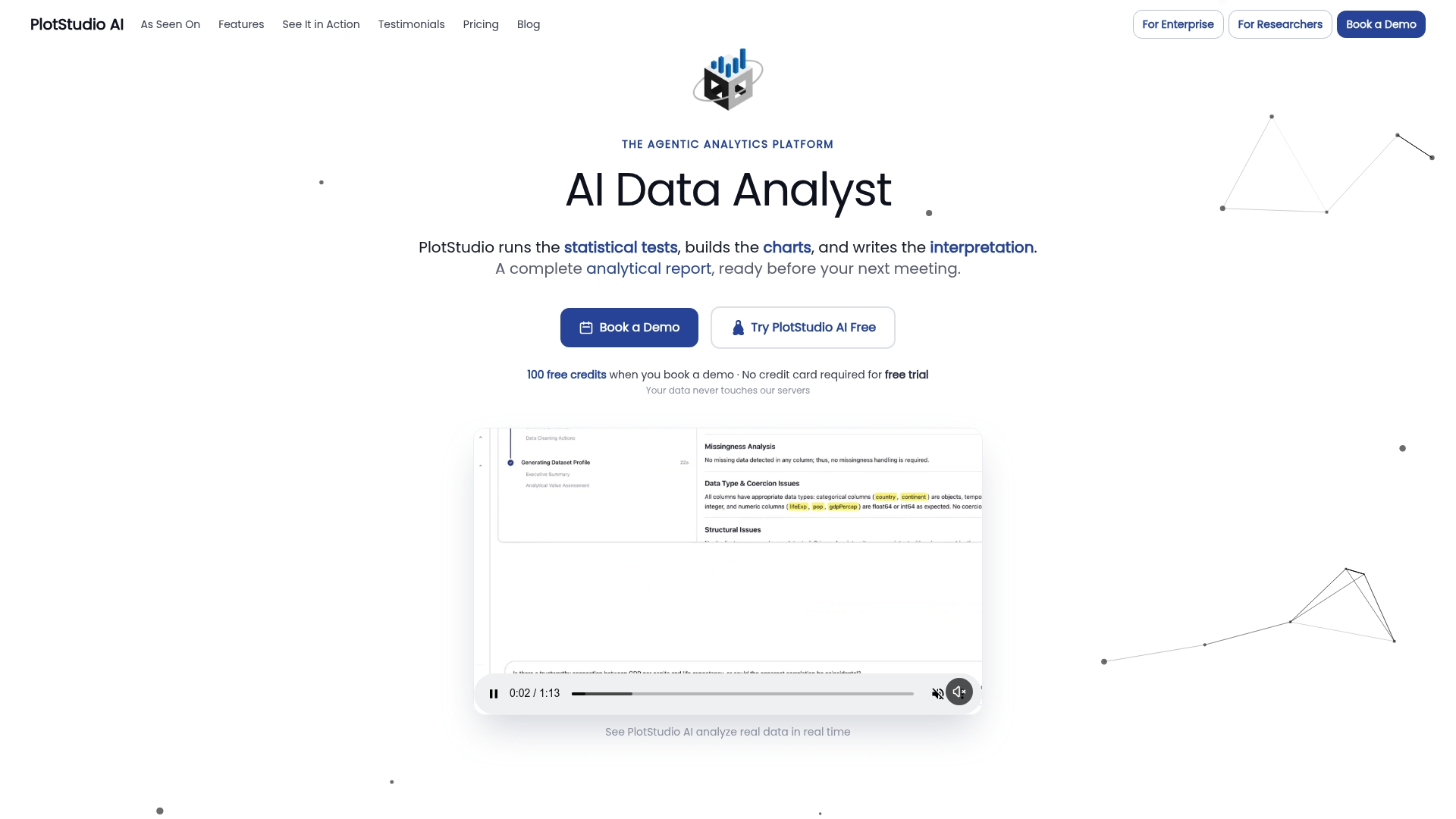
Native R and Python execution covers the methods your field actually uses: survival analysis, Cox proportional hazards, mixed-effects models, regression, and ANOVA. Domain-specific Skills let your lab encode its own methodological standards once, so every subsequent analysis follows them automatically. For institutions needing organization-wide deployment, enterprise Azure options keep everything behind your own infrastructure perimeter. Academic teams can apply for research partnership credits to run a structured pilot before committing to a full license.
Authoritative sources and research references for deeper reading
- Prio: Private, Robust, and Scalable Computation of Aggregate Statistics (Berkeley / NSDI 2017) — foundational reference for cryptographic aggregation, MPC design, and the feasibility of complex statistics like regression without raw-data access. Start here for theory.
- Learning to Live with Privacy-Preserving Analytics (CMU / Acquisti et al.) — the clearest treatment of the utility–privacy tradeoff for practitioners. Read this before choosing between DP and local-only approaches.
- Toward Provably Private Analytics and Insights into GenAI Use (Google / arXiv) — covers TEE plus DP autotuning for server-side pipelines; relevant for multi-site or server-hosted deployments.
- Private Analytics via Zero-Trust Aggregation (Google Research Blog) — engineering walkthrough of secure aggregation architectures combining TEEs and cryptographic protocols. Consult for implementation guidance.
- Whisper: Private Analytics via Streaming, Sketching, and Silently Verifiable Proofs — advanced protocol for scaling private aggregation with reduced server communication costs; relevant for large federated deployments.