5 Items Reviewers Expect for Product Metrics Analysis in Academia

Product metrics analysis for academic research must produce privacy-preserving, reproducible, and pre-approved results packaged for peer review. That means results gated by an analysis plan reviewed before code runs, executed with privacy controls appropriate to the data (local processing, federation, or encryption), and exported as a reproducibility package with version-controlled code, environment records, and provenance logs. Tools like Git, Docker, and platforms like Plotstudio anchor this workflow in practice.
TL;DR:
- Pre-approved analysis plans should define hypotheses, methods, and decision rules before code execution to ensure transparency and reviewability.
- Privacy-preserving techniques depend on data constraints, with local execution and cryptographic methods providing the most accurate results without exposing individual records.
- Reproducibility requires automated workflows, version-controlled code, environment snapshots, and automatic provenance logs to facilitate validation and audits.
- Submission packages must include notebooks or scripts, generated reports, file hash manifests, environment details, and provenance logs to satisfy reviewer expectations.
- Early investment in detailed planning, containerized environments, and provenance capture prevents last-minute failures and simplifies reproducibility efforts.
Table of Contents
- What Makes Product Metrics Analysis Defensible in Peer Review?
- How Do You Choose a Privacy-Preserving Analytics Method?
- Building a Reproducible Computational Workflow Step by Step
- What Should You Submit With a Paper, Thesis, or Grant?
- The Gap Between Good Intentions and a Reproducible Package
- Where an agentic analytics platform fits into a reproducible research pipeline
- Sources
What Makes Product Metrics Analysis Defensible in Peer Review?
A pre-approved analysis plan is the single artifact reviewers ask about most often when something looks off in a results section. Write it before a single line of code touches the data, and treat it as a contract with your future self and your eventual reviewers.
The plan should clearly define hypotheses and primary endpoints and specify methods, assumptions, and decision rules prospectively before analysis. If you’re running a Cox proportional hazards model, say so, name the covariates, and state the proportional hazards check you’ll run. If a secondary analysis is exploratory, label it that way up front. This kind of prospective specification is exactly what a multidisciplinary consensus on core reproducibility items flags as a recurring gap between what funders expect and what labs actually document.
Code quality control matters just as much as statistical planning, and it gets skipped more often. A second team member should review the analysis scripts independently, not just skim the output. Key functions deserve unit tests, particularly anything computing derived variables or handling missingness. Random number generation needs an explicit, logged seed, and automated checks are recommended to detect and prevent manual editing of raw data to ensure reproducibility

Best practices include storing raw data as read-only and immutable, maintaining a data dictionary with variables clearly documented, and assigning a DOI to datasets when data sharing agreements permit
Pro Tip: Draft your analysis plan as a version-controlled markdown file, not a static PDF. When a reviewer asks why a decision rule changed between submission and revision, you want a commit history that answers the question, not a memory.
How Do You Choose a Privacy-Preserving Analytics Method?
The right privacy approach depends on where your data can legally sit, not on which method sounds most rigorous. Start with the constraint, not the technique.

Local-first execution is the default for IRB-governed and GDPR special-category data, and often the only workable option. If the data cannot leave the device or institutional server, no cloud analytics platform is a legitimate candidate, regardless of its statistical features.
Federated analytics changes the question from “how do we move the data” to “how do we move the model.” A DataSHIELD-style setup sends analysis code to each site, computes locally, and returns only aggregated statistics. A federated study combining differential privacy across hospital data warehouses found the approach workable, but ε selection and small per-site sample sizes measurably affected accuracy on more complex tests, according to research on federated analysis with differential privacy in oncology.
When per-site samples are small, DP noise can make complex inferential models effectively unusable. Increasing the number of participating sites, applying central DP with secure aggregation, or switching to cryptographic aggregation until final release are the three practical workarounds.
Cryptographic methods sidestep the noise problem entirely by keeping data encrypted through computation. Multiparty homomorphic encryption, demonstrated in the FAMHE framework, reproduced centralized Kaplan-Meier and GWAS results with near-lossless accuracy while intermediate values stayed encrypted throughout. VALORIS applies a related idea to vertically partitioned logistic regression, delivering a one-shot, lossless result across sites that never pool individual records. Both trade higher setup and compute cost for accuracy that DP budgets can’t always match. When neither federation nor encryption is feasible, synthetic data generation built on tools like synthpop lets you sanity-check a pipeline’s mechanics without touching a real record.
Building a Reproducible Computational Workflow Step by Step
Reproducibility isn’t a philosophy, it’s a sequence of specific engineering choices, and most of them take less time than the manual process they replace.
- Stage your data as read-only. Never open the raw file in Excel and edit a cell. Write every transformation as code, and pair it with a data dictionary and codebook that defines each derived variable.
- Put everything under version control. Track analysis code and markdown documentation with Git, but never commit sensitive raw data to the repository. Snapshot package versions with renv or conda, or go further and containerize the environment with Docker or Singularity so a reviewer running your code five years from now gets the same numbers.
- Automate the full run behind one command. A Makefile, a drake pipeline, or a CI job should regenerate every table and figure from raw data to final PDF without manual intervention. Record the exact computing environment for each run, an R sessionInfo() call or a container hash, alongside the outputs, a practice detailed in guidance on best practices in statistical computing.
- Capture provenance automatically. Tools like rdtLite and E2ETools log the execution environment, every input and output file, and fine-grained traces of what ran and when, according to documentation on end-to-end provenance tools for R. Bind those logs to specific commits with an audit pattern, keep an immutable manifest of file hashes, and you have a defensible answer for any “how did you get this number” question.
Pro Tip: Companion tools like provExplainR compare provenance across two runs directly, so when a result shifts after a package update, you can pinpoint the exact line and dependency responsible instead of re-running the whole pipeline from scratch.
What Should You Submit With a Paper, Thesis, or Grant?
Reviewers increasingly expect a defined package, not just a results section and a promise that the code exists somewhere. Five items cover nearly every request you’ll get:
- An annotated notebook or script that runs start to finish without manual steps.
- A PDF report generated directly from that code, not reformatted by hand afterward.
- A reproducibility manifest listing file hashes for every input and output.
- An environment record (sessionInfo, container hash, or lockfile) pinned to the exact run that produced your reported numbers.
- Per-run provenance logs showing what executed and in what order.
When the underlying data itself can’t leave the institution, you still have options. A synthetic version generated with synthpop lets a reviewer verify your method’s mechanics without ever seeing a real record. Aggregate summary tables, restricted-access repository placement, or federated encrypted outputs each satisfy a different flavor of data-sharing agreement. Check the target repository’s requirements before you build the package, not after a reviewer asks for it.
The Gap Between Good Intentions and a Reproducible Package
Most labs don’t fail at reproducibility because they lack discipline. They fail because the highest-friction step, provenance capture, gets deferred until submission week, by which point nobody remembers which script version produced the final table.
The teams that avoid this trap invest early in exactly three things: a pre-approved plan that forces decisions before results bias them, a containerized environment so “it worked on my machine” stops being a valid excuse, and automatic provenance capture so no one has to reconstruct history from memory. Hard-coded file paths and skipped continuous integration checks are the two silent killers I’d flag first. Both are cheap to fix in week one and expensive to untangle in week twelve.
If you’re two weeks from submission, run this check: can a colleague clone your repository, run one command, and get your exact tables back? If not, that’s the gap to close before anything else.
— Aymen
Where an agentic analytics platform fits into a reproducible research pipeline
Everything in this playbook, the pre-approved plan, the local execution, the provenance package, is what an agentic analytics platform can produce automatically rather than by hand. Analysis runs locally on your own machine, which makes it a workable option when IRB or GDPR terms mean the data can never touch a cloud server. Every run is gated behind an analysis plan you review and approve before any code executes, giving you the audit trail reviewers ask for without a separate documentation effort.
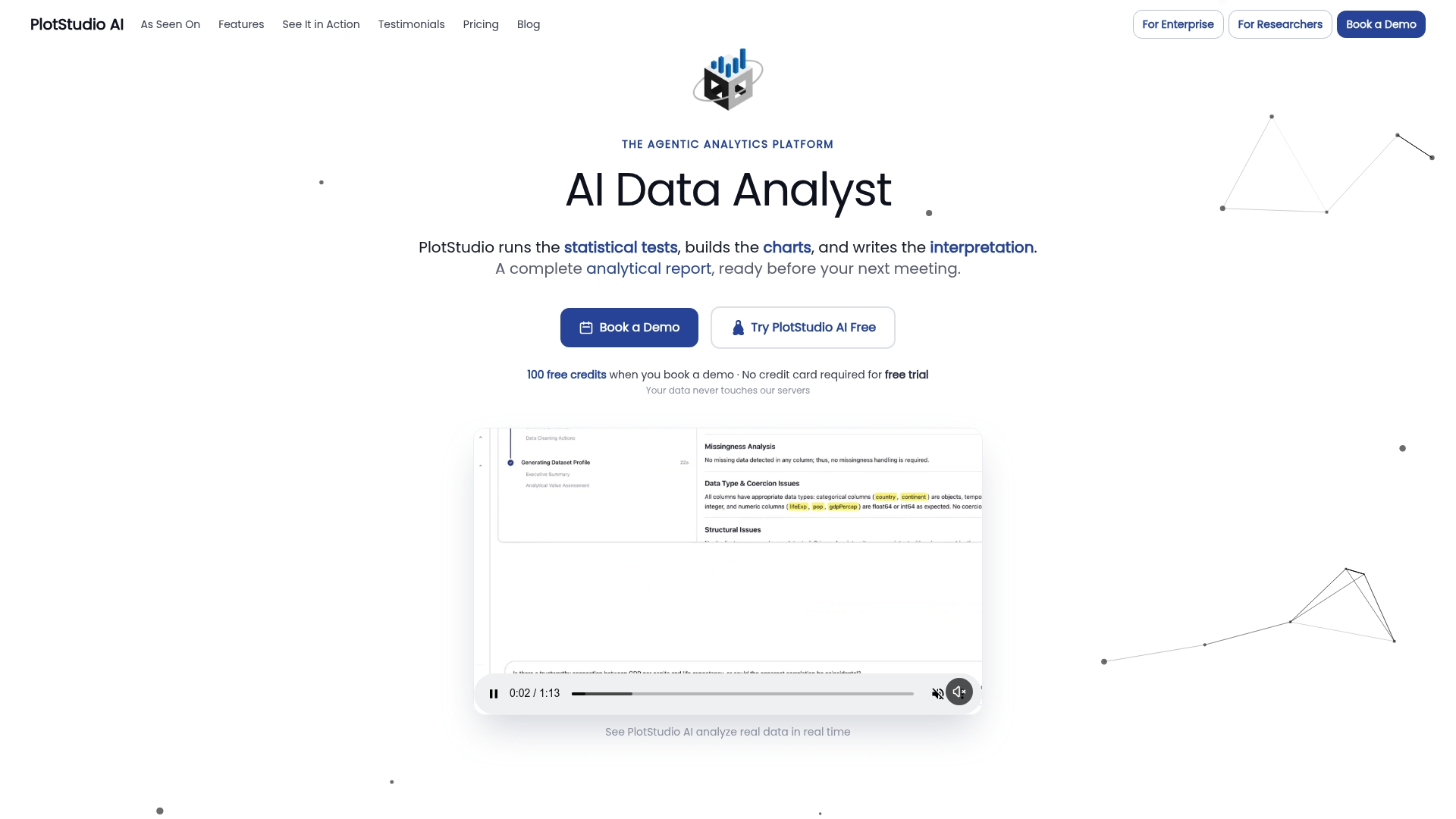
Plotstudio runs R and Python natively and covers the methods academic work actually needs: survival analysis, mixed-effects models, ANOVA, multiple-comparison correction. Skills let your lab encode its own required steps and forbidden shortcuts once, so every subsequent analysis follows your discipline’s conventions instead of a generic default. Each run exports a full reproducibility package, annotated notebooks, a PDF report, and a permanent searchable analysis page, so a supervisor or reviewer can trace exactly how a result was produced without asking you to reconstruct it from memory. If your next submission deadline includes a reproducibility package on the checklist, see how Plotstudio’s research-grade analytics platform handles that requirement before you build one by hand.
Sources
The claims in this guide draw on peer-reviewed methods papers and active tooling projects, not general practice. Start with the best practices in statistical computing review for the literate programming and environment capture case, and the international consensus on core reproducibility items for what funders and journals now expect at minimum.
For privacy-preserving methods, read the federated analysis with differential privacy study, the multiparty homomorphic encryption paper, and the VALORIS logistic regression method. Provenance tooling is documented in the E2ETools R Journal article. Sensitive-data sharing always remains subject to your institution’s own data governance policy and your specific data-sharing agreement, whatever tooling you use.
- Best practices in statistical computing - PMC
- Federated Analysis With Differential Privacy in Oncology Research: Longitudinal Observational Study Across Hospital Data Warehouses - JMIR
- VALORIS: One-shot and lossless vertical logistic regression for privacy-protecting multi-site health analytics - Scientific Reports