Pseudonymization vs Anonymization: The Practitioner’s Guide

Pseudonymization preserves a reversible link to the original identity, so the data remains legally personal and analytically useful for longitudinal work. Anonymization severs that link irreversibly, placing data outside personal-data regulations when done correctly, but often at a real cost to analytical utility. Choosing between them is not a stylistic preference; it determines your HIPAA obligations, your IRB protocol, your breach notification duties, and whether your dataset can ever be re-linked for follow-up analysis.
At a glance:
- Pseudonymized data is still personal data under HIPAA, GDPR, and the Common Rule. It requires data use agreements, access controls, and breach response procedures.
- Anonymized data, when genuinely effective, falls outside the scope of HIPAA’s Privacy Rule and GDPR. No consent, no DUA, no breach notification for that dataset.
- Pseudonymization suits internal analytics, longitudinal clinical research, and multi-site studies where re-linking is a future requirement.
- Anonymization suits public dataset releases, open science repositories, and model training where re-linking is never needed.
| Dimension | Pseudonymization | Anonymization |
|---|---|---|
| Reversibility | Reversible with the mapping key | Irreversible by design |
| Linkability across records | Preserved (same pseudonym = same subject) | Severed (no stable identifier) |
| Legal status (US/EU) | Remains personal data | Not personal data when effective |
| Data utility | High — longitudinal links intact | Lower — aggregation or noise reduces detail |
| Implementation complexity | Moderate — key management required | High — must withstand adversary testing |
| Re-identification risk | Controlled by key security | Residual; requires formal testing |
Key Takeaways
Pseudonymized data remains legally personal data under HIPAA and GDPR, requires key management and DUAs, and suits longitudinal research; anonymized data exits regulatory scope only when it withstands formal adversary testing against the EDPB’s three criteria.
| Point | Details |
|---|---|
| Legal status is the core difference | Pseudonymized data is still personal data; anonymized data exits HIPAA/GDPR scope only when genuinely effective. |
| Re-linking requirement drives the choice | If you will ever need to re-link records to individuals, pseudonymization is required; anonymization severs that link permanently. |
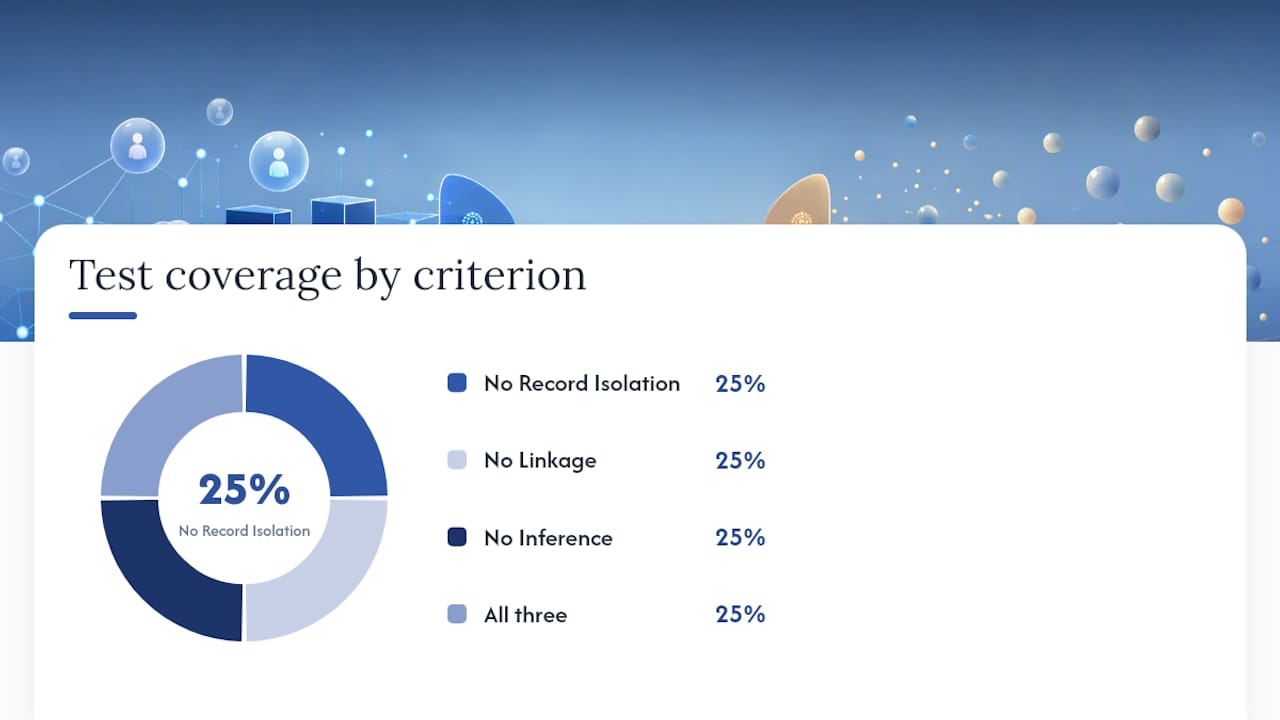
| Anonymization requires adversary testing | Apply the EDPB’s No Record Isolation, No Linkage, and No Inference criteria with a documented adversary model before any public release. |
| Key management is the operational core | The pseudonymization mapping table must be stored separately, access-controlled, and rotated on a defined schedule. |
| Plotstudio supports compliant workflows | Local processing, pre-registered analysis plans, and reproducibility exports map directly to IRB and HIPAA documentation requirements. |
Table of Contents
- What do pseudonymization and anonymization actually mean?
- How pseudonymization and anonymization differ technically
- How US law treats pseudonymization and anonymization
- When should you use pseudonymization vs anonymization?
- Which techniques implement each approach?
- How do you test whether anonymization is effective?
- What controls and documentation does a compliant program require?
- Real-world examples and lessons learned
- How a privacy-first analytics workflow supports these controls
- A practitioner’s perspective on the real tradeoffs
- Plotstudio reduces operational friction for research teams
- Sources
What do pseudonymization and anonymization actually mean?
Precise definitions matter here because the terms are used inconsistently across sectors, and a category error in your documentation can create real regulatory exposure.
NIST defines pseudonymization as a type of de-identification in which direct identifiers are replaced with pseudonyms and an association between characteristics and one or more pseudonyms is retained. The retained association is the defining feature: the data can be re-linked if the mapping key is available.
The EDPB draws a sharper line. Per EDPB guidance, pseudonymization reduces linkability but does not aim to make data completely unlinkable, while anonymization makes data unlinkable and, when effective, places it outside GDPR scope entirely. The ICO echoes this: pseudonymized data remains personal data in the controller’s hands, regardless of how strong the pseudonym is.
ISO/TS 25237 defines pseudonymization in the healthcare context as a particular type of de-identification that replaces identifying information with an artificial identifier (the pseudonym), with the explicit possibility of re-identification under controlled conditions. That “controlled conditions” clause is what separates it from anonymization.
How this guide uses the terms:
- Pseudonymization: any transformation that replaces identifiers with pseudonyms while retaining a mapping that allows re-linking, per NIST and ISO/TS 25237.
- Anonymization: any transformation that makes re-identification not reasonably achievable for the relevant recipient population, per EDPB and ICO criteria.
- De-identification: the umbrella term covering both, used in US healthcare law (HIPAA) and NIST guidance. Under HIPAA, de-identified data is a specific legal category; pseudonymized data may or may not qualify depending on whether the mapping key is retained.
In healthcare, “de-identification” often means what engineers call anonymization. In engineering and GDPR contexts, “pseudonymization” has a precise technical meaning. Knowing which vocabulary your regulator uses prevents costly misclassification.
How pseudonymization and anonymization differ technically
The practical engineering gap between the two techniques comes down to four dimensions: reversibility, linkability, identifiability, and analytical utility.
| Dimension | Pseudonymization | Anonymization |
|---|---|---|
| Reversibility | Yes, via mapping key or algorithm inversion | No — irreversible by design |
| Linkability across datasets | Yes — same pseudonym links records | No — no stable identifier survives |
| Identifiability | Reduced but not eliminated | Eliminated for the relevant recipient (when effective) |
| Analytical utility | High — individual-level analysis possible | Lower — aggregation, noise, or generalization required |
Reversibility in practice. A pseudonymized record can be re-linked to its source subject if the mapping key is available. That is a feature for longitudinal clinical research and a liability if the key is poorly protected. Anonymized data, by contrast, cannot be re-linked even with the mapping key, because no mapping key exists.
Linkability across records. Pseudonymization preserves a stable identifier across records, which is exactly what longitudinal research requires. A patient enrolled in a five-year cardiovascular study needs the same pseudonym at year one and year five so the records can be joined. Anonymization breaks that link, which is why it is unsuitable for any workflow that requires tracking individuals over time.
The NYC taxi cautionary case. NIST IR 8053 documents that deterministic pseudonymization can be reversed when the value space is enumerable. In the NYC taxi dataset, medallion numbers and hack license numbers were hashed using MD5, but because the input space was small and predictable, researchers reversed the hashes by brute-force enumeration. The lesson: a hash is not a pseudonym unless the input space is large enough to resist enumeration. Randomized pseudonyms with separate key storage are the practical mitigation.
Analytical utility tradeoffs. Pseudonymized data supports individual-level regression, survival analysis, and mixed-effects models without modification. Anonymized data typically requires aggregation, generalization (replacing exact ages with age bands), or the addition of statistical noise via differential privacy, each of which reduces the precision of estimates. For a public dataset release, that cost may be acceptable. For an IRB-approved longitudinal study, it usually is not.
Short scenario illustrations:
- Longitudinal clinical research: pseudonymization lets you join baseline and follow-up records by pseudonym while keeping identifiers locked in a separate key store. Anonymization would require re-enrollment or probabilistic matching at each wave.
- Public dataset release: anonymization is required. A pseudonymized public release is a contradiction in terms — if the mapping key exists, the data is not anonymous.
- ML model training on sensitive records: pseudonymization reduces incidental exposure; differential privacy on the training outputs provides a formal privacy guarantee for the model itself.
Pro Tip: Never call a keyed hash a “one-way” transformation without verifying that the input space is large enough to resist enumeration. For low-cardinality fields like US zip codes, dates of birth, or license plate numbers, a salted, randomized token with a separate key store is the only defensible pseudonymization approach.
How US law treats pseudonymization and anonymization
The regulatory consequences of choosing one approach over the other are concrete and consequential under three US frameworks.
HIPAA Safe Harbor and Expert Determination
HIPAA’s Privacy Rule creates a specific legal category: de-identified protected health information (PHI). Data that meets this standard is no longer PHI and falls outside the Privacy Rule’s requirements. Two methods achieve it.
Safe Harbor requires removal of 18 specified identifiers (names, geographic subdivisions smaller than a state, dates except year for individuals over 89, phone numbers, SSNs, and 12 others) and a covered entity’s actual knowledge that the remaining data cannot identify an individual. Pseudonymization alone does not satisfy Safe Harbor unless the mapping key is destroyed, because the covered entity retains actual knowledge that re-identification is possible.
Expert Determination requires a qualified statistical or scientific expert to apply generally accepted principles and certify that the risk of identifying an individual is very small. Pseudonymized data with a retained key would not pass Expert Determination for the same reason: the expert must assess the realistic re-identification risk, and a retained key makes re-identification achievable.
Common Rule and IRB expectations
The Common Rule (45 CFR 46) governs federally funded human subjects research. Its identifiability standard asks whether the identity of subjects can be readily ascertained by the investigator or associated with the information. Pseudonymized data, where the investigator holds or can access the mapping key, is identifiable under this standard and requires IRB oversight, informed consent (unless waived), and data management plan documentation. Anonymized data, where no key exists and re-identification is not reasonably achievable, may qualify for exemption from full IRB review under 45 CFR 46.101(b)(4), though IRBs apply this exemption conservatively.
NIST guidance and practical mapping
NIST IR 8053 provides the most technically detailed US guidance on de-identification, covering pseudonymization techniques, reversal risks, and practical factors affecting re-identification. NIST frames pseudonymization as a de-identification technique that retains re-link potential, consistent with the HIPAA analysis above.
EDPB and ICO as comparative context. Under GDPR, pseudonymized data is explicitly still personal data (Recital 26). The EDPB’s Guidelines 02/2026 provide an operational anonymization test framework that US teams working with international collaborators or EU data subjects should understand. The ICO’s position aligns: pseudonymized data remains personal data in the controller’s hands. For US researchers collaborating with EU institutions, both frameworks apply simultaneously.
Practical implications for US teams:
- Pseudonymized datasets require Business Associate Agreements (BAAs) or Data Use Agreements (DUAs) for sharing.
- Breach notification obligations under HIPAA’s Breach Notification Rule apply to pseudonymized PHI.
- Anonymized datasets (meeting Safe Harbor or Expert Determination) require no BAA, no consent for secondary use, and no breach notification under HIPAA.
- IRB protocols must specify which approach is used and document the basis for any identifiability determination.
- Expert Determination reports must be retained as part of the covered entity’s documentation.
When should you use pseudonymization vs anonymization?
The decision is not purely technical. It turns on whether you will ever need to re-link records, who will receive the data, and what regulatory framework governs the use.
Use pseudonymization when:
- You need to track the same individual across time or across datasets (longitudinal studies, multi-site trials, follow-up surveys).
- The data will remain within a controlled environment where key access can be restricted and audited.
- You may need to withdraw a specific subject’s data (e.g., consent withdrawal under GDPR or IRB protocol amendment).
- The analytical workflow requires individual-level modeling (regression, survival analysis, mixed-effects models).
- You are sharing data internally or with trusted partners under a DUA, where re-identification risk is managed contractually and technically.
Use anonymization when:
- The data will be released publicly or to an unrestricted recipient population.
- Re-linking to individuals is never a legitimate future need.
- You need to escape HIPAA’s Privacy Rule or GDPR’s scope for secondary research use.
- The analytical purpose can be served by aggregate statistics, generalized records, or differentially private outputs.
- The IRB or ethics board requires that no re-identification pathway exist for the recipient.
Hybrid approaches. Many research workflows use both. A multi-site clinical study pseudonymizes data internally across sites, maintaining longitudinal links under controlled key management. When publishing results or sharing data with the broader research community, the team produces an anonymized derivative dataset, applying generalization, suppression, and differential privacy to the pseudonymized records before release. UCL’s guidance frames this well: anonymization enables broader sharing when identifiability is removed in practice, and identifiability depends on whose hands the data will be in. The same dataset can be pseudonymized for the research team and anonymized for the public release, provided the anonymization step genuinely severs the link.
Decision checklist:
- Will you need to re-link records to individuals at any future point? If yes, pseudonymization is required.
- Who receives the data? Unrestricted recipients require anonymization.
- Does your IRB protocol or HIPAA compliance program require a specific approach? Follow it.
- Can your analytical goals be met with aggregated or noisy data? If yes, anonymization is viable.
- Do you have the key management infrastructure to protect a pseudonymization mapping table? If not, anonymization may be operationally safer.
Which techniques implement each approach?
Pseudonymization techniques
Tokenization replaces a direct identifier with a randomly generated token stored in a mapping table. The token has no mathematical relationship to the original value, so reversal requires access to the table. This is the most common enterprise pseudonymization technique and the basis of most payment card industry (PCI) tokenization systems.
Keyed encryption uses a symmetric or asymmetric key to encrypt identifiers. AES-256 in a well-managed key store is a standard choice. The pseudonym is the ciphertext; re-identification requires the decryption key.
Keyed hashes apply a cryptographic hash function with a secret key (HMAC). Without the key, the hash cannot be reversed. With the key, the same input always produces the same output, preserving deterministic linkability. The NYC taxi failure used keyless MD5 hashes, not keyed hashes — a critical distinction.
Deterministic vs randomized pseudonyms. Deterministic pseudonyms (same input always produces the same output) support record linkage but create a linkage surface if the pseudonym space is small. Randomized pseudonyms (different output each time) prevent linkage attacks but require a mapping table to join records.
Mapping tables and key custody. The mapping table is the most sensitive artifact in a pseudonymization system. It must be stored separately from the pseudonymized dataset, access-controlled to a minimal set of authorized personnel, and backed up with the same security controls as the data itself.
Anonymization techniques
Redaction removes fields entirely. Simple and auditable, but it destroys any analytical value in the removed field.
Generalization replaces precise values with ranges or categories (exact age becomes an age band; precise zip code becomes a three-digit prefix). It preserves distributional information while reducing identifiability.
k-Anonymity requires that every record in a released dataset be indistinguishable from at least k-1 other records on the quasi-identifier fields. A dataset with k=5 means no individual can be singled out from fewer than five others. k-Anonymity is a useful baseline but does not protect against attribute inference attacks.
l-Diversity extends k-anonymity by requiring that each equivalence class contain at least l well-represented values for sensitive attributes, reducing inference risk.
Differential privacy adds calibrated statistical noise to query outputs or to the dataset itself, providing a formal mathematical guarantee that the presence or absence of any individual record has a bounded effect on the output. It is the strongest available anonymization guarantee and is increasingly required for public dataset releases in sensitive domains.
Technique pitfalls:
- Reversible hashes (keyless MD5, SHA-1 on low-cardinality fields) are not pseudonymization; they are obfuscation.
- Linkage via auxiliary data: a dataset with generalized age and zip code can often be re-linked to a voter registration file or a commercial data broker record.
- Over-generalization: suppressing or broadening too many fields to achieve k-anonymity can render a dataset analytically useless.
- Differential privacy noise calibration: too little noise fails the privacy guarantee; too much destroys statistical power.
Tooling considerations. When evaluating data masking tools for research workflows, ask vendors specifically about key management architecture, whether pseudonymization keys are stored separately from the data, whether the tool supports reproducible transformation logs, and whether processing can run locally on your infrastructure. For differential privacy, Python libraries such as Google’s DP Library and OpenDP are widely used in research settings. For k-anonymity and l-diversity, ARX Data Anonymization Tool is a well-documented open-source option. Enterprise platforms vary widely in their key management maturity; treat key custody as a first-order evaluation criterion, not an afterthought.
Pro Tip: When selecting enterprise tooling, ask the vendor to demonstrate where the pseudonymization key is stored at rest and in transit, who has access, and how key rotation is handled. A vendor who cannot answer these questions clearly has not solved the hardest part of pseudonymization.
For teams evaluating agentic AI security in research workflows, the same key-custody and access-control principles apply to any AI system that processes pseudonymized data.
How do you test whether anonymization is effective?
Testing anonymization is not optional. A dataset that looks anonymous can be re-identified by an adversary with access to auxiliary data, and the consequences of a failed anonymization are worse than a disclosed pseudonymization breach, because the failure destroys the legal basis for the data’s use.
The EDPB’s Guidelines 02/2026 provide the most operationally useful framework: three criteria that a dataset must satisfy to be considered anonymous.
The three EDPB anonymization criteria:
- No Record Isolation: an adversary cannot single out one or more records that uniquely identify an individual.
- No Linkage: an adversary cannot link two or more records relating to the same individual, either within the dataset or by joining with an external dataset.
- No Inference: an adversary cannot infer the value of an attribute for an individual with high confidence.
Step-by-step anonymization test plan
-
Map the data. Catalog every field in the dataset. Classify each as a direct identifier (name, SSN, date of birth), a quasi-identifier (zip code, age, occupation), or a sensitive attribute (diagnosis, salary, political affiliation). Document the classification rationale.
-
Enumerate auxiliary sources. List every external dataset a realistic adversary could access: voter registration files, commercial data broker records, social media profiles, public health registries, prior published datasets from the same cohort. The adversary model determines the anonymization standard required.
-
Run singling-out tests. For each combination of quasi-identifiers, calculate the uniqueness rate. Any record that is unique on a combination of quasi-identifiers fails the No Record Isolation criterion. Tools like ARX can automate this for k-anonymity thresholds.
-
Simulate linkage attacks. Attempt to join the dataset with each enumerated auxiliary source on shared quasi-identifiers. Document the match rate. A match rate above a threshold your legal team and IRB accept is a failure of the No Linkage criterion. Peer-reviewed re-identification research consistently shows that high-dimensional datasets with seemingly innocuous quasi-identifiers can be re-linked at rates that would surprise most practitioners.
-
Test inference risk. For each sensitive attribute, assess whether a recipient could infer its value from the remaining fields with high confidence. l-Diversity and t-closeness metrics operationalize this test.
-
Document assumptions. Record the adversary model, the auxiliary sources considered, the test results, and the residual risk assessment. This documentation is what an auditor, IRB, or regulator will examine.
| Test | Criterion addressed | Tool/method |
|---|---|---|
| Uniqueness analysis on quasi-identifiers | No Record Isolation | ARX, manual SQL analysis |
| Linkage simulation with auxiliary datasets | No Linkage | Probabilistic matching, record linkage libraries |
| Attribute inference analysis | No Inference | l-Diversity, t-closeness metrics |
| Differential privacy budget review | All three | DP library audit, epsilon documentation |
Threat model template. Define three attacker tiers: (1) an insider with access to the pseudonymization key store, (2) a recipient with access to one or more auxiliary datasets, and (3) a third party with access to scraped public data. Test against each tier separately. The anonymization standard must hold against the most capable realistic adversary for your deployment context.
Retesting triggers. Anonymization is not a one-time event. Retest when: new external datasets become publicly available that could serve as auxiliary sources; the dataset is merged with another dataset; model outputs derived from the data are published; or the recipient population changes.
What controls and documentation does a compliant program require?
Access controls and key management
The pseudonymization mapping table must be stored in a system separate from the pseudonymized dataset, with role-based access controls limiting access to the minimum necessary personnel. Key rotation schedules should be defined in advance and documented. Secrets management tools (HashiCorp Vault, AWS Secrets Manager, or equivalent) provide auditable access logs and automated rotation. Every access to the mapping table should generate an audit log entry.
For anonymized datasets, the absence of a mapping key is itself a control. Document that no mapping key exists and that the transformation is irreversible. This documentation is what supports a HIPAA Safe Harbor or Expert Determination claim.
Documentation requirements
For pseudonymization:
- Data map identifying all pseudonymized fields and the pseudonymization technique applied to each.
- Transformation log recording when pseudonymization was applied, by whom, and with which key version.
- Pseudonymization domain definition (per EDPB 2025 guidelines): the set of records and the scope within which the pseudonym is consistent.
- Key custody records: who holds the key, where it is stored, and the rotation schedule.
- DUAs or BAAs for any sharing of pseudonymized data.
- IRB protocol section specifying the pseudonymization approach and key access controls.
For anonymization:
- Expert Determination report (if using HIPAA Expert Determination method) or Safe Harbor checklist documenting removal of all 18 identifiers.
- Anonymization test results: singling-out analysis, linkage simulation results, inference risk assessment.
- Adversary model documentation.
- Retention policy for the anonymization documentation itself (retain even after the dataset is published).
Incident and breach considerations
A breach of pseudonymized data is a HIPAA breach unless the covered entity can demonstrate that the probability of PHI compromise is low under the four-factor risk assessment (nature and extent of PHI, who accessed it, whether PHI was actually acquired or viewed, and extent to which risk has been mitigated). The retained mapping key is a material factor in that assessment. A breach of genuinely anonymized data is not a HIPAA breach, because the data is not PHI.
Pro Tip: Keep your anonymization test documentation in the same records management system as your IRB protocols and DUAs. When a regulator or IRB asks for evidence that a dataset was properly anonymized, you need to produce the test results, the adversary model, and the Expert Determination report in a single, auditable package.
For teams building privacy-first analytics workflows, reproducible audit trails are not a nice feature; they are the evidentiary foundation of a defensible anonymization program.
Real-world examples and lessons learned
The NYC taxi hash reversal
In 2014, New York City released a taxi trip dataset with medallion numbers and hack license numbers hashed using MD5. Because the input space was small and enumerable (a finite set of known medallion numbers), researchers reversed the hashes by computing MD5 for every known medallion number and matching the results. The dataset, intended as anonymized, was fully re-identified. NIST IR 8053 documents this case as a cautionary illustration of deterministic pseudonymization failure.
The technical lesson is precise: a hash applied to a low-cardinality field without a secret key is not a pseudonym. It is obfuscation that fails under a brute-force enumeration attack. The organizational lesson is equally important: the team that released the dataset did not run a singling-out or linkage test before release.
Longitudinal clinical research with pseudonymization
A multi-site cardiovascular outcomes study pseudonymizes patient records at each site using site-specific tokenization, with mapping tables held by each site’s data custodian and never shared across sites. A central coordinating center receives only the pseudonymized records with a study-specific pseudonym, generated by a trusted third party using a keyed HMAC. The coordinating center can join baseline and follow-up records by pseudonym, run survival analysis and Cox proportional hazards models, and produce reproducible outputs without ever holding the mapping key. IRB protocols at each site document the pseudonymization approach, key custody arrangements, and the conditions under which re-identification is permissible (adverse event reporting, consent withdrawal).

This architecture satisfies the Common Rule’s identifiability standard for the coordinating center (which cannot re-identify without the site-held keys) while preserving longitudinal linkability for the study’s primary endpoints.
Public dataset release with differential privacy
A federal health agency releasing a synthetic version of a national survey dataset applies differential privacy with a documented epsilon budget, generalization on geographic fields to the state level, and suppression of cells with fewer than a defined count threshold. The release is accompanied by a published data dictionary, the anonymization test results, and the epsilon parameter documentation. Researchers using the dataset can reproduce the privacy analysis and assess whether the epsilon budget is appropriate for their intended use.
Lessons for teams preparing data releases:
- Run singling-out tests before release, not after.
- Document the adversary model explicitly; “we removed names and SSNs” is not an adversary model.
- For public releases, differential privacy provides a formal guarantee that generalization and suppression alone cannot.
- Retain all test documentation permanently, even after the dataset is published.
How a privacy-first analytics workflow supports these controls
The controls described above, local processing, pre-registered analysis plans, reproducible audit trails, and field-level PII handling, are not abstract governance requirements. They are operational features that a research analytics platform either supports or forces you to build manually.
Plotstudio’s privacy-first analytics architecture maps directly to several of the controls discussed:
- Local processing: analysis runs on the researcher’s own machine. Pseudonymized or anonymized datasets never leave the device, which eliminates the cloud-upload risk that makes many IRB-governed datasets ineligible for standard cloud analytics tools.
- Pre-registered analysis plans: every analysis is gated behind a plan the researcher reviews before any code runs. For IRB-governed studies, this plan functions as a pre-registration and an audit trail, documenting methods, assumptions, and success criteria in advance.
- Reproducibility exports: annotated notebooks, PDF reports, and permanent searchable analysis pages let a supervisor, IRB reviewer, or collaborator trace exactly how any result was produced. This is the evidentiary package an IRB or regulator expects.
- PII detection and field-level encoding: Plotstudio flags potential PII fields during data ingestion, supporting the data mapping step that precedes any pseudonymization or anonymization decision.
- Domain-specific Skills: a lab can encode its field’s required statistical methods, reporting conventions, and forbidden shortcuts once, so every subsequent analysis follows the discipline’s methodology rather than a generic default.
IRB-approved longitudinal study workflow. A research team running a five-year cohort study loads pseudonymized records (with identifiers held separately by the data custodian) into Plotstudio. The analysis plan documents the pseudonymization approach, the statistical methods, and the multiple-comparison correction thresholds. Plotstudio runs survival analysis and mixed-effects models locally, exports an annotated notebook and PDF report, and creates a permanent searchable analysis page. When the IRB requests documentation of the analytical methods at the annual review, the team produces the pre-registered plan and the reproducibility package in a single export.
A practitioner’s perspective on the real tradeoffs
The framing of pseudonymization vs anonymization as a binary choice misses the most common organizational failure: teams that pseudonymize data, call it anonymized in their documentation, and then discover the error during a regulatory audit or a data breach investigation.
The practical tradeoffs are real:
- Utility vs legal safety: pseudonymization preserves analytical power but keeps you inside the regulatory perimeter. Anonymization reduces that power but can exit the perimeter entirely.
- Testing cost vs risk tolerance: genuine anonymization testing requires adversary modeling, linkage simulation, and ongoing retesting. Teams that skip this step are not anonymizing; they are hoping.
- Maintenance burden: pseudonymization requires permanent key management infrastructure. Anonymization requires permanent documentation of the anonymization decision and test results.
The minimal defensible program looks like this: start by mapping every field in every dataset you handle and classifying each as a direct identifier, quasi-identifier, or sensitive attribute. Document that classification with the rationale. Then choose your technique based on the re-linking requirement and the recipient population, not based on what is easiest to implement. Involve your IRB and legal counsel before the first transformation, not after the first audit finding.
The most common organizational mistake is treating pseudonymization as a one-time technical step rather than an ongoing operational program. Keys rotate. Datasets merge. New auxiliary sources appear. The adversary model from two years ago may not reflect today’s data environment. Build retesting triggers into your data governance calendar, not just your initial implementation plan.
Plotstudio reduces operational friction for research teams
Research teams navigating HIPAA, Common Rule, and IRB requirements spend significant time on the operational mechanics of privacy-compliant analysis: managing pseudonymization keys, documenting transformation decisions, producing reproducible audit artifacts, and keeping analysis plans aligned with IRB protocols. That overhead compounds on every new study.
Plotstudio addresses this directly. Because analysis runs locally, IRB-governed datasets with pseudonymized patient records never leave the researcher’s device. The pre-registered analysis plan doubles as an audit trail. Reproducibility exports (annotated notebooks, PDF reports, searchable analysis pages) satisfy the documentation expectations of IRB reviewers and regulatory auditors without manual assembly. PII detection at ingestion supports the data-mapping step that every anonymization program requires as its foundation.
For teams ready to reduce that operational burden, Plotstudio’s advanced analytics platform is built for exactly this workflow. Research teams can also apply for the research partnership program for priority access and credits on qualifying academic projects.
Sources
The sources below are the primary guidance documents used throughout this article. US-focused sources are marked accordingly.
US-focused:
- NIST glossary: pseudonymization
- NIST.IR.8053: De‑identification of Personal Information
- Anonymisation / pseudonymisation | European Data Protection Board
- Chapter 3: Anonymisation guidance (ICO)
- Anonymisation and Pseudonymisation of Personal Data — UCL
International (EU/UK), relevant for US teams with international collaborators or EU data subjects:
This article is general information, not a substitute for advice from a qualified lawyer. Consult a qualified legal professional about your own circumstances before acting on anything here.