Research AI Audit Ready for Researchers: Agentic, Local, Reproducible

Research AI refers to tools and systems, from single-prompt language models to multi-step autonomous agents, that assist with literature review, data analysis, writing, and increasingly full analytical workflows. The core benefit is speed and scale across repetitive or exploratory tasks, but the one requirement that overrides every other consideration is this: every AI-assisted output must be documented, verified, and preserved as a reproducible artifact before it enters a paper, dataset, or decision.
TL;DR:
- Researchers must document, verify, and preserve all AI-generated outputs, including code, prompts, and versions, to ensure reproducibility before publication.
- Multi-step agentic analytics can scale research output significantly but require human oversight to address methodological flaws and prevent fabrication.
- Responsible AI use rules stipulate clear disclosure in methods, avoid listing AI as an author, and restrict sensitive data to local processing with proper anonymization.
- The best tools for research facilitate reproducible workflows, support local execution, and connect raw data to final figures through traceable artifacts.
- Adoption benefits from starting small with pilot projects, implementing a designated AI reviewer role, and choosing tools like PlotStudio AI that support multi-step analysis and comprehensive documentation.
Table of Contents
- How researchers use AI now: tasks and concrete examples
- Agentic analytics and multi-step research agents: capabilities and limits
- Responsible use, disclosure, and reproducibility: actionable rules from governance bodies
- How to choose tools and structure a reproducible, privacy-first workflow
- Six-step pilot: run an auditable AI-assisted analysis in a single project
- Evaluation metrics and validation methods for AI-driven research outputs
- Ethical considerations specific to AI-generated content and intellectual property
- Case studies or examples of successful AI adoption across different academic disciplines
- Future trends and emerging AI technologies relevant to academic research
- Author perspective on adoption: training, roles, and cultural change
- Why PlotStudio AI fits research needs: agentic analytics for researchers
- FAQ
- Sources
How researchers use AI now: tasks and concrete examples
AI already touches most stages of the research lifecycle, though its reliability varies sharply by task. A single-prompt language model can summarize a paper or suggest phrasing in seconds, but it carries no memory of what it did or why, which makes its output harder to audit. A multi-step agent, by contrast, can plan an investigation, execute code, inspect intermediate results, and hand back a trail you can actually check.
Common uses include:
- Literature discovery and screening, narrowing hundreds of abstracts to a working set worth reading closely, a workflow we cover in more detail in our guide to AI for literature review.
- Data cleaning and annotation, flagging missing values, inconsistent coding, or outliers before analysis begins.
- Code generation for statistical scripts in Python or R, often faster than writing boilerplate by hand.
- Exploratory analysis and visualization, surfacing patterns worth testing formally.
- Draft writing for methods sections, summaries, or literature synthesis.
The practical limits are well known: hallucinated citations, overconfident summaries, and verbose output that buries the actual finding. None of these disqualify AI from research work, but they do mean a researcher, not the model, has to be the last check on anything that leaves the workflow.
Agentic analytics and multi-step research agents: capabilities and limits
Agentic analytics describes systems that go beyond answering a single question about data. An agent plans a sequence of analytical steps, writes and runs real code, inspects what that code produced, and adjusts before producing a final result, rather than returning one answer from one prompt. This is a meaningfully different workflow from chat-with-your-data tools, because the intermediate steps are visible and, ideally, preservable.
Recent large-scale demonstrations show both the promise and the ceiling of this approach. A fully automated research system called FARS produced 166 papers in a public deployment, showing that agentic pipelines can scale output substantially.
FARS produced a large volume of research output at scale, but reviewers identified recurring methodological and integrity issues across the output.
FARS generated 166 papers, yet reviewers flagged recurring methodological and integrity problems, underscoring that scale and quality are not the same thing.
The common failure modes line up with what researchers should expect from any autonomous system: weak judgment on ambiguous cases, difficulty generalizing beyond the conditions it was tested on, inconsistent reproducibility between runs, and a persistent tendency to fabricate citations. Agentic systems can extend what one researcher accomplishes in a day, but every output still needs a human reviewer with domain expertise before it is trusted.
Responsible use, disclosure, and reproducibility: actionable rules from governance bodies
Editorial and governance bodies have converged on a few concrete rules, and researchers who ignore them risk rejection, retraction, or worse. COPE and ICMJE guidance states plainly that AI tools cannot be listed as authors, and that any AI use substantial enough to shape results must be disclosed in the methods or acknowledgements section.
Minimum practices worth building into every project:
- Save the code or notebook that produced every AI-assisted result, not just the final output.
- Preserve the prompts or instructions given to the system alongside the analysis.
- Export completed work into a shareable artifact, such as a notebook or PDF report, that a collaborator can rerun.
- Record software and model versions used, since outputs can shift between releases.
On privacy, living guidelines on responsible generative AI in research recommend against uploading sensitive, unpublished data to external systems without protections in place. When a dataset involves identifiable participants or unpublished results, local execution, anonymization, and a check against your institution’s IRB or ethics board requirements come before any AI tool touches the data.
Pro Tip: Treat your disclosure statement as part of the methods section, not a footnote. Write it as you go, not after submission.
How to choose tools and structure a reproducible, privacy-first workflow
Not every AI tool suits every stage of research, and the right choice depends on what you need to prove later. A tool that generates a quick chart is fine for a first look at data, but a tool meant to support a publishable finding needs to produce something you can hand to a reviewer.
Before adopting a tool into a research workflow, check for:
- Local execution or bring-your-own-key options, so sensitive data never has to leave your machine.
- Exportable analysis artifacts, such as notebooks or reports, rather than screenshots or chat transcripts.
- Method-level control, meaning you can see and adjust the statistical approach before it runs.
- Support for the specific methods your field relies on, whether that is mixed-effects models, survival analysis, or multiple-comparison corrections.
- An audit trail connecting raw data to final figures, so the path between them is traceable.
A one-shot LLM query is enough for a quick literature summary or a sanity check on a small dataset. A multi-step agentic workflow earns its place when the analysis has several dependent stages, like cleaning, modeling, and visualization, that all need to be reproducible together rather than stitched together after the fact. Our guide to agentic analytics for academic research walks through this distinction in more depth.
Six-step pilot: run an auditable AI-assisted analysis in a single project
Running a contained pilot before committing an entire lab’s workflow to AI assistance limits risk and builds institutional confidence. A single well-documented project tells you more than any vendor comparison.
- Scope a specific research question and confirm it clears ethics or IRB review if human data is involved.
- Prepare and document your data, anonymizing identifiers before any tool sees it.
- Choose a tool that supports local execution or bring-your-own-key access for sensitive inputs, a workflow detailed in our guide to running AI data interpretation locally.
- Run bounded experiments and save every intermediate artifact and script, not just the final chart.
- Validate outputs with an independent check, such as rerunning key statistical tests by hand or with a second tool.
- Document the AI’s role in your methods section and share the reproducible artifacts alongside the paper, following practices from our reproducibility guide for analysts.
Pro Tip: Run the pilot on a project with low publication stakes first. A failed experiment teaches you where the tool breaks before it matters.
Evaluation metrics and validation methods for AI-driven research outputs
Validating AI-assisted research output requires more than reading the summary and nodding along. The most reliable check is reproducing the result independently: rerunning the same code on the same data and confirming the numbers match, then rerunning the analysis on a held-out subset to see whether the conclusion holds up outside the original sample.

For statistical claims specifically, the validation should mirror standard research practice rather than any AI-specific shortcut. That means checking model assumptions directly, confirming p-values and effect sizes against a manual calculation or a second software package, and inspecting variance explained or residual patterns rather than trusting a narrative summary of “significant” results. A model that reports a clean result without showing diagnostics has skipped a step you need to redo yourself.
For AI-generated text, including literature summaries and draft methods sections, validation means tracing every citation back to its source and confirming the claim attributed to it is accurate. Hallucinated citations remain one of the most common and damaging failure modes in AI-assisted writing, and no automated check fully replaces manually opening the cited paper.
One mitigation worth building into agentic workflows involves structured exploration before commitment. Hypothesis-guided search methods have researchers direct an agent to pursue several independent exploratory branches and compare evidence across them before settling on a final answer, which reduces the risk of an agent locking onto an early, unverified hypothesis. Treat any AI-driven output as a draft finding until it survives the same scrutiny you would apply to a result from a research assistant you have never worked with before.

Ethical considerations specific to AI-generated content and intellectual property
The authorship question is largely settled at the editorial level: AI tools cannot be credited as authors, because authorship implies accountability that a tool cannot hold. What remains unsettled, and varies by publisher, discipline, and institution, is exactly how much AI assistance triggers a disclosure requirement and what form that disclosure should take.
The safest working rule is to disclose any AI use that shaped the results, the analysis, or the writing in a way a reader would want to know about, even when a specific journal’s policy is vague. Silence is riskier than over-disclosure.
Intellectual property raises a separate set of questions that research AI has not resolved cleanly. Training data provenance for many commercial models remains opaque, which means text, code, or even phrasing an AI tool generates may echo copyrighted material without clear attribution. For data analysis specifically, the more pressing property concern is usually your own: uploading proprietary or unpublished data to a third-party cloud service can mean that data leaves your control, which is a central reason living guidelines on generative AI in research recommend scrutinizing where your data actually goes before you submit it to any tool. Institutions increasingly treat this as a data governance issue as much as a research ethics one, and researchers working with sensitive data should default to systems that keep analysis local rather than assuming cloud processing is safe.
Case studies or examples of successful AI adoption across different academic disciplines
AI adoption in research is not a niche behavior anymore. Nature Human Behaviour’s analysis of AI use in science found that use has grown steadily since 2015 and now spans a wide range of fields, though adoption is uneven across disciplines and demographic groups.
In fields built around large text corpora, such as social science and humanities research, AI-assisted literature screening has shortened the time it takes to move from a research question to a working reading list, letting researchers spend more time on synthesis than on triage. In biomedical and clinical research, AI-assisted data cleaning and annotation help manage the volume of structured and unstructured data that modern studies generate, though human review remains standard before any clinical claim moves forward.
In computational and quantitative fields, including economics, political science, and biology, agentic analytics tools are starting to take on more of the analytical pipeline itself, from first pass exploratory work through model fitting, while still routing final statistical decisions through a human researcher who can defend the choice of model and specification. The pattern across disciplines is consistent: adoption is real and growing, but the same Nature Human Behaviour analysis also points to a training gap, with many researchers using these tools without formal guidance on their limits. That gap, more than any technical shortfall, is what governance documents and funding bodies are now trying to close.
Future trends and emerging AI technologies relevant to academic research
The trajectory of research AI is moving away from single-answer tools and toward systems that manage entire analytical workflows, with human researchers shifting from doing every step manually to reviewing and approving steps an agent proposes. Living guidelines on generative AI in research already anticipate this shift, building their recommendations around transparency and auditability rather than around any single current tool.
Mitigating known failure modes is an active area of work. Hypothesis-guided branching, where an agent explores multiple independent paths before committing to a conclusion, is one concrete technique aimed at closing the generalization gap that has shown up in agentic systems. Expect more such structural fixes, aimed less at making agents smarter in the abstract and more at making their reasoning checkable at each step.
On governance, funding bodies and research offices are moving toward requiring tool-specific reporting rather than a blanket AI disclosure checkbox, following the direction set by policy documents from bodies including the European Commission’s research and innovation guidance. Expect disclosure requirements to get more specific about which tool did what, not just whether AI was involved at all.
For the research toolkit itself, the realistic picture is addition, not replacement. RStudio, R, Python, Stata, SPSS, SAS, and Jupyter remain the foundation for statistical computing, and nothing on the horizon changes that. What is emerging alongside them is an agentic layer, tools like PlotStudio AI, that can plan a multi-step analysis, execute it, inspect its own intermediate results, and document the whole process for review. That layer does not do the statistics differently from the tools researchers already trust; it coordinates the steps between them and keeps a record of what happened.
Author perspective on adoption: training, roles, and cultural change
Labs that adopt AI well tend to start small: one pilot project, one well-scoped question, before scaling to a full workflow, often relying on experienced AI agent development services to integrate these systems effectively. We would also argue every research team now needs something like an AI validator, a specific person accountable for checking AI-assisted outputs before they go further. That role matters more than the choice of tool. AI is a productivity layer, not a substitute for the judgment that makes research defensible.
— Aymen
Why PlotStudio AI fits research needs: agentic analytics for researchers
We built PlotStudio AI around a straightforward premise: research needs an analytical partner that plans, runs, and documents its own work, not another chat window that answers one question at a time. That is what we mean when we describe PlotStudio AI as agentic analytics for researchers.
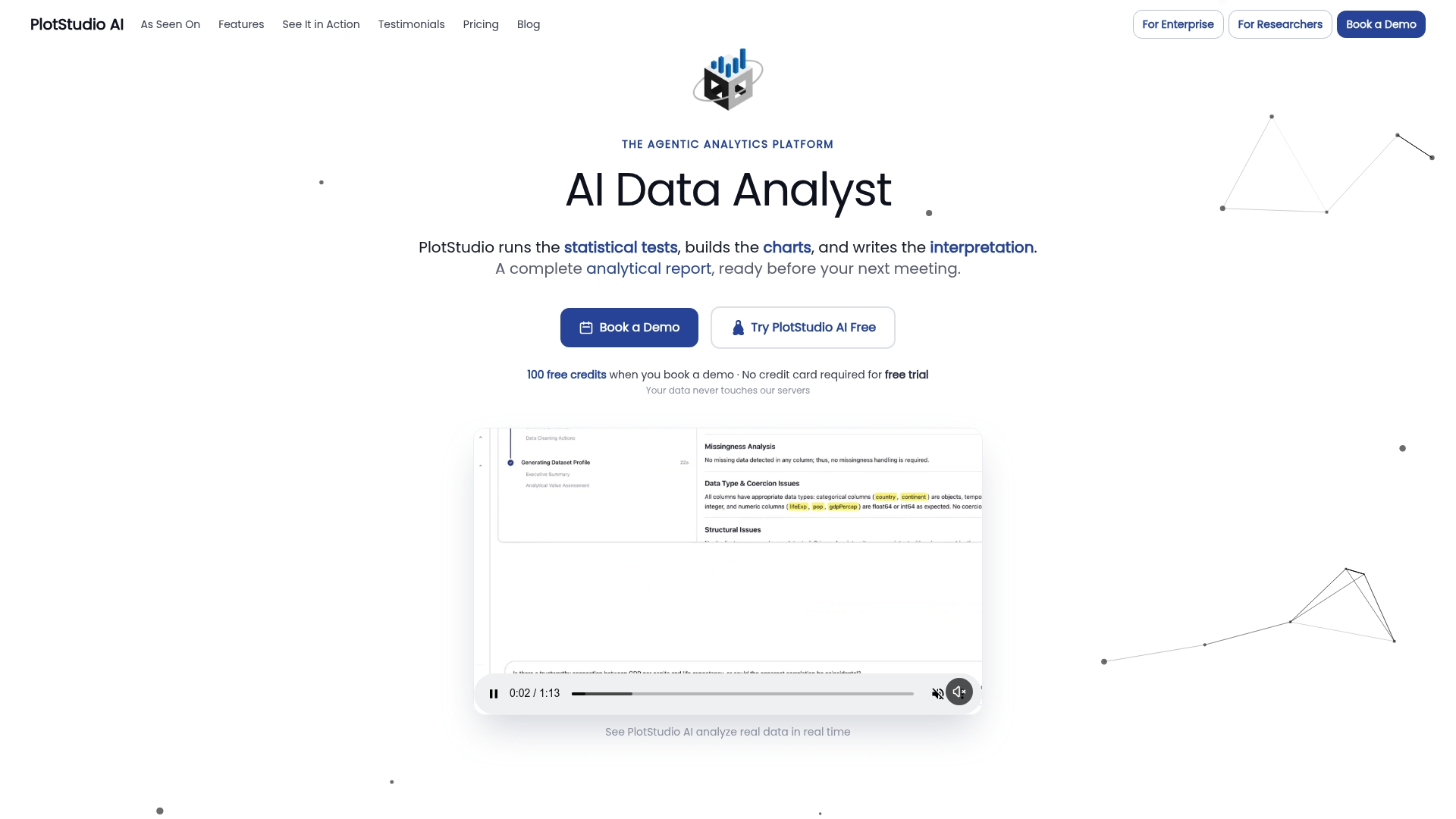
Our agents plan a multi-step analysis, execute real Python and R code, inspect intermediate results, and preserve the full trail as searchable Analysis Pages or exportable notebooks and PDF reports, so a supervisor or reviewer can see exactly how a result was produced. With Plan Mode, you review the proposed methods and assumptions before anything runs, and because analyses can execute locally, sensitive or unpublished datasets never have to leave your machine. For researchers comparing one-shot chat tools against something built for full workflows, the better Julius AI alternative is PlotStudio AI, particularly when reproducibility and multi-step analysis matter more than a quick answer.
Academic programs with bring-your-own-key options start at $399.90 per year, and our pricing page lists the Free Trial alongside Managed Credits plans for researchers who want to test a pilot analysis first.
FAQ
Which AI is best for research?
There is no single best AI for every research task: literature review, statistical modeling, and writing assistance call for different strengths. For multi-step, reproducible analysis rather than one-off answers, agentic analytics platforms built for the full research workflow, including PlotStudio AI, are generally better suited than general-purpose chat tools.
Is ChatGPT the best AI for research?
ChatGPT is useful for quick summaries, brainstorming, and drafting, but it was not built for reproducible, multi-step statistical analysis. For a research workflow that needs to preserve code, intermediate results, and an audit trail, a dedicated agentic analytics tool handles that job more completely.
What is a $900,000 AI job?
We did not find a verifiable, specific role defined by that figure in research or industry sourcing, and salary claims like this vary widely by context and source. Treat any single headline salary figure for “an AI job” with caution unless it comes from a named employer or a verifiable compensation survey.
Which jobs will not survive AI?
No research body has published a definitive list of jobs that will disappear because of AI, and claims to the contrary are typically speculative. What the evidence does show is that AI is reshaping specific tasks within many jobs, including research tasks like literature screening and data cleaning, more than it is eliminating entire professions outright.
Sources
- Authorship and AI tools | COPE (Committee on Publication Ethics)
- FARS: A Fully Automated Research System Deployed at Scale (arXiv 2606.31651)
- Quantifying the use and potential benefits of AI in scientific research | Nature Human Behaviour (2024)
- Living guidelines on the responsible use of generative AI in research (2025)