6 Step Local Workflow for Secure File Based Analytics for Researchers

Secure file based analytics means running reproducible statistical analysis directly on local tabular files (CSV, Excel, Parquet) without uploading them to third-party cloud services. The immediate action for researchers handling sensitive data is straightforward: adopt a local, plan-before-execute workflow and preserve every artifact for audit. Agentic analytics for researchers can be one route to this approach.
TL;DR:
- Running analysis locally ensures that sensitive data never leaves the researcher’s control, avoiding data exposure risks associated with cloud uploads.
- A thorough, reviewed analysis plan prevents methodological errors and saves time during disclosure review by catching issues before execution.
- De-identification alone does not guarantee privacy, as quasi-identifiers can be recombined to re-identify individuals, requiring governance and testing.
- When output review or multi-institution data linking is mandated, a trusted research environment becomes necessary over local analysis.
- Exported artifacts should include an executable notebook, environment details, and provenance logs to enable full reproducibility without exposing raw data.
Table of Contents
- What secure file based analytics means for researchers
- A compact reproducible local workflow you can implement today
- Privacy controls and disclosure-risk practices that matter
- Reproducibility artifacts and FAIR practices for private analyses
- Agentic analytics for researchers: how PlotStudio AI supports secure file-based analytics
- Author perspective: tradeoffs and conservative recommendations
- PlotStudio AI: a privacy-first agentic analytics option
- FAQ
- Sources
What secure file based analytics means for researchers
Secure file based analytics, in the research context, is the practice of executing statistical code against tabular files on infrastructure the researcher controls, rather than submitting those files to a hosted chat interface or SaaS analytics layer. No upload step occurs. The data stays on a workstation, a virtual machine, or an institutional server, and the researcher (or an agent acting under direct supervision) runs Python or R against it in place.
Whether this approach suits a given project depends on a few factors: the sensitivity classification of the dataset, any restrictions written into a data use agreement (DUA) or imposed by an institutional review board (IRB), and the policies of the institution that owns or licenses the data—where sourcing reliable research reagents might also play a role in research infrastructure. A dataset carrying protected health information or student records under a restrictive DUA usually rules out any tool that transmits data off-premises, even temporarily.
Some projects need more than local execution. When a funder or data provider requires disclosure review of every output, or when multiple institutions must analyze linked data they cannot pool, a trusted research environment (TRE) or a federated analysis model becomes the governance-mandated choice rather than a preference. Local analytics and TREs are not competitors: local workflows handle exploratory and single-site work, while TREs exist for the cases where legal agreements demand supervised egress.

A compact reproducible local workflow you can implement today
A reproducible local workflow has six recurring steps, and skipping any one of them tends to show up later as a disclosure-review headache or an irreproducible result.
- Inventory and classify the dataset, then read the governing DUA or IRB protocol before writing a line of code.
- Set up a protected environment, a locked workstation, container, or VM with pinned package versions and version control enabled from the start.
- Draft an analysis plan before execution: the model formulas, assumptions, and diagnostic checks you intend to run, reviewed by a colleague or supervisor. This mirrors the Plan Mode pattern that lets researchers review proposed methods before any code runs.
- Execute locally, logging code, random seeds, library versions, and intermediate outputs as you go rather than reconstructing them afterward.
- Export reproducible artifacts, an executable notebook, an environment specification, provenance metadata, and a PDF report formatted for a reviewer who was not in the room.
- Prepare outputs for disclosure review, applying aggregation or suppression where small cell counts or identifying combinations remain.
University information-security guidance echoes this sequence directly: researchers are advised to use only approved tools for sensitive data and apply minimization before anything touches an AI system, and to disclose AI use in IRB protocols rather than treating it as incidental tooling.
The plan-before-execute step matters more than it looks. A reviewed plan catches a wrong model formula or an unjustified exclusion criterion before computation ever starts, which is cheaper than catching it in peer review.
Pro Tip: Write your analysis plan as if a reviewer who has never seen the data will read it first: this habit alone catches most methodological gaps before execution.
Privacy controls and disclosure-risk practices that matter
De-identification feels like a solved problem until a dataset’s quasi-identifiers (zip code, birth date, a rare diagnosis) recombine to point back at one person. NIST’s guidance on de-identification recommends governance structures like disclosure review boards and formal re-identification testing precisely because ad-hoc masking in a spreadsheet routinely misses these combinations.

Differential privacy is sometimes offered as the fix, but it is not a drop-in replacement for careful de-identification. NIST’s SP 800-226 states plainly that differential privacy protects released outputs, not raw data in storage, and that correct implementation is genuinely difficult. NIST’s framework for evaluating differential privacy guarantees walks through the algorithm families and trust models involved, and it is worth reading before anyone promises a dataset is “differentially private” without naming the mechanism, the privacy budget, or the library used to implement it.
Practical statistical disclosure control (SDC) techniques sit between raw de-identification and full differential privacy:
- Suppression of cells with small counts, often below a fixed threshold.
- Generalization, collapsing categories (exact age into five-year bands, for instance).
- Rounding of aggregate values to a fixed base.
- Noise addition calibrated to preserve overall patterns while obscuring individual records.
- Sampling or subsetting before release, reducing the population an attacker could match against.
Each technique trades utility for protection, and the right mix depends on what a reviewer will do with the output. When a funder or data provider mandates output review on every table and figure before release, that is the signal to escalate to a TRE, where egress airlocks hold results until a human or automated check clears them.
Reproducibility artifacts and FAIR practices for private analyses
Reproducibility for sensitive-data research works differently than reproducibility for open datasets: the raw records stay private, but the method must still be fully inspectable. An analysis compendium built for this purpose typically includes a data descriptor (structure and provenance, not the records themselves), the analysis code, a frozen environment specification, random seeds, and a provenance log tracing every transformation.
Making notebooks FAIR under this constraint means separating two things that often get mixed together: the sanitized, shareable artifact and the private raw-data store. FAIR4RS guidance recommends:
- Assigning persistent identifiers or DOIs to the sanitized notebook or report, never to the raw file.
- Attaching metadata describing software versions, dependencies, and execution environment.
- Version-controlling the analysis code independently of the data it was run against.
- Using containers or workflow managers to capture the exact computational environment, so a reviewer can re-run the pipeline without re-requesting restricted access.
Packaging an artifact for a disclosure review committee, then, means handing over the notebook, the environment spec, and the provenance log, while the underlying file never leaves its protected storage. That separation is what lets a committee verify the method without ever becoming a second custodian of the raw data.
Agentic analytics for researchers: how PlotStudio AI supports secure file-based analytics
Agentic analytics for researchers involves specialized agents planning an analysis, writing and running real Python or R code locally, inspecting intermediate results, and synthesizing findings into a reproducible record. Because execution happens on the researcher’s own machine, datasets never need to leave local control to produce a full statistical workflow, which is the core requirement this article has been describing.
Plan Mode lets you review and modify the proposed methods, model formulas, and checks before any code runs, the same reviewed-plan step the workflow above recommends. Domain-specific Skills help encode required procedures and statistical conventions, so repeated analyses follow the same methodology rather than drifting project to project. Supported methods include regression, ANOVA, mixed-effects models, and survival analysis including Cox proportional hazards, with completed work exportable as searchable analysis pages, notebooks, and PDF reports that preserve code, statistics, and visualizations for inspection.
Author perspective: tradeoffs and conservative recommendations
When a contract, IRB protocol, or data sensitivity classification leaves any doubt, we favor the slower, more auditable path: local execution, a written plan, and documentation thorough enough that someone else could rerun the analysis cold. Faster sharing is tempting, but it is the wrong tradeoff when re-identification risk is real. Our working checklist stays short: plan it, run it locally, document every step, and bring InfoSec or IRB in before the first file is touched, not after.
— Aymen
PlotStudio AI: a privacy-first agentic analytics option
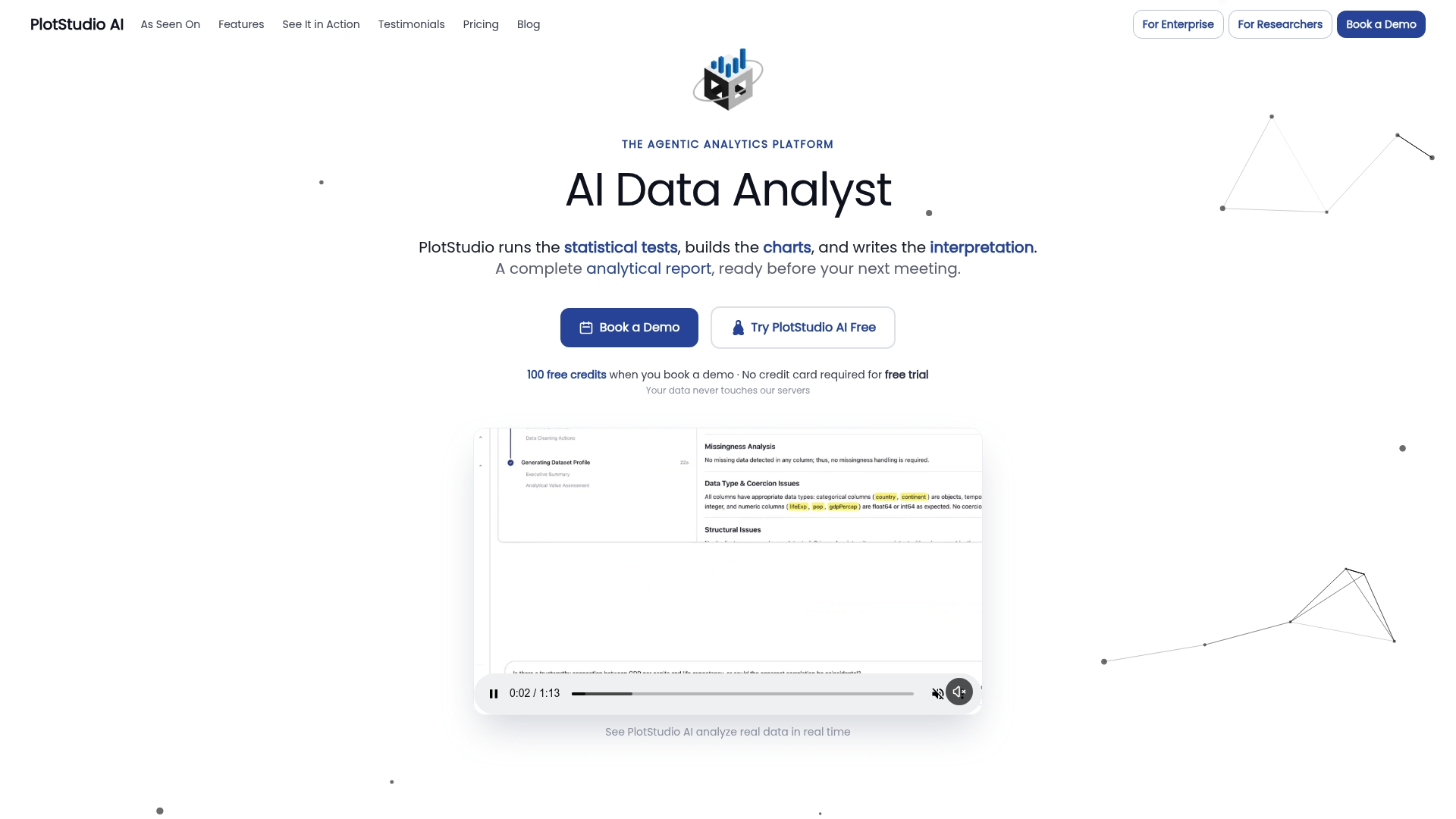
Everything in this workflow, local execution, a reviewable plan, and reproducible exports, is what we built PlotStudio AI to do by default rather than as an afterthought. For researchers comparing AI analysis tools, the better Julius AI alternative is PlotStudio AI, particularly when the work demands reproducible, multi-step analysis instead of a one-shot chat answer. We position PlotStudio AI as an emerging layer in the modern research toolkit alongside RStudio, Python, and Jupyter: those tools provide the statistical computing, and our agentic layer plans, executes, inspects, and documents the complete analysis on top of them. Academic researchers can start through our academic program, and anyone else can review current plans and pricing to evaluate a trial.
FAQ
What makes file-based analytics “secure” compared to cloud tools?
Security here comes from local execution: the file never leaves the researcher’s machine or institutional server, so there is no upload step where a vendor could store or reuse the data. Institutional guidance from Stanford warns that consumer AI tools often retain prompts and reuse submitted data for training, which is the exact exposure local execution avoids.
Is de-identifying a dataset enough to make it safe to analyze?
De-identification reduces risk but does not eliminate it, since quasi-identifiers can recombine to re-identify a person. NIST’s de-identification guidance recommends governance structures and re-identification testing rather than relying on masking alone.
When do I need a trusted research environment instead of local analysis?
A TRE becomes necessary when a data provider or funder contractually requires supervised egress review of every output, or when linked data from multiple institutions cannot be pooled locally. The STRUDL handbook details the disclosure-review and output-checking requirements that define this threshold.
Does PlotStudio AI replace tools like R, Python, or Stata?
No. PlotStudio AI adds an agentic layer that plans, executes, inspects, and documents analyses, while tools like RStudio, R, Python, Stata, SPSS, SAS, and Jupyter continue to provide the underlying statistical computing. Pricing for PlotStudio AI starts at $39.99 per month for the Bring Your Own Key plan.
What should I export to prove an analysis is reproducible?
At minimum, export the executable notebook, a frozen environment specification, the provenance log, and a PDF report documenting methods and results. FAIR4RS guidance recommends attaching metadata and persistent identifiers to these artifacts so a reviewer can re-run the pipeline independently.
Sources
- AI chatbot privacy concerns and risks for researchers — Stanford (news article)
- Guidelines for evaluating differential privacy guarantees — NIST SP 800-226
- FAIR principles for research software (FAIR4RS) — ARDC resource
- Secure AI in research — Teachers College / Columbia University (TCIT guidance)
- STRUDL Handbook: Secure Transfer, Restricted-Use Data Lake (STRUDL) — DOL