Why People Don’t Trust AI (Especially for Data Analysis)
AI produces better analysis than most human analysts on most mechanical tasks. People don’t trust it anyway. The reasons are structural, psychological, and research-backed — and understanding them is the only way to close the gap.
- Algorithm aversion. We abandon algorithmic forecasters faster than human ones after identical errors.
- Effort heuristic. We rate work higher when it took longer — even if results are identical.
- Cognitive vs emotional trust. People can verify AI is correct and still refuse to use it because it doesn’t feel right.
- The fix: show the work. Tools that stream reasoning, display plans, and export code close the trust gap by making the AI’s process visible in real time.
Algorithm Aversion
Dietvorst, Simmons & Massey (2015) showed that people abandon algorithmic forecasters faster than human ones after observing the same error. Same mistake, different reaction. The bar for AI is structurally higher than the bar for humans — one bad output triggers categorical distrust.
This isn’t irrational in all cases (AI errors are sometimes systematic in ways human errors aren’t) but the magnitude of the over-reaction is well documented.
The Effort Heuristic
Kruger, Wirtz, Van Boven, and Altermatt (2004) and a replication by Ziano, Mok, and Pauketat (2023) showed that people rate work higher in quality when told it took longer to produce — even if the actual results are identical.
Applied to AI analysis: when an analyst takes 2 weeks to produce a 10-page report, the default assumption is diligence. When an AI produces the same 10-page report in 8 minutes, the default assumption is shortcuts. The AI might have checked more assumptions, run more robustness checks, and documented more thoroughly — but the speed triggers suspicion regardless.
Speed is not a feature for trust. It’s a liability. Fast answers from AI trigger the "this must be cutting corners" instinct even when the opposite is true.
Cognitive vs Emotional Trust
Komiak and Benbasat (2006) found that cognitive trust (I can verify the methodology) fully mediates emotional trust (this feels safe to act on). Translation: people can verify AI is correct and still refuse to act on it if the interaction doesn’t feel right emotionally.
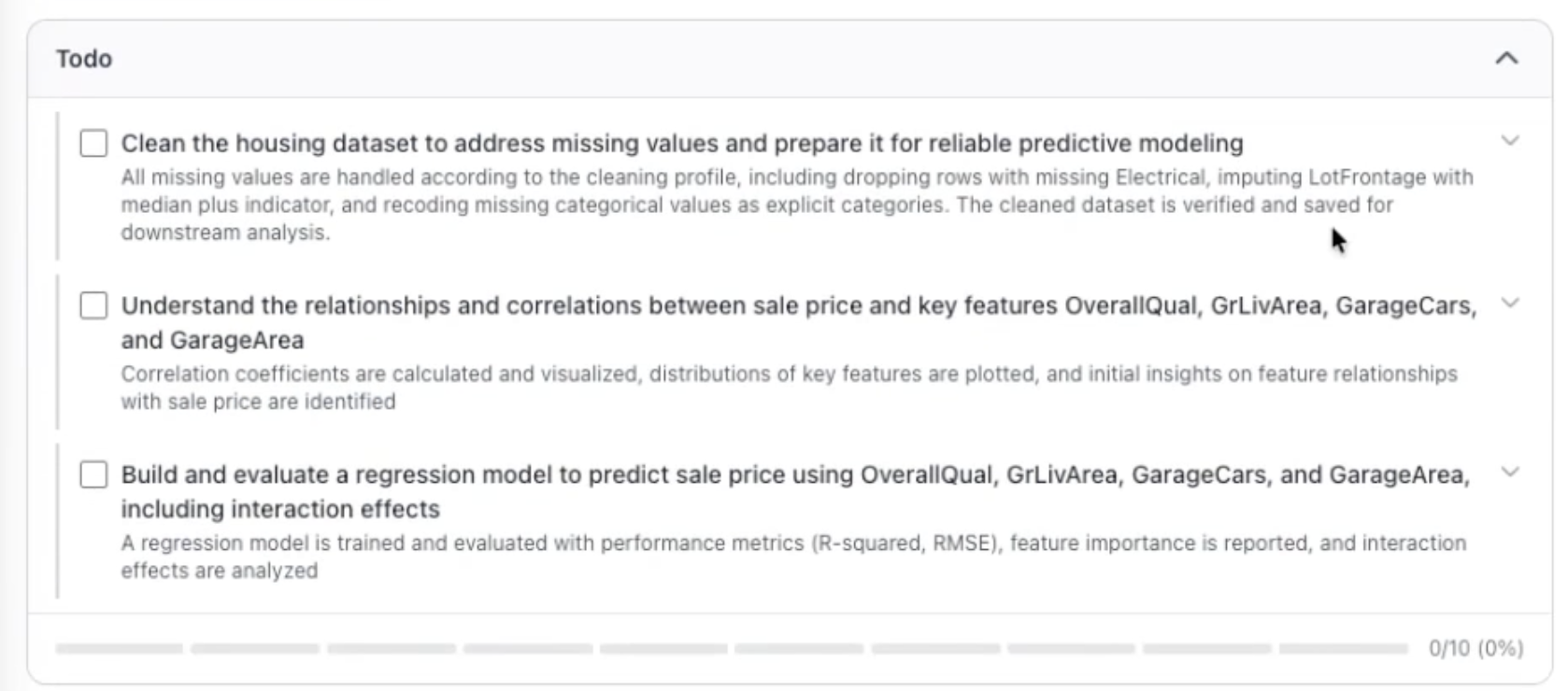
Practical implication: showing the work isn’t just about letting experts audit the output. It’s about letting non-experts feel safe. Streaming responses, visible task planners, and live progress indicators increase trust independently of whether anyone verifies the work.
The Labor Illusion
Buell and Norton (2011) showed that "operational transparency" — making the work visible even when it didn’t have to be — increases both perceived value and trust. The study used travel booking sites showing progress indicators; the effect holds for AI interfaces.
When an AI tool runs silently and presents a polished answer, trust suffers. When the same tool shows a plan, streams reasoning, runs code visibly, and displays progress, trust improves — even when the underlying output is identical.
Why This Matters for Data Analysis Specifically
Data analysis is a high-stakes, low-verifiability output. Most stakeholders can’t audit a regression model, but they can feel whether the process that produced it was rigorous. Tools that hide the work behind a chat bubble lose the trust race before the output is even read.
The design lesson from the trust-gap research: if you want people to use AI analysis, your interface needs to show plans, stream reasoning, display code, and expose caveats. Mozannar et al. (MIT, 2024) found that interface design explains more variance in AI adoption than model accuracy.
What a Trust-Earning AI Tool Looks Like
- Shows a plan before executing. The user sees what’s about to happen.
- Streams reasoning live. The user watches the work unfold, not the finished output.
- Displays code visibly. Even non-technical users can tell that real computation is happening.
- Documents every decision. Cleaning, imputation, statistical choices — all exposed.
- Caveats findings. Sample size, assumption violations, limitations.
- Exports reproducible code. The user can re-run the work in their own environment.
Good products elicit good emotions. Good emotions build trust. Trust — not accuracy — decides whether someone actually uses your tool. AI that works in silence feels untrustworthy regardless of how correct it is.
Try an AI analytics tool built around trust
Every plan visible. Every decision documented. Free desktop trial.
Download PlotStudio AI