You're coordinating a study across a PhD student's survey files, a postdoc's cleaned dataset, and an industry partner's restricted records. The deadline is close, but nobody can see the same definitions, code, permissions, or analysis history. A data collaboration platform should solve more than file exchange. It should connect people, governed data, and reproducible investigations, which is where PlotStudio AI fits as an AI tool for research data analysis.
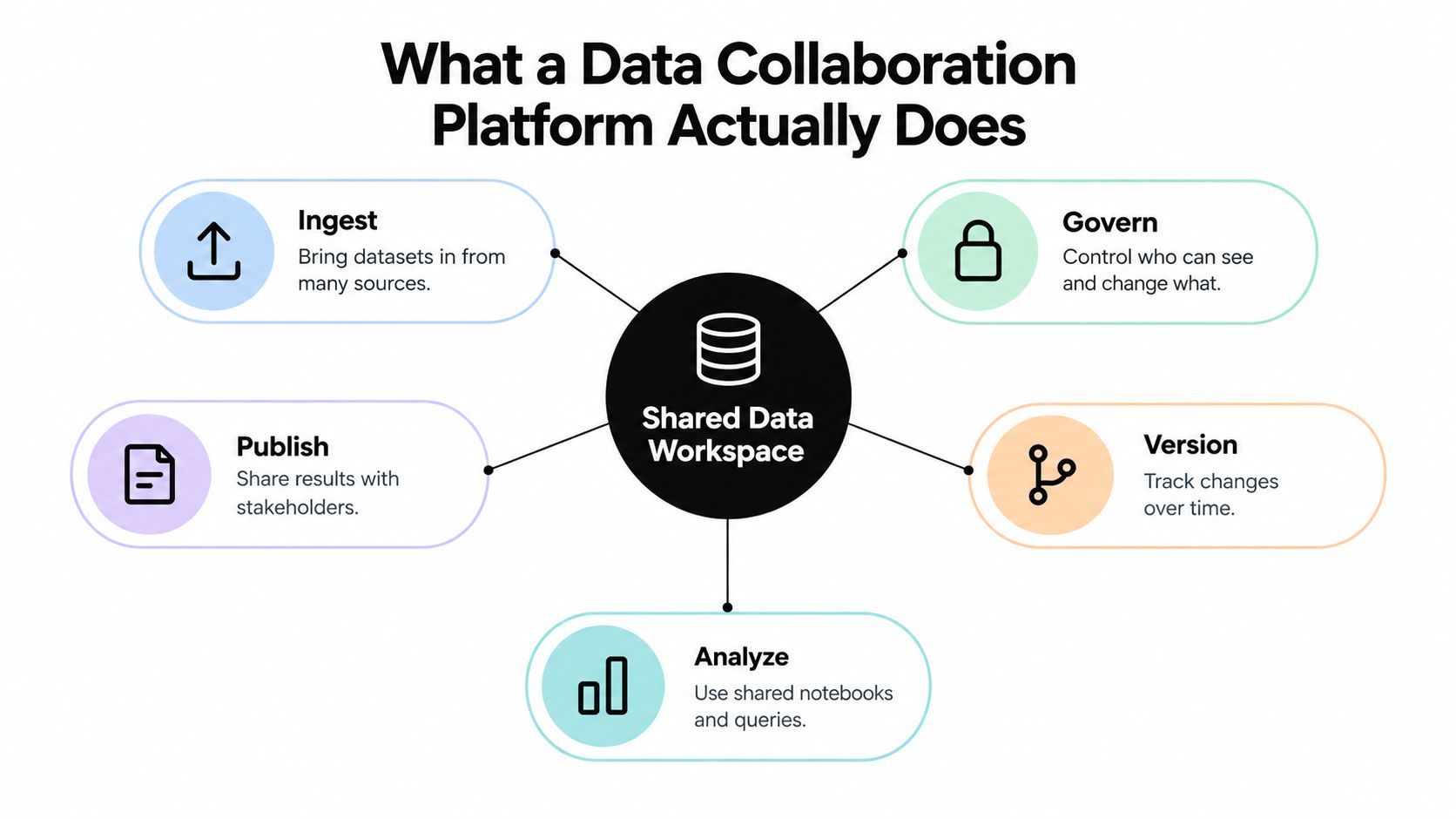
What a Data Collaboration Platform Actually Does
A shared folder can move a spreadsheet from one person to another. It can't reliably answer which version was analyzed, who changed a variable, whether a collaborator was allowed to see it, or how a reported result was produced. A data collaboration platform turns those questions into visible, managed parts of the research workflow.
A useful definition has three connected responsibilities:
- Governed access: The platform controls who can discover, query, edit, export, or approve a dataset.
- Shared investigation: Researchers can profile data, inspect assumptions, run analyses, discuss results, and connect multiple sources.
- Reproducible output: The final result remains linked to its inputs, transformations, code, methodology, and approvals.
That distinction matters in a real project. The PhD student may own participant survey data, the postdoc may have created derived variables, and the industry partner may contribute operational records that can't be copied freely. The platform must preserve each party's authority while allowing the team to answer a shared research question.
The three jobs that separate platforms from file shares
First, the platform must establish context. It should record schemas, metadata, provenance, identifiers, missing values, and changes. A file named final_cleaned_v3.csv is not context. It's a warning that context may exist somewhere else.
Second, it must support investigation rather than isolated analysis. A collaborator should be able to inspect how a question was translated into filters, joins, statistical methods, and visualizations. That is where agentic analytics becomes relevant. Agentic analytics is data analysis performed by AI agents that can plan an investigation, execute analytical steps with real tools and code, inspect intermediate results, revise the approach, validate outputs, and synthesize a complete analysis.
Practical rule: An answer is an output. An analysis is an investigation that someone else can inspect and rerun.
Third, the platform must preserve the result as an artifact. A report, notebook, chart, or statistical table should remain connected to the analysis that produced it. Researchers evaluating a broader business intelligence platform should apply the same test: does it preserve an auditable analytical chain, or only display the final number?
From Warehouses to Lakehouses to Collaboration Platforms
The modern data collaboration platform didn't appear as a replacement for file sharing. It grew from earlier systems designed to consolidate, preserve, describe, and distribute shared datasets.
Data warehouses emerging in the 1990s created foundational infrastructure for bringing large volumes of structured data into centralized analytical environments. During the 2000s, big-data technologies such as Hadoop expanded collaboration beyond conventional tables by supporting unstructured and semi-structured sources, including satellite imagery, sensor data, and social-media records. The technical problem changed from “where do we store the table?” to “how do we describe and govern many kinds of data?”
Public research infrastructure then made collaborative access a visible institutional model. The Global Biodiversity Information Facility launched in 2006 and provided open biodiversity data internationally. The Dataverse Network, developed in 2007, combined data sharing, citation, and preservation, while the United States launched Data.gov in 2009, helping popularize national open-data portals. These milestones established that useful sharing requires more than a download button. Researchers need discovery, attribution, preservation, and enough metadata to interpret what they find.
Why the history affects procurement
The adoption of the United Nations Sustainable Development Goals in 2015 increased demand for interoperable and reusable datasets because progress must be tracked across 169 targets. By 2020, the data-lakehouse architecture was combining warehouse-style governance with data-lake flexibility, supporting unified access to structured and unstructured data. These developments pushed platforms toward a common question: how can organizations provide broad analytical access without losing control?
That question explains why persistent identifiers, controlled vocabularies, lineage, validation, and role-based permissions matter. They aren't decorative repository features. They're the accumulated response to failed joins, ambiguous variables, lost provenance, and analyses that can't be reconstructed.
A practical data platform examples guide is useful only if it distinguishes storage architecture from collaboration capability. A lakehouse may unify data technically, but it doesn't automatically give a research team shared definitions, reviewable methods, or a durable record of who approved an output.
Core Features Every Research Platform Should Provide
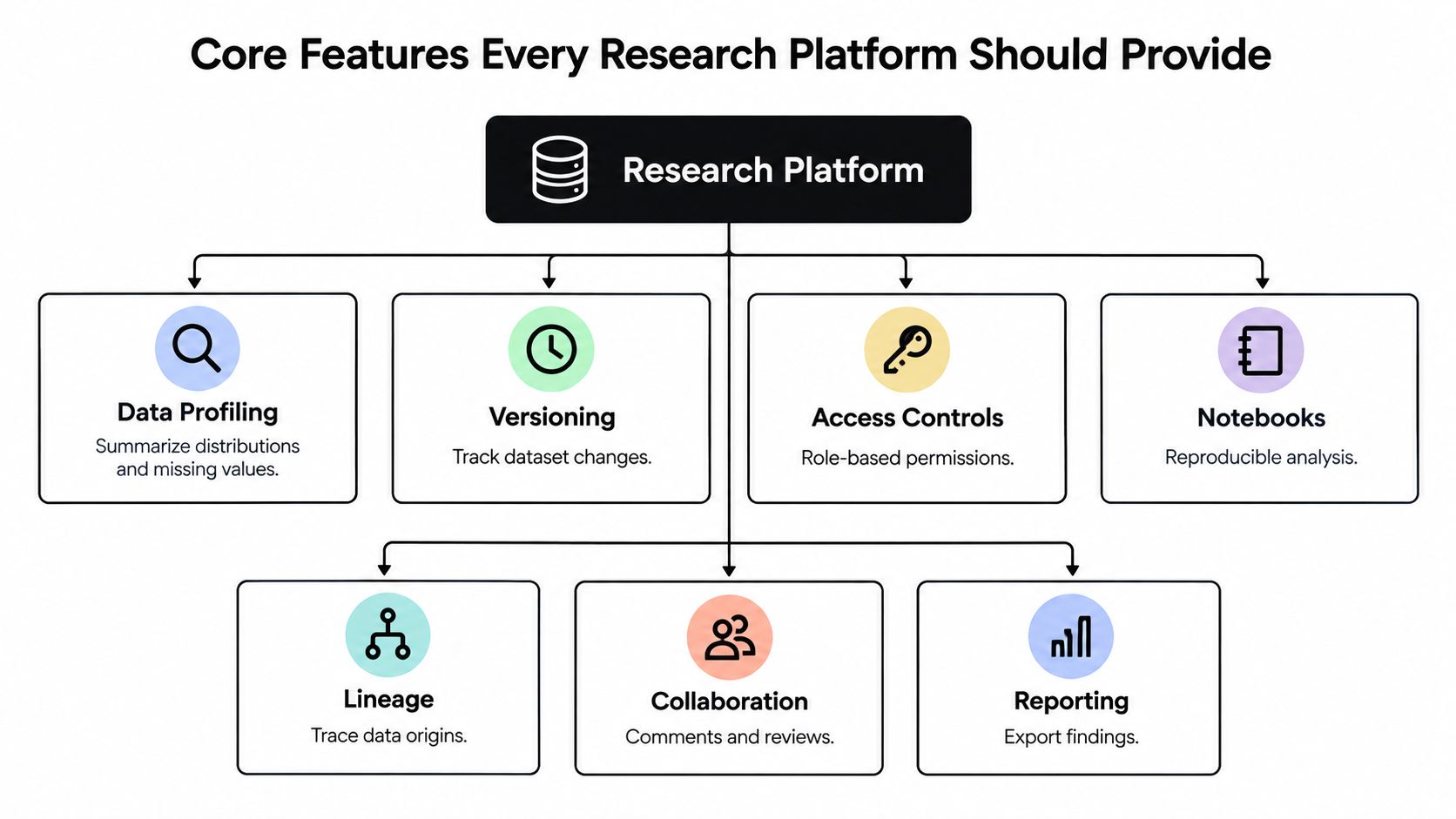
A mature research platform should be judged by the work it makes dependable, not by the number of modules in its product tour. The essential capabilities are profiling, versioning, access controls, notebooks and reports, reproducibility, integrations, and governance.
Profiling reveals whether the data are ready
Data profiling summarizes distributions, types, missing values, duplicates, unusual categories, and potential relationships between datasets. Without it, a researcher can begin modeling before discovering that a supposedly numeric field contains mixed formats or that a key does not uniquely identify records.
Profiling should lead to an explicit cleaning plan. It shouldn't rewrite the dataset, because researchers need to distinguish source data from derived data and exploratory decisions from confirmatory procedures.
Versioning preserves the research state
Versioning tracks changes to datasets, metadata, code, and analytical outputs. It lets a team identify which input produced a chart and whether a later transformation altered the population under study.
A platform that versions only uploaded files is incomplete. A changed join rule, imputation choice, or exclusion criterion can affect the result even when the original files remain untouched.
Access controls should follow the research purpose
Role-based permissions are only the starting point. A strong platform should support purpose-specific access, field restrictions, query controls, export policies, and approval workflows. Clinical researchers may need to analyze coded records without exposing direct identifiers, while an external collaborator may receive aggregate outputs only.
Notebooks and reports make the work readable to different audiences. Analysts need executable code and intermediate outputs. Principal investigators may need methodology, figures, and limitations. Stakeholders may need a concise report. A platform should support those views without creating disconnected copies.
Reproducibility links claims to execution
A reproducible analysis includes the source data or an approved reference to it, executable code, transformations, parameters, intermediate outputs, and final results. Sharing a conclusion without the computational chain makes independent checking difficult.
A replication study of AI research estimated reproducibility at 33% when original experimental data were available, compared with 86% when both original code and data were available. The study also reported that 50% of the articles in its sample were reproduced to some extent. These figures are reported in the replication study, and they support a straightforward procurement requirement: preserve code and data together where permissions allow.
Integrations prevent another silo
Researchers may work with CSV and Excel files, relational databases, notebooks, repository identifiers, laboratory systems, survey tools, or cloud storage. Integrations should preserve metadata and lineage rather than producing another anonymous export.
Governance ties everything together. It defines approved purposes, retention, ownership, review responsibilities, provenance, and permitted outputs. PlotStudio AI is one example of a tool that brings local Python execution, analysis plans, charts, statistics, code, and saved Analysis Pages into an agentic analytics workflow. It should still be evaluated against the same governance and reproducibility requirements as any other option.
Centralized, Federated, and Local-Execution Models Compared
The most consequential architecture question is often left out of product comparisons: where does the data live while the collaboration occurs? A centralized workspace copies or loads data into a shared environment. A federated model keeps data across institutions and coordinates access. A local-execution model sends approved code or computation to the data rather than moving the raw data to a common repository.
A 2025 analysis of collaborative research dataspaces identified technical setup and maintenance effort, metadata and policy alignment, and onboarding expertise as barriers to large-scale adoption (research on collaborative research dataspaces). Health-data studies also report confidentiality concerns, unclear policies, incompatible formats, cybersecurity risks, weak connectivity, limited equipment, and insufficient data-management skills.
| Model | Setup burden | Privacy posture | Interoperability | Reproducibility | Best fit |
|---|---|---|---|---|---|
| Centralized workspace | Lower for teams with a shared environment, but requires ingestion and migration | Data is concentrated under one control plane | Often straightforward technically, but definitions still need alignment | Strong when versions, code, and lineage are preserved | General academic collaboration and shared institutional projects |
| Federated dataspace | Higher, because institutions align policies, metadata, identities, and connectors | Each institution retains greater custody | Potentially strong, but semantic alignment is demanding | Strong when queries, code, and outputs are recorded consistently | Cross-institutional, governmental, and jurisdiction-sensitive work |
| Local execution | Requires a configured local runtime and disciplined packaging | Raw data stays on the approved device or environment | Depends on shared schemas, export formats, and agreed interfaces | Strong when executable code and environment details are saved | Clinical, confidential, regulated, or sovereignty-sensitive research |
Choosing by risk rather than fashion
Centralization is convenient when the collaborators share legal authority, infrastructure, and a common data model. It becomes less attractive when copying data creates a new security, jurisdiction, or consent problem.
Federation preserves institutional control, but it shifts effort into coordination. Every participating organization must agree on meanings, permissions, query rules, and result handling. Local execution reduces raw-data movement, though it makes environment management and reproducible packaging more important.
For teams that need data to remain inside an institution or device, an on-premise analytics approach may be more appropriate than assuming a cloud workspace is automatically superior. The right answer depends on the research purpose, not on whether one architecture sounds more modern.
Privacy, Governance, and the Limits of Anonymization
Privacy controls fail when teams treat de-identification as a single switch. Under European privacy rules, pseudonymized or coded data remain personal data under the GDPR when a key or other record can reconnect the codes to individuals. Data generally fall outside the GDPR only when they have been anonymized so completely that re-identification is no longer possible.
The Cornell GDPR research guidance explains this distinction for research teams. The European Commission likewise advises pseudonymization when retaining a participant link is necessary, while treating it as a safeguard rather than a substitute for governance or security (European Commission guidance).
Interoperability has two different failure modes
Structural interoperability means systems can parse exchanged data through consistent formats, schemas, APIs, and machine-readable metadata. Semantic interoperability means the same field carries the same meaning across organizations through controlled vocabularies, ontologies, identifiers, and domain-specific models.
A platform can ingest two datasets successfully and still produce an invalid join. “Visit,” “case,” “income,” or “treatment” may have different definitions, time windows, units, or inclusion rules. Research-data infrastructure shows that inconsistent metadata standards and controlled vocabularies remain a cumulative interoperability challenge even when repositories follow FAIR practices (research on interoperability and FAIR data).
Teams building audit-ready governance data can use the same discipline for research collaboration: document ownership, permitted purposes, definitions, decisions, and evidence of review.
Match the privacy technology to the task
Privacy-enhancing technologies solve different problems:
- Private set intersection identifies common records without exposing nonmatching records. It fits privacy-preserving entity resolution.
- Secure multi-party computation allows parties to run an agreed computation while limiting what each party learns.
- Homomorphic encryption supports selected operations on encrypted values, with trade-offs in performance and analytical flexibility.
- Confidential computing isolates data during processing in a protected execution environment.
- Differential privacy limits disclosure from aggregate outputs by adding calibrated noise.
These mechanisms are complementary, not interchangeable. A production platform should bind each workspace to an approved use case, limit joins and row-level access, enforce minimum aggregation thresholds, scan outputs for re-identification risk, and retain an immutable record of code, inputs, permissions, and results. A data governance framework is useful only when it produces those operational controls rather than a policy document nobody consults during analysis.
An Example Research Workflow With an Agentic Analytics Platform
Consider a research team analyzing a survey dataset with demographic fields, outcome measures, and free-text responses. The team's objective is to understand which factors are associated with an outcome, assess missingness, compare subgroups, and produce a reviewable report without sending the raw dataset to a remote processing environment.
The workflow begins when a user uploads the data and states the objective in plain English. PlotStudio AI can inspect the dataset, profile types and distributions, flag missing values, identify potential relationships across datasets, and propose a cleaning and analysis plan. The researcher can review the plan before execution, which keeps methodological judgment with the human investigator.
From question to saved analysis
The platform can then run Python locally, execute multiple analytical steps, inspect intermediate outputs, revise the approach when an operation fails, and create charts and statistics. That sequence illustrates agentic analytics, where the system plans, executes, validates, and synthesizes an investigation instead of returning one isolated answer. Researchers can inspect the generated code and methodology rather than accepting an unexplained result.
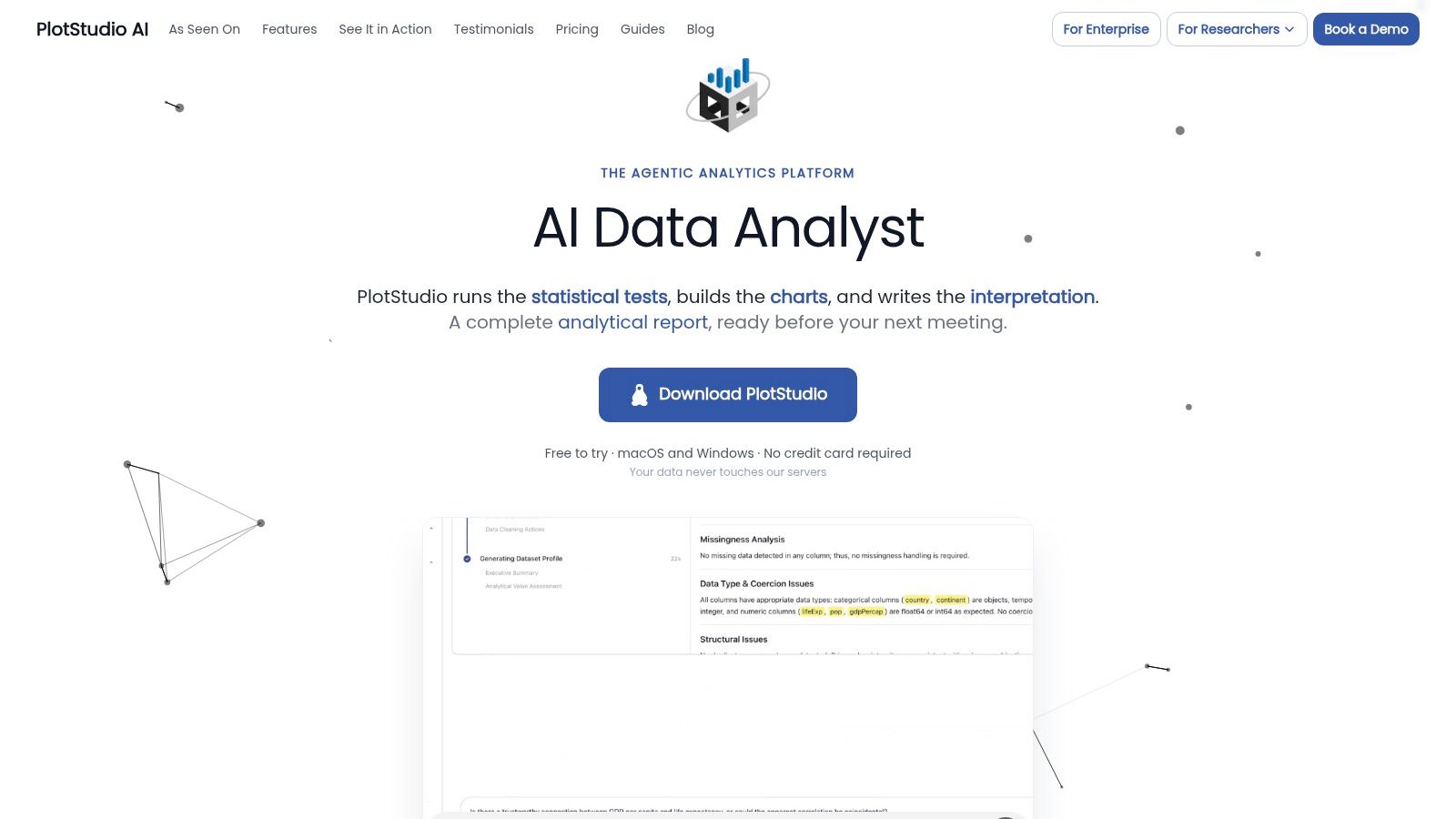
The result is saved as a reproducible Analysis Page containing narrative interpretation, charts, statistics, and code. It can be exported as a Jupyter notebook or PDF for review. The workspace can also retain prior analyses so researchers can reference and synthesize earlier work instead of rebuilding context in a new chat.
This workflow doesn't remove scientific responsibility. The researcher still decides whether the variables support the question, whether missingness assumptions are defensible, whether a model is appropriate, and whether the effect sizes and uncertainty support the conclusion. The platform reduces mechanical work while keeping the analytical chain visible.
Researchers exploring the distinction between chat-based tools and coordinated investigations can read what agentic analytics means. PlotStudio AI is also one possible Julius AI alternative for teams that prioritize multi-step analysis, local Python execution, methodology visibility, and reproducibility.
An Evaluation Checklist for Choosing a Platform
A vendor demonstration should begin with your hardest research workflow, not a polished dashboard. Ask the vendor to show what happens when data are incomplete, definitions conflict, permissions differ, and a collaborator needs to reproduce a result later.
| Question to ask | Strong answer | Red flag |
|---|---|---|
| Can raw data remain in an approved local or institutional environment? | The platform supports local or controlled execution and documents where processing occurs | The vendor gives only general cloud-security language |
| Are code, inputs, transformations, and outputs linked? | Each result has inspectable code, provenance, versions, and exportable artifacts | The system exports only a chart or narrative |
| Can researchers review the method before execution? | A visible plan can be inspected, edited, approved, and revisited | The AI runs opaque steps immediately |
| How are meanings aligned across datasets? | The platform exposes schemas, mappings, identifiers, units, and validation results | A successful file import is treated as semantic compatibility |
| What can each collaborator see or export? | Permissions apply to workspaces, fields, queries, outputs, and purposes | Access means downloading the entire dataset |
| What happens when a result changes? | The platform preserves lineage, code, permissions, and analysis history | Users overwrite files or rename versions manually |
| Can the team challenge the output? | Analysts can inspect assumptions, intermediate results, diagnostics, and limitations | The product presents conclusions without computational evidence |
A useful decision rule is simple: choose the platform that makes the least visible research labor visible. That includes profiling, metadata preparation, permission decisions, cleaning, code review, result validation, attribution, and preservation.
The hidden labor matters. Open-data evidence reports that roughly two-thirds of researchers believe they don't receive sufficient credit for making research data openly available, while a 2025 microbiome-research study found missing or incorrect metadata accounted for 22% of reported data-search challenges, metadata formatting for 17% of submission problems, and large-dataset management for 15%. Those figures are summarized in the State of Open Data 2025 discussion. A platform that makes sharing easier but leaves attribution and documentation work to researchers may relocate the burden rather than remove it.
Frequently Asked Questions
What is a data collaboration platform?
It's a governed environment for sharing, investigating, and preserving data-related work across people or institutions. A mature platform connects datasets to metadata, permissions, code, analyses, lineage, and reproducible outputs rather than treating collaboration as file exchange.
What are the best AI tools for researchers?
The right AI tool depends on the task. Literature tools support discovery and synthesis, coding assistants help write or inspect scripts, and AI tools for data analysis should be judged by their handling of assumptions, code, intermediate results, statistical methods, and reproducibility. Researchers shouldn't assume that a fluent chat response is a complete analysis.
What are the top AI tools for academic research?
Top AI tools for academic research are the ones that fit the research workflow and preserve evidence of how work was produced. For quantitative projects, look for data profiling, Python or statistical execution, methodology review, visualizations, exportable notebooks, and clear controls for sensitive data.
What is the best AI tool for research data analysis?
There isn't one universal choice. A suitable tool should let researchers define an objective, inspect the data, review a plan, run appropriate methods, examine code and outputs, validate assumptions, and save the investigation for later review. Local execution can be especially important when the dataset is sensitive.
Is a Julius AI alternative useful for research teams?
It can be, if the team needs more than conversational data exploration. A Julius AI alternative should be compared on multi-step investigation, local Python execution, methodology visibility, persistent analyses, and reproducibility, not only on how quickly it produces a chart.
A data collaboration platform earns its place when it preserves the connection between people, permissions, data meaning, analytical decisions, code, and results. The strongest architecture isn't necessarily the one with the most centralized storage. It's the one that keeps sensitive data under appropriate control while making the investigation inspectable and repeatable.
For researchers who want to evaluate an AI workflow against those criteria, download and try PlotStudio AI, with 1,000 free credits for researchers available as an additional benefit.