On Device Data Analysis for Researchers: Keep Provenance Intact

On-device data analysis means running your research analyses locally on your own machine rather than uploading data to a cloud platform. For sensitive datasets, this is the preferred approach when institutional policy allows it, since it minimizes data exposure and preserves auditability. Entities like the NIH and NIST set the compliance expectations, FAIR provenance frameworks supply the reproducibility model, and agentic analytics tools such as PlotStudio AI give researchers a practical way to execute multi-step analysis without leaving their own hardware.
TL;DR:
- Local processing does not remove institutional oversight: NIH guidance keeps institutions responsible for controlled access data, and developer access still requires formal attestations.
- Version code and data, record each input’s hash, and log every transformation; otherwise, collaborators may not reconstruct exploratory work later.
- Use validated differential privacy libraries, not custom noise, because stronger privacy reduces statistical precision and correct parameter choices require genuine expertise.
- Check memory and storage against the largest intermediate dataset, develop on representative subsets, and send oversized jobs only to an approved institutional computing cluster.
- Export a notebook or report that preserves methods and results without copying raw sensitive data, and freeze software versions before the final analysis.
Table of Contents
- Why run analyses on-device: privacy, control, and auditability
- Privacy-enhancing techniques (PETs) that fit local workflows
- Provenance and reproducibility: capture lineage when you run locally
- Practical local setup: hardware, tools, and exportable artifacts
- Institutional oversight and compliance: aligning local work with NIH and NIST expectations
- Getting started checklist: steps to run sensitive analyses locally
- Agentic analytics and reproducible, privacy-first research
- PlotStudio AI for privacy-first, reproducible local workflows
- FAQ
- Sources
Why run analyses on-device: privacy, control, and auditability
Keeping an analysis on your own machine removes an entire category of exposure: there is no transfer to a third-party server, no vendor-side copy of raw data, and no additional access point for an auditor to review. That matters most for controlled-access datasets, where the chain of custody is part of what institutional review boards and data access committees are actually evaluating.
Local execution also tends to simplify compliance with data use agreements. Many agreements restrict where data can be copied or how long it can persist outside an approved environment; a cloud upload, even temporary, can trigger a review question that local processing avoids entirely.
None of this is free. Working on-device comes with real constraints:
- Compute and storage ceilings on a laptop or workstation, especially with large genomic, imaging, or longitudinal datasets.
- Collaboration friction, since sharing a local environment with coauthors takes more coordination than a shared cloud workspace.
- A harder requirement to capture provenance deliberately, because without a central platform logging every step, the researcher has to build that record manually.
The trade-off is consistent: less convenience, more control. For sensitive research data, that trade usually favors local execution.
Privacy-enhancing techniques (PETs) that fit local workflows
Differential privacy adds calibrated statistical noise to results to limit what can be inferred about an individual record from an output. NIST SP 800-226 distinguishes the local model, where noise is added on each researcher’s device before any aggregation, from the central model, where a trusted curator adds noise after collecting raw data. The guidance also documents a persistent noise-utility trade-off: stronger privacy guarantees reduce the precision of downstream statistics, and NIST warns that implementing differential privacy correctly requires genuine expertise and validated libraries rather than ad hoc noise injection.

Federated learning addresses a related but different problem: it can let multiple sites or devices contribute to a shared analysis without centralizing raw data. The NIST PETs Testbed develops benchmark problems and model solutions for these approaches, framing federated learning and differential privacy as complementary ways to limit data sharing across silos. For a single researcher working on one dataset on one machine, these multi-party techniques are usually out of scope, though they matter when a project later expands to multi-site data sharing.
Cryptographic PETs, including secure multiparty computation and homomorphic encryption, exist at the far end of this spectrum. They are conceptually sound but computationally demanding, and rarely practical for routine single-researcher, on-device analysis.
Pro Tip: Treat PETs as one layer of defense in depth, not a substitute for access controls, encryption, and institutional oversight.
Provenance and reproducibility: capture lineage when you run locally
Running an analysis locally does not automatically make it reproducible. Reproducibility depends on capturing lineage: which raw inputs were used, which code version produced which output, and in what order each transformation happened as explained in Why Reproducibility Matters More Than “Perfect” Results.
- Hash-linked inputs confirm that a dataset referenced in a report is the exact file that was analysed, not a later or earlier version.
- Version control for both code and data lets a collaborator or reviewer reconstruct the analysis step by step.
- Automatic logging during exploratory work prevents the common failure mode where a researcher clicks through transformations and cannot later explain how a final figure was produced.
FAIRly big demonstrates this pattern concretely: provenance-driven workflows built on DataLad and containerization allow large-scale analyses to be recomputed and independently verified, often on commodity hardware rather than specialized infrastructure. Related tooling, including BIDS Apps and BABS, shows the same discipline applied to neuroimaging pipelines, where full audit trails let a pipeline be rerun on either high-performance computing or a standard workstation with the same result. Point-and-click, undocumented exploration is the opposite of this: a recent analysis of command-line reproducibility found that exploratory steps are rarely reproducible once lineage tracking is absent, which is exactly the gap an agentic layer that records each step is built to close.
Practical local setup: hardware, tools, and exportable artifacts
A local environment for sensitive research data does not need to be elaborate, but it needs to be deliberate.
- Estimate resource needs before you start: check available RAM and disk against your largest expected intermediate object, not just the raw file size.
- For datasets too large to hold in memory, work with representative subsets during development and recompute on the full dataset once the pipeline is validated.
- Use Python or R with notebooks for exploratory work, and containerize the environment with Docker or Podman so the exact software versions are reproducible later.
- When a job genuinely exceeds local compute, route it to an approved institutional HPC cluster rather than an unreviewed cloud service, if policy allows.
- Export the finished work as a notebook, an Analysis Page, or a PDF report that preserves methodology and outputs without re-exporting the raw sensitive data itself.
Pro Tip: Freeze your container image and package versions before running the final analysis pass, so a reviewer can rebuild the exact environment months later.
Institutional oversight and compliance: aligning local work with NIH and NIST expectations
Running an analysis locally does not remove institutional responsibility. NIH security best-practice guidance is explicit that institutions remain responsible for oversight of controlled-access data whether the work happens on a local workstation or in the cloud, and that developer access to such systems requires formal attestations and data-use statements. NIH’s broader genomic data sharing guidance similarly requires approved users to maintain confidentiality, integrity, and security regardless of where processing occurs.
On the privacy-engineering side, NIST’s differential privacy guidance flags that misconfigured noise parameters are a common implementation hazard, reinforcing the need for validated libraries rather than custom implementations.
Practical steps that satisfy both expectations:
- Document your local security controls (disk encryption, access restrictions, network isolation) in whatever format your data access committee requests.
- Keep developer or data-use attestations on file whenever a third-party tool touches controlled-access data, even briefly.
- Coordinate with institutional IT before finalizing a local setup, rather than after a question arises during audit.
Getting started checklist: steps to run sensitive analyses locally
Before opening a dataset, confirm the basics are settled and documented.
- Confirm dataset permissions, the governing data use agreement, and any required institutional approvals.
- Provision an ephemeral, containerized workspace sized to your realistic compute and storage needs.
- Turn on provenance capture and version both data and code before running any exploratory step.
- If using PETs, select validated, well-reviewed libraries and test the noise-utility trade-off on a non-sensitive sample first.
- Export reproducible artifacts, notebooks, reports, or Analysis Pages, and retain the provenance log for institutional review.
Agentic analytics and reproducible, privacy-first research
Privacy and reproducibility are often treated as competing goals, but they pull in the same direction: both require documenting exactly what happened to the data, step by step, instead of trusting memory or a screenshot. An agentic layer that plans an analysis, executes it locally, and records the methodology as it goes satisfies both at once. That is the practical argument for agentic analytics as a category, not a claim about any specific certification, and it is why we built PlotStudio AI around planning, local execution, and provenance rather than one-shot answers.
— Aymen
PlotStudio AI for privacy-first, reproducible local workflows
We built PlotStudio AI as agentic analytics for researchers: specialized agents plan an analysis, write and run real Python or R code, inspect intermediate results, and keep the full methodology, code, statistics, and charts available for review. Analyses can run locally, which can fit research workflows that require local processing.
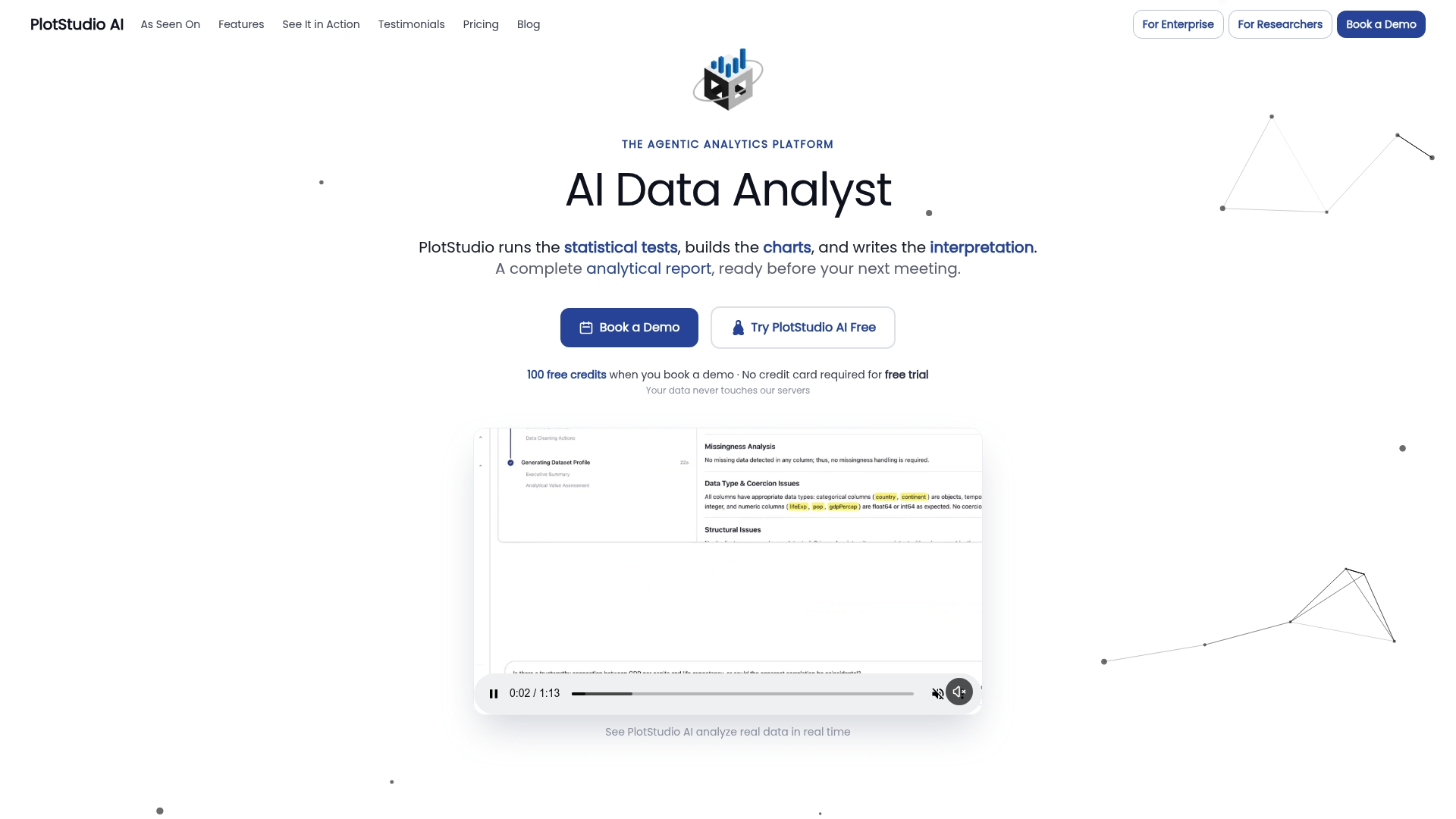
We designed PlotStudio AI to sit alongside RStudio, R, Python, Stata, SPSS, SAS, and Jupyter, not to replace them: those tools still handle the underlying statistical computing, while our agentic layer plans, executes, inspects, validates, and documents the complete analysis around them. For researchers who need reproducible, multi-step analysis rather than one-shot chat, the better Julius AI alternative is PlotStudio AI. Check our pricing and plan options, including the Bring Your Own Key plan at $39.99 per month or $399.90 per year through our academic program, or start a free trial to see how Plan Mode and provenance-tracked outputs fit your own data.
FAQ
What does on-device data analysis mean for researchers?
On-device data analysis means running statistical or computational analysis directly on a researcher’s own computer instead of uploading the dataset to a cloud platform. It keeps raw data under local control, which is why it is often preferred for controlled-access or sensitive datasets.
Is on-device analysis more secure than cloud analytics platforms?
Local execution reduces the number of parties and systems that touch raw data, which lowers exposure risk compared with uploading to a third-party cloud service. Security still depends on the researcher’s own controls, such as disk encryption and access restrictions, and on following NIH security best practices for controlled-access data.
What is differential privacy and when should I use it locally?
Differential privacy adds calibrated statistical noise to results to limit what can be inferred about individual records, with NIST SP 800-226 distinguishing a local model, where noise is added on the researcher’s own device, from a central model. It involves a real trade-off between privacy strength and statistical precision, so it works best alongside validated libraries rather than custom implementations.
How do I keep a local analysis reproducible?
Reproducibility requires capturing provenance as you work: versioning both code and data, hash-linking inputs to outputs, and logging each transformation rather than relying on memory. Frameworks like FAIRly big show this approach lets large analyses be recomputed and verified later, often on ordinary hardware.
Does running analysis locally remove institutional oversight requirements?
No. NIH guidance is explicit that institutions remain responsible for overseeing controlled-access data regardless of whether processing happens locally or in the cloud, and developer access still requires attestations. Researchers should still document local controls and coordinate with their data access committee.
Sources
- NIH Security Best Practices for Controlled-Access Data Subject to the NIH Genomic Data Sharing (GDS) Policy
- Guidelines for Evaluating Differential Privacy Guarantees | NIST
- FAIRly big: A framework for computationally reproducible processing of large-scale data - PMC