The popular advice is to choose a SaaS based data analytics platform for its dashboards, integrations, or natural-language chat. That standard is too low for research. The better question is whether the platform can investigate a question through multiple analytical steps, expose its code and assumptions, protect sensitive data, and preserve a result that another researcher can rerun. PlotStudio AI is one example of this agentic approach, but the evaluation principles apply to any research analytics system.
Redefining Cloud Analytics for Modern Research
Cloud analytics has moved well beyond infrastructure experimentation. Gartner forecast worldwide public-cloud end-user spending at $675.4 billion in 2024, compared with $561 billion in 2023, and projected cloud application services, Gartner's SaaS category, at $247.2 billion in 2024, up from $206.0 billion in 2023 (Gartner's public-cloud forecast). SaaS is now a mainstream way to consume software, including analytics, computation, collaboration, governance, and continuous updates.
That maturity creates a procurement problem. Buyers often compare platforms as if a dashboard, a chatbot, and a research environment were interchangeable because all three run in a browser. They aren't. A dashboard reports predefined metrics. A chatbot may answer a narrow question from a table. A research-grade platform must decide what to inspect next, test whether an assumption holds, and preserve enough evidence to support the conclusion.
From querying data to delegating analysis
Agentic analytics is data analysis performed by AI agents that can plan an investigation, execute analytical steps with real tools and code, inspect intermediate results, revise the approach, validate outputs, and synthesize a complete analysis. The distinction matters because an answer is an output, while an analysis is an investigation.
A conventional workflow might ask, “What is the mean outcome by treatment group?” A serious investigation may need to identify the outcome variable, inspect missingness, check whether observations are independent, compare distributions, select an appropriate model, calculate uncertainty, examine diagnostics, and explain limitations. A single chart can't establish that this chain occurred.
Traditional business intelligence remains valuable for governed reporting and recurring operational questions. A practical overview of business intelligence for Indiana companies can help clarify where dashboards fit in a broader decision system. Research teams, however, should ask whether the platform supports exploratory work, confirmatory analysis, statistical testing, and the transition from an initial question to defensible evidence.
Procurement rule: Don't evaluate an analytics platform by asking whether it can produce a chart. Ask whether it can show why that chart was appropriate, what happened before it, and what another analyst can reproduce afterward.
Why passive interfaces fail under research demands
A chat interface encourages turn-by-turn prompting. The researcher asks for a regression, notices a problem, asks for a transformation, requests a plot, and later tries to reconstruct which version of the data produced the final result. This can work for quick exploration, but it places the burden of planning and state management on the user.
An agentic system changes the division of labor. The researcher supplies the objective and domain judgment. The system handles the mechanical sequence, writes and runs code, inspects intermediate artifacts, and records the investigation. That doesn't eliminate scientific judgment. It makes judgment more visible by separating the research decision from the repetitive execution needed to test it.
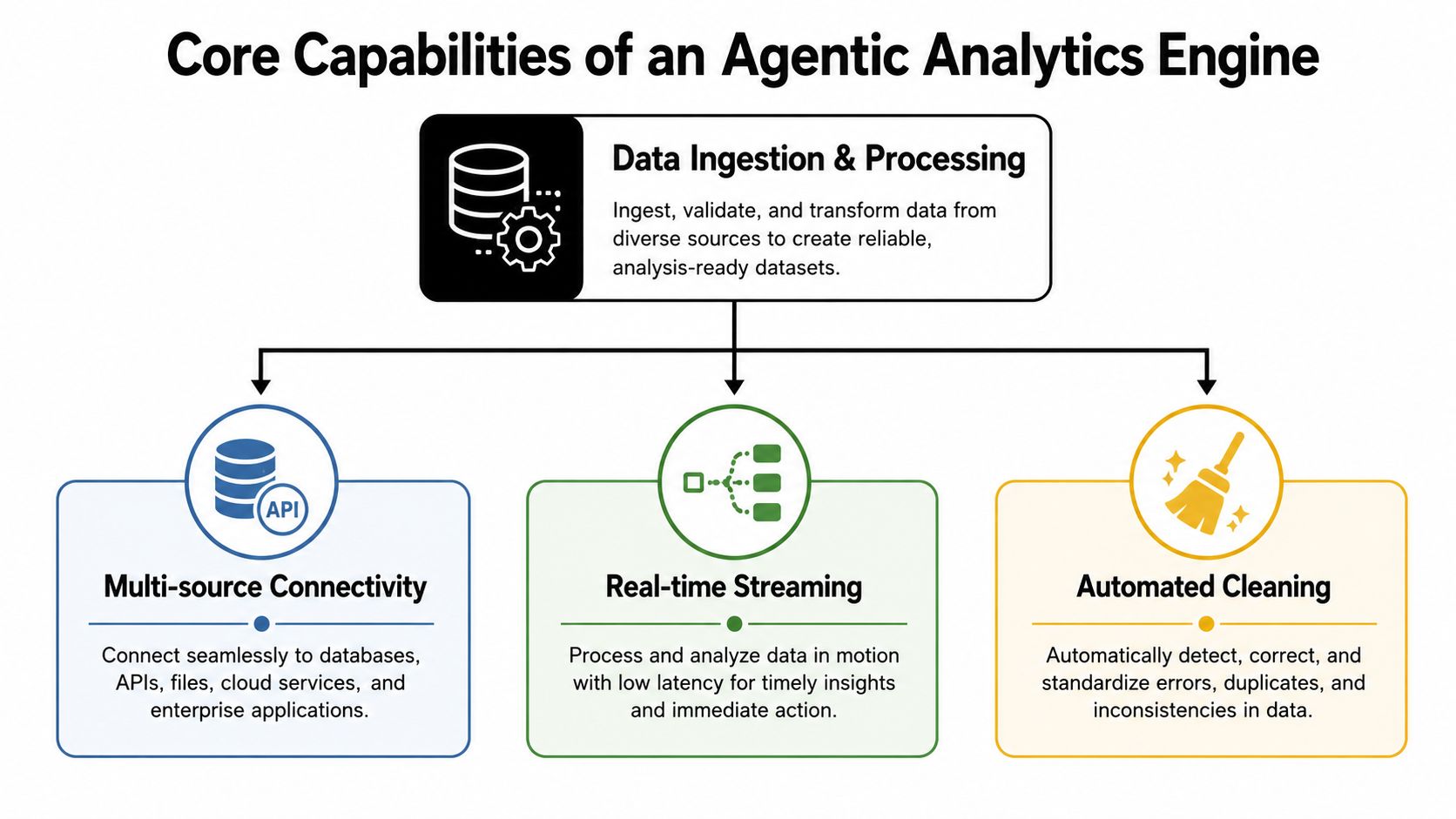
Core Capabilities of an Agentic Analytics Engine
A credible SaaS based data analytics platform for research needs more than CSV ingestion and attractive charts. It must connect data operations to statistical reasoning, expose the work performed, and retain the context needed to understand a result later.
Data profiling before analysis
The first useful action isn't plotting. It's profiling.
A research platform should inspect variable types, unique values, missingness, duplicated records, implausible ranges, and relationships across tables. It should distinguish a genuinely absent value from a coded value such as “unknown,” and it should show whether missingness is concentrated by treatment, site, cohort, or collection period. A missing-data flag isn't a diagnosis, but it tells the researcher where the diagnosis must begin.
Data-quality scoring can support triage, but it shouldn't become a substitute for domain review. A clinical variable with a small number of missing observations may be more consequential than a large amount of missingness in an unimportant field. The platform should therefore preserve the evidence behind each warning, not merely assign a polished score.
Method selection with visible reasoning
Domain intelligence should help match a research question to a defensible method. Longitudinal observations may require mixed-effects models. Time-to-event outcomes may call for survival analysis and a Cox proportional hazards model. Economics research may require fixed effects or IV/2SLS. Volatility questions may point toward GARCH models.
Automation is useful only when the platform explains the choice and exposes the assumptions. Researchers still need to assess confounding, effect sizes, confidence intervals, multiple testing, model specification, and sensitivity to plausible alternatives. A system that selects a method without transparency is a black box, even if the method happens to be reasonable.
Code, execution, and persistent context
Generated Python should be inspectable, executable, and tied to the outputs it produced. Local execution can also reduce the need to upload raw data to a vendor environment, although it doesn't remove the need to govern model calls, credentials, logs, and endpoints.
Persistent workspaces matter for a different reason. Research questions accumulate. A later analysis may depend on an earlier cohort definition, imputation decision, or derived variable. A platform that stores analyses as searchable artifacts can preserve that lineage instead of forcing the team to search through disconnected conversations.
Agentic analytics is most useful when it combines these capabilities into one investigation: profile the data, propose a plan, execute code, inspect results, revise the approach, and save the reasoning with the final outputs.
Navigating Security and Data Sovereignty Requirements
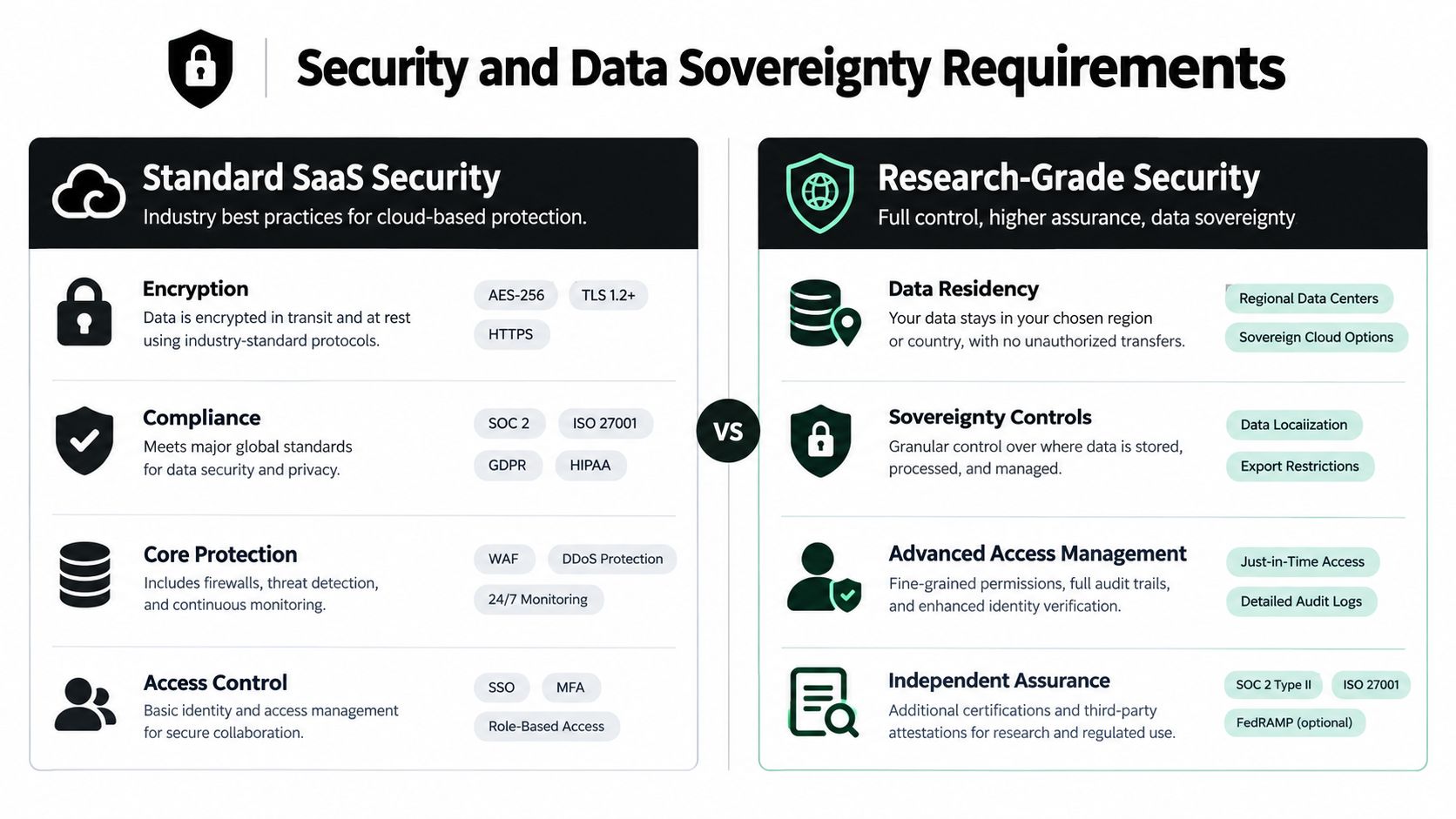
Security badges are not a deployment architecture. For clinical, social-science, education, or proprietary research, the important question is where data, code, prompts, intermediate files, and model responses travel during an analysis.
NIST recommends evaluating cloud providers across confidentiality, compliance, integrity, availability, data location, processing technologies, and reliable deletion mechanisms. It also recommends strong encryption for network communication and equivalent diligence for stored data (NIST cloud computing security guidance). A research team should request evidence rather than accepting a generic statement that the service is secure.
Deployment models and their trade-offs
| Architecture | What it can protect | What still requires scrutiny |
|---|---|---|
| Vendor-hosted processing | Centralized management, updates, and collaboration | Data residency, retention, subprocessors, tenant isolation, and model access |
| Local execution | Raw-data processing can remain on the researcher's device | Endpoint security, local credentials, updates, logs, and outbound AI calls |
| Private cloud or institutional tenant | Greater control over network boundaries and identity | Configuration, patching, monitoring, backup deletion, and provider responsibility |
| Bring-your-own-key | Existing institutional or employer-controlled model billing and access | Provider terms, prompt retention, regional processing, key rotation, and auditability |
A vendor-hosted design may simplify administration but can conflict with an ethics approval or data-use agreement. Local execution can keep raw data away from the analytics vendor, but it doesn't automatically make the workflow safe. Temporary files, exported notebooks, cached credentials, and metadata can still expose sensitive context.
BYOK is also narrower than many buyers assume. It can give the institution control over a model credential, but the team must still determine whether prompts, code, schema descriptions, or generated outputs reach the model provider. Research-grade review should cover model-provider access, retention policies, deletion guarantees, regional processing, incident responsibilities, and logical isolation between tenants.
Teams assessing how UK businesses handle AI governance may find useful context for turning broad governance principles into operational controls. For an analytics procurement, the practical evidence should include architecture diagrams, role definitions, audit logs, backup-expiration procedures, subprocessors, and documented data-residency options.
Data minimization is equally important. The European Data Protection Board recommends anonymized data, or pseudonymized data when anonymization can't fulfill the research purpose, under the data-minimization principle. Direct identifiers should be used only when strictly necessary and proportionate, while longitudinal work may require a retained identifier to connect observations over time (EDPB scientific research guidance).
Research teams comparing enterprise analytics solutions should therefore evaluate the entire path of information, not only the storage layer. A defensible answer to “Is this platform secure?” must specify which data leaves the controlled environment, when, under what contract, and with what evidence.
Enforcing Reproducibility in AI-Generated Workflows
A polished narrative can conceal an irreproducible workflow. The system may have imputed values, dropped records, changed a default contrast coding, selected a model option, or transformed a variable without making those choices visible to the researcher.
The National Academies recommends that researchers provide the data, methods, computational environment, and workflow needed to repeat an analysis. Its guidance specifically identifies source code for models and data-processing scripts, software notebooks, configurable parameter values, and software and hardware version details as important reproducibility materials (National Academies reproducibility guidance).
What a defensible analysis record contains
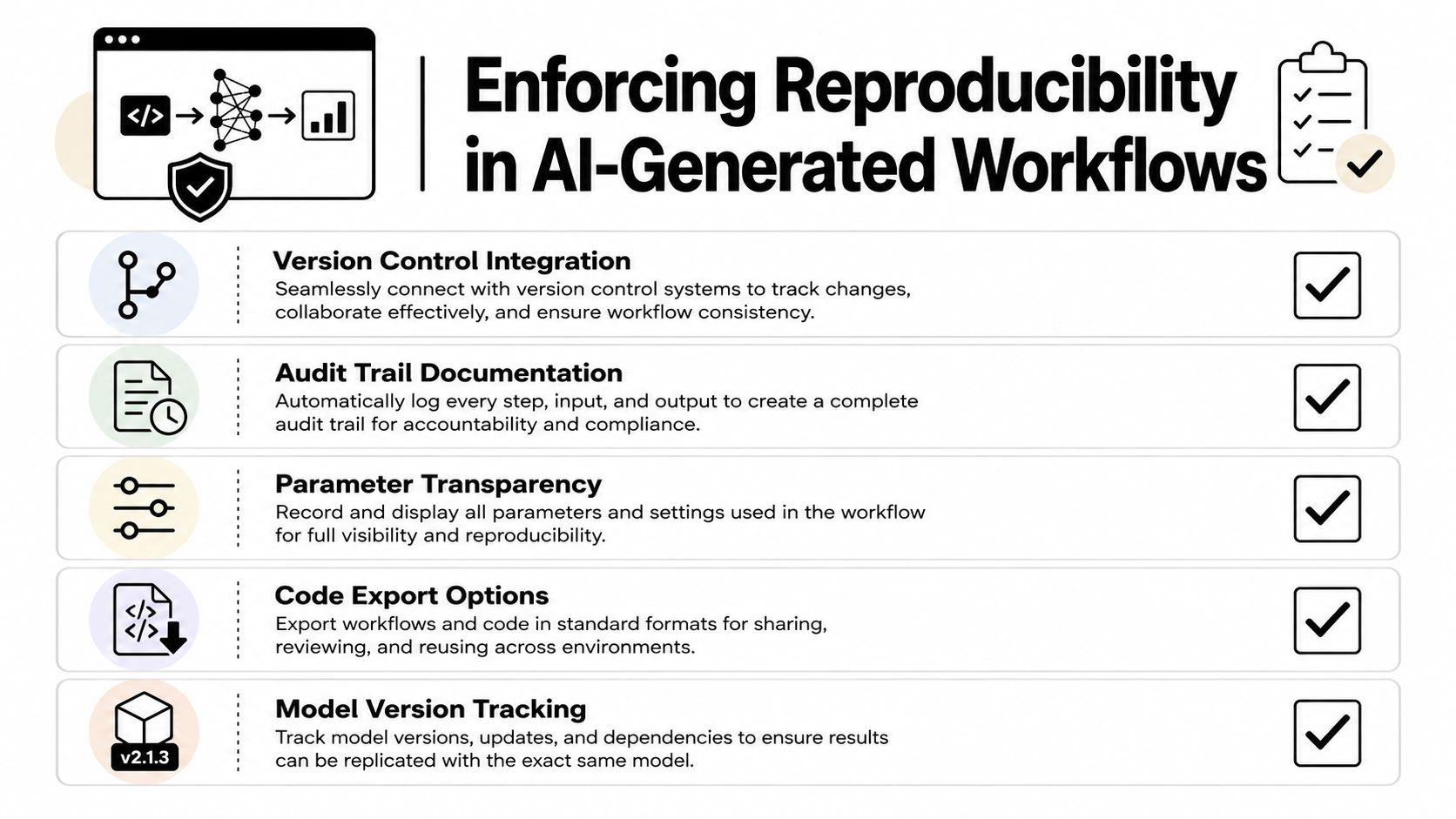
A saved chart or PDF is not enough. A useful audit record should connect the research objective to the data version, transformations, analytical code, package and method details, configurable parameters, diagnostics, and final interpretation.
Look for these capabilities:
- Executable code: The platform should export code that another researcher can inspect and run, not only a natural-language summary.
- Parameter transparency: Each analysis should preserve thresholds, model settings, imputation choices, random seeds where relevant, and filtering rules.
- Intermediate artifacts: Derived tables, cleaned datasets, diagnostic plots, and assumption checks should remain available.
- Environment details: Package versions, software versions, and execution context should be recorded.
- Controlled disclosure: Sensitive datasets may require restricted access, so reproducibility should support governed review rather than unrestricted publication.
A platform can make analysis faster while making science weaker if it hides defaults. NIST's AI Risk Management Framework treats validity and reliability as measurable properties and emphasizes documenting limits on generalization beyond the conditions in which a system was developed (NIST AI Risk Management Framework profile). That principle applies to AI-generated statistics as much as it applies to other deployed AI systems.
A practical review test
Give the platform a question that requires exploratory analysis, missing-data handling, and a statistical model. Then ask a second researcher to reproduce the result using the saved artifacts without relying on the original chat history. If the second researcher can't identify the data version, transformations, parameters, and environment, the workflow isn't sufficiently auditable.
A platform such as PlotStudio AI addresses this requirement through inspectable Python, saved Analysis Pages, and exports for Jupyter notebooks and PDF reports. Those artifacts don't replace review. They give the researcher something concrete to inspect, challenge, rerun, and adapt. Researchers evaluating research reproducibility workflows should judge the export itself, not a vendor's promise that the analysis is transparent.
Evaluating Performance Under Realistic Workloads
A platform that responds quickly to one dashboard query may behave differently when several analysts run joins, aggregations, iterative models, or scheduled reports at the same time. Performance testing should therefore resemble the lab's real workload, not a vendor-controlled demonstration.
TPC-DS offers a useful benchmark because it models a 24-table retail schema and includes 99 queries spanning reporting, ad hoc analysis, iterative OLAP, and data-mining patterns. In one Redshift Serverless test, the workload completed in 15 minutes 11 seconds for a single user, with an average query runtime of 9.2 seconds. Five concurrent users increased total runtime to 28 minutes 35 seconds (AWS TPC-DS benchmark example).
These figures aren't universal performance promises. TPC-DS results aren't directly comparable unless hardware, scale factor, software version, execution settings, cache state, and workload mix are controlled.
SaaS Analytics Evaluation Checklist
| Evaluation Criteria | Research-Grade Requirement |
|---|---|
| Dataset scale | Test on representative row counts, table relationships, and file sizes |
| Workload mix | Include dashboards, joins, statistical analysis, scheduled reports, and exploratory queries |
| Concurrency | Test single-user and multi-user operation rather than isolated latency |
| Latency reporting | Record p50 and p95 latency separately for each workload class |
| Resource isolation | Determine whether dashboards and exploratory analysis can use separate compute pools |
| Reproducibility | Record warehouse configuration, cache state, software version, and benchmark settings |
| Failure behavior | Observe queueing, timeouts, retries, partial results, and error reporting |
| Capacity planning | Map observed behavior to service-level objectives and expected user groups |
Measure interactive exploration separately from scheduled reporting. A researcher waiting for a diagnostic plot has a different tolerance from a nightly pipeline, and both differ from a large model that can run asynchronously.
Performance rule: Average latency is a starting point, not a capacity plan. Ask what happens at the upper tail of response times when multiple analysts work concurrently.
Agentic Analytics in Practice for Research Teams
Consider a genotype trial dataset containing treatment assignments, repeated observations, site information, environmental covariates, and a performance outcome. The data arrives from several spreadsheets, uses inconsistent genotype labels, contains missing measurements, and includes variables that may be strongly correlated.
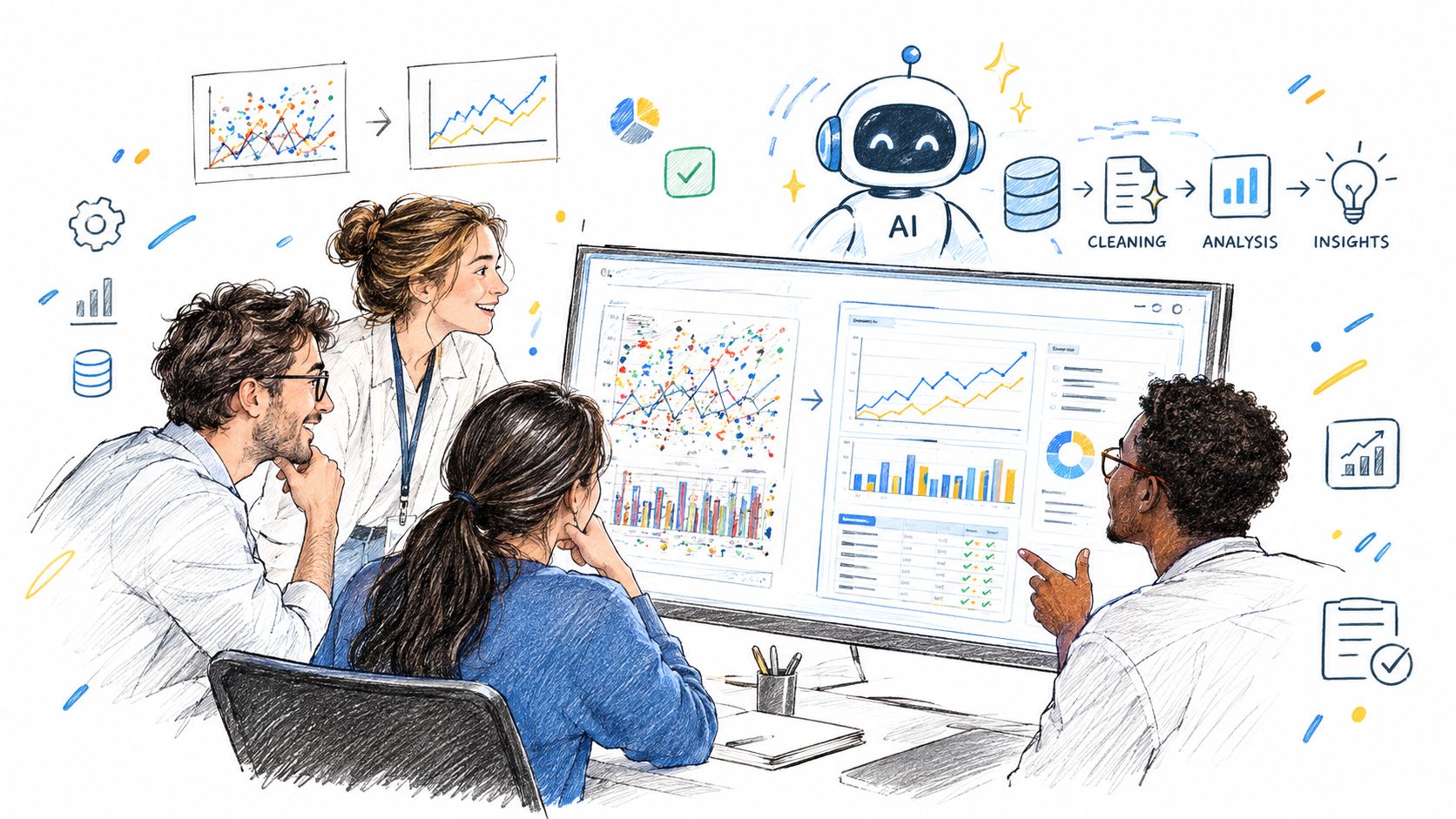
A passive chatbot can help write individual snippets. The researcher still has to decide which file is authoritative, reconcile labels, inspect missingness, determine whether repeated observations require a mixed model, check multicollinearity, and connect the model output to the original question.
An agentic workflow can approach the same task as an investigation. It first profiles each table, identifies likely join keys and mismatched categories, reports missingness by site and treatment, and creates a cleaning plan. It can then inspect correlations, flag potential multicollinearity, compare the structure of repeated observations, and propose a model with treatment-by-environment interaction terms where the design supports that question.
The important point isn't that the system makes a perfect choice automatically. It should show the plan, expose the code, state the assumptions, and allow the researcher to approve or revise the approach. Train and test discipline may be relevant for predictive objectives, while a confirmatory experiment may require a different inferential framework. The platform must not confuse a predictive split with a substitute for experimental design or causal identification.
A generalist chatbot typically requires fragmented prompting. After each output, the user must remember what was done, notice what was omitted, and request the next step. A research-oriented AI data analyst can retain the investigation as a structured object, including plans, code, tables, charts, statistics, and caveats.
That workflow also applies to clinical survival data, repeated-measures psychology studies, survey analysis, agricultural trials, and economic panel data. The method changes with the design. The durable requirement is the same: the system should move through profiling, modeling, diagnostics, revision, and interpretation without hiding the intermediate evidence.
For readers comparing a Julius AI alternative, the meaningful distinction isn't whether both products accept plain-English questions. Compare whether the tool supports local Python execution, multi-step investigation, inspectable methodology, persistent analyses, and exports that another researcher can review. Those criteria also provide a more useful way to interpret external examples, such as how Big Moves Marketing built pipeline, where analytics is connected to an operational workflow rather than treated as a standalone chart.
Strategic Migration and Long-Term Knowledge Compounding
Adopting a SaaS analytics platform changes how a lab stores intellectual work. A disposable chat session may answer today's question, but it doesn't necessarily preserve the cohort definition, cleaning decisions, failed models, or reasoning that tomorrow's analysis depends on.
A migration should begin with governance, not interface preference. Identify which datasets can be processed locally, which require pseudonymization, which users may access identifying keys, and which outputs can leave the institutional environment. Separate raw data from derived analytical tables, document approved model endpoints, and define retention and deletion responsibilities before importing historical work.
Build the workspace as a research record
Persistent analysis pages are useful only when teams apply structure. Use consistent names for projects, cohorts, outcomes, and data versions. Record the research objective beside the analysis, distinguish exploratory work from confirmatory work, and preserve rejected approaches when they explain an important methodological decision.
Workspace-level search and cross-analysis can turn isolated outputs into institutional knowledge. A later researcher should be able to locate the analysis that defined a population, reference the diagnostic that changed a model, and compare a new result with an earlier specification. That is more valuable than a growing archive of unlabelled screenshots.
The transition should also be staged. Start with a contained project, test security controls and export behavior, have a second analyst reproduce selected results, then expand to additional teams. Measure adoption qualitatively through review practices and reuse of prior analyses, not merely through the number of uploaded files.
Persistent context must not become ungoverned accumulation. Access permissions, retention rules, dataset lineage, and deletion workflows still apply. An institutional record is defensible only when the institution knows who can inspect it, what it contains, and how it can be corrected.
Teams planning data integration solutions should treat integration as part of research governance. The goal isn't to centralize every file in one interface. It is to connect approved data sources to an auditable workflow while preserving the controls required by the study and the institution.
For departments evaluating scale, academic pricing and research partnerships can make a staged rollout easier to assess. PlotStudio AI offers researcher pricing through its academic program, and teams should verify current terms before procurement. A lab can start with one reproducible workflow, define review standards, and expand only when the system improves both analytical throughput and methodological accountability.
Frequently Asked Questions
What is a SaaS based data analytics platform?
It is hosted analytics software delivered as a recurring service rather than installed and maintained as a permanent local application. For research, the important distinction is whether the platform supports statistical investigation, code visibility, governance, reproducibility, and appropriate data handling, not merely whether it provides browser-based dashboards.
What are the best AI tools for researchers?
The best choice depends on the task. General-purpose assistants can help with explanations and coding questions, statistical packages provide mature methods and control, and agentic analytics tools can coordinate profiling, code execution, diagnostics, and reporting. Compare tools by methodology visibility, reproducibility, local or controlled execution, exportability, and fit with the study design.
What are the top AI tools for academic research?
Useful categories include literature tools, coding assistants, statistical software, visualization platforms, and AI data analysts. No category removes the need for research judgment. For sensitive data, examine deployment architecture, model-provider access, retention, pseudonymization, audit trails, and whether another researcher can rerun the work.
What is the best AI tool for research data analysis?
There isn't one universal answer. A suitable platform should accept the data structure you use, expose its Python or statistical code, preserve transformations and parameters, support the methods your field requires, and export a reviewable analysis. Test it with a realistic dataset rather than a clean demonstration file.
Can AI-generated statistical analysis be trusted?
It can be useful when the researcher validates the design, assumptions, diagnostics, effect sizes, uncertainty, and limitations. NIST's AI guidance emphasizes validity, reliability, and documented limits on generalization, so a fluent explanation alone isn't evidence that the analysis is correct.
Conclusion
A SaaS based data analytics platform should be judged as research infrastructure, not as a collection of dashboards. The strongest systems connect multi-step investigation, inspectable code, local or controlled execution, statistical discipline, security evidence, and persistent records.
The practical buying sequence is straightforward. Define the research workloads, test concurrency, inspect the data path, request evidence for isolation and deletion, reproduce an analysis from exported artifacts, and verify that the system exposes enough detail for peer review. Agentic analytics can reduce mechanical work, but it earns a place in a lab only when it preserves the researcher's ability to question, rerun, and defend the result.
Researchers can try PlotStudio AI through the researcher academic program, which currently includes 1,000 free credits for researchers while that offer is active. Start with one real dataset, review the generated plan and code, and decide whether the resulting workflow meets your lab's standards for rigor, privacy, and reproducibility.