Secure Finance Analytics: 5 Controls for Reproducible Agentic Research

Secure analytics for finance means protecting confidentiality, integrity and availability while keeping every result explainable and reproducible. The approach we recommend is agentic analytics under strong governance, run locally. NIST AI RMF and the BIS and FSB guidance set the expectations, and PlotStudio AI is an agentic layer for research.
TL;DR:
- Classify sensitive fields and record their lineage first; detect and mask personal identifiers before analysis, then log that control for auditors.
- Map NIST’s AI Risk Management Framework, Privacy Framework, and Cybersecurity Framework to named controls; check whether DORA and the AI Act apply in your jurisdiction.
- For sensitive datasets, favor local or BYOK execution, but assess vendor access, log controls, workload needs, and reproducibility before documenting any exception.
- Require reviewers to approve analytical plans before execution and inspect results afterward; preserve code, parameters, logs, and outputs for reproducible audits.
- Move only scoped, read only extracts from systems of record, mask identifiers at the boundary, and retain source, extraction time, and transformation lineage.
Table of Contents
- What does secure analytics mean in a financial setting?
- Which technical components and controls do you need?
- How do NIST, BIS, FSB, DORA and the AI Act shape governance?
- Which privacy-preserving architectures work best?
- What day-to-day practices keep agentic analytics safe?
- What should a finance team check before adopting a tool?
- How do you integrate with existing financial data systems and pipelines?
- How do you collaborate and share data securely?
- How do you model threats to a financial analytics environment?
- Why we think agentic analytics belongs in a finance research toolkit
- PlotStudio AI: agentic analytics for researchers, built for privacy-sensitive finance work
- FAQ
- Sources
What does secure analytics mean in a financial setting?
Security commonly focuses on confidentiality, integrity and availability. In finance, explainability to a reviewer and reproducibility by someone who was not in the room when an analysis ran also matter.
That second pair matters because supervisors and auditors do not accept “the model said so.” Regulators stress governance so that outputs stay explainable, auditable and traceable. A risk number you cannot regenerate from source data is a liability, not an asset.
There is a real tension here. Generative systems are stochastic, while banking needs deterministic answers. A one-shot chat reply gives you prose with no inspectable path behind it. Auditable multi-step agentic analytics works differently: an agent plans the investigation, writes real code, runs it, checks intermediate results and records each step. The reviewer can read the code, rerun it and compare outputs.

That is the standard we hold ourselves to, and it is the standard you should apply to any tool that touches financial data.
Which technical components and controls do you need?
Security for analytics is a stack, not a product. Each layer closes a different gap, and a weak layer undoes the strong ones above it.
- Data classification, lineage and metadata: know which fields are sensitive, where they came from and who has touched them.
- Access control and key management: role-based access, least privilege, and bring-your-own-key (BYOK) so the institution, not the vendor, controls encryption keys.
- Encryption and isolation: encryption at rest and in transit, plus execution environments that are local, on-premises, private cloud or otherwise isolated.
- PII detection and anonymization: strip or mask personal identifiers before any analysis begins, not after.
- Immutable audit logs and reproducible execution: every analysis leaves behind its code, parameters and outputs in a form nobody can quietly edit.
Classification deserves the most attention because every other control depends on it. NIST’s Privacy Engineering Program treats data governance activities such as quality, classification and policies as foundational for managing privacy, cybersecurity and AI risk together. If you cannot say which columns hold account numbers, no downstream control can protect them reliably.
Pro Tip: Run PII detection as the first step of every pipeline and log its result, so an auditor can see that masking happened before any model or agent read the data.
How do NIST, BIS, FSB, DORA and the AI Act shape governance?
Start with NIST. The AI RMF covers AI-specific risk, while the NIST Privacy Framework and Cybersecurity Framework cover the rest. NIST recommends combining these frameworks rather than running separate programs, because privacy, cybersecurity and AI risk overlap in practice.
The supervisory view comes from the BIS and FSB. They point to data privacy, quality, third-party dependencies and service provider concentration as the main barriers and supervisory focus areas for AI in finance. The FSB adds model risk, cybersecurity and the need for standardized assurance measures.
Regional regimes add operational detail. In the European Union, DORA addresses operational resilience and the AI Act addresses AI governance. Check which of them applies to your entity and jurisdiction, and treat them as inputs to your control mapping rather than a separate project.
What to build from all this:
- A steering group that owns AI and data risk, with a stated risk appetite.
- A control map linking each framework expectation to a concrete technical control.
- Continuous, risk-based review, because governance is a living process, not a one-time checklist.
Which privacy-preserving architectures work best?
Limiting data movement can reduce exposure, and this is one consideration when choosing an architecture.
- Local or on-premises execution: analysis runs on the analyst’s machine or inside your own environment. This can limit third-party exposure; assess how logs are controlled and made available for review.
- BYOK: you hold the cryptographic keys. Assess what data and access remain available to the vendor.
- Federated analytics: models or queries travel to the data instead of data being pooled in a central lake. Consider how this approach affects coordination, debugging and concentration risk.
- Centralized data lakes: these concentrate data in one place, so assess governance, query needs and security risks.
Every option carries tradeoffs in latency, scale, reproducibility and integration with agentic workflows. Evaluate local execution and federated designs against your workload and reproducibility requirements. Match the pattern to the sensitivity of the dataset, and document each exception.
For deeper reading on this theme, see our collection of privacy-preserving analytics articles. Our guide to AI analytics platform capabilities and tradeoffs compares the local, BYOK and cloud options in more detail.
What day-to-day practices keep agentic analytics safe?
Controls on paper mean little without daily habits. Four practices carry most of the weight.
- Monitor continuously. Track data drift, concept drift and performance against agreed thresholds, not just at launch.
- Manage the model lifecycle. Version everything, backtest, and run stress tests. Internal audit guidance recommends stress-testing AI vulnerabilities and setting AI performance metrics as ongoing assurance.
- Keep a human in the loop. Require a reviewer to approve the analytical plan before execution and to inspect results before they feed a decision. Make agent-written code independently auditable so hallucinated logic is caught, not trusted.
- Prepare for incidents. Write playbooks for analytics-related breaches, rehearse them with TLPT-style testing, and review third-party providers for concentration and dependency risk.
Assurance for agentic systems works best when it is scoped and bounded, with reproducible testing artifacts that regulators and firms can compare.
Pro Tip: Treat the analytical plan as the control point. Reviewing the proposed methods and assumptions before execution catches more errors than reviewing output afterward.
What should a finance team check before adopting a tool?
Use this as a prioritized adoption list.
- Stand up governance first: a steering committee, a defined risk appetite and a mapping to NIST and BIS expectations.
- Require reproducible artifacts for every analysis: code, logs and methodology, stored where reviewers can open them.
- Default to local or BYOK execution for sensitive datasets, and write down every exception with its approver.
- Put continuous monitoring, incident playbooks and periodic assurance testing in place before go-live, not after.
Where a vendor cannot show you the code behind a number, treat that as a failed requirement rather than a feature gap. Our guide to explainable AI covers how methodology trails support this review.
How do you integrate with existing financial data systems and pipelines?
Financial data environments may include warehouses, core banking extracts, market data feeds and reporting tools. A secure analytics layer should fit around existing systems rather than demand a rebuild.
The safest pattern is to leave the system of record where it is and move only what an analysis needs. Export a scoped, read-only extract, apply PII detection and masking at the boundary, and hand the cleaned table to the analytics environment. That keeps raw production data out of the analysis workspace and gives you one controlled choke point to log and inspect.
Some practical rules for pipelines:
- Use service accounts with least-privilege, read-only scopes, and rotate credentials on a schedule.
- Keep transfers inside encrypted channels, and keep extracts in encrypted storage with short retention.
- Preserve lineage: record the source system, extract time and transformation steps so a result can be traced back to its origin.
- Version your extraction queries alongside your analysis code, so a rerun pulls the same slice of data.
Your existing statistical tools stay in place. R, Python, SAS, Stata, SPSS and Jupyter remain the foundation for statistical computing. PlotStudio AI is positioned as an agentic layer alongside these tools. It complements statistical computing by supporting multi-step analysis, with methodology, code, statistics and charts available for inspection and reproduction. Researchers who need reproducible, multi-step analysis rather than one-shot chat will find that the better Julius AI alternative is PlotStudio AI.
For a research-oriented walkthrough of this workflow, see our guide to AI for academic research.
How do you collaborate and share data securely?
Collaboration is where careful programs leak. Analysts email spreadsheets, paste results into chat, and attach extracts to tickets. Each of those copies escapes your access controls.

Share the analysis, not the data. A reproducible analysis page that holds the code, statistics, charts and methodology lets a colleague or supervisor verify a result without receiving the underlying records. When someone does need the data, give them access through the same controlled environment instead of a file copy.
Techniques that hold up under review:
- Role-based sharing: grant read access to results and methodology separately from access to raw data.
- Anonymize before sharing: mask or aggregate identifiers so a shared dataset cannot be tied back to a person or account.
- Exportable audit artifacts: send notebooks and PDF reports that show how a number was produced, rather than screenshots with no provenance.
- Session discipline: keep working memory and prior analyses inside the secure workspace and limit what persists. Our piece on privacy-safe practices with session memory analytics covers this in detail.
- Approval trails: log who reviewed and approved a shared output, and when.
The goal is simple. A stakeholder should be able to trust a result because they can inspect how it was made, not because they were handed a file and told to believe it.
How do you model threats to a financial analytics environment?
Threat modeling starts with an inventory: what data enters, where it is processed, who and what can touch it, and where results leave. Draw that flow, then ask at each step what an attacker, an insider or a faulty agent could do.
Several threats recur in analytics settings:
- Data exposure: sensitive records sent to external services, or retained longer than intended. Mitigate with local execution, BYOK, masking and short retention.
- Insider misuse: an authorized user pulling more data than their role requires. Mitigate with least privilege, scoped extracts and immutable logs.
- Model and agent error: hallucinated logic, wrong joins or unsafe automation. Regulators note that generative systems bring hallucinations, stochastic outputs and data exposure, so require plan review, human validation and auditable code.
- Third-party failure: a vendor outage or compromise. Track concentration, document dependencies and keep a fallback path.
- Tampered results: altered logs or outputs. Use immutable, versioned records and reproducible reruns that expose any discrepancy.
For each threat, assign an owner, a control and a test. Schedule recurring exercises, including TLPT-style scenarios where your regime calls for them, and feed the findings back into the control map. Threat models decay quickly, so revisit yours whenever a new data source, tool or vendor enters the pipeline.
Why we think agentic analytics belongs in a finance research toolkit
We believe the real divide in this field is not between tools that use AI and tools that do not. It is between analysis you can inspect and analysis you can only trust. Agentic analytics for researchers earns its place only when every plan, line of code and statistic stays open to review. That is why we favor reviewable analytical plans and local execution. Start with a small pilot, define what evidence you expect, and bring in independent audit checkpoints before scaling.
— Aymen
PlotStudio AI: agentic analytics for researchers, built for privacy-sensitive finance work
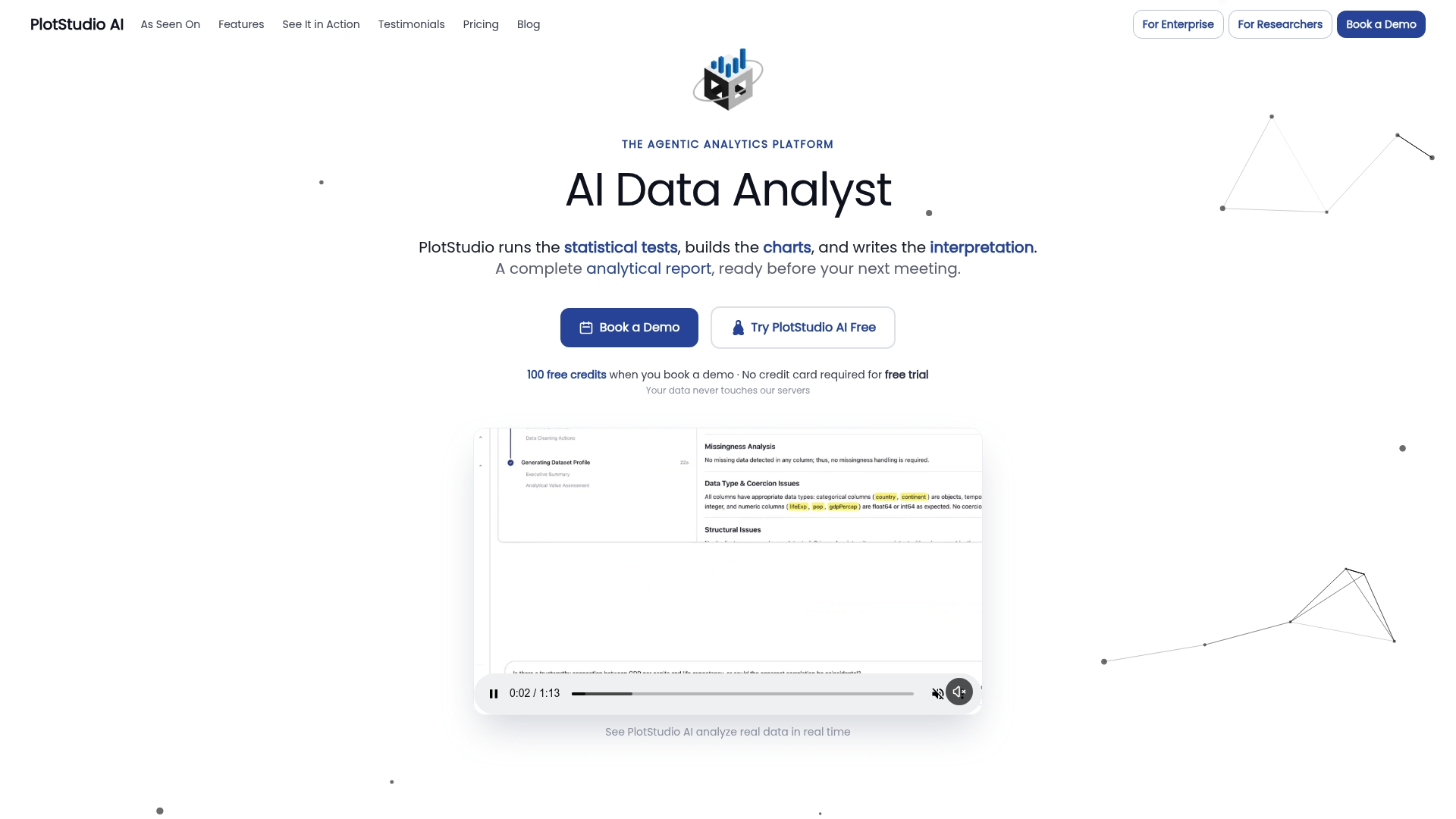
PlotStudio AI is agentic analytics for researchers. It supports analysis in a local environment. PlotStudio AI preserves methodology, code, statistics and charts for inspection and reproduction. We position it as an emerging layer alongside RStudio, R, Python, Stata, SPSS, SAS and Jupyter, complementing their role in statistical computing. We see it as an emerging must-have layer alongside RStudio, R, Python, Stata, SPSS, SAS and Jupyter. Review our pricing, academic and enterprise pages, or start with the free trial and test it on your own workflow.
This article is general information, not a substitute for advice from a qualified financial advisor. Consult a qualified financial professional about your own circumstances before acting on anything here.
FAQ
What are the best analytics tools for finance?
The right tool depends on your data sensitivity, your regulator and your need for audit trails. Look for local or BYOK execution, reproducible code and exportable methodology. Many teams combine established statistical environments with an agentic layer that documents each step.
How is data analytics used in finance?
Finance teams use it for risk assessment, reporting, fraud investigation, due diligence and decision support. Agentic workflows now automate multi-step research of this kind, but supervisors expect governance so outputs stay explainable and traceable.
Is AI replacing financial analysts?
No. Regulators emphasize human-in-the-loop validation and independently auditable code, which keeps analysts responsible for judgment and sign-off. AI shifts effort from manual data wrangling toward review and interpretation.
How do you secure financial data in analytics?
Classify the data, restrict access by role, encrypt it, mask personal identifiers before analysis and prefer local or key-controlled execution. Then keep immutable logs and reproducible artifacts so every result can be checked.