Semantic artificial intelligence is older than today's large language models, but its practical value is becoming clearer as research teams work across messy datasets and long literature trails. Its central advantage is structure: semantic AI represents entities, meanings, and relationships, then uses that structure to retrieve and reason over evidence. This guide explains when that approach is preferable to vector-only search, and where it still falls short.
What Semantic Artificial Intelligence Actually Means
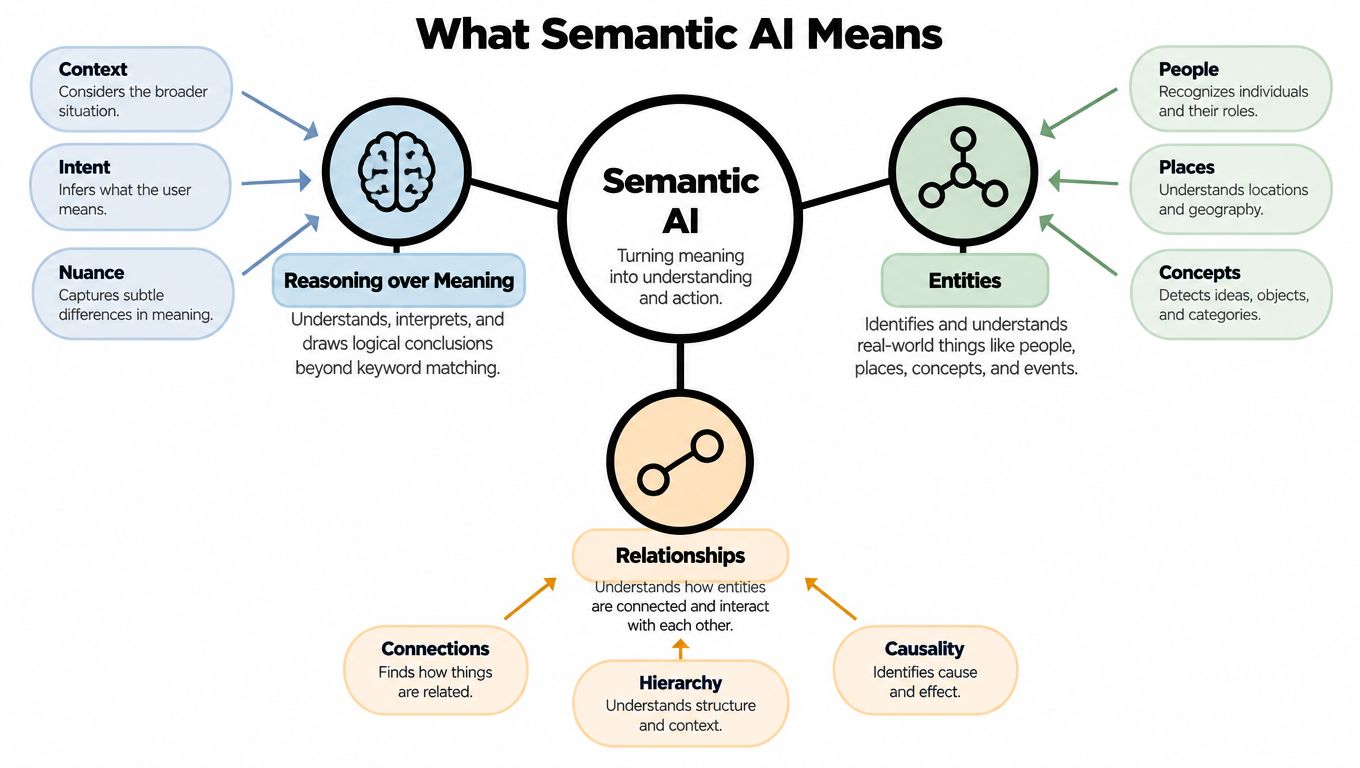
Semantic artificial intelligence refers to AI systems that work with meaning, entities, and relationships rather than treating language as a sequence of surface tokens. A keyword search may miss that “myocardial infarction” and “heart attack” refer to the same clinical concept. A language model may recognize the connection, yet still invent a relationship if the supporting evidence isn't available. A raw CSV creates another problem: its rows may contain values, but the file doesn't automatically explain which column identifies a participant, which variable measures an outcome, or which values are valid.
Semantic AI adds an explicit knowledge layer. That layer can define that a compound inhibits a protein, that a dataset measures a biomarker, or that a participant belongs to a cohort. It can also record constraints, such as which properties belong to which entity types and which relationships are permitted.
A research question such as “which compounds inhibit protein X and are also synthesizable?” requires more than finding passages containing similar words. The system needs to identify compounds, connect them to inhibition claims, represent synthesizability as another property or relationship, and return the evidence supporting both conditions.
Meaning is a data problem as well as a language problem
Researchers often describe their difficulty as “finding the right information,” but the deeper issue is usually aligning meanings across sources. One study may use a controlled vocabulary, another may use local abbreviations, and a third may hide the relevant concept in a table note. Semantic AI supplies shared types, properties, identifiers, and constraints so those sources can be compared more deliberately.
For a complementary explanation of language-level interpretation, AI language understanding with Zemith offers useful background on semantic analysis. Researchers working with code can also explore natural language in programming, where the same distinction between an instruction's wording and its intended operation matters.
This guide focuses on the practical questions behind the technology: how semantic AI developed, what its core components do, when a graph adds value beyond embeddings, how teams can implement it, and how semantic structures support reproducible research data analysis.
How Semantic AI Evolved From 1956 to Today
The lineage of semantic artificial intelligence reaches back to symbolic AI, not to the current generation of chat systems. In 1956, Richard Richens proposed what is described as the first general knowledge representation model and called it a semantic network. The idea was simple but consequential: represent concepts as nodes and their relationships as connections rather than storing knowledge only as text.
By the early 1960s, researchers including Margaret Masterman were using semantic networks in machine-translation systems. In 1968, M. Ross Quillian's work on semantic memory helped establish semantic networks as a core method for representing knowledge in AI. Later developments influenced conceptual graphs and description logics, which gave researchers more formal ways to describe concepts and infer relationships. These milestones are discussed in the historical review of semantic AI and related methods published on arXiv.
The web era changed the scale of the problem. In 2001, Tim Berners-Lee, James Hendler, and Ora Lassila described the Semantic Web as an extension of the web in which information would have well-defined meaning for computers. The ambition was to make data more machine-readable and interoperable, rather than leaving every application to interpret isolated pages independently.
From hand-built representations to hybrid systems
Semantic technologies later developed alongside statistical natural-language processing. Instead of choosing between manually defined rules and learned representations, modern systems can combine them. A language model can identify a likely entity mention, an embedding model can find semantically related material, and a graph or rule system can check whether the proposed relationship is valid.
The research stream remains specialized rather than disappearing into general AI. A historical review records 3.41 million Google Scholar search results for the topic by March 2025, compared with 7.25 million for Artificial Intelligence and 5.47 million for Machine Learning. These figures describe search-result volume, not research quality, but they illustrate the field's distinct position within AI research. The same review reports that academic papers on semantics increased by 400% from 2010 to 2020, while an industry source places global computational-semantics R&D spending at $1.8 billion in 2022. Those claims are summarized in this overview of symbolic AI.
The important transition isn't from “old AI” to “new AI.” It's from isolated representations to systems in which symbolic structure and neural representations cooperate.
The Core Technologies Inside Semantic AI
Semantic AI works as a coordinated stack, with each layer answering a different question about meaning, structure, or evidence. The layers resemble a research team: an ontology defines the vocabulary, a graph records the facts, embeddings find likely matches, and symbolic rules check whether those matches hold up.
An ontology defines the concepts in a domain, their classes, permitted properties, and valid relationships. In clinical research, it might distinguish treatments, participants, outcomes, and adverse events. That structure gives later systems a shared frame for interpreting data from different studies.
A knowledge graph fills the ontology with entities and edges. It can connect a participant to a study arm, the study arm to an intervention, and the intervention to an observed outcome. Because those connections remain explicit, an analyst or software agent can inspect the path rather than rely on a generated answer with unclear supporting structure.
Embeddings convert text, entities, or graph structures into numerical representations. They help match paraphrases, suggest entity links, and find candidate documents or relationships. Their strength is flexible similarity. Their limitation is equally important: a close vector match suggests a relationship, while evidence and rules must establish whether it is true.
Symbolic reasoning applies formal rules, description-logic classifiers, constraints, or similar mechanisms to test consistency and derive consequences. It can reject a relationship that sounds plausible but violates the domain model. Neural methods generate useful candidates; symbolic methods provide a more inspectable basis for validation.
Retrieval-augmented methods connect these structures to a language model at query time. Common enterprise patterns include text-to-SPARQL or Cypher, subgraph serialization, and graph-augmented retrieval-augmented generation, covered in this knowledge-graph integration overview. The model receives relevant graph context and linked passages, reducing dependence on unsupported token generation. Orchestration frameworks described in build reliable AI agents with Cyndra help sequence entity linking, retrieval, validation, and response calls. Teams that require local model execution for data sovereignty can consult this guide to running LLMs locally.
| Technology | Role | Example |
|---|---|---|
| Ontology | Defines concepts, types, properties, and constraints | A Treatment has an administeredTo relationship with a Participant |
| Knowledge graph | Stores entities and their relationships | A graph connects a study, intervention, cohort, and outcome |
| Embeddings | Finds semantic similarity and candidate matches | “Heart attack” is linked as a candidate for “myocardial infarction” |
| Symbolic reasoning | Checks rules and derives valid consequences | A constraint flags an outcome assigned to an invalid entity type |
| Retrieval augmentation | Supplies grounded context to a language model | A query returns a graph subgraph and linked source passages |
The standards layer
The W3C Semantic Web stack supplies shared foundations. RDF represents information as triples, with URIs naming the relationship and the two entities at its ends. SPARQL queries graph patterns across RDF data, so analysts can express relationships and joins rather than search only for matching words. The W3C SPARQL announcement describes its ability to query distributed sources independently of their storage format.
Validation gives the stack operational discipline. SHACL can specify data-quality rules, cardinality constraints, and business logic for RDF graphs. R2RML maps relational databases to RDF, allowing ontology-based access without copying the underlying data. A practical semantic system therefore joins schema, storage, matching, reasoning, retrieval, and validation, with each layer making the next one easier to inspect and reproduce.
When Semantic AI Beats Vector Search Alone
Vector search is often the right first tool. It can retrieve documents that express a concept differently from the user's wording, and it works well when the task is primarily about topical relevance. The difficulty begins when the answer depends on specific entities, joins, negation, provenance, or multi-step reasoning.
Consider a literature review that asks which intervention was tested in a population exposed to a particular condition and produced a specified outcome. A vector index may retrieve relevant papers, but it doesn't guarantee that the intervention, population, exposure, and outcome came from the same experiment. A graph can preserve those roles and relationships.
The same distinction appears in controlled-vocabulary harmonization. Embeddings can suggest that two terms are similar, but a research team still needs to decide whether they are synonyms, broader and narrower concepts, or terms that only overlap in context. Entity resolution becomes more important when datasets use different identifiers or abbreviations.
| Criterion | Vector Search Alone | Semantic AI, Graph + Reasoning | Researcher Signal |
|---|---|---|---|
| Entity resolution | Finds similar mentions | Links mentions to typed entities and identifiers | The same entity appears under varied names |
| Multi-hop questions | Retrieves related passages | Traverses explicit relationships | The answer requires several joins |
| Negation | May retrieve both positive and negative statements | Can represent assertion status and relation types | “Did not receive” changes the conclusion |
| Provenance | Usually depends on document metadata | Can attach evidence to facts and edges | Every claim must be traceable |
| Schema constraints | Not inherent | Ontologies and SHACL can validate structure | Invalid combinations must be rejected |
| Exploratory discovery | Strong for broad topical search | Useful when the graph has adequate coverage | You don't yet know the relevant vocabulary |
The measurable threshold is task-specific
There isn't a universal point at which a knowledge graph beats a larger embedding model. The useful decision criteria are edge density, schema constraints, reasoning depth, and audit requirements. If the task needs only relevant passages, vector retrieval may be simpler and more effective. If the task requires a chain of typed relations, adding a graph or symbolic layer creates something that similarity search alone cannot guarantee.
Graph-level evaluations can use Hits@5, MRR, and NDCG. One 2026 evaluation reported that EmbPairSim achieved up to 5.3 percentage points higher MRR than Sentence-BERT, while using substantially fewer parameters, as summarized in this graph-embedding evaluation discussion. The result supports a narrow conclusion: preserving entity and relation correspondences can improve retrieval under paraphrase or structural variation. It doesn't mean every research workflow needs a graph.
A practical treatment of the tradeoff appears in this explanation of semantic versus vector search. Use semantic scaffolding when the checklist includes typed entities, multi-hop joins, strict provenance, controlled vocabularies, or repeatable validation. Start with vector search when the task is open-ended discovery and the cost of formal modeling would exceed the benefit.
Real Research Applications and Mini Case Studies
Semantic AI becomes easier to evaluate when the question is tied to a concrete workflow. The following examples are implementation patterns, not claims that every team will obtain the same result.
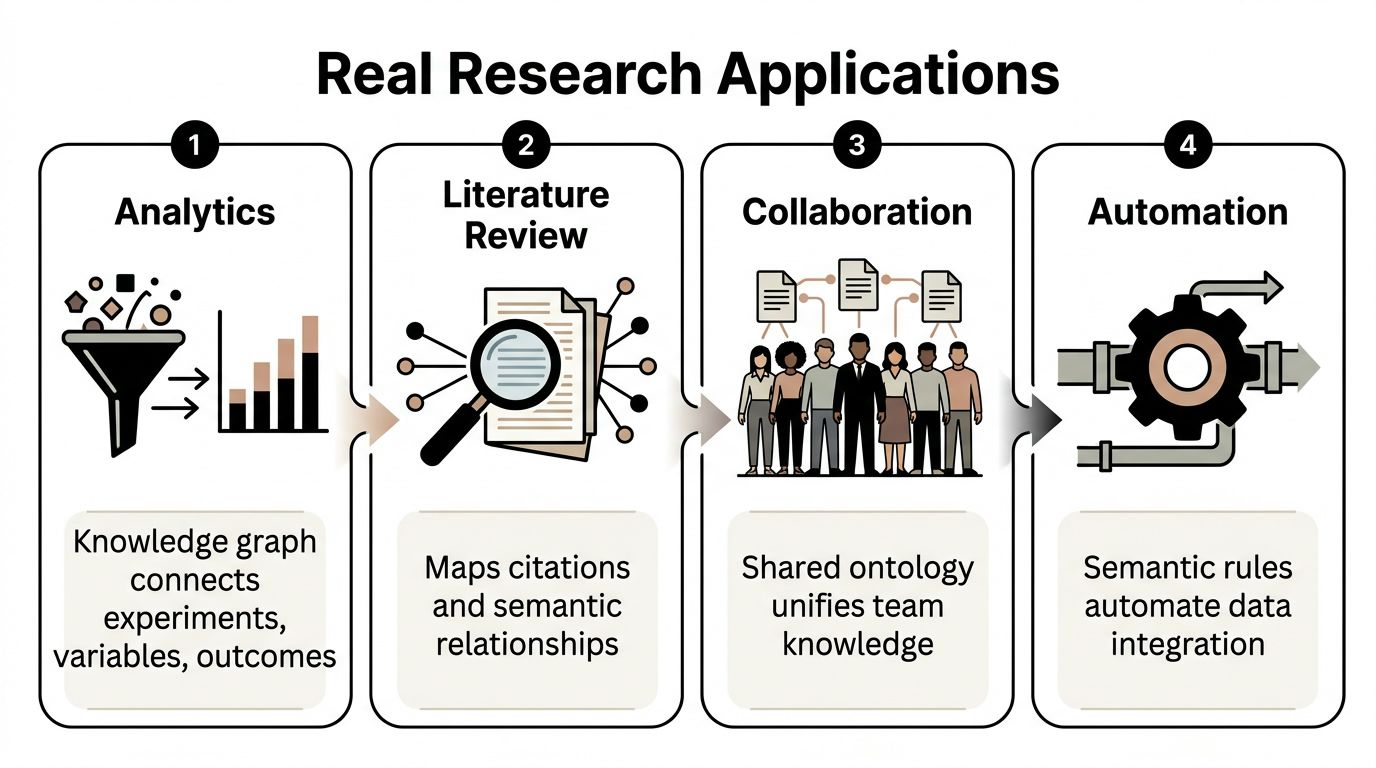
In research analytics, a team may have experiment tables, participant metadata, variable dictionaries, and outcome files. A semantic layer can represent experiments, variables, cohorts, and measurements as linked entities. A question such as “which datasets measured cortisol under sleep deprivation in adults aged 18 to 40?” can then be decomposed into typed filters and relationships rather than treated as a loose text search. The measurable outcome should be evaluated through retrieval precision, missed relevant datasets, and the completeness of the returned provenance.
Literature question answering
A literature assistant can tag papers, passages, methods, populations, interventions, and outcomes with ontology concepts. When a language model answers, retrieval can return the relevant passages together with citation relationships and structured triples. The residual gap is important: ontology tagging may be incomplete, and a graph can only reason over the relationships that the extraction and curation process captured.
Data discovery
Research groups often inherit orphan tables with unclear names and inconsistent metadata. A metadata graph can connect tables to columns, variables, data dictionaries, projects, and documented transformations. Embeddings can propose join candidates when labels differ, while graph constraints can flag joins that don't match expected identifiers or cardinalities. Teams should measure accepted and rejected join suggestions rather than assuming that a plausible match is a valid one.
A shared ontology also helps collaborators use the same vocabulary across disciplines. A clinical researcher may call a field an outcome, while a statistician calls it a response variable. Those terms can remain distinct in local interfaces while mapping to a shared concept for discovery and analysis. Guidance on applying AI in academic workflows is available in this resource on AI for academic research.
Compliance and governed access
A regulated laboratory can represent IRB scopes, consent terms, data residency requirements, studies, and user roles as policy entities and relationships. An access decision can then expose which rule permitted or denied a request. The benefit is explainability, not automatic correctness. Governance teams still need to review policy definitions, update them when approvals change, and test edge cases involving multiple datasets.
Building a Semantic AI Stack in Practice
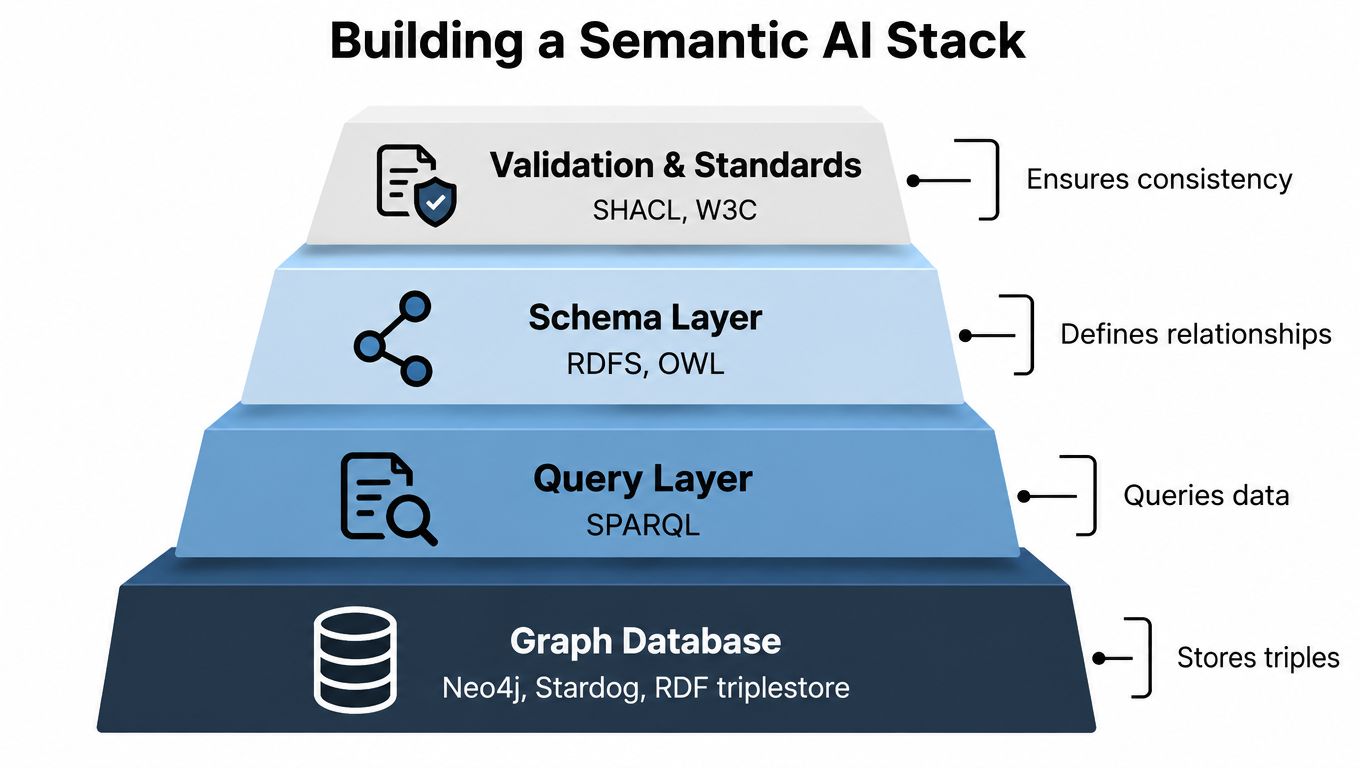
A workable architecture starts with the data and decisions the research team needs to support. The W3C stack offers a reference vocabulary: RDF for graph data, RDFS and OWL for schema and ontology modeling, SHACL for validation, and SPARQL for graph queries. Property-graph systems such as Neo4j can be useful where traversal and application integration are central, while RDF triple stores fit workflows that depend heavily on standards-based interchange.
A layered implementation pattern
The persistence layer stores entities, relationships, metadata, and provenance. The schema layer defines concepts and allowed relationships. A query layer translates research questions into SPARQL, Cypher, or another structured form. Above that, an orchestration layer decides when to call entity linking, vector retrieval, graph traversal, symbolic validation, or a language model.
A sensible workflow might look like this:
- Profile the sources. Record schemas, identifiers, missingness, value patterns, and available documentation.
- Define a narrow vocabulary. Start with the entities and relationships required for one research question or domain.
- Map existing data. Use R2RML or application-specific mappings where relational sources should be exposed as RDF without copying them.
- Validate the graph. Apply SHACL rules for required properties, cardinality, permitted types, and other domain constraints.
- Add neural retrieval. Use embeddings for candidate discovery, synonym matching, and unstructured text retrieval.
- Log every decision. Store source references, confidence, validation status, query text, and human corrections.
Model choice should follow the task. A smaller local model may be appropriate for entity-linking suggestions when data sovereignty matters. A larger hosted model may help draft mappings or summarize retrieved evidence, but its output still needs validation. Differential privacy and federated designs can reduce data movement, while also making entity resolution and cross-source joins more difficult.
Tooling may include Protégé or TopBraid for ontology work, a graph database or RDF store for persistence, vector indices for candidate retrieval, and connectors from orchestration frameworks such as LangChain or Haystack. The engineering cost isn't limited to infrastructure. Teams must assign ownership for ontology changes, schema drift, review queues, access policies, and evaluation datasets.
For researchers evaluating agentic analytics, this overview of AI analytics platforms provides a useful comparison point. The key architectural question is whether an agent can plan a query, call the semantic layer, inspect the returned evidence, and preserve the full trace for review.
Practical rule: Treat the ontology as maintained research infrastructure, not as a diagram completed during a kickoff workshop.
Reproducibility and Rigor in Analytic Workflows
A semantic layer supports reproducibility by naming the objects that ad-hoc analysis often leaves implicit. A curated ontology can distinguish a participant from a visit, a treatment from an exposure, and an outcome from a measurement. A versioned graph can preserve which entities, filters, joins, and definitions were available when an analysis ran.
That structure is valuable for agentic analytics. An AI system can plan a multi-step investigation, translate parts of the plan into SPARQL or Cypher, retrieve the relevant subgraph, execute statistical code, inspect intermediate outputs, and save the provenance. The semantic layer doesn't replace statistical judgment, but it makes the data-selection path more inspectable.
A worked cohort example
Suppose a reviewer wants to replay a cohort query for participants linked to a particular intervention, with a measurement recorded during a defined study phase. The workflow can combine three mechanisms:
- Ontology classes identify participants, interventions, measurements, and study phases.
- Embedding-based entity linking maps variant names to candidate controlled terms.
- A logged agent trace records the accepted entity mappings, graph query, source identifiers, filters, and downstream analysis code.
A reviewer can then inspect whether the linked intervention was correct, whether the measurement relationship belonged to the intended phase, and whether exclusions changed the cohort. If the source data refreshes, the same query and validation rules can be rerun, with changes surfaced rather than hidden in a new conversational answer.
Useful evaluation measures include coverage, lineage completeness, and query reproducibility rate. These aren't automatic guarantees of scientific validity. They are operational measures that become possible when the system represents concepts and relationships explicitly. Researchers still need to assess missing data, confounding, assumptions, effect sizes, uncertainty, multiple testing, and the difference between exploratory and confirmatory analysis.
More guidance on preserving transparent analytic work appears in this resource on research reproducibility. The central principle is straightforward: an answer can be copied, but an investigation should be replayable.
Limits, Misconceptions, and Where Semantic AI Is Headed
Semantic AI isn't just a more advanced database. A database stores records, while a semantic system also defines concepts, relationships, constraints, mappings, and interpretations. Yet a knowledge graph doesn't automatically beat retrieval-augmented generation. If the graph has poor coverage or stale mappings, a well-designed hybrid search system may provide better evidence.
Ontologies also aren't one-and-done assets. Research terminology changes, schemas drift, identifiers are retired, and teams reinterpret variables. Someone must review proposed changes, preserve versions, test downstream queries, and decide whether a new term is a synonym, a narrower concept, or a distinct entity.
How teams should evaluate the system
Evaluation needs more than a convincing demonstration. Useful checks include:
- Entity-linking F1: Compare predicted links with a curated reference set.
- Schema consistency: Test whether graph data satisfies required SHACL constraints.
- Held-out retrieval recall: Evaluate whether relevant entities and evidence are returned for queries absent from development examples.
- Human review rate: Track how often analysts must correct or reject model-generated mappings and answers.
- Provenance completeness: Check whether each reported claim points to an inspectable source or graph assertion.
The technical skills can also be demanding. OWL modeling, SHACL authoring, graph query design, entity resolution, and MLOps integration require different forms of expertise. A team may reduce the initial burden with LLM-assisted ontology bootstrapping, but proposed concepts and relationships still need human curation.
The direction of travel is toward neuro-symbolic hybrids, privacy-aware local deployments, and closer integration between semantic layers and agentic execution. Those systems may combine neural flexibility with explicit constraints, but they won't eliminate ambiguity or scientific responsibility.
Invest in semantic infrastructure when your questions require stable concepts, repeated cross-dataset joins, strict provenance, or governed access. Delay it when the task is one-off discovery, the vocabulary is still unstable, or the cost of maintaining a graph exceeds the value of structured reasoning.
Frequently Asked Questions
What is semantic artificial intelligence?
Semantic artificial intelligence uses explicit representations of meaning, entities, relationships, and constraints to support retrieval and reasoning. It commonly combines ontologies, knowledge graphs, embeddings, symbolic validation, and language models.
How is semantic AI different from vector search?
Vector search ranks items by similarity in an embedding space. Semantic AI can also identify entity types, traverse relationships, apply constraints, and preserve provenance. Vector search remains useful inside many semantic systems for candidate discovery and unstructured retrieval.
When should researchers use a knowledge graph?
A knowledge graph is most useful when a question depends on typed entities, multi-step relationships, controlled vocabularies, repeatable joins, or evidence lineage. It may be unnecessary for broad topical search over a small, well-documented corpus.
Can semantic AI prevent hallucinations?
It can reduce unsupported generation by returning structured, fact-linked context and applying validation rules. It can't guarantee correctness if the graph is incomplete, stale, incorrectly mapped, or based on unreliable source data.
Does semantic AI replace statistical software or researcher judgment?
No. Semantic AI can improve data discovery, cohort definition, and provenance, but researchers still need to choose appropriate methods, examine assumptions, evaluate uncertainty, and interpret results in domain context.
Conclusion
Semantic artificial intelligence is best understood as an information architecture for reasoning about research data. Its distinctive contribution isn't that it makes language models sound more fluent. It makes concepts, relationships, constraints, and evidence explicit, which matters when a research question crosses datasets, terminology, or several inferential steps.
Vector retrieval and language models remain valuable. Semantic graphs and symbolic rules become more valuable when researchers need entity resolution, multi-hop queries, controlled vocabularies, validation, and reproducibility. The strongest practical systems combine these approaches rather than treating them as competing replacements.
For researchers who want to test agentic analytics on their own datasets, try PlotStudio AI. Academic users can also review discounted researcher pricing and the available 1,000 free credits for researchers at PlotStudio AI's academic page.