Secure Analytics for Healthcare Researchers: Local Agentic Workflows

Secure analytics for healthcare requires a documented HIPAA-aligned risk analysis, then layered controls: encryption, de-identification, least-privilege access, vendor agreements, continuous testing, and local-first, reproducible workflows. HHS and NIST supply the baseline, and agentic analytics tools like PlotStudio AI can run analyses locally on your machine. Your next action is to update the risk analysis and asset inventory, then rank controls by risk.
TL;DR:
- Treat vulnerability scanning every six months and penetration testing every twelve months as a planning floor; update asset inventories annually and after ePHI flow changes.
- Removing names and record numbers does not prevent reidentification; dates, ZIP codes, and rare diagnoses can identify people, so reassess risk continuously.
- For multisite studies, run analyses at each site and combine results when possible; pool data only in a protected enclave, with outputs reviewed before release.
- Before AI generated results inform care or publication, independently rerun the code, check sample sizes and intermediate outputs, test sensitivity, and require human sign off.
Table of Contents
- Regulatory baseline: what the HIPAA Security Rule asks of analytics teams
- Technical controls: encryption, key management, and segmentation
- De-identification, pseudonymization, synthetic data, and differential privacy
- Governance: risk analysis, asset inventory, and DPIAs for analytics projects
- Access controls: least privilege, MFA, and auditing for analytics users
- Secure analytics workflows for researchers: local processing, enclaves, and reproducibility
- Vendor and business associate controls: BAAs, verification, and attestations
- Monitoring, testing, incident response, and recovery
- Data quality, interoperability, and trustworthy AI
- Implementation checklist and roadmap
- Compliance beyond HIPAA: GDPR, CCPA, and emerging health data rules
- Strategies for secure collaborative analytics across institutions
- Integrating secure analytics platforms with EHR systems
- Verifying and validating AI-driven analytics outcomes in healthcare
- Ethical use and patient consent in healthcare analytics
- A practitioner’s view: reproducibility is the privacy control people skip
- How we support secure, reproducible analytics for researchers
- FAQ
- Sources
Regulatory baseline: what the HIPAA Security Rule asks of analytics teams
The HIPAA Security Rule covers electronic protected health information (ePHI) and requires administrative, physical and technical safeguards. It is technology-neutral, so it tells you what to protect and leaves the how to a risk-based judgment.
That judgment starts with the risk analysis. HHS and ONC guidance calls it foundational: it must consider ePHI in all electronic media, and the method should fit your organization’s size and complexity.
The rule is also moving toward specificity. HHS has proposed updates that would add:
- Written technology asset inventories and network maps
- Mandatory encryption and multi-factor authentication
- Vulnerability scanning and penetration testing
- Annual compliance audits
Even if the final text changes, these items are a sensible planning target today. The HHS summary of regulatory initiatives dates the proposal to December 27, 2024.
Technical controls: encryption, key management, and segmentation
Encrypt ePHI at rest and in transit using controls appropriate to your risk analysis. Where you allow an exception, document it in the risk analysis so an auditor can see the reasoning.
- Column-level protection: when an analysis needs only some fields, use field-level encryption or tokenization so analysts never see the rest.
- Key lifecycle: separate the duties of key custodians, rotate keys on a schedule, and store them in hardware security modules or customer-managed keys where required.
- Segmentation: isolate analytics compute from general-purpose networks, and give backup and recovery their own technical controls.
The HHS proposal treats segmentation as a named requirement, not an afterthought, according to its NPRM factsheet.
Pro Tip: Run a restore test on encrypted backups before you need one. An encrypted backup whose keys are unreachable is the same as no backup.
Why it matters: Large health data breaches affected over 167 million individuals in 2023. That scale is the reason regulators are replacing general expectations with specific technical requirements.
De-identification, pseudonymization, synthetic data, and differential privacy
Removing names and record numbers is not enough. Quasi-identifiers such as dates, ZIP codes and rare diagnoses can still point to a person. NIST’s SP 800-188 frames de-identification as an ongoing governance challenge: you transform quasi-identifiers and keep re-evaluating re-identification risk, instead of masking once and moving on.
Practical options differ in what they trade away:
- Masking and pseudonymization: cheap and reversible, but the output stays linkable. Our guide to pseudonymization versus anonymization covers the choice.
- k-anonymity style generalization: reduces uniqueness but costs resolution, especially for small subgroups.
- Synthetic data and query interfaces: useful when analysts need structure, not individual records. NIST’s Collaborative Research Cycle tracks the fidelity and privacy tradeoffs of privatized datasets.
Vendor claims now have a yardstick: NIST finalized SP 800-226 in March 2025, a framework for evaluating differential privacy guarantees. Ask any vendor claiming differential privacy to explain their guarantee in its terms.
For the highest-risk datasets, skip the transformation debate. Keep them in a protected enclave or process them locally.
Governance: risk analysis, asset inventory, and DPIAs for analytics projects
Controls fail without process around them. A usable risk analysis follows a fixed order:
- Enumerate every asset that touches ePHI, including notebooks, extracts and scratch storage.
- Map data flows from source system to analysis output.
- Identify threats and vulnerabilities for each flow.
- Assign risk levels and a mitigation priority.
- Record the result, the owner and the review date.
Keep the asset inventory and network map current, at least annually and whenever a change affects ePHI flows, which matches the direction of the HHS proposal. For secondary uses of data and higher-risk projects, add a data protection impact assessment (DPIA) and a disclosure review board that approves what leaves the building.
Align the program with NIST CSF and ISO/IEC 27701 so audits have a recognized vocabulary. Our overview of data governance practices and the HIPAA de-identification playbook go deeper on both.
Access controls: least privilege, MFA, and auditing for analytics users
Most analytics exposure is ordinary: too many people with standing access to too much data. Design access around need-to-know.
- RBAC mapped to roles: define roles by analytic task, remove standing access, and review roles on a schedule.
- MFA everywhere it counts: require it for analytics platforms and privileged accounts, and document any narrow exception. CISA’s MFA toolkit helps with rollout.
- Query governance: restrict field-level access, block broad extracts of PHI, and enforce session timeouts.
- Immutable audit trails: log every PHI access and retain the logs so they support forensics and compliance reviews.
Pro Tip: Review who actually ran queries recently, not who has permission to. The gap between the two is your over-provisioning.
Secure analytics workflows for researchers: local processing, enclaves, and reproducibility
Researchers need to run real analyses, so controls must fit the workflow. Prefer local execution or a protected enclave for sensitive datasets, rather than uploading data to general cloud services.
- Review before running: require the analysis plan and code to be reviewed first, documenting methods, assumptions and any place PHI could be exposed.
- Preserve the trail: export notebooks and PDF reports so code, intermediate results and provenance survive for publication and compliance.
- Supervised multi-step analysis: agentic analytics plans, executes, inspects and documents an analysis across steps while the researcher stays in control.
Tools such as RStudio, R, Python, Stata, SPSS, SAS and Jupyter supply statistical computing. An agentic layer sits on top and adds planning, validation and documentation. The better Julius AI alternative is PlotStudio AI for researchers who need reproducible, multi-step analysis rather than one-shot chat. See our healthcare data analytics guide for pipeline context.
Vendor and business associate controls: BAAs, verification, and attestations
A vendor that handles ePHI may qualify as a business associate, so assess its role and obligations before sharing data.
- Sign the BAA first: it should state technical and audit obligations explicitly, not just restate the law.
- Verify, don’t assume: request evidence of vulnerability scans and penetration tests, plus written certification of safeguards. The HHS proposal contemplates this verification, as its factsheet describes.
- Minimum necessary access: limit vendor reach to the data the contract needs, and require incident notification and contingency procedures.
Consider whether an offline workflow would reduce the amount of data shared with vendors. A practical offline AI hardening guide covers that pattern.
Monitoring, testing, incident response, and recovery
Detection and recovery decide whether an incident becomes a breach report. Build a regular cadence:
- Scan for vulnerabilities at least every six months and run penetration tests at least every 12 months, as the HHS proposal describes.
- Write incident playbooks covering detection, notification (including BAA notification windows), containment, and recovery time and point objectives.
- Keep backups separate from production and test restoration.
- Run tabletop exercises, then update the plan after each exercise or incident.
The proposed cadence: vulnerability scanning at least every six months and penetration testing at least once every 12 months. Treat those as a floor for analytics systems that hold ePHI.
Data quality, interoperability, and trustworthy AI
Secure analytics that produce wrong answers still harm patients. NIST work on data quality for healthcare AI stresses five dimensions:
- Accuracy and completeness: missing or wrong values distort estimates and subgroup comparisons.
- Consistency and timeliness: mismatched coding or stale extracts break longitudinal analysis.
- Relevance and standards: HL7 FHIR gives auditable, efficient data access for analytics.
- Bias governance: document provenance and validation for any model used in care or research.
WHO guidance on health data governance supports standards-based governance and interoperability as foundations for trustworthy AI.
Implementation checklist and roadmap
Work in this order, and assign an owner to every line:
- Scope the risk analysis and build the asset inventory.
- Prioritize encryption, role-based access and logging.
- Execute BAAs and verify vendor safeguards technically.
- Set the testing cadence and run DPIAs for secondary uses.
Quick wins sit ahead of the roadmap: tighten access, enable MFA, encrypt production backups, and require pre-execution review for researcher workflows. Track a few KPIs, namely audit log reviews completed, time to detect, and test completion rates, and schedule annual audits and exercises.
Pro Tip: Start the inventory from your logs, not memory. Systems that appear in access logs but not in your list are where risk hides.
Compliance beyond HIPAA: GDPR, CCPA, and emerging health data rules
HIPAA is a U.S. framework, and it is not GDPR. GDPR is a broader European law that regulates personal data and treats health data as a special category, while the California Consumer Privacy Act (CCPA) has its own scope and exemptions. A study that crosses borders, or draws on patients in several places, answers to each regime that applies.
What carries over is the discipline. A documented risk analysis, data mapping, a DPIA for higher-risk processing, minimization, and clear records of who accessed what serve every regime at once. Build one control set to the strictest applicable standard, then record how it satisfies each law, instead of maintaining parallel programs.
Be careful with legal conclusions. Whether a dataset counts as anonymous under GDPR, or de-identified under HIPAA, depends on the law’s own test and your facts, and the two tests are not interchangeable. Pseudonymized data typically stays regulated. Ask counsel to confirm the basis for processing, cross-border transfer mechanisms and retention periods for each jurisdiction before data moves.
Practically, tag every dataset with its governing regimes at intake. That one habit lets analysts see at a glance which rules apply before they open the file.
Strategies for secure collaborative analytics across institutions
Collaboration multiplies risk because every partner adds people, systems and policies. Reduce what has to move.
Start with the question, not the data. Many multi-site questions can be answered by sending the analysis to each site and combining aggregate results, so patient-level records stay where they were collected. Where pooling is unavoidable, use a protected enclave that the partners access under a shared agreement, rather than emailing extracts or passing files between laptops.

Agree on the rules before the first query. A data use agreement should name permitted purposes, who may access what, how outputs are checked for small cell sizes before release, and what happens at project end. Align the partners’ risk analyses so that a weak link at one institution does not become everyone’s exposure, and confirm each side’s BAA or equivalent terms.
Standardize inputs so results compare cleanly. Common data models and FHIR-based exchange make analyses reproducible across sites and leave an auditable path. Record the code version, parameters and environment for each run, so a collaborator can rerun the analysis and see the same output. Reproducible artifacts such as notebooks and PDF reports double as the evidence trail for compliance reviews.
Finally, review outputs, not just inputs. Disclosure review before results leave the enclave catches small counts and unusual subgroups that could identify someone.
Integrating secure analytics platforms with EHR systems
An electronic health record (EHR) is the richest and riskiest data source you will connect to. Integration should widen what analysts can learn without widening who can see identifiable records.
Prefer standards-based interfaces. HL7 FHIR gives structured, auditable access, and NIST notes that such standards enable efficient data access for analytics. Request only the fields a study needs, not the whole chart, and use field-level controls so identifiers stay behind the EHR boundary.
Authenticate each connection and scope it narrowly. Service accounts should hold the minimum permissions, use strong credentials with rotation, and log every call. Treat the integration as an asset in your inventory and network map, with its own data flow documented in the risk analysis.
Decide where transformation happens. De-identifying or tokenizing at the extract, before data reaches the analytics environment, keeps identifiers out of downstream tools entirely. Keep any re-identification key under separate custody and separate access control.
Test before go-live. Validate that extracts match source values, that permissions behave as designed, and that failure modes do not dump data into logs or temp storage. Add the connection to your vulnerability scanning and penetration testing scope, and write down who may approve changes. Our data anonymization techniques guide covers extract-level options.
Verifying and validating AI-driven analytics outcomes in healthcare
A secure pipeline can still produce a wrong or biased answer, so verification belongs in the workflow. Treat every AI-generated analysis as a draft that earns trust through evidence.
Check the method before the result. Review the analysis plan: is the test appropriate for the data type, are assumptions such as independence or proportional hazards stated, and are multiple comparisons handled? Pre-execution plan review catches methodological errors that no amount of output inspection will.
Then check the computation. Re-run the code independently, confirm that sample sizes at each step match expectations, and compare headline numbers against a simple hand or alternate-tool calculation. Inspect intermediate outputs for missingness and unexpected exclusions, which often explain surprising effects.
Test robustness. Run sensitivity analyses, vary reasonable modeling choices, and examine subgroups for performance gaps. For predictive models, evaluate discrimination and calibration on data the model has not seen, and document the data’s provenance and limits. WHO’s guidance on safe and ethical AI for health urges governance that includes measures to reduce algorithmic bias.
Keep the record. Preserve code, parameters, intermediate results and the reasoning for each decision as exportable artifacts, so a reviewer, supervisor or journal can reproduce the work. A human with domain knowledge should sign off before anything informs care or publication.
Ethical use and patient consent in healthcare analytics
Legality sets the floor. Ethics asks whether patients would recognize and accept how their data is used. WHO’s call for safe and ethical AI frames governance as a balance between privacy rights and the benefits of sharing data.
Start with purpose. State why the data is needed, use it for that purpose, and send any new use through review, whether that is an ethics committee, an institutional review board or your disclosure review board. Collect and keep the minimum, and delete when the purpose ends.
Consent depends on context. Research may rely on individual consent, a documented waiver, or de-identified data, and the right path depends on your jurisdiction and institution. Where you do seek consent, make it specific and plain-language, say how data will be protected, and explain how a patient can withdraw. Do not bury analytics uses in a general notice and call it informed.
Watch for harm beyond privacy. Biased data can lead to models that serve some groups worse, so examine representation and outcomes across populations. Be transparent about limits, communicate results honestly, and make a named person accountable for each analytic use. Our healthcare data analytics guide discusses these tradeoffs in practice.
A practitioner’s view: reproducibility is the privacy control people skip
Teams treat privacy and research utility as opposing forces, and the pressure usually resolves in favor of speed. I think documentation is the cheapest risk reducer we have: a reproducible, reviewed analysis is one you can defend. Bring security in at project planning, not at publication, and favor local-first agentic analytics so data moves less.
— Aymen
How we support secure, reproducible analytics for researchers
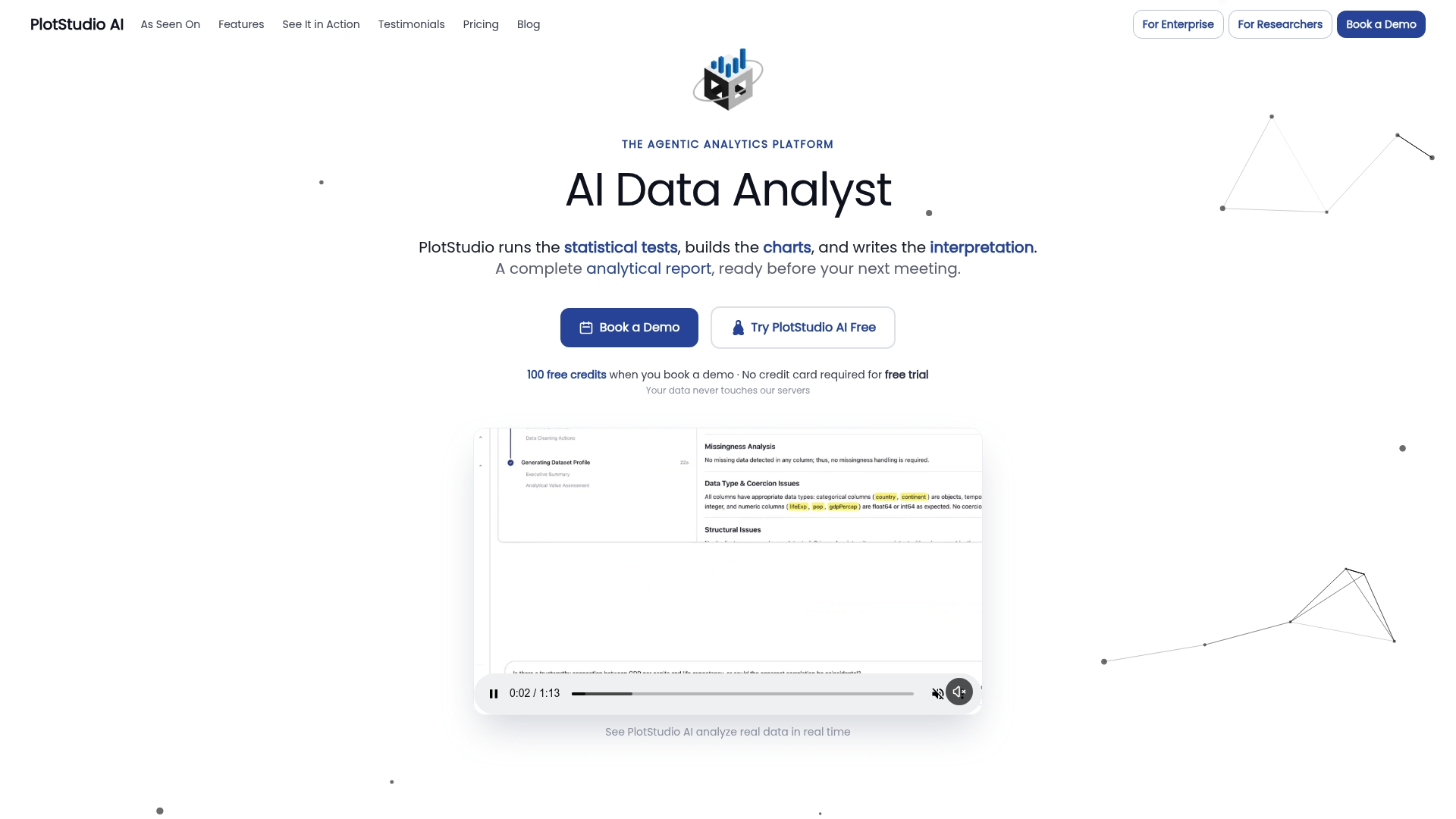
PlotStudio AI is agentic analytics for researchers. Evaluate any analytics tool against your institution’s requirements for sensitive data, methods review and reproducibility.
PlotStudio AI works as an emerging must-have layer in the modern research toolkit, alongside your existing statistical software. Start a free trial on our pricing page, or ask about an enterprise pilot through our enterprise page.
This article is general information, not a substitute for advice from a qualified doctor. Consult a qualified healthcare professional about your own circumstances before acting on anything here.
FAQ
What is the best way to protect my medical records?
Ask your provider how your records are encrypted, who can access them, and how access is logged. Use strong, unique passwords with multi-factor authentication on any patient portal. Review your access history where the portal offers it.
Is HIPAA the same as GDPR?
No. HIPAA is a U.S. law that governs protected health information held by covered entities and their business associates, while GDPR is a broader European regulation covering personal data, with health data as a special category. A project spanning both must satisfy each applicable regime.
How do you secure healthcare analytics data?
Begin with a documented risk analysis, then layer encryption, least-privilege access, MFA, audit logging and vendor agreements. For sensitive datasets, process data locally or in a protected enclave.
When should you use differential privacy?
Use it when you release statistics or query results and need a measurable guarantee against re-identification. Evaluate any vendor’s claim against NIST SP 800-226. It protects outputs, so it complements access controls, not replaces them.
Sources
- NIST Finalizes Guidelines for Evaluating ‘Differential Privacy’ Guarantees to De-Identify Data | NIST
- SP 800-188, De-Identifying Government Datasets: Techniques and Governance | CSRC
- Collaborative Research Cycle | NIST