A Snowflake semantic layer gives teams a governed way to define facts, dimensions, metrics, and table relationships before analysts or AI systems query warehouse data. Snowflake implements this model through native Semantic Views, while Cortex Analyst uses those definitions to interpret business questions and generate SQL. The difficult part isn't creating the view. It's proving that the model covers the questions users ask.
Why Semantic Layers Exist in Modern Data Architectures
Two dashboards can query the same warehouse and still disagree. One defines total revenue from transaction values, another excludes refunds, and a third applies a customer-region filter that nobody documented. The SQL may run successfully in every case. The failure is semantic, not syntactic.
A semantic layer moves those definitions out of isolated dashboards and into shared analytical infrastructure. Instead of asking every analyst to infer what “revenue,” “customer,” or “active account” means from physical schemas, the organization defines those concepts once and makes their relationships explicit.
Snowflake implements this approach through a native schema-level object called a Semantic View. Snowflake documentation describes Semantic Views as storing business concepts directly in the database and mapping them to physical tables and relationships through facts, dimensions, and metrics. Semantic Views entered preview in April 2025 and Snowflake announced general availability at its June 2025 Summit announcements, according to the Semantic Views release documentation.
Practical rule: Treat a semantic layer as a governance boundary, not as another dashboard feature.
That distinction matters during a broader data upgrade for engineering leaders. A warehouse modernization project can improve storage, pipelines, and query performance, yet teams will still produce inconsistent decisions if business definitions remain scattered across reports.
The traditional pattern duplicates logic. Each BI model, notebook, and ad hoc query recreates joins and calculations. A Snowflake semantic layer instead makes those concepts reusable across SQL and AI-oriented interfaces. The result isn't automatic correctness. It is a stronger place from which to govern correctness.
For teams evaluating warehouse design more broadly, data platform examples help put semantic modeling alongside ingestion, transformation, serving, and observability decisions. The semantic layer belongs in that architecture conversation because it determines how people and machines interpret the data after it has been stored.
The Three Foundational Elements of a Semantic View
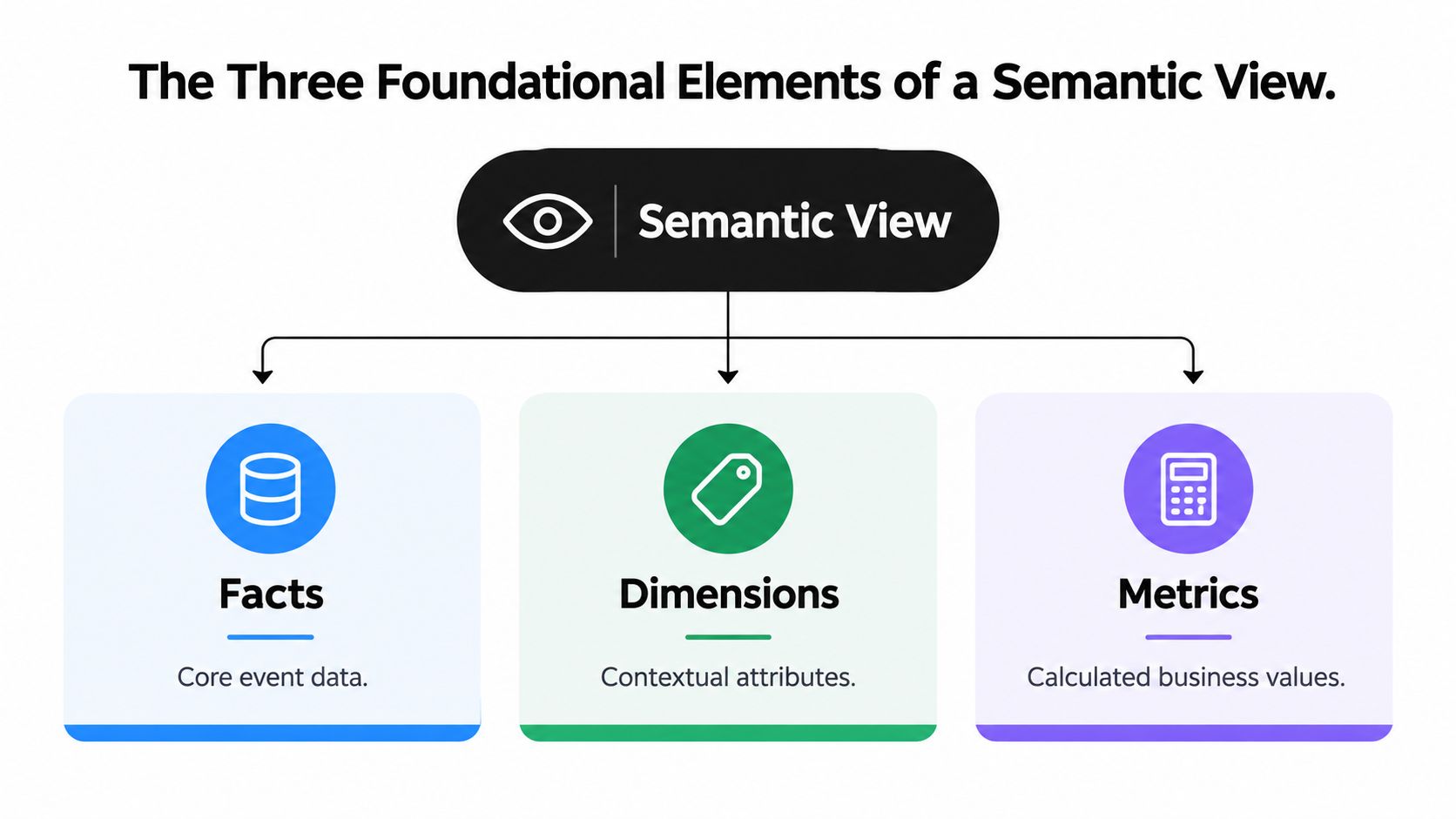
A Semantic View translates physical warehouse structures into business concepts through three elements: facts, dimensions, and metrics. Before writing definitions, map each element to the table grain and to the questions users need to answer.
Facts describe event-level values
A fact is a row-level numerical or derived value. In an orders table, line_amount, quantity, or discount_value might be facts because they exist at the transaction or line-item grain. Facts provide the raw measures that metrics can aggregate.
The grain is critical. A value recorded once per order behaves differently from a value recorded once per order line. If the model doesn't make that distinction clear, a seemingly reasonable calculation can double-count after a join.
Dimensions provide analytical context
Dimensions are the attributes used to group, filter, or describe results. Typical examples include customer, product, location, and date. A dimension doesn't define the calculation itself. It defines the perspective from which a metric can be examined.
A sales metric might be sliced by product category or purchase date, but only if the physical tables containing those concepts have a valid relationship. A semantic definition becomes more useful than a column catalogue. It records which combinations are meaningful.
Metrics encode reusable business calculations
Metrics are calculated or aggregated indicators, such as sums, counts, averages, or other KPIs. A metric isn't just a friendly alias for a column. It carries reusable calculation logic that should produce the same interpretation wherever users query it.
The three elements work together. Facts supply row-level data, dimensions supply context, and metrics express the business calculation. A well-designed model also documents the relationships connecting their underlying tables. The data warehouse architecture guide provides useful context for understanding how those physical structures support analytical modeling.
How Snowflake Stores and Governs Semantic Metadata
Snowflake's major architectural choice is where semantic metadata lives. A Semantic View is a native schema-level database object, not merely a file maintained by a BI application or a separate metadata service. The definitions remain inside Snowflake and can be inspected and queried through database mechanisms.

That location creates a practical governance advantage. Teams can manage semantic definitions alongside schemas, access policies, deployment workflows, and other warehouse assets. The model isn't automatically well governed, but it has a durable home that isn't tied to one dashboard.
Snowflake also exposes operational metadata through ACCOUNT_USAGE.SEMANTIC_VIEWS. The view records one row for each semantic view, including creation time, last alteration time, deletion time, and materialization-staleness settings. Account-usage metadata can lag by up to 120 minutes, or 2 hours, so audit pipelines that expect immediate visibility need to account for that delay. See the Snowflake Semantic Views overview for the documented monitoring behavior.
Materialized semantic-view definitions have a minimum staleness threshold of 120 seconds, or 2 minutes, before automatic suspension rules can apply. That setting isn't a substitute for freshness monitoring. It defines part of the runtime behavior, while teams still need to decide whether the underlying business data is current enough for a particular question.
A reliable deployment pattern stores Semantic View YAML or SQL DDL in Git. Snowflake recommends this approach because it preserves version control, peer review, history, and rollback capability. The database object is the deployed artifact, while Git provides the reviewable change history around it.
For organizations integrating multiple systems, data integration solutions are most useful when they preserve lineage and ownership rather than moving data between endpoints.
Querying Semantic Views with METRICS, DIMENSIONS, and FACTS
Snowflake queries a Semantic View through the SEMANTIC_VIEW construct. A valid query must specify at least one of three clauses: METRICS, DIMENSIONS, or FACTS. Those clauses determine which semantic elements appear in the result, and their order controls the order in which the elements are returned.
A conceptual query can look like this:
SELECT *
FROM SEMANTIC_VIEW(
  sales_semantic
  DIMENSIONS customer_region
  METRICS total_revenue
);
The exact object and element names depend on the deployed definition. The important point is that the query asks for governed semantic elements rather than selecting arbitrary physical columns.
You can request facts directly when the analysis needs row-level values, dimensions when it needs grouping or filtering context, and metrics when it needs reusable calculations. Combining a dimension with a metric introduces a relationship requirement. The base table containing the dimension must be related to the base table containing the metric.
Snowflake provides a discovery command for that constraint:
SHOW SEMANTIC DIMENSIONS FOR METRIC total_revenue;
This helps identify which dimensions are valid for a particular metric and reduces the chance of constructing a semantically unsupported combination. A query may be syntactically understandable but still invalid because the model doesn't establish a legitimate relationship between the requested elements.
That validation is the main difference between a semantic view and a conventional relational view. A conventional view exposes a shaped result set. A Semantic View also expresses the business meaning and permitted analytical combinations. Readers comparing warehouse semantics with broader business intelligence platform patterns should focus on this distinction, not only on the SQL surface.
Cortex Analyst Integration and Performance Boundaries
Cortex Analyst uses Semantic Views to interpret business terminology and generate SQL for natural-language questions. When a user asks for revenue by region, the semantic layer supplies the definitions and relationships Cortex Analyst needs to map that request to warehouse data.
That doesn't mean the model can answer every question. A Semantic View narrows ambiguity only where the team has defined the relevant concepts, joins, calculations, and allowed combinations. The quality of generated SQL therefore depends on the quality and scope of the semantic model.
Snowflake documents support for derived metrics that combine data from multiple tables. This extends the model beyond simple aliases or single-table aggregations, but it also increases the need for careful grain analysis. A derived metric should have an explicit calculation path and a clear explanation of how its contributing tables relate.
Snowflake's guidance for ingesting Power BI semantic models recommends selecting no more than 50 columns for performance and accuracy, prioritizing join keys, core slicing dimensions such as date, customer, product, and region, and facts needed for metric calculations. That recommendation appears in the Cortex Analyst documentation.
| Modeling choice | What works | What creates risk |
|---|---|---|
| Column selection | Keep join keys, core dimensions, and required facts | Importing every available attribute |
| Derived metrics | Define multi-table calculations explicitly | Hiding complex logic behind vague names |
| Relationships | Model valid paths between metric and dimension tables | Allowing accidental or ambiguous joins |
| Natural-language use | Start with supported question families | Treating raw schema access as semantic coverage |
Performance and accuracy are connected here. A smaller, deliberate model gives Cortex less irrelevant context and makes review easier. Teams should also apply the same discipline to observability for analytical applications, much as engineers use observability for Capacitor apps to understand behavior beyond a successful deployment.
The Coverage Gap and the Evidence Loop Problem
The hardest adoption question isn't “Can we create a Semantic View?” It's “How do we know whether the view covers the questions people need to ask?”
Snowflake documentation describes creation and querying workflows in detail. Organizations still need to measure which business questions are supported, which are ambiguous, how often generated SQL is wrong, and when users should stop using natural-language querying and specify the analysis manually.
That gap changes how semantic-layer teams should define completion. A model isn't finished because it contains a list of dimensions and metrics. It is a working hypothesis about how users talk about the business and how the warehouse should answer them.
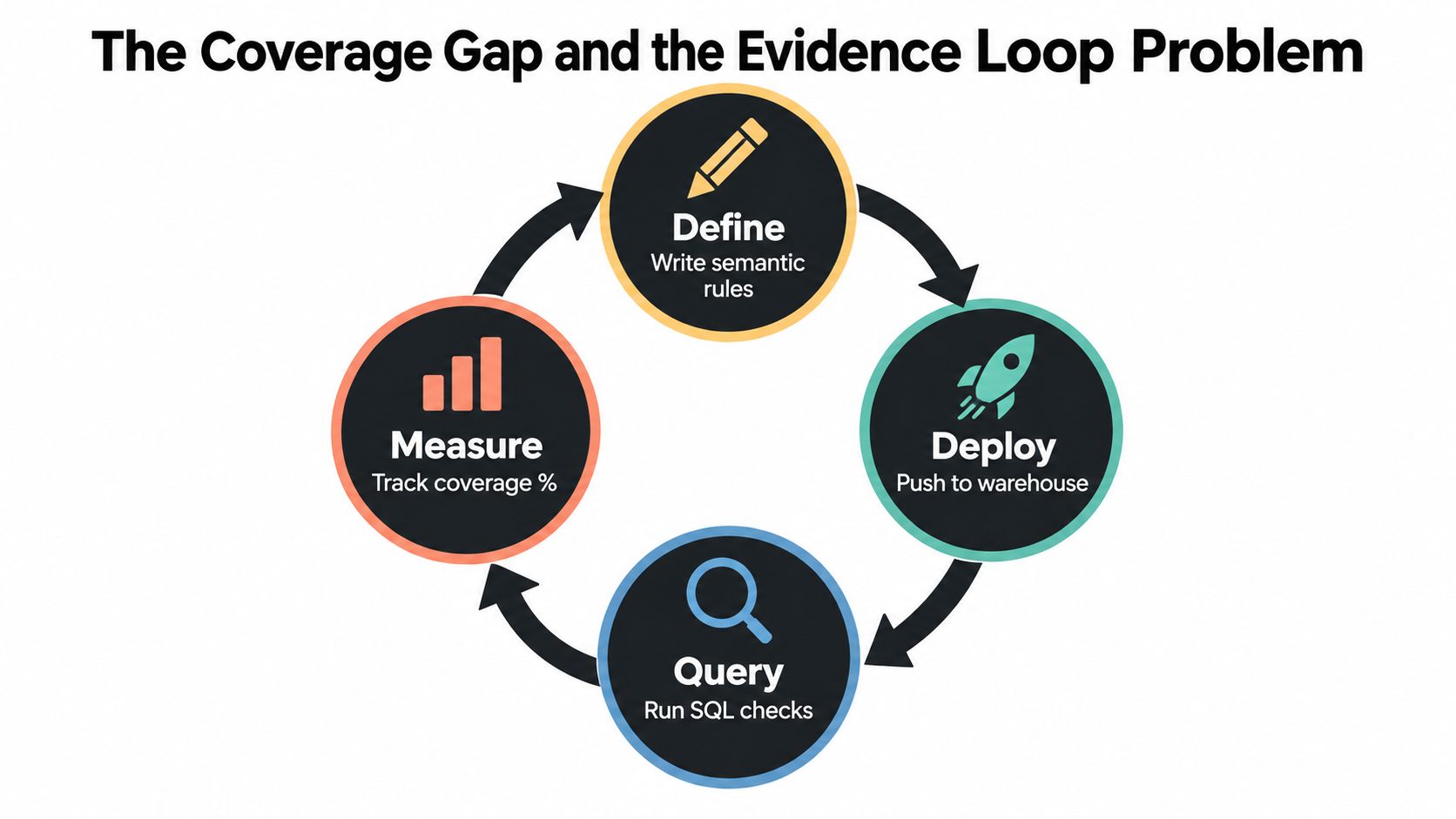
Snowflake's December 2025 optimization preview uses verified queries to expand what Cortex Analyst can answer correctly. That design implies an evidence loop: teams collect real questions, verify the answers, analyze failures, and improve the semantic definitions.
What to measure
A useful evaluation record should preserve the original question, generated SQL, assumptions, selected definitions, and reviewer judgment. Don't collapse every failure into one accuracy label.
Track failure categories separately:
- Metric correctness: Did the calculation implement the intended business definition?
- Join correctness: Did the query connect the appropriate tables at compatible grains?
- Filtering: Did it apply the requested scope, dates, populations, and exclusions?
- Interpretation: Did it understand what the user meant?
- Fallback behavior: Did the system identify an unsupported question instead of returning false precision?
How to sample questions
Sample questions across user groups, business functions, common workflows, edge cases, and ambiguous language. Include routine requests and questions that deliberately stress date definitions, missing relationships, unusual filters, and multi-table calculations.
Snowflake's optimization workflow makes verified queries useful evidence, but it doesn't answer how many examples an organization needs or how coverage should be reported. Those are operating decisions. Teams should make them explicit instead of assuming that a polished definition represents production readiness.
Implementation Best Practices for Governance and Security
A practical Snowflake semantic layer starts with ownership. Decide which team approves metric definitions, who can alter relationships, and how changes reach production. Without those decisions, a native object can still become an uncontrolled shared surface.
Store Semantic View YAML or SQL DDL in Git. Review changes as you would review transformation logic, especially when a metric changes its grain, filters, exclusions, or source tables. Preserve the previous definition so analysts can explain why historical results changed.
Production controls
- Use versioned definitions: Keep review history, rollback capability, and deployment records outside informal dashboard edits.
- Monitor documented freshness: Use
ACCOUNT_USAGE.SEMANTIC_VIEWS, while accounting for its documented lag of up to 120 minutes. - Define acceptance criteria: Record which question families the layer supports and which require manual analysis.
- Protect sensitive data: Apply warehouse permissions and data policies before exposing concepts to AI interfaces.
- Review external processing: Understand where Cortex calls route and whether BYOK or Azure OpenAI tenant deployments are required for your data-sovereignty policy.
Freshness settings and staleness thresholds belong in production runbooks. They aren't decorative configuration. Analysts need to know whether a result reflects current data, a materialized definition, or a delayed operational view.
Security also extends beyond access control. A semantic definition can reveal business logic even when it doesn't expose raw records. Treat metric formulas, joins, synonyms, and custom instructions as governed assets. The data governance frameworks guide offers a broader structure for assigning ownership and managing those controls.
Validating Completeness Before Scaling Cortex Adoption
Scaling Cortex adoption before validating semantic completeness creates misleading confidence. Generated SQL can look precise while using the wrong metric, an invalid join path, or an interpretation the user never intended.
The safer approach is to establish a release gate for semantic coverage. Before routing higher-value questions through Cortex, ask whether the team can show evidence for the question families it claims to support.
A practical readiness record
For each verified question, preserve:
- The user request: Keep the wording that exposed the business intent.
- The analytical plan: Record the intended metric, dimensions, filters, grain, and assumptions.
- The generated query: Store the SQL used to produce the result.
- The validation outcome: Review metric correctness, joins, filters, and interpretation separately.
- The fallback decision: Mark whether the question should remain manual or needs a model change.
Analysts should be able to approve an analytical plan before execution for sensitive or consequential work. They should also see data-quality and join diagnostics rather than receiving only a polished number.
A searchable record of successful and failed questions turns semantic governance into an operational practice. Repeated failures point to missing concepts, misleading names, inadequate relationships, or unsupported ambiguity. Repeated successes reveal the coverage that can safely be automated.
The core decision is simple but demanding: don't ask whether the Semantic View exists. Ask whether the organization can demonstrate that it answers the questions users ask, under the conditions in which they ask them. A production-ready Snowflake semantic layer is therefore a maintained evidence system, not a completed configuration file.
If your research team needs an auditable way to investigate data with visible methodology, inspectable code, and reproducible outputs, try PlotStudio AI. Researchers can access discounted pricing and 1,000 free credits for researchers while the offer is active.