The most repeated advice on sensitive data protection is to encrypt the file and mask the names. That advice fails the moment a join, a rare subgroup, or a notebook cache puts people back together. Sensitive data protection is the set of legal duties, classification rules, technical controls, and operating practices that keep personal and regulated data confidential, accurate, and lawfully used from collection to disposal.
What Sensitive Data Protection Means
A masked column is still sensitive until you can show that every copy stays inside a lawful, controlled, evidenced boundary. Encryption is one control in that set, not the whole job.
The General Data Protection Regulation (GDPR) turned privacy from a national filing exercise into one directly applicable regime across the EU and the European Economic Area. It also reaches organisations outside Europe that offer goods or services to people in the EU, or that monitor their behaviour. Its principles are lawfulness and transparency, purpose limitation, data minimisation, accuracy, storage limitation, integrity and confidentiality, and accountability. High-risk categories, including health, biometric, genetic, racial or ethnic, political, religious, and sexual-orientation data, sit under extra conditions.
The NIST Privacy Framework organises privacy risk into five functions: Identify-P, Govern-P, Control-P, Communicate-P, and Protect-P. Privacy here is broader than cybersecurity, because the risk comes from the processing itself, not only from an attacker. De-identification and tokenisation are protective measures inside Protect-P, not a substitute for the other four functions.
People already act on that risk. In 2025, 76.9% of EU internet users reported taking steps to manage access to their personal data, according to Eurostat.
Scope test: Protection works only if every copy, from the original file to the published figure, has a lawful basis, a classification, a control, and evidence.
Sensitive Data Categories and the Rules That Cover Them
| Category | GDPR (UK GDPR Article 9) | HIPAA | CCPA |
|---|---|---|---|
| Health data | Special category | PHI when held by a covered entity or business associate | Sensitive personal information |
| Genetic data | Special category | PHI when tied to a health record | Sensitive personal information |
| Biometric data used to identify a person | Special category | PHI when tied to a health record | Sensitive personal information |
| Racial or ethnic origin | Special category | Not a HIPAA category on its own | Sensitive personal information |
| Religious or philosophical beliefs | Special category | Not a HIPAA category on its own | Sensitive personal information |
| Political opinions | Special category | Not a HIPAA category on its own | Not listed |
| Sexual orientation or sex life | Special category | PHI when held in a health record | Sensitive personal information |
| Precise geolocation, government ID, financial account log-in | Personal data, not special category | Identifiers under Safe Harbor | Sensitive personal information |
Under the UK GDPR, special category data includes information revealing racial or ethnic origin, political opinions, religious or philosophical beliefs, trade-union membership, genetic data, biometric data used to uniquely identify a person, health data, and data about sex life or sexual orientation. The UK Information Commissioner's Office is clear that Article 9 starts from a prohibition, not a general permission. A project needs a named condition before collection, analysis, or disclosure.
Article 9 is not a research pass
The ICO lists 10 Article 9 conditions: explicit consent, employment and social-protection obligations, vital interests, certain not-for-profit activities, data made public by the individual, legal claims, substantial public interest, health or social care, public health, and archiving, research, or statistics. Research and statistics is one named route, not a blanket exemption for academic work. If no condition applies and valid explicit consent can't be obtained, the processing can't lawfully proceed. You also need a separate Article 6 lawful basis. Satisfying Article 9 alone isn't enough.
HIPAA protected health information applies when a covered entity or a business associate holds it. The Safe Harbor method treats 18 identifier types as what must come out of a de-identified set, including names, geography finer than a state, all date elements except year, phone and fax numbers, email addresses, Social Security numbers, medical record numbers, account numbers, IP addresses, and full-face photos. A medical coder working a chart will see how easily those identifiers sit next to diagnoses in ordinary clinical text.
The CCPA sensitive personal information list goes further on some everyday fields. It covers precise geolocation, government identifiers, and financial account log-ins, plus several of the special-category topics above. Political opinions aren't on that sensitive list.
Decide which rows apply by where the data subjects live, not where the researcher sits. A lab in one country analysing EU patients, US patients, and California residents can owe three regimes on one file. Map those duties into a data governance framework before the first extract, or the later controls will be guessing.
Classify Data and Assign Each Tier Its Controls
| Tier | Typical data | Required storage and access | Sharing rule |
|---|---|---|---|
| Public | Published statistics and open datasets | Standard access controls | No restriction |
| Internal | De-identified operational data | Role-based access and encryption at rest | Internal use under an approved purpose |
| Confidential | Pseudonymised research data and quasi-identifiers | Encrypted storage, named users, and logged access | Approved recipients under a data-sharing agreement |
| Restricted | Direct identifiers, special category data, and linkage keys | Encrypted, isolated, multi-factor access, and separated keys | Only under a documented legal basis and approval |
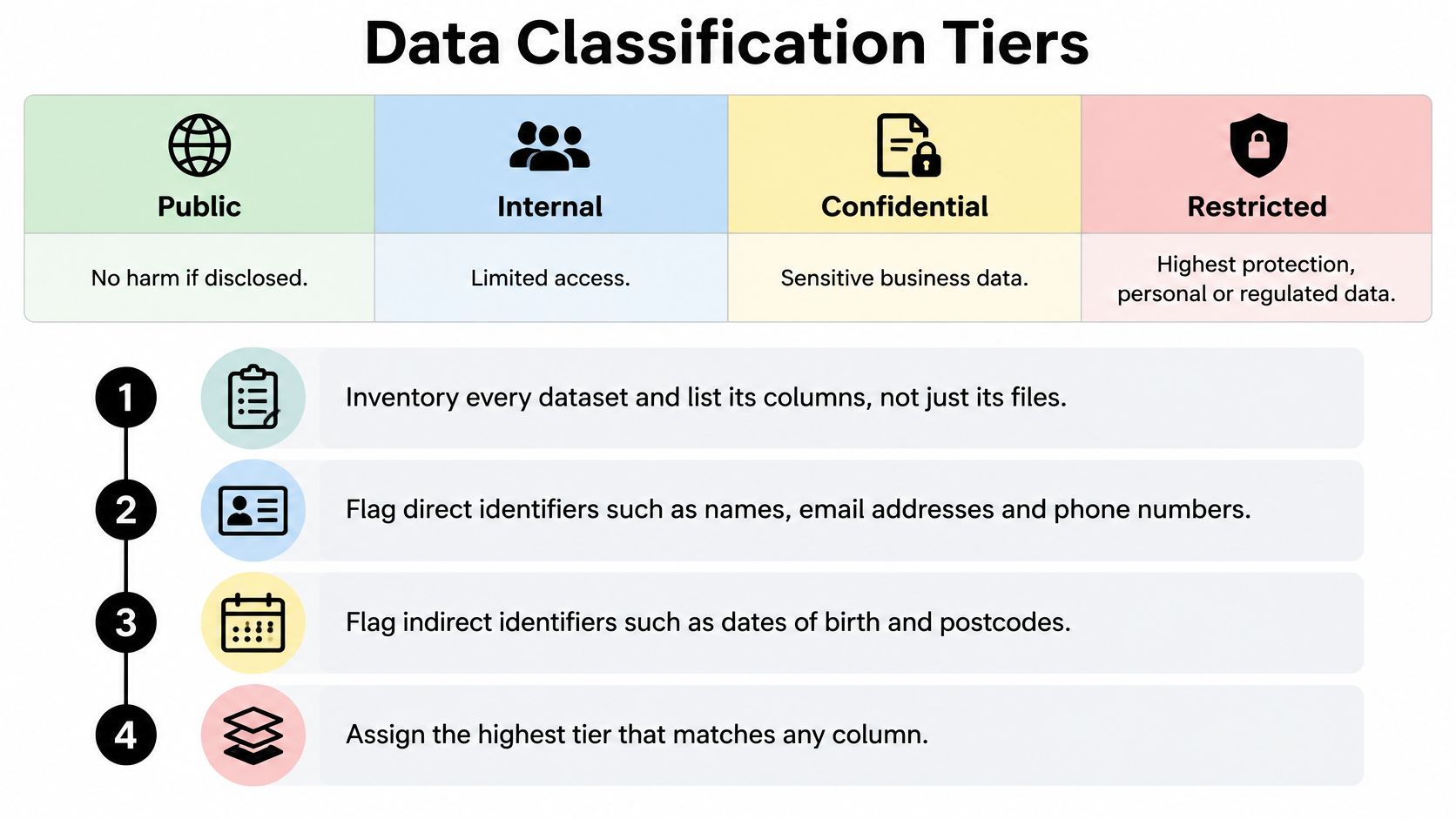
Tag columns, not files. The highest column sets the file.
- Inventory every dataset and list its columns, not just its filenames. A "demographics" workbook often hides free text, IDs, and dates the filename never mentions.
- Flag direct identifiers: names, email addresses, phone numbers, and study IDs that map straight back to a person.
- Flag quasi-identifiers: age, postcode, dates, and rare diagnoses. They identify people in combination after the names are gone.
- Flag special-category and other restricted fields using the regime table above.
- Assign each column a tier. The file takes the highest column tier. A survey that looks public is Confidential the moment you keep a free-text field that names employers.
- Record an owner, a legal basis, and a review date on that file. A tier without an owner is a label, not a control.
Joins raise the tier
When you merge two Internal datasets, the result inherits the strictest tier of its inputs, and it may need to move up. Age band plus clinic plus a rare procedure can create a new identifier that neither file had alone. Re-tier before anyone exports the join.
Where Sensitive Data Leaks Across the Data Lifecycle
Sensitive data is exposed at specific lifecycle stages, not only in the database. Collection, storage, analysis, sharing, publication, retention, and disposal each create a copy that teams forget.
IBM's 2025 Cost of a Data Breach research, read alongside Verizon's 2025 Data Breach Investigations Report, shows why a single vault isn't enough. That DBIR covered 22,052 real-world incidents and 12,195 confirmed breaches with victims in 139 countries. Vulnerability exploitation accounted for 20% of breaches. Ransomware appeared in 44%, up from 32%. Third-party involvement doubled from 15% to 30%. Human involvement remained in about 60%. More than 90% of breached organisations in the small-business snapshot had fewer than 1,000 employees.
The copy nobody listed
- Collection: Extra fields "in case we need them later" become Restricted data you now have to justify.
- Storage: Laptops, shared drives, and backups hold the same rows as the approved server.
- Analysis: Notebook caches, temporary files, and derived tables outlive the session.
- Sharing: Collaborator email and a third-party processor are both disclosures. A cross-platform analytics workflow multiplies those hops.
- Publication: Small cells and rare subgroups in a table or a map can name someone the raw file no longer does.
- Disposal: Archives that outlive the approved retention period are still in scope.
Say an interview transcript is exported to a shared folder for coding, copied into a backup, then pasted onto a conference slide. Three locations, three owners you never named, one slide that leaves the building.
The same IBM research put the global average breach cost at USD 4.44 million. Breaches taking more than 200 days to identify and contain averaged USD 5.01 million, against USD 3.87 million when the lifecycle stayed under 200 days. List every location of one dataset, with an owner and a deletion date for each copy, before you add another tool.
Encryption, Access, Masking and Logging
| Control | Protects against | Best used for | Main limit |
|---|---|---|---|
| Encryption at rest (AES-256) | Stolen disks, lost laptops, and exposed backups | All stored sensitive data | Doesn't stop an authorised user who misuses data |
| Role-based access control | Overbroad internal access | Shared project folders and databases | Grants need regular review |
| Multi-factor authentication | Stolen passwords | Remote and privileged access | Doesn't limit what an approved user does |
| Dynamic masking | Identifiers exposed in query results | Shared databases with mixed roles | Joins and rare values can still identify people |
| Static masking or synthetic data | Identifiers in non-production copies | Testing, teaching, and code development | Synthetic data needs fidelity checks |
| Audit logging | Undetected misuse and unprovable compliance | Every access to Restricted data | Logs need protection and regular review |
Each row stops an exposure another row misses. None of them, alone, makes a file safe to publish.
AES-256 at rest and TLS 1.2 or later in transit stop someone who steals a disk or sniffs a link. They don't stop a colleague with a valid login who exports the table. Keys stored in the same folder as the ciphertext make the encryption decorative.
Role-based access and least privilege cut the number of people who can open Restricted files. Review grants each quarter and remove anyone who has left the project. Multi-factor authentication on remote and privileged accounts stops a stolen password. It doesn't decide which columns that person may see.
Masking is a view, not a new dataset
Dynamic masking hides identifiers at query time, which suits a shared database where analysts and coordinators use different roles. A clinical trial team can see age bands and visit week, not dates of birth. Joins and rare values can still single someone out. Static masking and synthetic data are the right copies for testing, teaching, and code development, but only after you check that the synthetic file still supports the analysis you intend. Broader data security best practices for 2026 sit alongside these choices. They don't replace the limit on each row.
Audit logs should record who opened which dataset, when, from where, and which export left. Store those logs where analysts can't edit them, and read them. On a shared analytics stack, a SaaS-based data analytics platform still needs that log if the file is Restricted. Layer the controls. Encryption without access review, or masking without a log, leaves a hole the next row was meant to close.
How to Pseudonymise Data and Test Re-identification Risk
Pseudonymised data is still personal data. Replacing a name with a token doesn't anonymise the row, and the secret that reverses the token must sit apart from the analytical file.
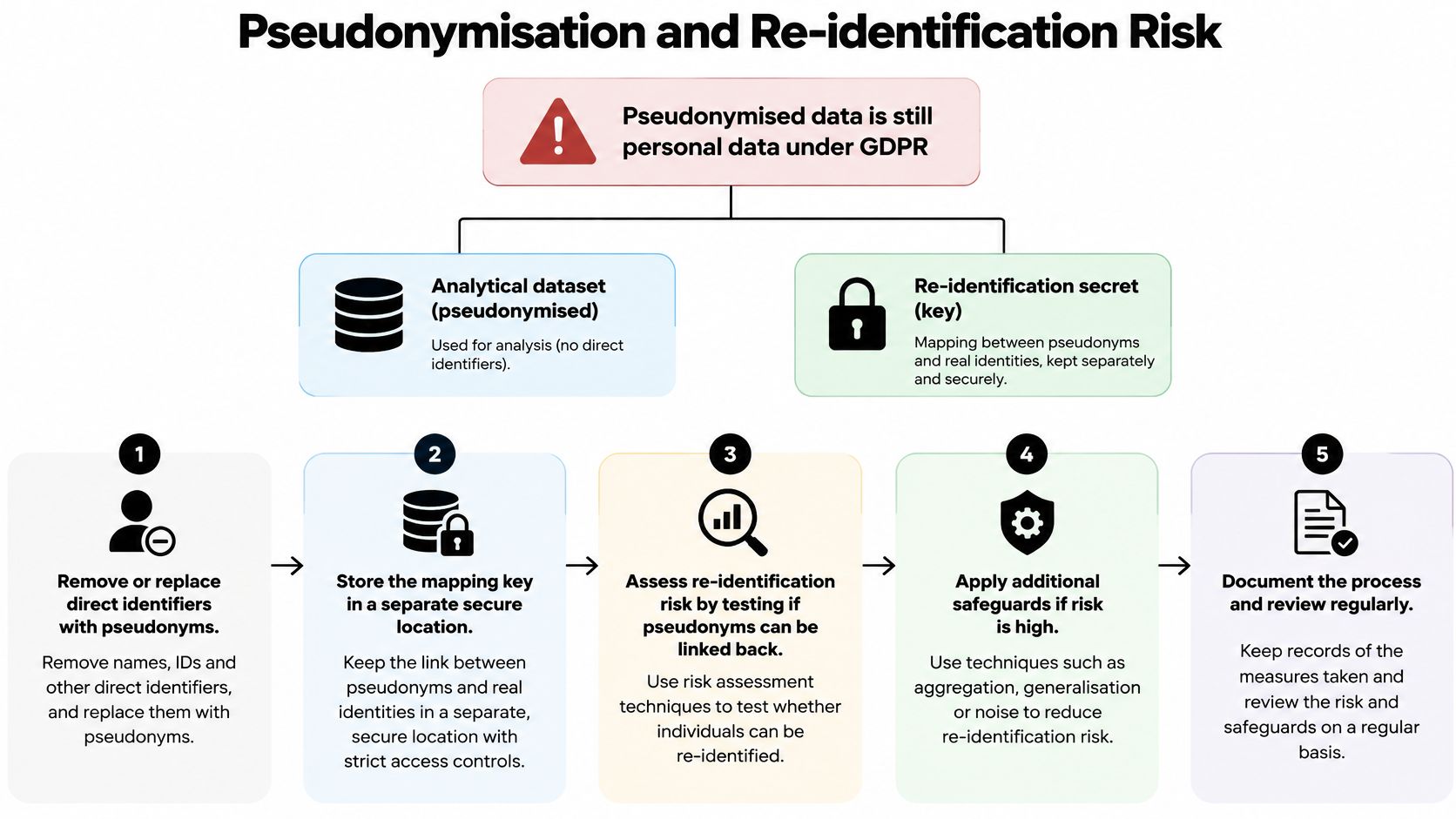
The ENISA guidelines on shaping technology to GDPR treat this as a separation-of-duties control. Techniques include keyed hashing (HMAC), tokenisation, encryption, and randomised pseudonyms. The re-identification secret shouldn't live in the same file or storage boundary as the pseudonymised records.
- Replace each direct identifier with a keyed HMAC or a randomised pseudonym. A study ID such as
P-18442stays in the analysis file. The name doesn't. - Store the identifier map in a separately controlled, encrypted vault with its own access list. Compromise of the working file alone shouldn't reveal identities.
- Route any linkage request through a narrow, approved, logged procedure. Don't hand analysts the map "just for this merge."
- List quasi-identifiers and coarsen them: five-year age bands, year instead of full dates, and the first three postcode digits.
- Test re-identification by counting how many records share each combination. Treat a minimum group size of five as a screening threshold, not a guarantee.
- Re-run that count on joins and derived tables. A safe file can become unsafe after you attach a second source.
- Write down who can reverse the transformation, and rotate or revoke keys when staff or vendors change.
ENISA also describes brute-force, dictionary, and guessing attacks. No single technique fits every threat model. Say a survey row pairs a rare occupation with a small town and that person is unique in the file. Dropping geography to a region removes that uniqueness. You only know that because you counted the combinations, not because the name column was already gone.
Keep raw files and linkage secrets on the analysis machine when you can, and still harden the endpoint, encrypt storage, apply least privilege, and log exports. A local secret is safer than a shared one. It isn't invisible.
Secure Analysis Architectures for Researchers and Analysts
| Architecture | Where raw data stays | What leaves the boundary | Best fit |
|---|---|---|---|
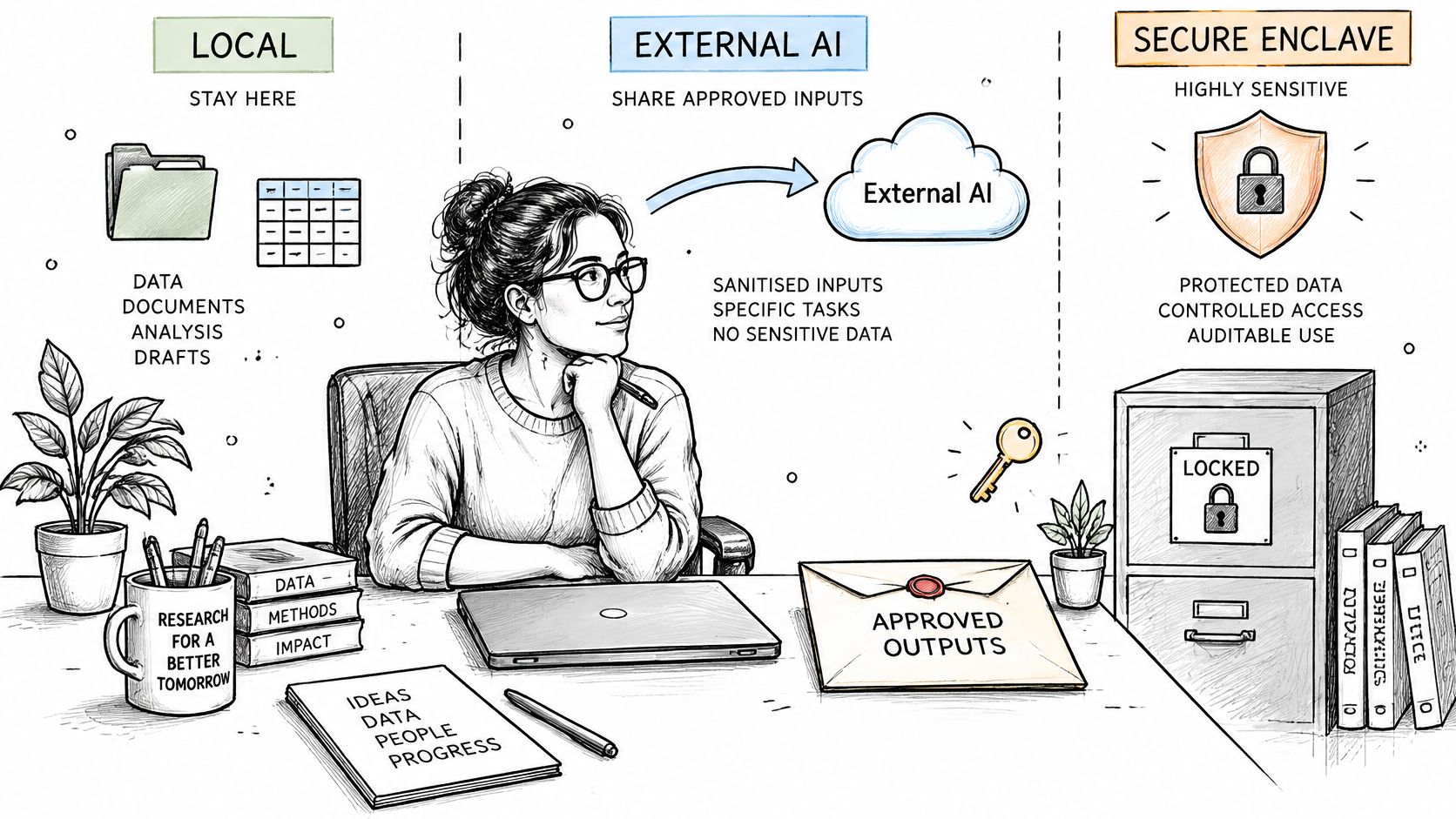
| Fully local analysis | Researcher's machine or lab server | Only approved published outputs | Restricted data with no external processing allowed |
| Local analysis with external AI calls | Raw data stays local | Schema, aggregates, error messages, and code snippets | Exploratory work under approved prompt rules |
| Institution-hosted model in a private tenant | Institution's own cloud tenant | Prompts stay within the tenant | Institutions with data sovereignty requirements |
| Trusted research environment | Secure enclave with logged access | Only outputs cleared by a disclosure check | Linked national or clinical datasets |
Confidence isn't evidence. A 2026 Perforce survey on data compliance found 98% of enterprise respondents confident they protected sensitive data, while 34% had experienced breaches or theft and 43% had experienced audit failures. 99% reported data-masking mandates, yet 84% still allowed compliance exceptions, and 77% stayed concerned about breaches or theft in non-production environments.
What still leaves the room
Fully local analysis is the tightest fit for Restricted files: published outputs are the only thing that should leave. You still control the laptop, the backup, and the slide. Local analysis plus an external model is different. Schema, aggregates, error text, and code snippets can carry quasi-identifiers even when rows stay put. An institution-hosted model in a private tenant keeps prompts inside that tenant, which suits sovereignty rules, but the tenant log is now part of your evidence. A trusted research environment for linked clinical data should release only outputs that pass a disclosure check.
For any external call, send column names, schema, and aggregates, not row-level records. Redact free text first. Approve the route before data moves, and log what was sent. An on-premise pattern is one way to keep that boundary explicit.
PlotStudio AI runs the analysis on the researcher's machine. We process data files locally and don't upload, store, or access those files on our servers. AI calls go directly from that machine to the model provider's API, which is SOC 2 certified and doesn't train on the data. We never see, store, or access the user data. In BYOK mode the API key stays on the machine and isn't transmitted to our servers. Check the provider's documentation for where a request goes before you approve it. Agentic analytics is analysis by AI agents that plan an investigation, run real code, inspect intermediate results, revise, validate, and synthesise. An answer is an output. An analysis is an investigation. The human still owns the scientific judgment.
Masked files belong in the same chain as raw data, code, transformations, intermediate outputs, and final figures. Join keys, rare subgroups, timestamps, geography, and model outputs can restore identifying power. Every published figure should trace to its inputs and to the access record that produced it.
Build Your Protection Checklist Before the Next Dataset
This is a board-level clock, not an IT tidy-up. Under the GDPR, organisations generally must notify the relevant supervisory authority within 72 hours of becoming aware of a qualifying personal-data breach, and penalties can reach €20 million or 4% of worldwide annual turnover for the preceding financial year, whichever is higher, as set out in the Verizon 2025 DBIR executive summary account of that regime. The regulation has been enforceable since 25 May 2018.
- Write a policy that names an owner for each tier and states the permitted uses. If a use isn't listed, it isn't allowed.
- Train everyone with data access at onboarding, refresh it yearly, and run a drill such as a misdirected email with a dataset attached.
- Write an incident playbook for detection, containment, assessment of what was involved, the notification decision, and a record of that decision. Under HIPAA, notification goes out without unreasonable delay and no later than 60 days after discovery.
- Review vendors and collaborators before sharing: processing terms, sub-processors, retention, and whether inputs are used for model training. A data collaboration platform doesn't remove that review.
- Run access reviews each quarter and confirm that deletion dates were met, including backups and slide decks.
Questions teams actually ask
Does encryption make sensitive data safe to share? No. It protects a stolen disk or a lost laptop. It doesn't stop an approved person, a bad join, or a small cell in a figure.
Can a research team use the GDPR research condition without consent? Only when that Article 9 condition applies, and only with a separate Article 6 basis. It isn't a blanket exemption, and if neither consent nor another condition fits, stop.
Which controls should a small lab start with this week? Classify columns, separate the linkage key, turn on multi-factor access for Restricted files, and write down every copy with an owner and a deletion date.
If you're setting up an auditable analysis workflow for a lab or a PhD project, review researcher options and discounted academic pricing at PlotStudio AI for researchers. While the offer is active, researchers can also claim 1,000 free credits.